
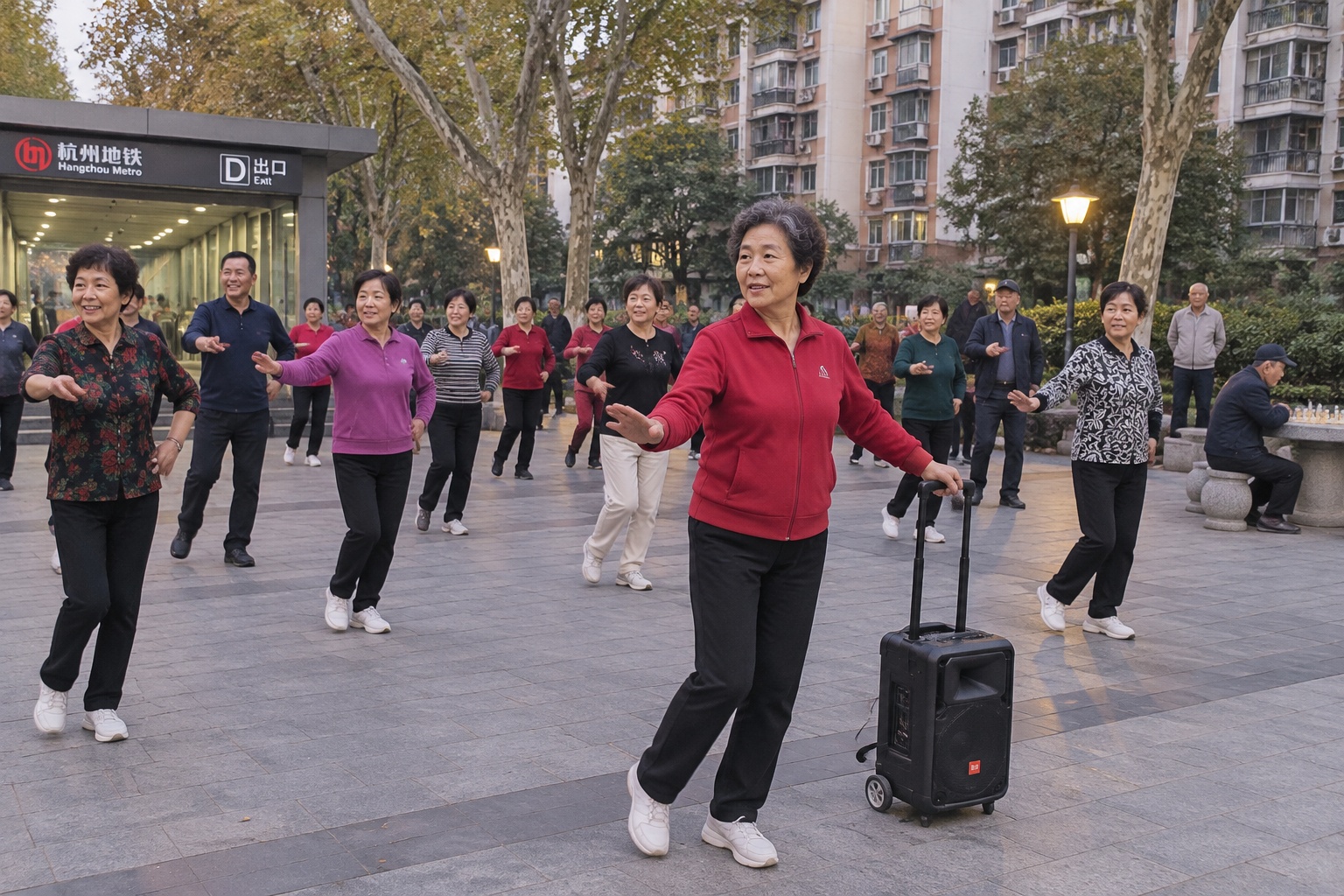

7:20 p.m., Just Outside the Subway Exit
The speaker comes out of the bicycle basket at almost exactly 7:20. It is a black trolley speaker, the kind with two wheels and a telescopic handle, and the woman pulling it wears a red zip-up jacket. She parks it beside a plane tree, plugs an extension cord into a socket box the neighborhood committee installed last year, and presses play.
By the second song there are eleven people on the paving stones. By the fourth there are thirty-one. I know because I counted once, standing at the edge with a bag of groceries, waiting for a friend who lives above the square.
This is a residential plaza in Hangzhou, about the size of two tennis courts, wedged between a subway exit, a convenience store and six apartment blocks. On a Tuesday evening in early autumn it holds a dance team, four men playing chess on a stone table, a cluster of kids on scooters, two dog walkers, and me.
Who Is Actually Out There Dancing?
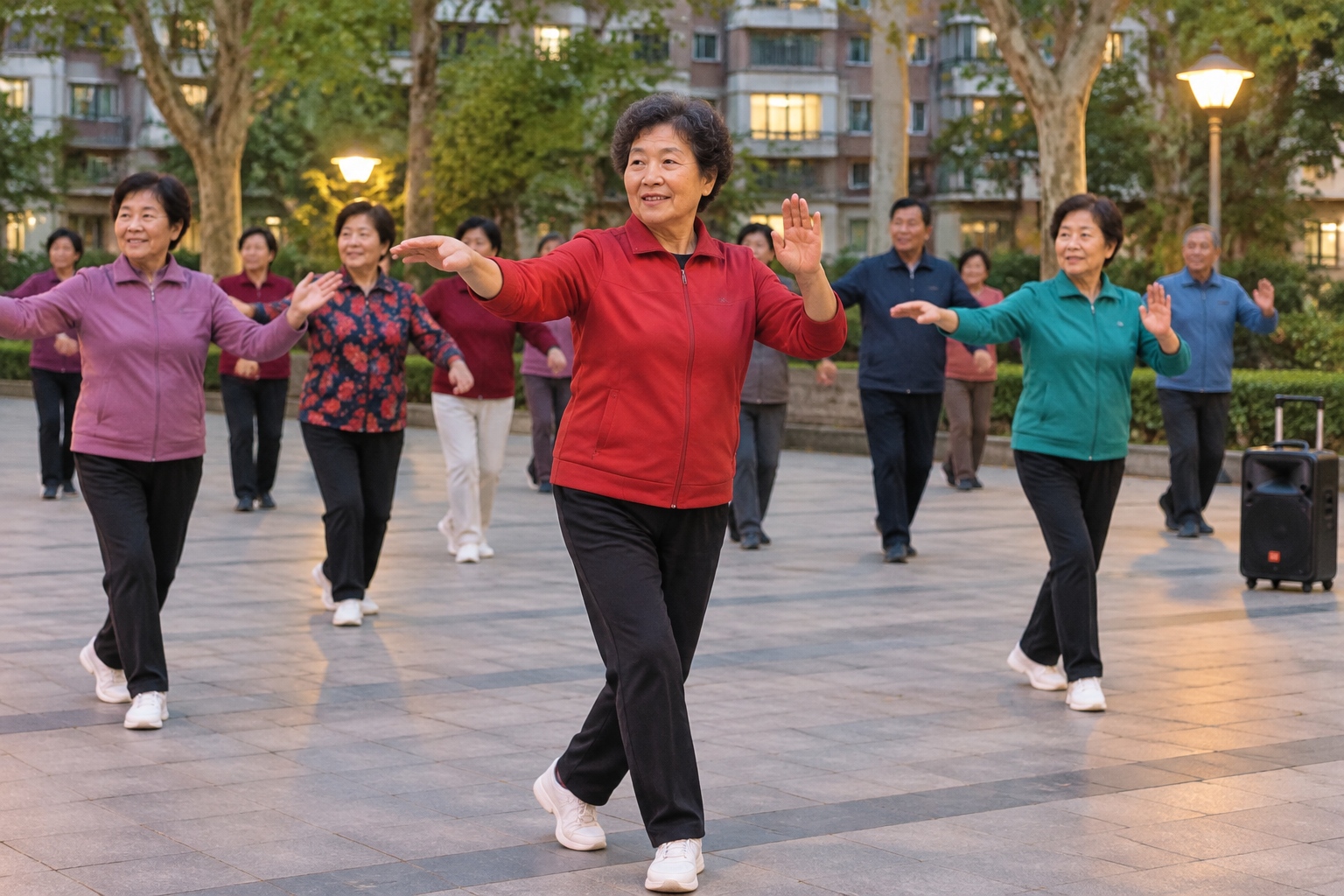
The word most people outside China learn for this is “dama” — literally “big mother,” an auntie. And yes, the core of the group is women in their fifties and sixties. The woman with the speaker is Wang Ayi, 62, a retired accountant who spent thirty years at a state-owned trading company. Short permed hair, the same red jacket every night (“it’s my uniform”), a phone full of downloaded songs.
But the row behind her is more mixed than the stereotype suggests.
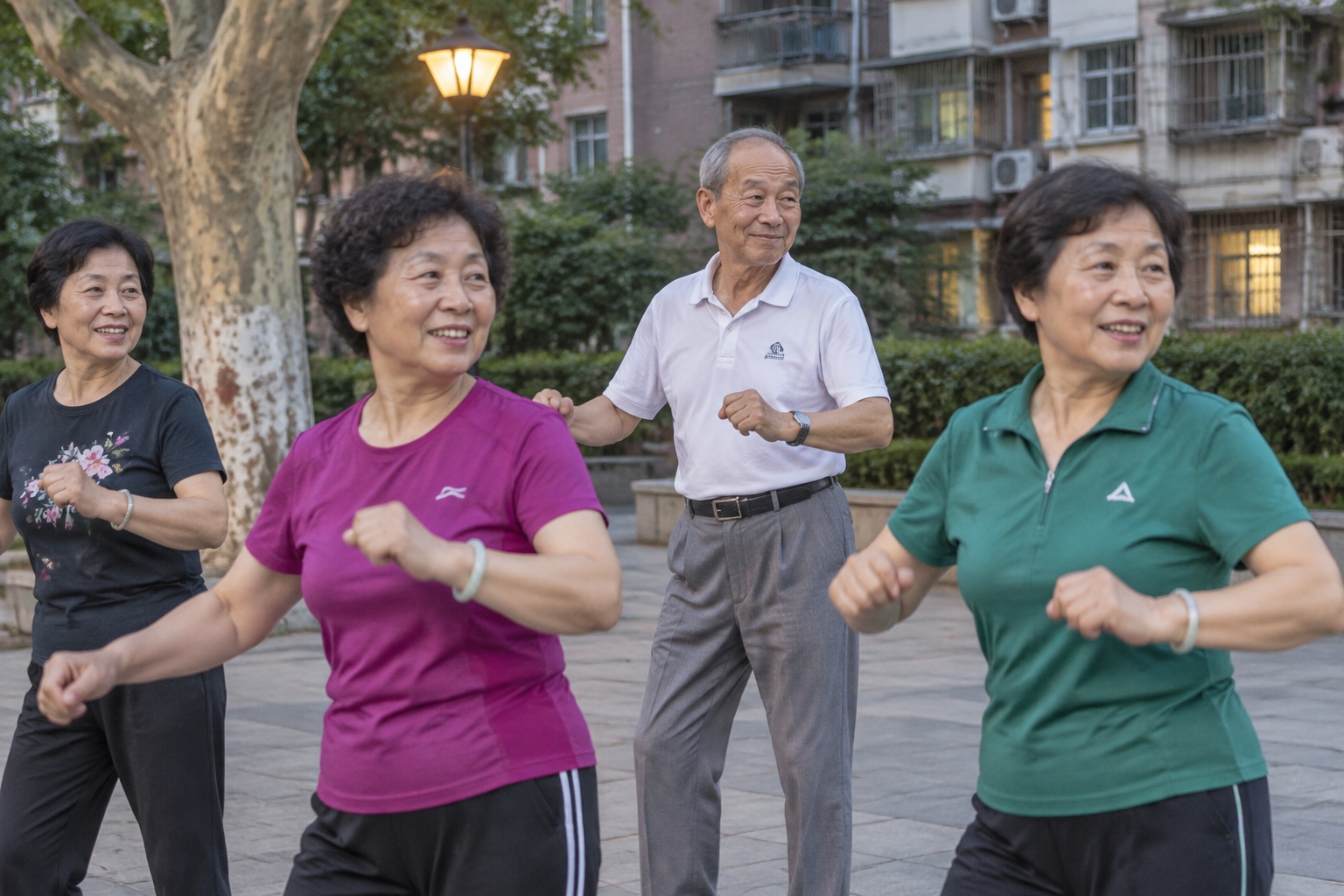
There is Chen, 68, a retired bus driver in a white polo shirt who stands in the back row and does roughly seventy percent of the moves. “I come for the walking,” he told me. “The dancing is a bonus.” His wife died three years ago. He says the hour after dinner used to be the hardest part of the day, and now it isn’t.
There is a woman in her thirties in a navy tracksuit who arrives around 7:50, after her son’s homework has been checked. She works in logistics and stays near the back, where the light is dimmer. “I’m not old enough for this group,” she laughed, “but my back hurts and it’s free.”
Two men in their forties come on Fridays only. A group of college students filmed a video here once and never came back.
Why It Caught On So Fast
Square dancing did not spread because of a campaign. It spread because it solved four problems at once, cheaply.
1. It’s free, or nearly free
A decent trolley speaker costs a few hundred yuan, split across the team. Some groups collect ten or twenty yuan a month per person for electricity and new music. Set that against a gym membership in a Chinese city, commonly 2,000 to 5,000 yuan a year, or a dance studio class at 60 to 100 yuan a session. For someone on a pension of 3,000 or 4,000 yuan a month, the gap matters.
2. Retirement is a social cliff
Chinese women typically retire at 50 or 55, men at 60. Overnight, the colleagues, the commute, the canteen lunch and the structure of a day all disappear. The number of people aged 60 and over in China reached roughly 310 million at the end of 2024 — about 22 percent of the population — and it is still climbing. Square dancing hands back one hour of that vanished structure.
3. It costs almost nothing to organize
One person, one speaker, one WeChat group. No registration, no membership fee, no coaching license. If it rains, it doesn’t happen. If the team leader goes to visit her daughter for a month, someone else carries the speaker. Estimates of total participants in China run above 100 million; nobody has an exact figure, which is itself telling. This isn’t an institution. It’s a habit.
4. The space already exists
Chinese neighborhoods are dense, and many have leftover paved areas: in front of the subway exit, beside the property management office, between two residential blocks. These are places built for circulation, not for gathering. Square dancing turned them into rooms without walls.

The Noise Argument, and the Deals That Follow
Let’s not pretend this is frictionless. It isn’t. The complaints are real, and I’ve heard them from people I like: a nurse on night shifts, a mother whose child does homework at eight, a ground-floor resident whose windows face the square.
What interests me is what happens next, because in most places something does.
In my neighborhood the rules are printed on a laminated sheet taped inside the property management office. Dancing from 7:00 to 8:45 p.m. Volume no higher than 60 decibels at the edge of the square. No dancing in the parking area. No dancing in the two weeks before the national college entrance exam in June. It is not a law. It’s a negotiation, agreed by the team leader and the property manager.
Across China the solutions rhyme without being identical. Some cities installed noise-monitoring screens that display live decibel readings, so a team can see when it’s over the line. Some neighborhoods moved dance teams to a park 400 meters away, or into a covered space under a road. In a handful of places, dancers wear wireless headphones — silent-disco style — which fixes the noise and produces a strange, lovely sight: thirty people dancing in complete quiet.
None of this works perfectly. Anywhere. But it works better than the online argument suggests.
A Small Society With a Speaker
The part I most want to explain to friends abroad isn’t the dancing. It’s what the dancing produces.
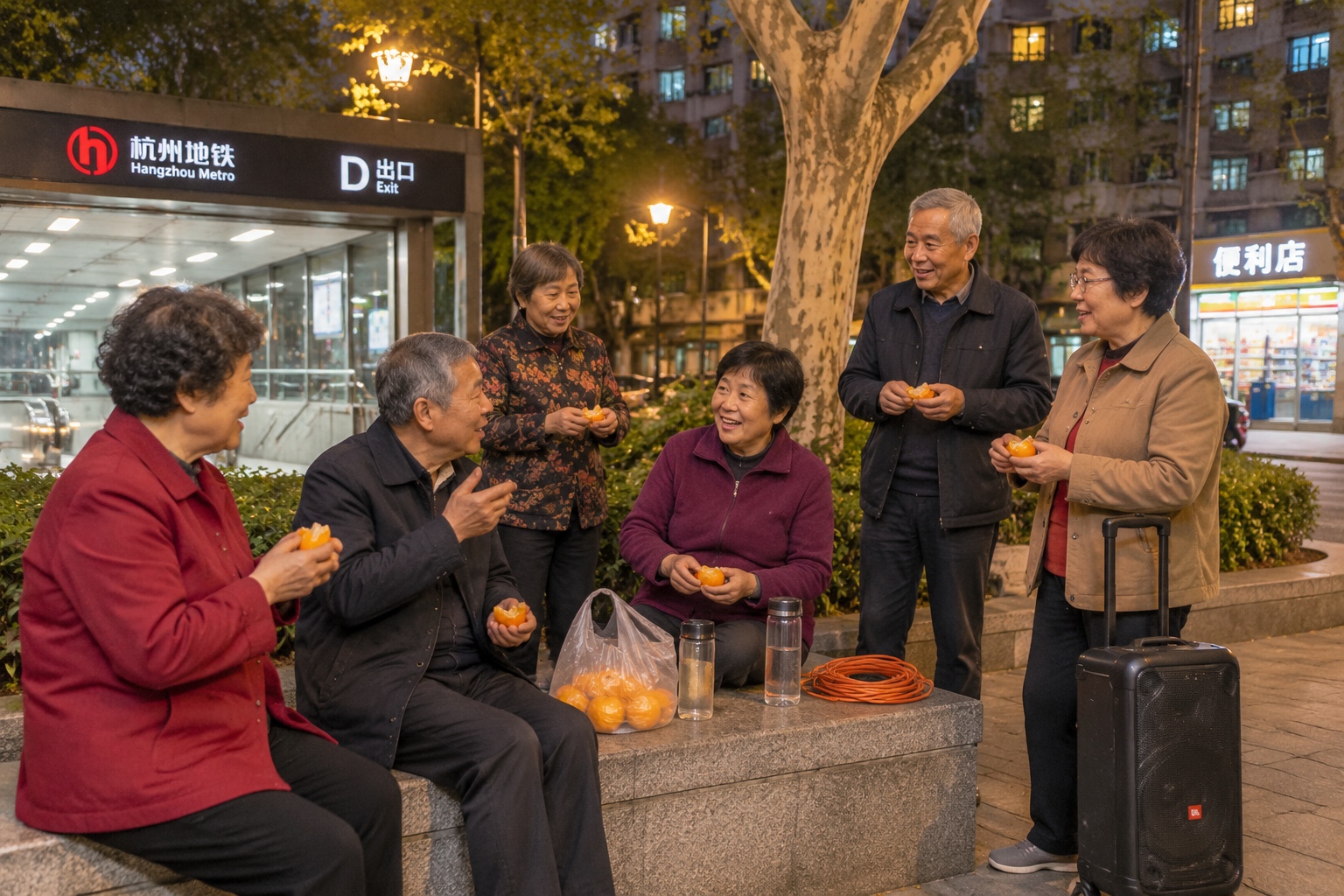
Someone maintains the playlist and updates it — a mix of 1990s Mandopop, Tibetan folk songs, and a Douyin track that everyone under 30 finds funny and everyone over 55 finds excellent. Someone brings a spare cable. Someone notices when a regular hasn’t shown up for three nights and calls her. When one dancer fell and broke her wrist last spring, the team took up a collection and two of them went to the hospital.
Sociologists call this social capital. What it actually looks like is a plastic bag of oranges being passed around after the last song.
It also changes how public space gets used. A paved square that planners probably drew as a walkway becomes, for 105 minutes a night, a living room. City governments have noticed: some districts now pay for lighting, install power sockets, or list dance teams in community activity registries. That’s grassroots governance in practice — not a campaign from the top, but a local office deciding it’s cheaper to install a socket than to keep answering complaints.
If You’re Reading This From Somewhere Else
The easy joke for foreign readers is that this is uniquely Chinese. It isn’t, quite. Anyone who has crossed a park in Seoul at six in the morning, or a plaza in Lima, or a community hall in Manila, has seen a close relative: older people claiming public space with music and their bodies.
The Chinese version is bigger, more visible, and better organized, and it happens in cities built dense enough that the square outside your building is genuinely shared. That’s the difference worth noticing — not the dancing, but the density of the shared life around it.
8:45 p.m., the Speaker Goes Back in the Basket
At 8:45 Wang Ayi unplugs the extension cord, coils it, and lowers the telescopic handle. The music stops mid-verse. Nobody says a formal goodbye. Two women walk off toward the noodle shop. One man promises to bring a new song tomorrow. Someone asks whether the group is coming on Saturday, because it might rain.
For ten minutes the square is empty and looks like a square again: paved ground between a subway exit and six apartment blocks, with a plane tree, a socket box, and a plastic bag someone forgot.
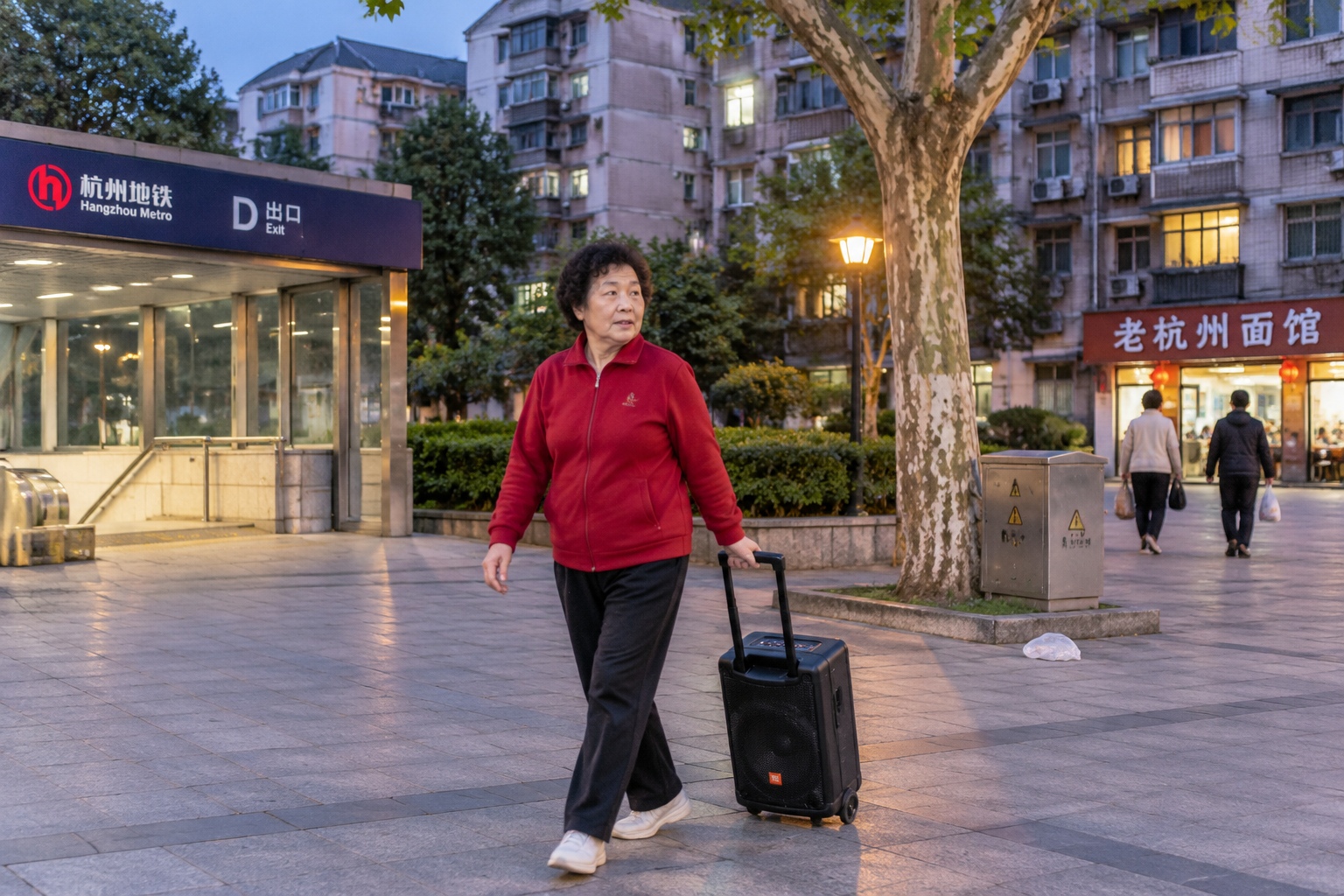
Then the chess players pack up, a scooter goes past, and the last of the evening traffic cuts through. Square dancing is neither a spectacle nor simply a noise problem. It’s about ninety minutes a night when a piece of the Chinese city stops being a corridor and becomes a room — and about a hundred million people who decided they would rather be in that room than not.