


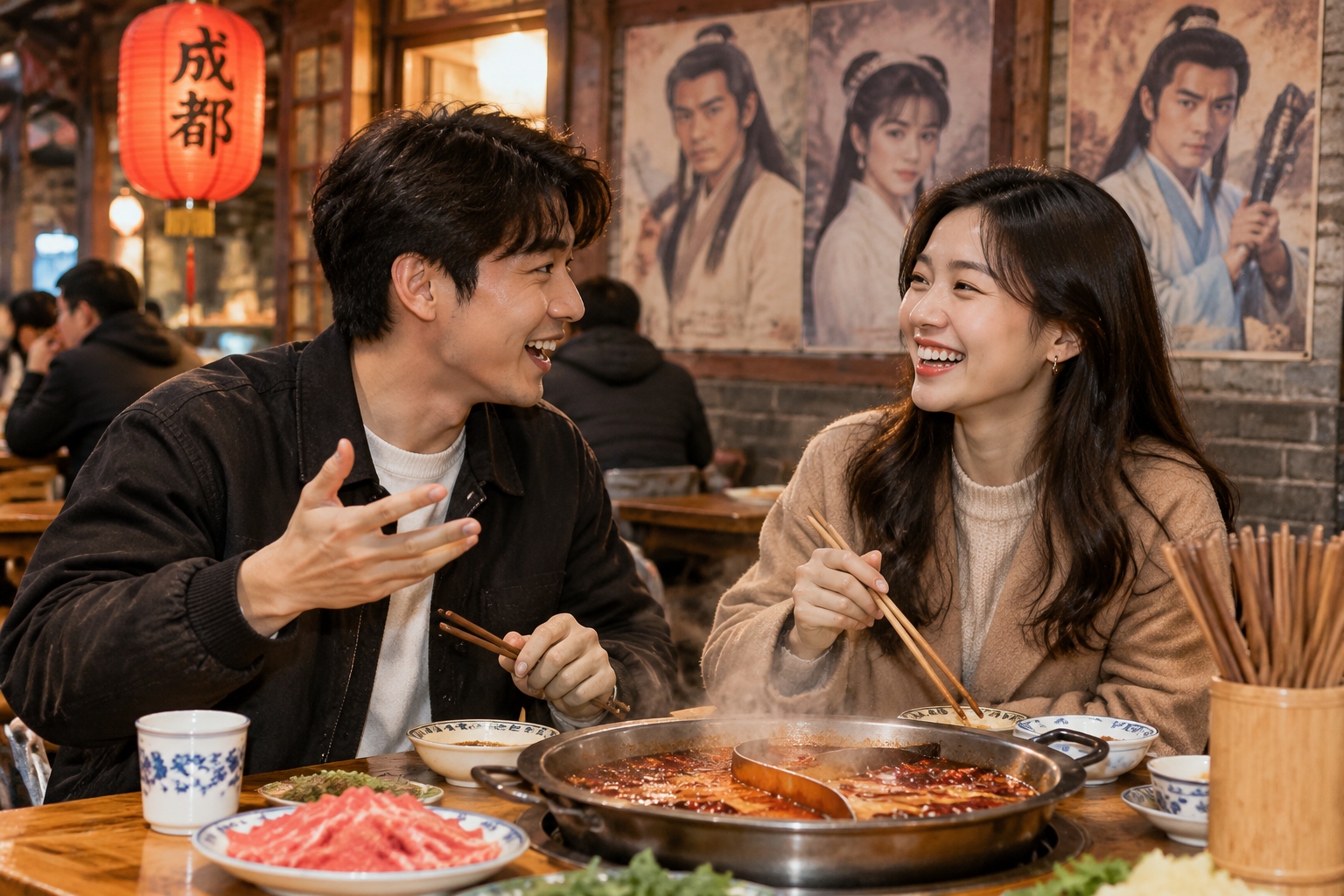
It’s a rainy Friday evening in Shanghai. I’m sitting in a small, steam-filled dumpling shop with my colleague, Li Wei. We’re exhausted from the week’s work, talking about our boss’s latest unreasonable demand. Suddenly, Li Wei sighs and mutters, “He’s pulling a Yue Buqun.”
I laugh. He laughs. The waiter, passing by with a tray of steamed buns, chuckles too.
If you’re not familiar with Chinese culture, this moment might seem confusing. Who is Yue Buqun? Why does his name explain our boss’s behavior? This tiny interaction holds the key to understanding one of the most powerful forces in the Chinese-speaking world: Jin Yong.
The Architect of a Shared Universe
For non-Chinese readers, Jin Yong (Louis Cha) is often described simply as “the J.R.R. Tolkien of China.” But that comparison, while helpful, misses the sheer scale of his presence in daily life. Tolkien created Middle-earth; Jin Yong created “Jianghu”—a term literally meaning “rivers and lakes,” but culturally signifying a parallel society governed by martial arts codes, honor, and complex human emotions.
Between 1955 and 1972, Jin Yong wrote fourteen major novels. They were published serially in newspapers, a format that kept millions of readers on the edge of their seats every morning. Today, his works have sold over 300 million copies worldwide. But sales figures don’t capture the reality: for many Chinese people, these aren’t just books. They are a shared language.
Why “Linghu Chong” Is More Than a Name
To understand Jin Yong’s impact, you have to look at how his characters have escaped the page and entered everyday conversation. Take Linghu Chong, the protagonist of The Smiling Proud Wanderer. He is carefree, dislikes authority, loves wine, and values freedom above all else.
In Chinese offices or friend groups, if someone refuses to attend a mandatory team-building dinner because they prefer solitude, friends might joke, “You’re acting like Linghu Chong.” It’s shorthand for a specific personality type: the rebellious romantic. Similarly, calling someone a “Yue Buqun” (as Li Wei did about our boss) is a sharp critique of hypocrisy—someone who appears righteous and moral on the outside but manipulates others for power.
This linguistic penetration is rare. In English, we might say someone is acting like a “Machiavellian,” but Jin Yong’s characters are more nuanced, more human, and far more integrated into casual speech. They provide a moral compass and a vocabulary for social critique that has been refined over seven decades.
A Quick Map of the Fourteen Novels
If you want to grasp why this matters, you don’t need to read all fourteen novels. You just need a map of their emotional cores. Jin Yong didn’t just write about fighting; he wrote about the tragedy of power, the pain of love, and the struggle for identity.
The Trilogy of Fate
Condor Heroes series (The Legend of the Condor Heroes, The Return of the Condor Heroes, The Heaven Sword and Dragon Saber): These are often the entry point for younger readers. They explore loyalty, national identity, and the cost of heroism. The character Guo Jing is the archetype of the stubborn, loyal patriot—often used to describe someone who is principled but inflexible.
The Trilogy of Freedom
Demi-Gods and Semi-Devils, Smiling Proud Wanderer, The Deer and the Cauldron: Here, Jin Yong moves away from traditional heroism. The protagonists are flawed, funny, or anti-heroes. This shift mirrors a cultural change in late 20th-century China: moving from collective duty to individual expression.

Jin Yong in the Modern Digital Age
You might think Jin Yong is a relic of the past, something for your grandfather’s bookshelf. But walk into any Chinese university campus or scroll through social media apps like Douyin (TikTok) and Xiaohongshu, and you’ll see him everywhere.
Young people use Jin Yong memes to comment on workplace politics, dating dilemmas, and historical dramas. There are countless mobile games based on his novels, TV adaptations that break streaming records, and even academic papers analyzing the sociology of his martial arts sects.
I recently visited a bookstore in Beijing’s Sanlitun district. The Jin Yong section wasn’t dusty. It was surrounded by young readers, many buying limited-edition illustrated versions. One student told me, “My parents read these as escape fiction. I read them to understand the underlying logic of Chinese social relationships.”
Why This Matters for Outsiders
Understanding Jin Yong is less about learning plot twists and more about decoding cultural shorthand. When a Chinese business partner talks about “Jianghu rules,” they aren’t talking about ancient laws. They are referring to an unwritten code of reciprocity, face-saving, and loyalty that still influences how deals are made in Shanghai or Shenzhen.
When you hear someone reference “East Invincible” (a character who defeated everyone but was lonely), they are invoking a metaphor for the isolation of extreme success. These references allow Chinese speakers to communicate complex social judgments quickly and subtly.

The Legacy of a Journalist
Jin Yong stopped writing fiction in 1972, not because he lost his inspiration, but because he was too busy running Ming Bao, one of Hong Kong’s most influential newspapers. He believed that journalism and fiction both required truth-telling—just in different forms.
He passed away in 2018, triggering a massive outpouring of grief across the Chinese-speaking world. It wasn’t just nostalgia. It was a recognition that he had given them a common cultural ground during a time of rapid, often disorienting change.
So, the next time you’re in a Chinese city and hear a group laughing about “Jianghu,” don’t ask for an explanation immediately. Just listen. You’re hearing the echo of fourteen novels that taught a generation how to be brave, how to love, and how to survive in a complex world.