
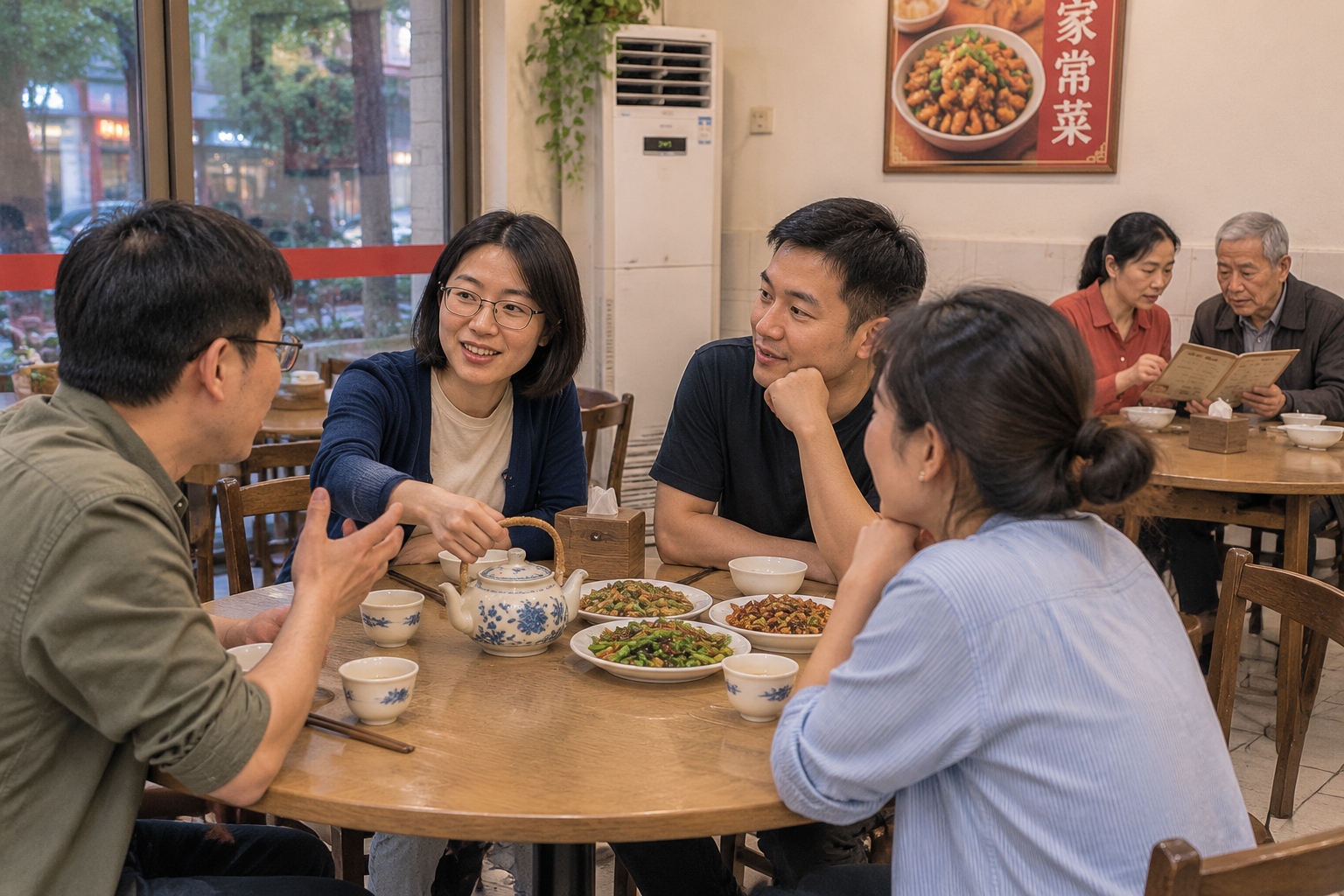

Picture four friends around a round table in a neighborhood restaurant in Chengdu. One of them, a woman in a navy cardigan, reaches for the teapot just as the friend across from her gets to the good part of a story. A server sets down a plate, somebody laughs, and the storyteller raises his voice to finish. One friend likes the bustle because she can laugh without feeling that the whole room has turned to look. Another cups a hand behind his ear and asks the storyteller to say the last bit again.
At the next table, a daughter has been asking her father what he wants to order. She repeats the question and turns the menu toward him. For the friends, the room gives their conversation some cover. For the daughter, the burst of laughter means another attempt at a simple question. Both reactions fit this imagined dinner, and they can happen a few feet apart.
What a lively restaurant tells you in China
In Mandarin, rènao (热闹) can describe a busy street, an animated dinner or a celebration that has drawn a crowd. “Lively” is often a good translation. In a restaurant, the word can also carry approval. When someone says a place is hěn rènao, or very lively, they may be recommending the atmosphere along with the food. “Noisy” gives an English reader a different impression because it already sounds like a complaint.
The layout of a meal helps explain why. At a round table with dishes in the middle, someone may ask the person across from them to pass the fish while two other people are telling a story. Plates and voices travel in several directions. In a room with tile floors and bare walls, conversation bounces around, and diners raise their voices to stay audible. The table next door does the same. People who came for the company may enjoy the result right up to the moment they have to repeat themselves.
If you have tried to tell a story across a table in a packed pub on a Friday night, you already know much of the feeling. For a visitor from the United States or Europe, the surprise may come at lunch, when a room full of families sharing dishes can have the energy they associate with a busy bar. In China, too, the expectation changes with the venue. Friends can choose a quieter café for a long catch-up or ask whether a restaurant has a private room when several generations are eating together.
How market calls and festival drums become rènao
At an open-air produce stall, a vendor might call out the price of spring greens to people still walking past. The call lets a shopper know what is on offer from several steps away. A familiar vendor may also call out a greeting or ask how the shopper cooked yesterday’s purchase. Voices do some of the work of selling and give people who see each other regularly a chance to talk. To someone deciding where to stop, the cluster of voices around a stall can suggest that business is good.

At a Lunar New Year event with a lion dance, drums and cymbals give people farther down the street a reason to turn and look. The percussion helps performers keep time, and a family arriving after the dance starts can follow the sound toward the crowd. For someone watching from the front, that volume is part of the event. Someone working a night shift and trying to sleep in a flat above the street hears the same drums from a bedroom. How long the performance lasts matters a great deal from up there.
China’s Noise Pollution Prevention and Control Law, which took effect in June 2022, addresses this specifically for activities such as recreation and exercise in public spaces. Article 64 requires participants and organizers to follow public-space managers’ rules on where and when those activities take place and how loud they can be. It also bars the use of audio equipment at excessive volume. For a group that meets to dance in a square and residents whose windows overlook it, those details determine when the music will reach the apartments and when it will stop.
What changes in a hospital waiting room
Now picture the woman in the navy cardigan at an outpatient clinic, helping her mother check when she will be seen. The screen above the seats lists queue numbers, and a speaker calls patients to consulting rooms. A friend phones, and her first “Hello?” comes out at dinner-table volume. When her mother looks up at the speaker, the woman moves the phone closer to her mouth and speaks more softly. She can still finish the call, and her mother can listen for her number.
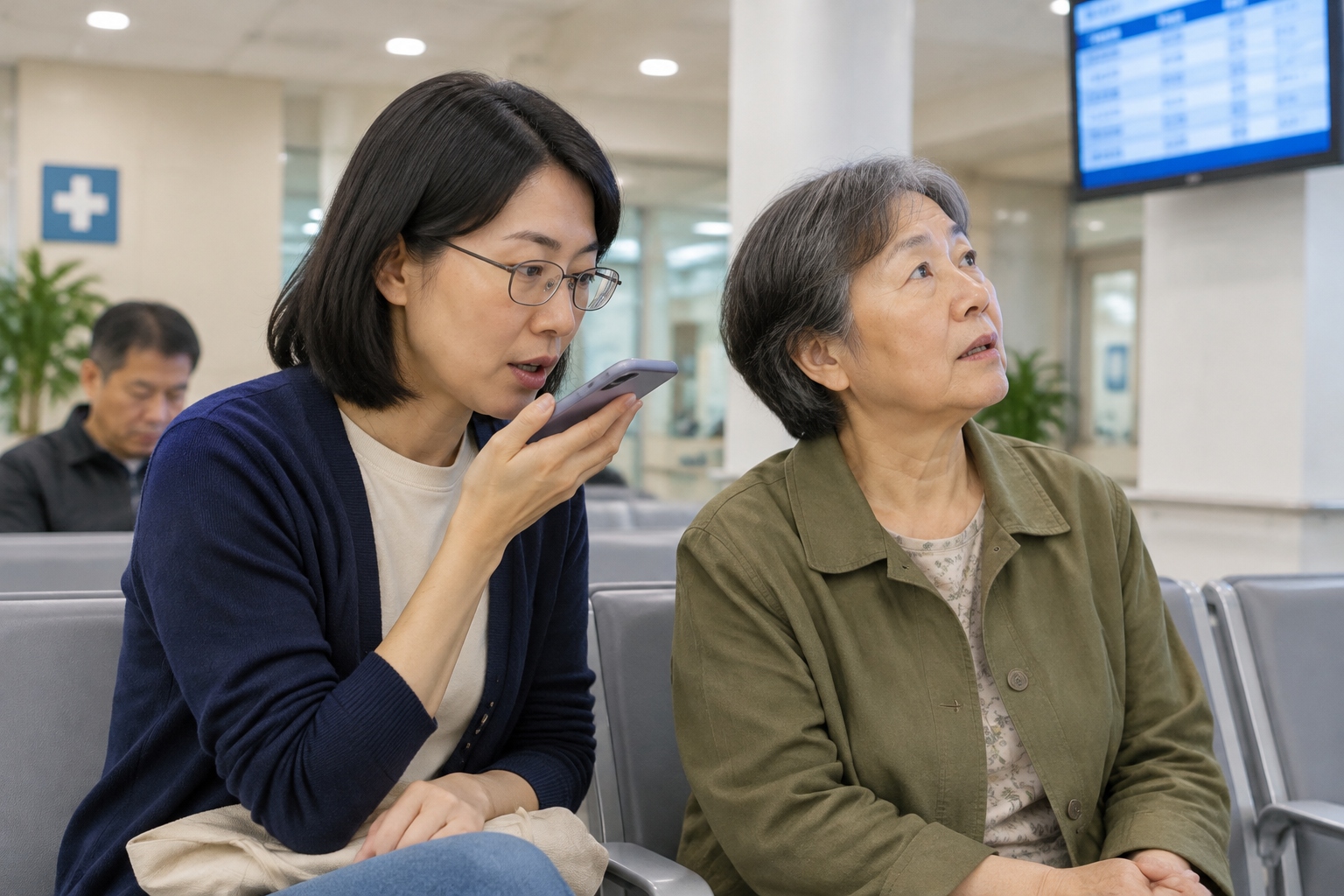
Hospital waiting areas can get loud for practical reasons. Relatives help older patients work out which room to go to, a child cries, or someone across the aisle asks a nurse where to pay. The quick exchange that helps a patient find the right door is easy to understand. A long call on speakerphone competes with announcements and brings a conversation into a room where people may need to stay until they are called. A neighbor might say, “Could you turn that down a little? I’m listening for my number.” Giving a reason makes it clear what the other person needs right now.
A library reading room makes the adjustment visible in a different way. Two people can talk at the return desk, walk past the doors into the reading area and finish the same exchange in a whisper. A librarian might point a caller toward the corridor. Even a quiet voice carries if everyone nearby is reading, and the person speaking can often tell by how clearly they hear each word coming back off the room’s hard surfaces. A library with a separate children’s area can make room for a story read aloud and a silent study session under the same roof.
Who gets to call a place lively?
The diner at the next table can ask to move if there is a seat free. The patient waiting for a number has less room to maneuver, and the person upstairs cannot move the bedroom away from the square. That difference in who can leave helps explain why time limits matter in a park and why a brief request for quiet can land well in a clinic. In a restaurant, the same concern might prompt a server to turn down the background music so people can hear their own table.
Back at the round table, the friend who missed the end of the story leans in for the repeat. The storyteller leans in too, and this time he only has to carry his voice halfway across the table. The daughter next door slides her finger down the menu until her father points to a dish. Ten minutes later, after they have ordered, the laughter might barely register for either of them.