

A Door in the Cliff
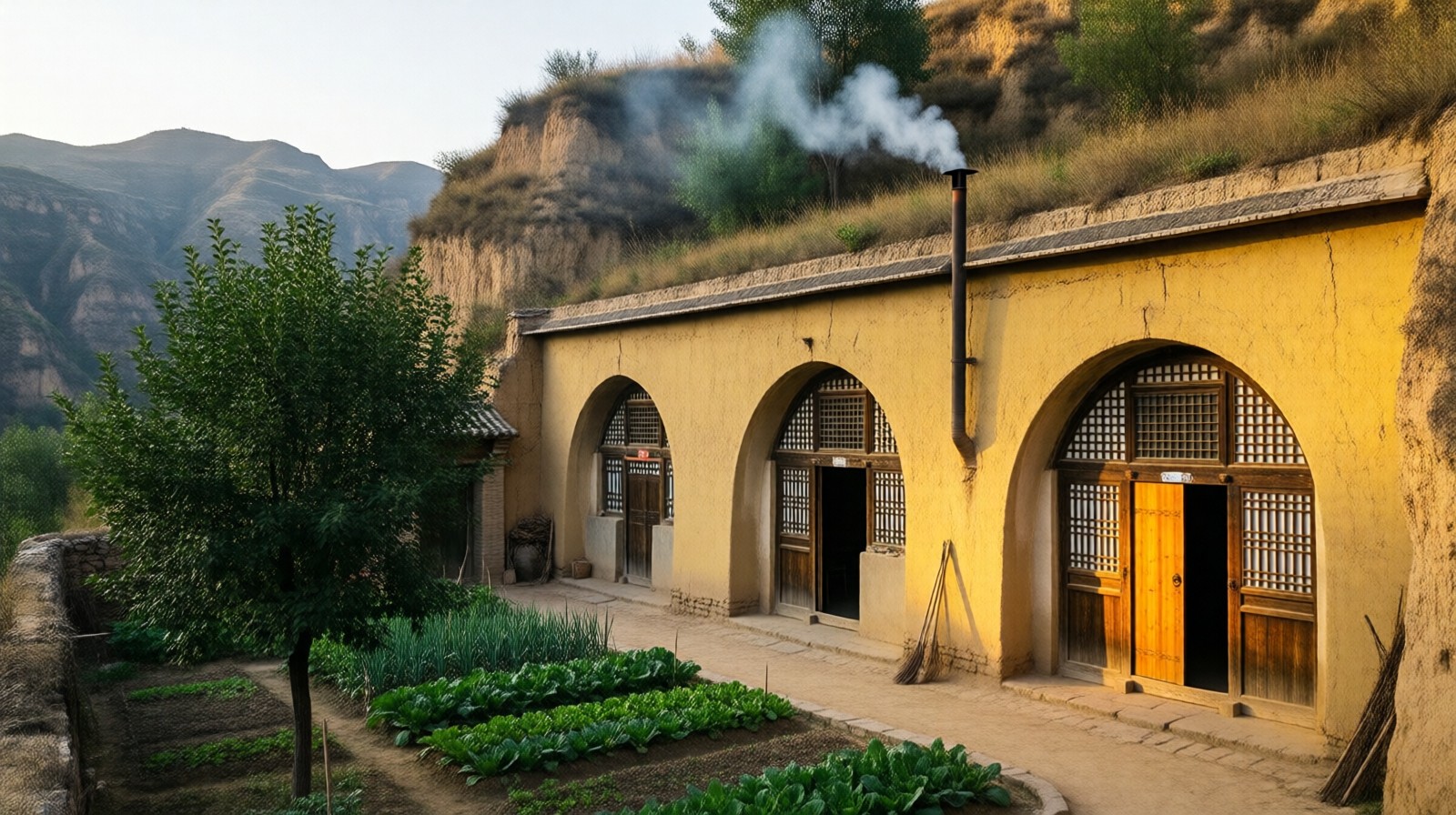
Just after sunrise, Li Guihua pulls open a heavy wooden door set into a wall of yellow earth. The top of the door is an arch, matching the curved roof of the cave behind it. Inside, the smell of dry soil and woodsmoke mixes with the hum of a small electric pump. A few years ago, this narrow room was a storage space. Today it is a guesthouse lobby with tiled floors, a mini fridge, and a guestbook with names from Shanghai, Guangzhou, and even London.
Li Guihua, 62, lives in a village on the edge of Yan’an, a city famous in Chinese history as the base of the Communist revolution. Now the hills around Yan’an attract a different kind of visitor, not for revolutionary sites but for the traditional cave dwellings that once sheltered local families. From the opposite bank of the Yan River, the village looks like dozens of dark holes punched into a yellow cliff. Thin smoke rises from a few chimneys. Except for the occasional blue tile roof and a satellite dish, the scene could be a century old.
After her children moved to the city, the cave was empty. But a village tourism association offered grants, and a local builder showed her how to upgrade it. “The structure was still strong,” she says. “My grandfather’s grandfather cut this cave. We just needed to make it comfortable.”
A House That Breathes
For readers who have never visited northern China, a cave dwelling — yaodong in Chinese — is a home cut horizontally into a cliff of loess, a fine yellow soil found across the Loess Plateau of Shaanxi, Shanxi and Gansu. The practice dates back over a thousand years. Builders hollow out a tunnel-shaped room into the compacted earth, leaving a curved ceiling. To increase stability, they sometimes line the entrance with bricks. A cave’s thick soil skin acts as a natural insulator: in winter, the indoor temperature stays around 12 to 18 degrees Celsius even without heating, while outside it can drop far below freezing. In summer, the same walls keep the room cooler than a brick house. “The earth breathes,” locals say.
Each family often had several caves dug into the same cliff, sharing a courtyard. The center of life was the kang, a heated brick bed built into the floor and connected to a small wood stove. Smoke from the stove passed through a flue under the bed, then out a chimney in the cave wall. In cold months, the family would stay on the kang all day, eating, working, and sleeping on it. It was not just furniture; it was the family’s engine.
But by the 1990s, many locals considered caves a symbol of poverty. The caves lacked running water, and their interiors were often dusty. When brick houses with flat roofs and electric pumps arrived, young people moved out. Hundreds of caves were abandoned to crumble or were used as sheds. Some were demolished for construction material.
The Hotel Renovation Wave
Tourism changed the math. Over the past decade, a visible trend has emerged: converting abandoned caves into guesthouses and boutique hotels. The first renovations were basic — owners added waterproof flooring, electricity, a shower and an internet connection, then shared photos on Xiaohongshu, a social media app popular with Chinese travellers. Weekend guests from Xi’an, Beijing and Shanghai started arriving.
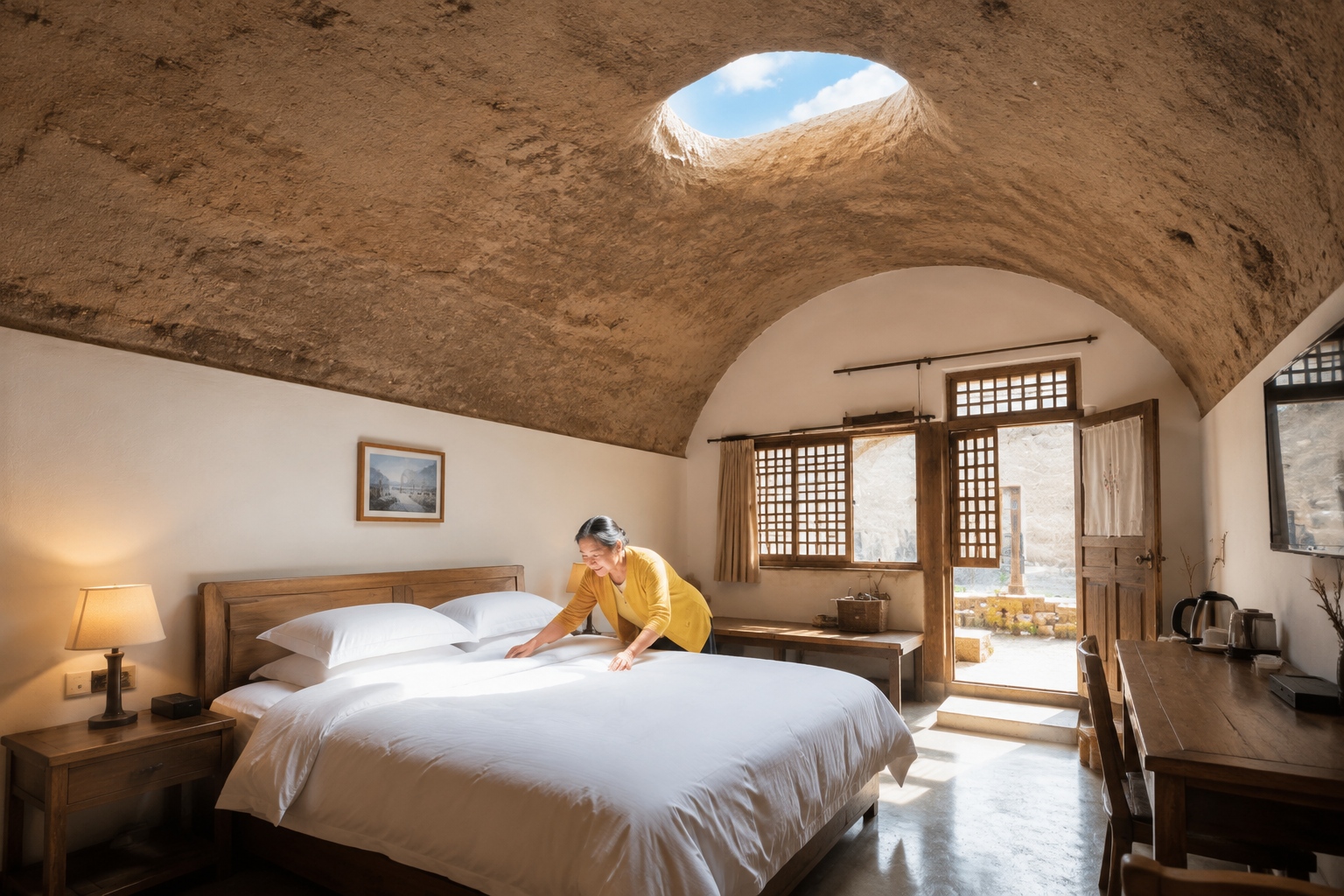
Today, better renovations respect the original structure. Builders seal the earthen walls with a transparent protector, lay drainage to keep out groundwater, and tuck pipes and wiring into the floor. Water is a constant enemy, so every bathroom must be carefully sealed and the drainage carried away from the cliff face. A lime-based plaster helps the wall breathe while repelling moisture. The curved arches and rough texture are kept, but the cave now contains a thick duvet, a rainfall shower, fast WiFi, and a thermos of boiled water — a habit many Chinese travellers still expect.
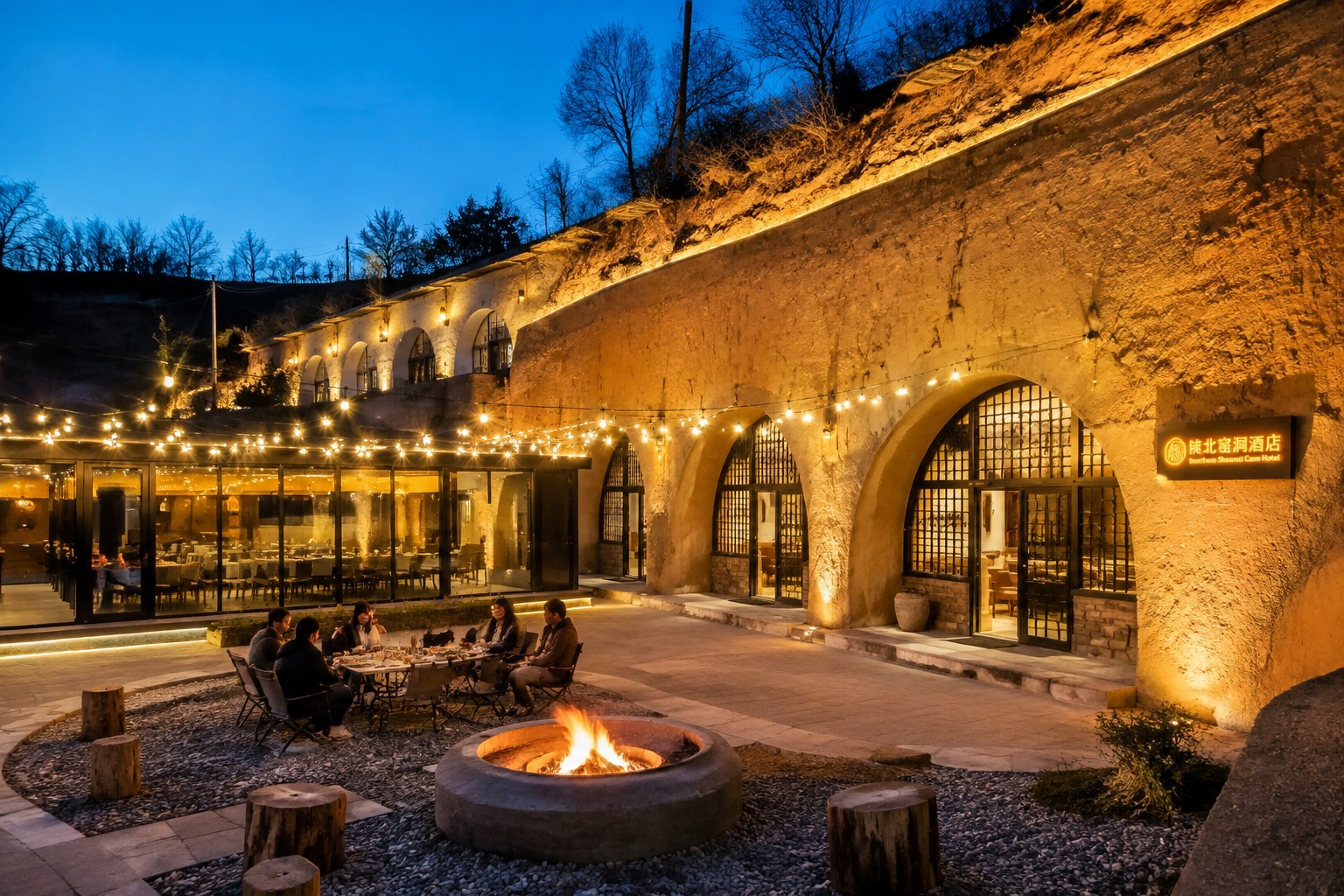
In the guesthouse Li Guihua runs, the former grain room is now a bedroom with a skylight cut through the ceiling. At night, guests can lie in bed and watch the stars through a pane of glass set into the earth. One project near the Yellow River converted a row of caves into a hotel with a glass-walled restaurant and a courtyard fire pit, charging premium rates for a “warm cave experience” in winter. Another village less than an hour from Yan’an has opened a “cave hostel” with a shared kitchen, where backpackers trade travel stories.

The People Coming Home
The new guesthouses have brought some people back to villages. Wang Qiang, Li Guihua’s 34-year-old son, returned home after ten years of construction work in Xi’an and Beijing. He handles bookings on a smartphone and takes guests to the guesthouse from the Yan’an train station. “My mother is better at cleaning, I’m better at posting,” he jokes. He also flies a small drone to take aerial shots of the guesthouse for its listing. The photos show a row of rounded doors in a cliff face, a vegetable garden in the courtyard, and the deep green valley below.
His sister, who works in a hospital in Yan’an, comes on weekends to help with laundry. She does not want to live in the cave, but she likes the extra income. In Li Guihua’s guesthouse, meals are made with vegetables from the courtyard and lamb from a neighbouring village. She and her son keep the profits; a tourism association collects a service fee. Summer weekends are booked, and a growing number of foreign travelers find the caves through online platforms. A couple from Germany stayed for five nights, using the cave as a base to hike the surrounding farmland. They said it was the quietest place they had slept since leaving Berlin.
Not every project succeeds. Some owners skip proper ventilation, and the caves become damp and moldy. Water remains a major constraint in the Loess Plateau; a hot shower in every room requires a large tank and a pump, which many projects cannot afford. In the oldest rural villages, no tourism has arrived, and empty caves continue to collapse. “The internet is fast, but water is still a problem,” says Wang Qiang.
Rules and Renewal
Local authorities have started to treat cave renovation as something other than a commercial side business. New guidelines in some counties require that any project preserve the original structural form and use traditional materials where possible. There are subsidies, but also limits: no cutting down old village trees, no paving over the courtyard with concrete. One county even requires that the outward face of the cave stay unchanged — the wooden door frame and the exposed earth must remain as they were. Inside, however, almost anything is allowed.
The cave dwelling’s status has shifted in official culture, too. Once associated with poverty, it is now featured in photo books and at conferences as an example of sustainable design — it uses a hillside that would otherwise be bare, needs less energy, and renovates with less concrete than a new house. In 2021, a traditional cave village near the Yellow River was selected by a national architecture association as an example of “adaptive reuse.” That label makes it sound like a museum piece, but the village is still lived in.
Living with the Soil
The transformation is not a call to return to the past. It is a quiet, selective negotiation. A cave that once stored grain is now a room with a key card. A grandmother who cooked over a wood fire now uses an induction stove, but she still sleeps against the same earthen wall her father built. A young man who left to work on building sites has come back to sell something less concrete: the feeling of a warm, curved room that smells of the ground.
Li Guihua puts it simply. “I lived in a brick house for eight years,” she says, looking up at the curved ceiling. “The walls were too quiet. Here, I feel like the mountain is alive.” As we leave, she stands at the door, a yellow scarf around her neck, the arch of the cave holding the night outside. Behind her, the renovated room is half in shadow, half lit by a lamp. It is no longer a relic of old China, nor exactly a new thing. It is a home that decided to try another century.
Start the discussion at forum.chinacomes.com