
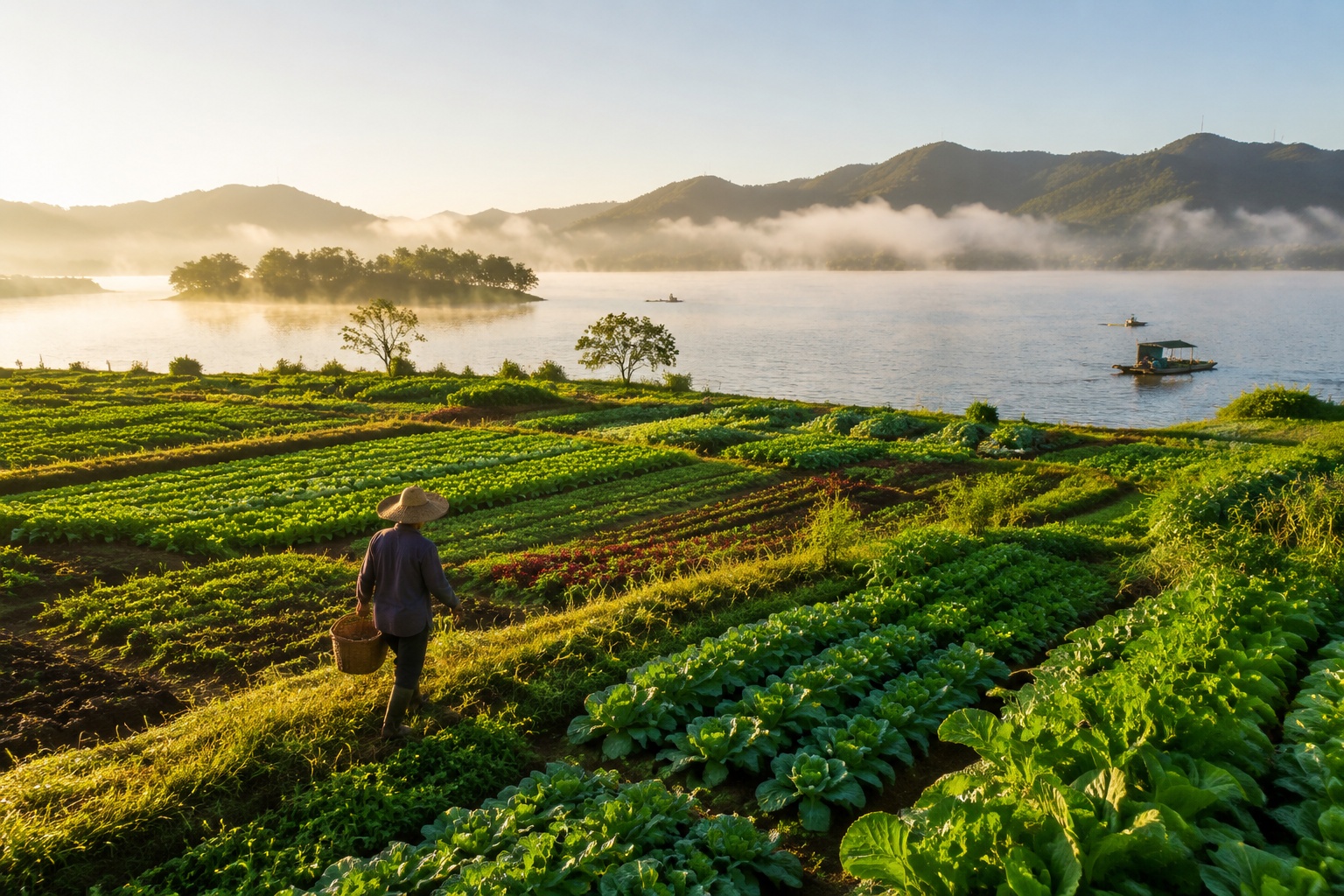

Introduction: A Morning by the Lake
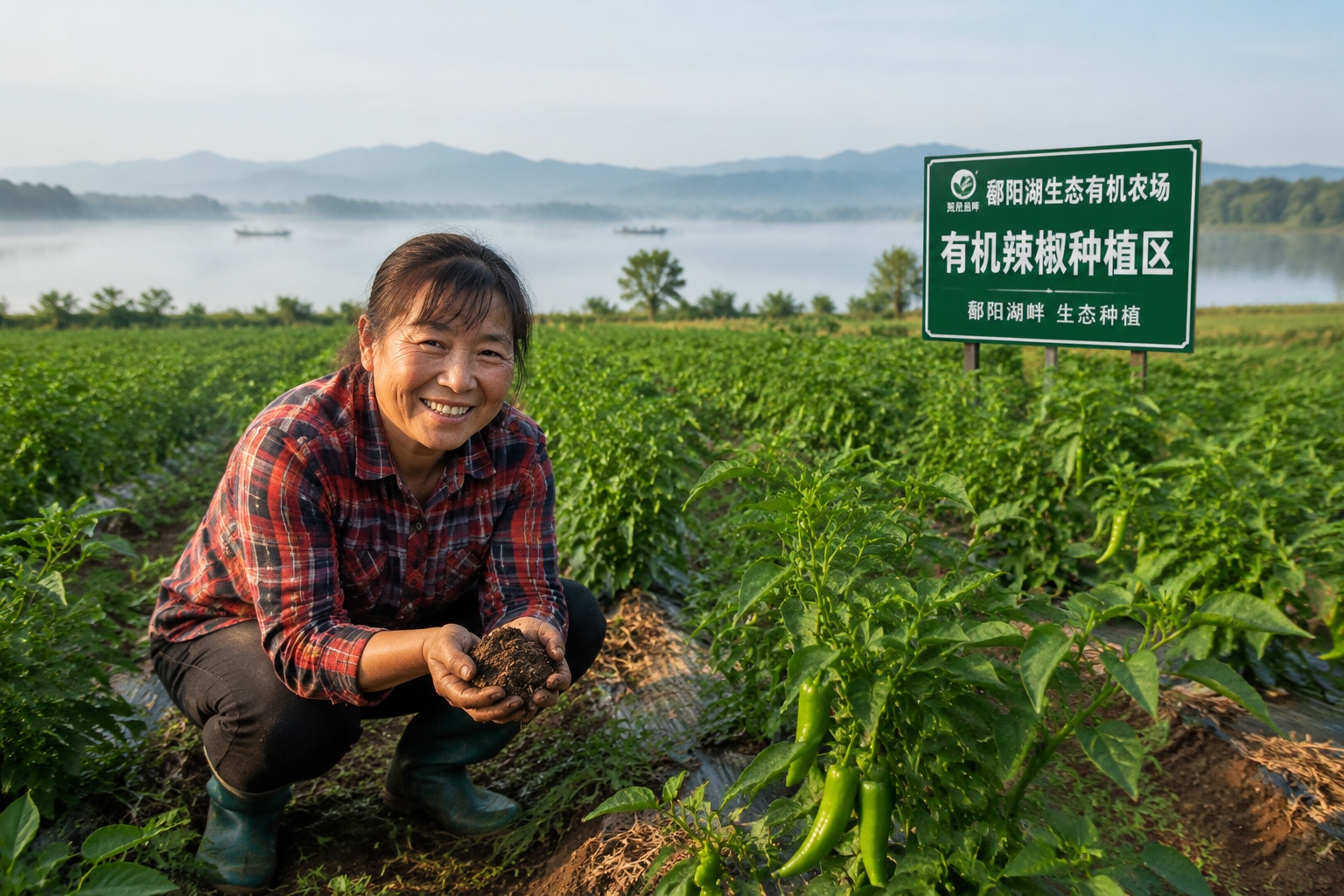
At 5:30 in the morning, the mist has not yet lifted from Poyang Lake, but 52-year-old Liu Fang is already in her vegetable field. She kneels down, picks up a handful of dark soil, and brings it to her nose. “It’s alive,” she says. “Feel it. It’s soft and smells like the forest. That’s what our crops need.”
Poyang Lake, in eastern China’s Jiangxi province, is the country’s largest freshwater lake. It is famous for its wetlands and migratory birds—siberian cranes travel here every winter. But for decades, the lake has suffered from pollution, much of it from agriculture. Fertilizers and pesticides washed into the water, feeding algae blooms and threatening the birds. Now, the lake is at the center of a different kind of experiment: an organic farming push that aims to protect the water while keeping farmers on the land.
Liu Fang is part of that experiment. She is one of hundreds of farmers in the lakeside village of Wucheng, about an hour’s drive south of the city of Nanchang, who have traded chemical-heavy farming for certified organic methods. The change has not been easy, but watching her move through the rows of pepper plants, you see the difference.
The Farmer’s Turn: From Chemicals to Compost
For over twenty years, Liu did what most small-scale farmers in China did: she used whatever chemicals worked. “We sprayed pesticides every week, sometimes twice,” she says. “The land got harder and harder. We needed more fertilizer each year just to get the same yield.” It was a cycle that hurt both the soil and her family’s income. A bad harvest, or a drop in market prices, could wipe out a year’s work.
In 2021, the village cooperative that buys her vegetables signed a deal with a new buyer—a Shanghai-based organic food company. The company offered to teach farmers organic methods and pay a premium for certified organic produce. Liu was skeptical. “My husband said, ‘The pests will eat everything.’ But we had nothing to lose, so we tried.”
The first year was rough. Yields fell by about 30%. Organic fertilizer costs more, and the new techniques took time to learn. But the price was nearly double what she got for conventional vegetables. By the second year, the soil started to recover. “The leaves got greener, and the plants were stronger,” she says. Her income, she tells me, has increased by about 40% compared to her last conventional year.
Her story is echoed across the Poyang Lake region. According to the Jiangxi Department of Agriculture and Rural Affairs, the province’s organic and green food acreage has grown steadily over the past five years, with more than 2,000 farms certified. Behind that stat are ordinary farmers like Liu, taking a risk on a method that promises less poison and more patience.
Smart Tools and Simple Tricks: How Organic Farming Works in Practice
Organic farming in Poyang is not just about replacing chemicals with compost. It is a quiet blend of old techniques and modern technology, adapted to local conditions.
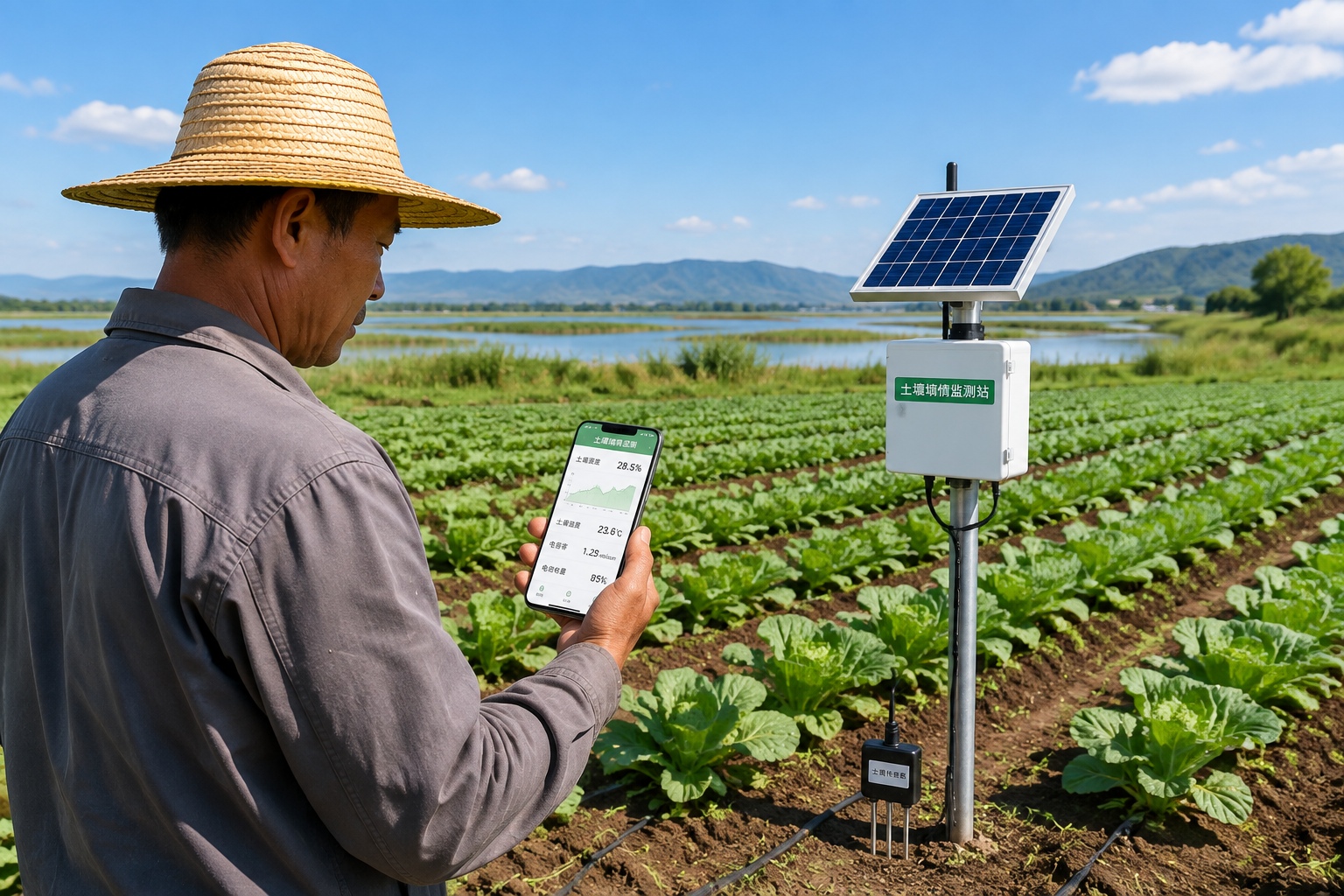
Take pest control. Instead of spraying insecticides, Liu and her neighbors rely on a mix of traditional and high-tech solutions. Yellow sticky boards trap aphids. Solar-powered LED lamps attract and kill moths at night. And every few rows, small sensors buried in the soil measure moisture, temperature, and nutrient levels. A solar-powered modem sends the data to her phone.
“Look at this,” she says, scrolling through an app. “The soil moisture is at 45%. I need to water this section tonight.” The sensors were installed by the cooperative, which collects the data and shares it with an agricultural technology company. The company helps spot problems early, such as a damping-off fungus that can kill young seedlings.
Between rows, farmers grow white clover as a “living mulch.” It keeps weeds down and fixes nitrogen in the soil. “We learned this from the technicians,” Liu says. “It used to look messy. Now we know it’s doing the work.”
A Chain That Connects Fields to Cities
All this works because there is a market waiting on the other end. The cooperative that Liu belongs to does more than just collect produce. It sorts, packages, and sends vegetables directly to a distribution center in Nanchang, about 100 kilometers away. From there, trucks take the produce overnight to supermarkets in Shanghai, Hangzhou, and other cities.
In an era when Chinese consumers are increasingly worried about food safety, the organic label is powerful. Each batch of vegetables carries a QR code. Scan it, and you can see the field where the crop was grown, the name of the farmer, and the date of harvest. This level of traceability, common in organic programs worldwide, is still rare in rural China—and it gives farmers more bargaining power.
“We used to sell at the local market and take whatever price was offered,” Liu says. “Now we have a contract. The buyer commits for the whole season.” That stability, she explains, is worth as much as the premium price. The cooperative also helps her plan which crops to plant, so two farmers in the village don’t produce the same vegetable in the same month.
The Lake Bounces Back, and So Do the Birds
The effects of this shift are visible in the lake itself. With fewer chemicals flowing off the fields, the water around the shore has become clearer. Wang Rui, a local environmental official, points to a recent survey: “We’re seeing less algae and more aquatic plants. The water’s oxygen level has improved in the bays where farmers have signed up for organic land.”
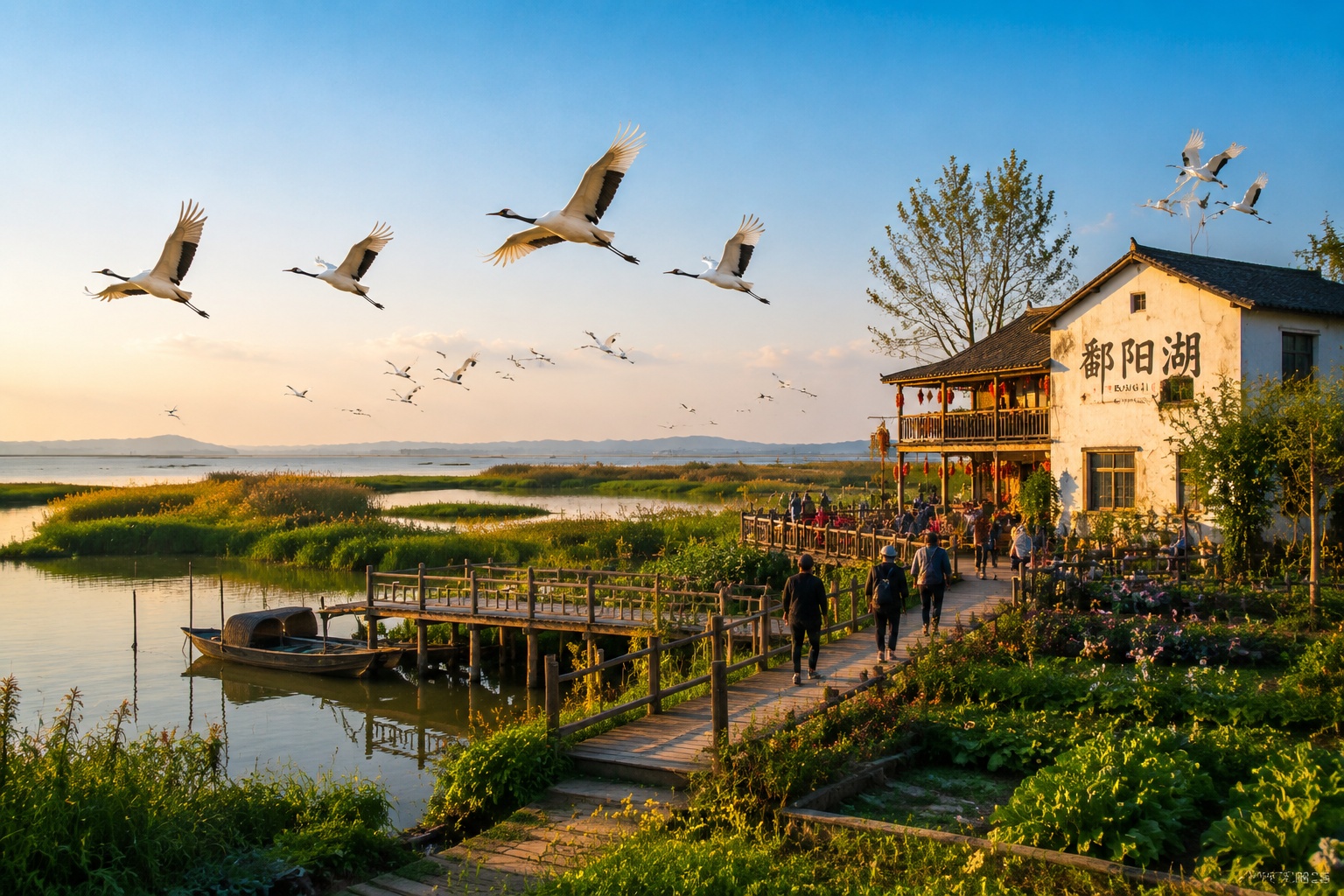
The birds notice too. Poyang Lake is one of the world’s most important wintering grounds for the Siberian crane, with an estimated 90% of the global population spending the winter here. In the past few winters, local birdwatchers have counted more cranes arriving. It is too early to attribute this directly to organic farming, but the relationship between land use and wildlife is clear.
Then there is tourism. Today, visitors come to Wucheng not just to see the lake but to pick vegetables and stay at farmhouses. Liu’s family runs a small guesthouse in their home. On weekends, she cooks organic dishes for guests and tells them stories about the lake. “Before, the young people left the village because there was no work,” she says. “Now some are coming back.”
The Honest Picture: Costs, Certificates, and Uncertainty
It would be misleading to describe all this as a smooth transition. Organic certification in China is expensive—often tens of thousands of yuan per farm—and requires constant paperwork. Liu’s cooperative covers the cost, but not all villages have that support. Many farmers who try organic methods end up selling their “green” vegetables without certification, at lower prices.
Market access remains uneven. Organic supermarkets and delivery apps in big cities have grown quickly, but in smaller towns, consumers still hesitate at the higher price. A head of organic lettuce might cost 15 yuan, more than twice the price of a conventionally grown one. That’s a hard sell for many families.
And climate change has made farming less predictable. Heavy rains in spring can wash away young plants; a dry autumn can reduce yields. Organic crops, with their stricter rules and no synthetic fallback, are more vulnerable. “Last year we lost a whole field of eggplants because of a flash flood,” Liu says. “We didn’t have money to buy new plants, and we can’t use quick chemical fixes.”
Still, she doesn’t want to go back. “The land is getting better. My body is better, too. I don’t have to wear a mask when I apply fertilizers.”
Conclusion: A Seed of Change for Rural China
Liu Fang’s story is not a grand success story, nor a complete failure. It is a quiet, ongoing attempt to reimagine how agriculture interacts with nature. Around Poyang Lake, the organic movement is still small. But it shows that Chinese farmers, often viewed as passive agents of industrial agriculture, can lead a green transition when given the right tools, markets, and support.
The experiment here touches everything: the taste of a tomato, the migration of cranes, the income of a rural family, the health of an entire lake. As Liu puts it: “If we take care of the water, the water takes care of us.”
Start the discussion at forum.chinacomes.com