
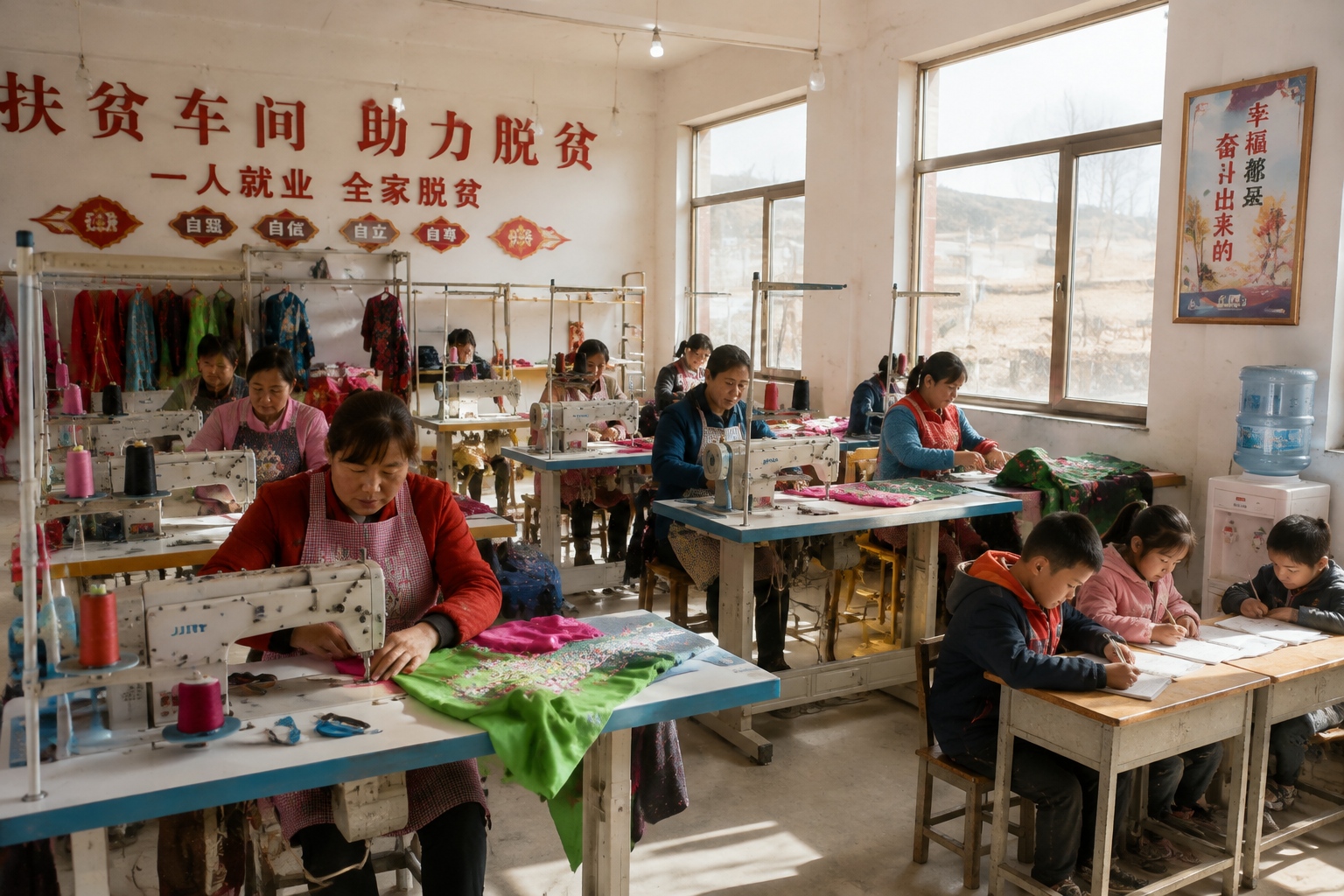

A Sewing Machine at the Village Gate
The air smells of wheat and dust. At 7:30 in the morning, Wang Chunyan walks her seven-year-old son to the village primary school, then crosses the dirt road to a one-story building with a red sign: “Xiahe County Poverty-Alleviation Workshop.” Inside, rows of sewing machines hum. She sits down, threads a needle, and begins another workday.
Wang, 36, used to work in Shenzhen, an electronics factory on the Pearl River Delta, ten hours a day, six days a week. Her son stayed with his grandmother in Gansu and only saw her once a year during the Spring Festival. “He would cry on the phone and say he didn’t remember my face,” she says, without pausing the machine. That memory still stings. Now she sees him every day. She takes him to school, picks him up, makes him dinner, and earns money at the same time.
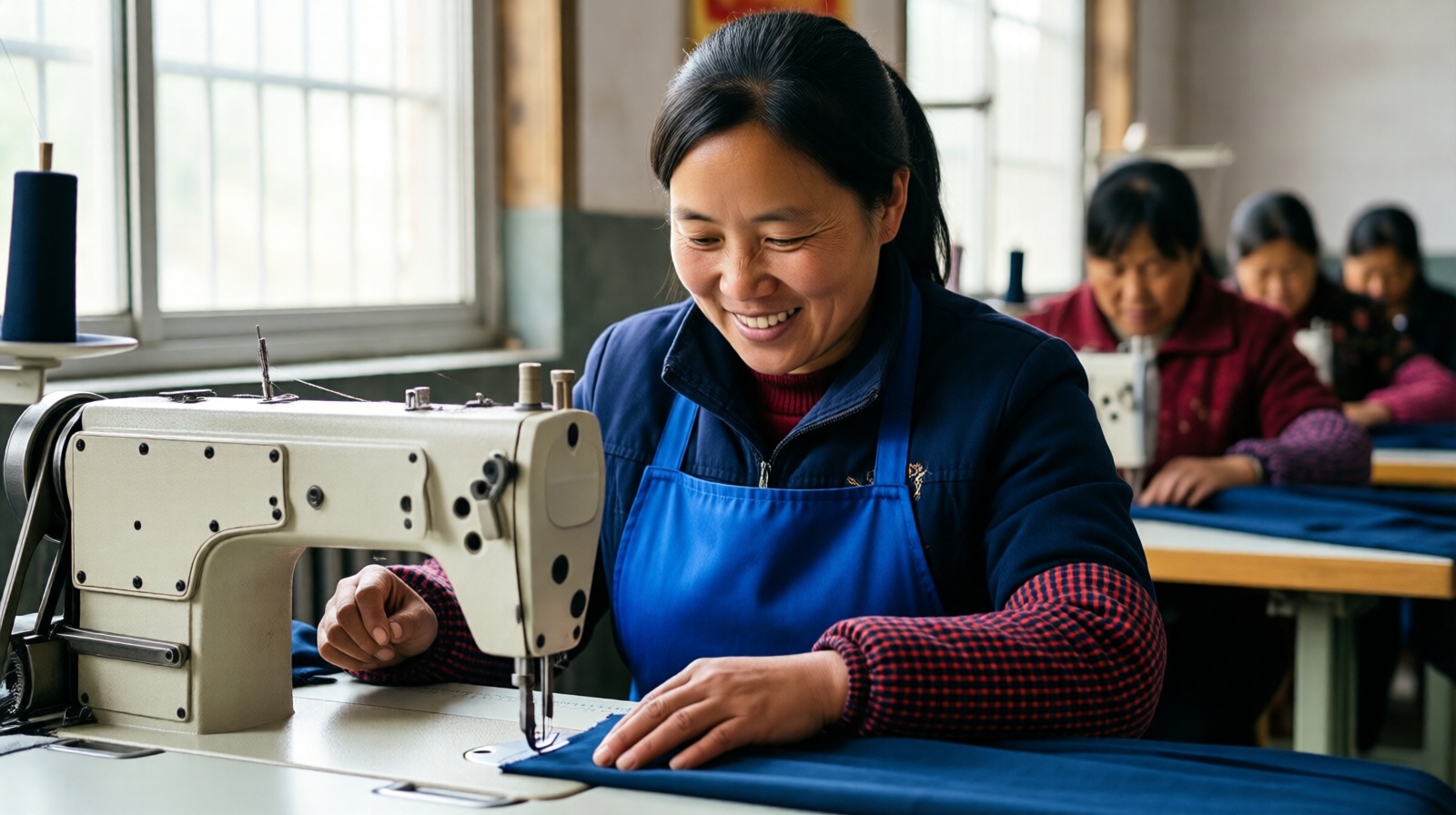
Wang is one of hundreds of women in Xiahe County, a remote area on the Qinghai-Tibet Plateau, where poverty used to be a fact of life. For years, young adults left for the coast, leaving behind elderly parents and children known as “left-behind.” But that pattern is changing. One of the forces behind it is the poverty-alleviation workshop—a simple idea that has had profound effects on rural women and their families.
What Exactly Is a Poverty-Alleviation Workshop?
In simple terms, it’s a small factory built in a rural area, usually in a village or town, where local people—especially women—can work without migrating. The workshops make clothes, shoes, handbags, toys, or handicrafts. Some process local agricultural products such as buckwheat or walnuts. Companies bring orders and technical training; local governments provide free or low-cost space, sometimes converting empty schools or village offices.
Gansu is one of China’s most challenging regions for economic development. Much of its land is arid or mountainous, and rainfall is scarce. Historically, farming alone could barely support a family. In 2013, Gansu had more than 5 million registered poor residents. The national government launched a targeted poverty-alleviation campaign, and among its many tools were these workshops.
By 2020, official figures showed that Gansu had built over 2,000 poverty-alleviation workshops, creating jobs for more than 60,000 people. The vast majority of workers are women, many of them middle-aged mothers who had never held a full-time job outside the home. The workshops offer flexible hours and piece-rate pay, making it feasible to balance work and childcare.
A Room Full of Stories
The workshop in Xiahe is a long hall with about thirty workstations. On one side, women sew tracksuit jackets and school uniforms with precise, practiced movements. On the other side, older women stitch felt dolls and embroidery. The chatter is constant—about children, prices, and dinner plans. A large water dispenser stands in the corner, and a radio plays folk songs from the Gannan Tibetan region.
Li Hongmei, 29, is the youngest here. She studied fashion design in Lanzhou, the provincial capital, but returned to the village after her daughter was born. “At first I thought it was a step backward,” she says, laughing. “But now I’m the quality inspector and I also teach older women new stitching techniques.” She earns around 2,800 yuan ($390) a month. It’s less than she could make in Lanzhou, but she doesn’t pay rent, and her daughter sleeps in her arms every night.
Zhao Guifang, 47, spent years as a migrant worker on construction sites. A back injury ended that life. For a long time, she sat at home, growing depressed. Then the workshop opened. “They offered to teach me to use a sewing machine,” she says. “I was afraid at first, but the manager was patient.” Now she stitches zippers on school bags and says the light work actually helps her back feel more flexible. “Most importantly, I have a reason to get up in the morning,” she adds softly.
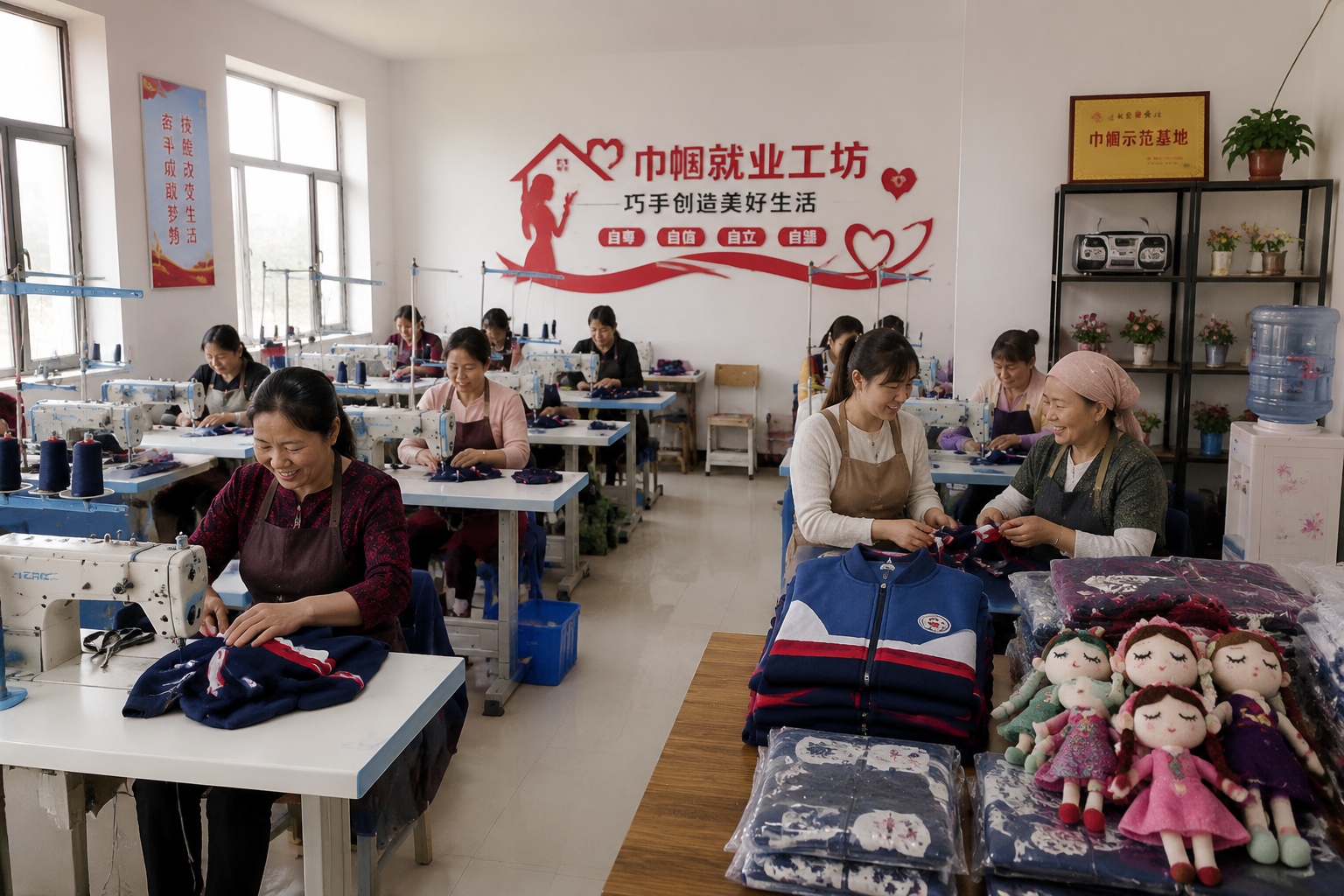
The workshop is not just a workplace. It’s a space where women exchange experiences. During lunch breaks, they share recipes, talk about children’s schooling, and sometimes discuss issues like domestic violence or financial planning. A social worker from the county women’s federation visits regularly to run health and legal education sessions.
The Children Are the Real Winners
The most visible change can be seen in the children. When mothers were away for months, kids often struggled academically and emotionally. Teachers in Xiahe remember children who refused to speak or who cried when seeing photos of their mothers. Now, those same children run into the workshop after school, chattering about their day.
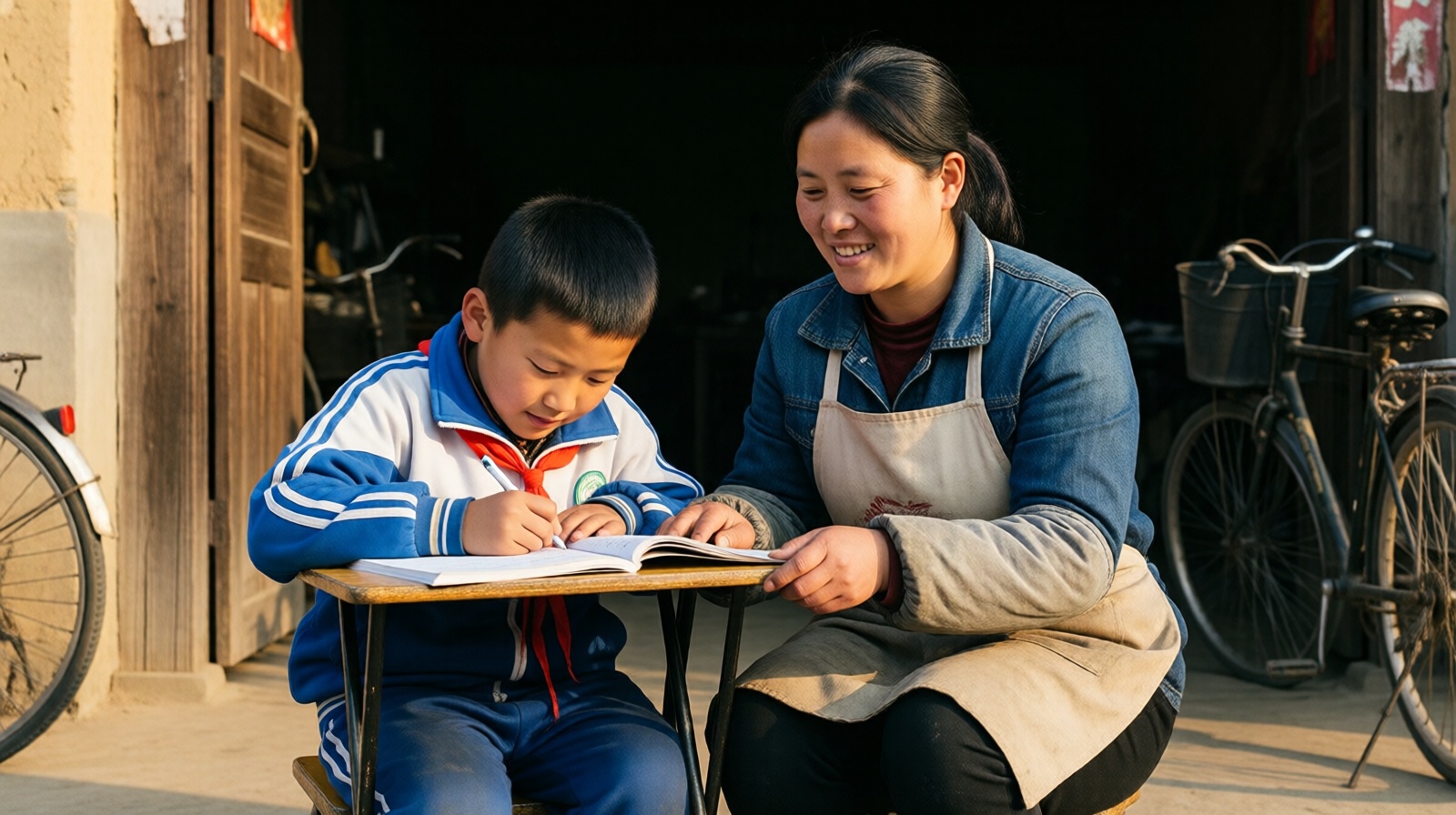
Seven-year-old Xiaoyu, whose mother Zhang Lijuan works the morning shift, often sits at a small desk near her machine doing homework. He sometimes draws on scrap fabric. “Before, he used to stare at my photo,” Zhang says. “Now he can pinch my arm whenever he wants.” Mothers say their children’s grades have improved, and teachers also report better attendance and participation in class.
The economic effect is real as well. A 2021 report from the Gansu provincial government indicated that families with a member in a poverty-alleviation workshop saw household income increase by about 4,000 yuan ($550) per year on average. That money often goes to better food, school supplies, and health care. In rural Gansu, where the average annual net income of a poor family was less than 20,000 yuan, this is significant.
Not Without Challenges
Let’s be honest. These workshops are not paradise. Wages are lower than in Shenzhen or Guangzhou, and orders sometimes slow down, especially during the off-season. Some younger women, especially those without children, still choose to migrate for bigger paychecks. And the workshops face real business challenges: shipping goods from remote mountain areas is expensive, and suddenly everything must meet national and international quality standards.
But many workshops are adapting. Some have upgraded to more skilled products, such as traditional embroidery with ethnic designs, which sell well on e-commerce platforms. Others are experimenting with live-stream sales, where workers themselves appear in front of cameras to showcase their handbags and quilts. “We are learning as we go,” says Ma Jun, the manager of the Xiahe workshop. “The sewing machine is our anchor, but we’re not afraid of change.”
During the COVID-19 pandemic, many workshops faced meltdowns when orders dried up. The government stepped in with subsidies and helped find new buyers. This resilience won trust from the workers. “I felt that the village would not let us starve,” Zhao Guifang says.
A Quiet Revolution at the Doorstep
In 2021, China announced that it had eliminated extreme poverty. Such a statement is easy to debate when statistics are involved, but go to a workshop in Gansu and you see what it means in real terms. A woman no longer has to choose between being a provider and being a mother. She can feed her child and tuck them into bed at night.
The workshops have also changed the power structure in many households. When a wife earns her own money, her voice in family decisions grows. A 2019 study by the Chinese Academy of Social Sciences found that rural women’s employment had a strong positive correlation with their influence over household spending and their children’s education.
Walking out of the workshop at sunset, you can hear the sewing machines still humming behind you. A group of children runs by, calling out for their mothers. The women look up, smile, and wave. In the distance, the mountains rise, but they no longer feel like a closed door. For these families, opportunity has arrived right at the doorstep.
Start the discussion at forum.chinacomes.com