
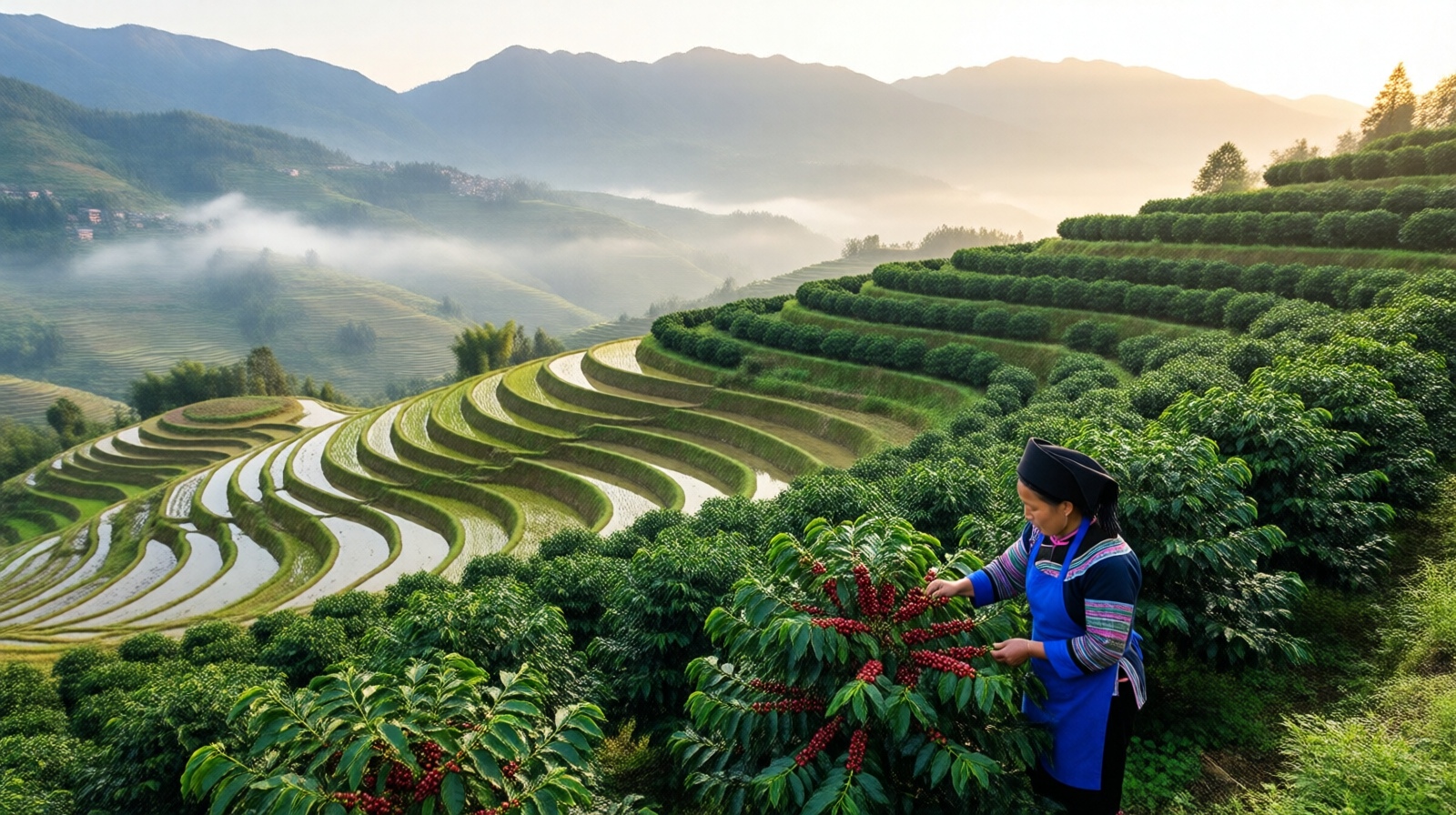

The woman among the coffee rows
At 6 a.m., when the clouds still cling to the shoulder of the Ailao Mountains, Li Mei walks up the stone steps of her family’s terraced field. She carries a small woven basket, a tool she once used to collect rice but now fills with bright red coffee cherries. In Yuanyang County, in China’s southwestern Yunnan Province, these terraces are more than just fields—they are a UNESCO World Heritage Site, celebrated for the way the Hani people have shaped the land over 1,300 years. Yet today, the golden waves of rice that once defined this landscape are increasingly being replaced by the deep green of coffee bushes and the red of ripening berries.
A terraced empire built on rice
The Hani have been cultivating these mountains since the Tang Dynasty, carving horizontal steps into the slopes and directing water through a sophisticated network of channels that begins at the forested summits. The system is not only a feat of engineering but also a social model: water sharing is governed by communal rules, and every terrace is part of a hydraulic culture that kept entire villages alive. Rice was the staple of that culture, a grain that reinforced identity. Festivals, ceremonies, and everyday family life revolved around the rice calendar. The terraced rice paddies also acted as a shield against soil erosion, storing water in their saturated soil and releasing it slowly over the year.
When rice no longer pays
But by the late 20th century, the economic foundation of this world began to crack. A hectare of rice paddy in the Honghe Prefecture yields roughly 7 tons of grain, bringing in about 15,000 yuan ($2,100) a year. Once the costs of improved seeds, chemical fertilizers, and hired labour are counted, the profit margin is scant. Younger Hani looked at the math and left, seeking factory jobs in the coastal cities. Between 2000 and 2015, the population of many terraced villages dropped by a third, and an increasing number of terraces were abandoned or left to dry. The remaining farmers were ageing. The UNESCO listing in 2013 did bring tourism and preservation awareness, but tourism alone could not fill the gap left by shrinking agricultural returns.
The arrival of coffee
In the early 2000s, government agencies and agricultural researchers in Yunnan—a province already famous for its coffee—set their eyes on the highlands of Honghe Prefecture. Yunnan grows some 98% of China’s coffee, mostly in the lower-elevation Pu’er and Baoshan territories, but the higher terraces of Yuanyang were largely untouched. The climate, however, was ideal for Arabica: 1,200–1,800 meters above sea level, cool nights, abundant sunshine, and a moderate dry season that helps the coffee fruit develop its sugars. The Government launched pilot programs, distributing free seedlings and offering training. Cooperatives were formed, and by 2010, a few hundred Hani families were experimenting with coffee into their plots.
Going organic: a market bet rather than nostalgia
The most significant move began in 2016, when the Terraced Coffee Cooperative in Yuanyang decided to apply for organic certification. The decision was not a homage to a romantic past but a competitive strategy. As Wang Lin, an agro-economist at Yunnan Agricultural University, explains: “China’s labour costs are too high to compete with Brazilian and Vietnamese coffee at the commodity level. But organic coffee attracts a premium, and the Hani’s traditional, low-input farming style already approached organic practices. It was a natural fit.”
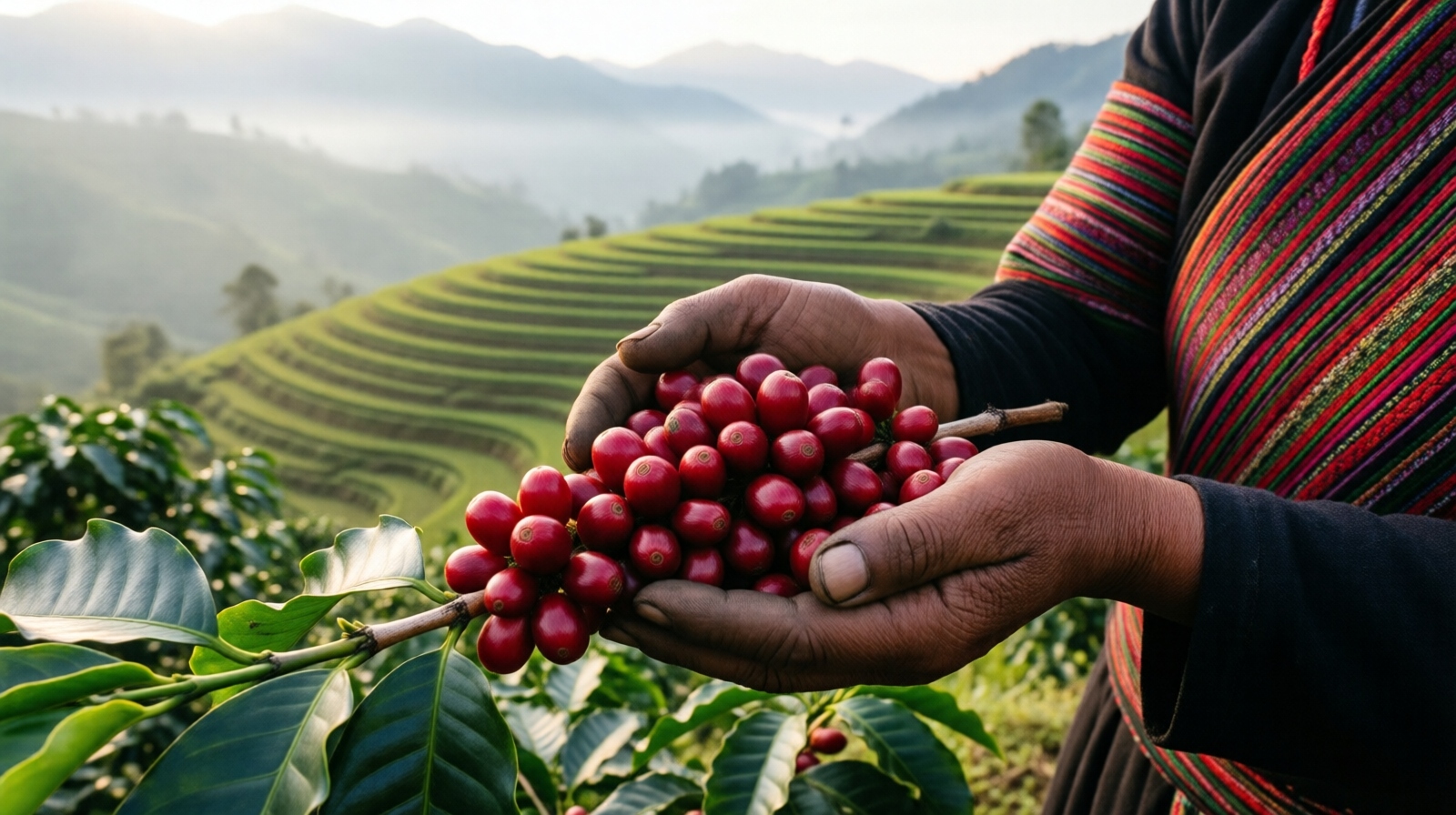
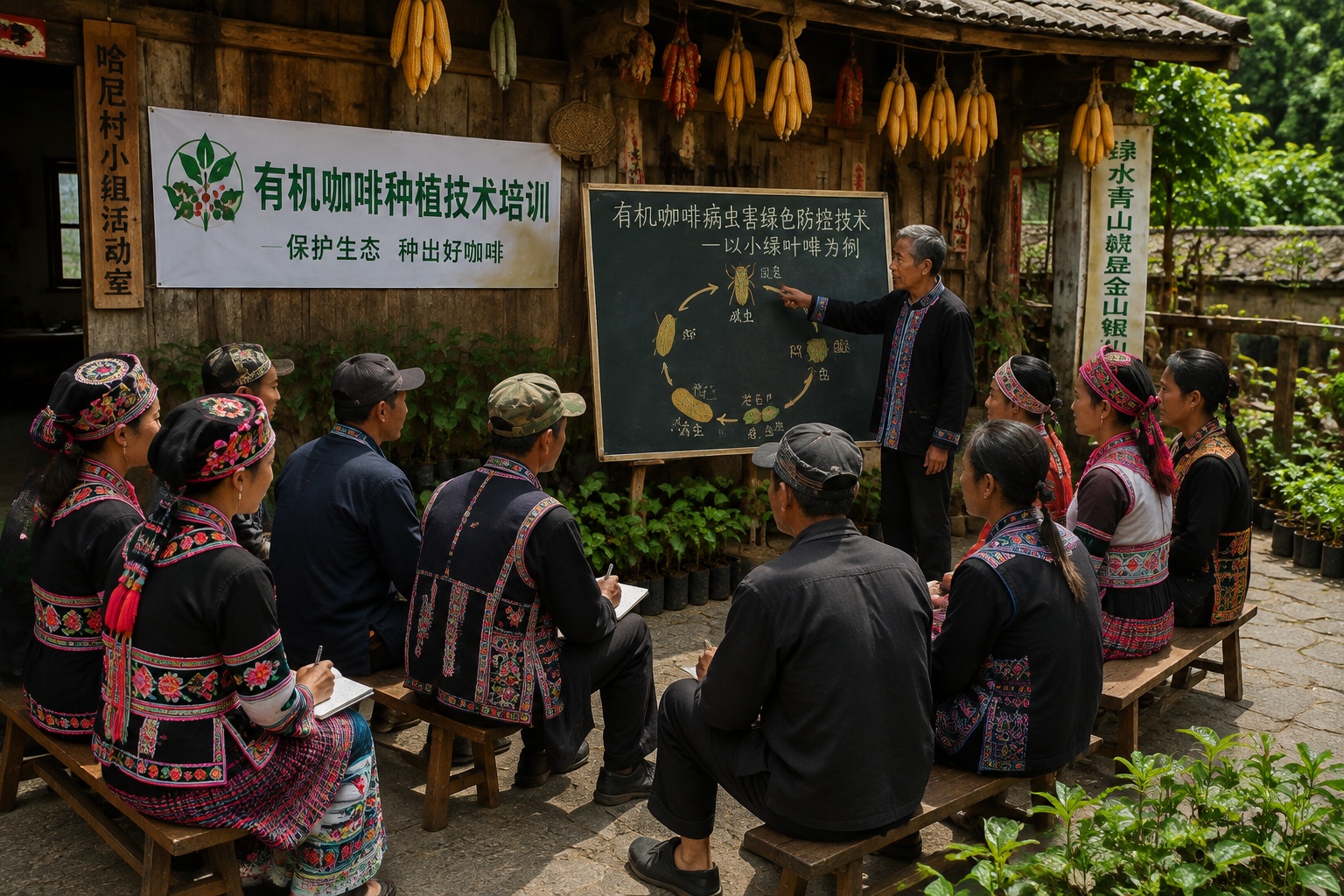
To achieve certification, the cooperative had to endure a three-year conversion period with no synthetic pesticides or chemical fertilizers. They built compost stations using cattle and poultry manure, introduced traps for the coffee berry borer, and cultivated beneficial plants to attract natural predators. Farmers were trained in the intricacies of green manure and biological pest control. For Li Mei, it meant more labour, but also a connection to the old ways: “We used to compost rice straw; now we compost the pulp from coffee cherries. It’s the same idea.”
The rural math has changed
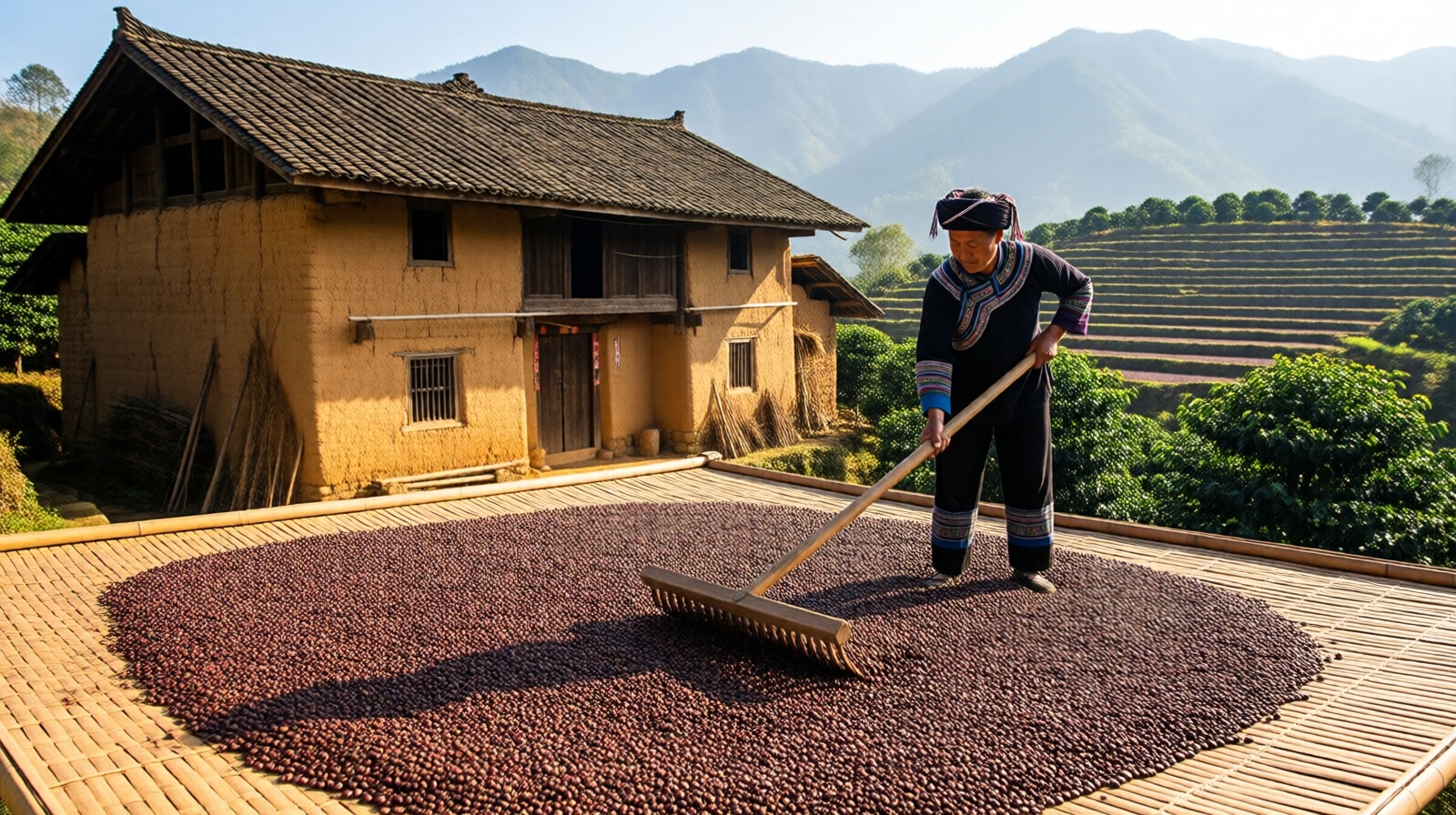
The economic shift has been radical. According to the Yuanyang County Agricultural Office, coffee cultivation has expanded from roughly 500 hectares in 2015 to 2,000 hectares in 2024, and about 60% of it is now certified organic. More than 3,000 households earn their primary income from coffee, and the average annual household income from coffee has climbed from about 8,000 yuan in 2014 to 25,000 yuan today. The premium matters: organic coffee cherries fetch 8–10 yuan per kilogram, compared to around 5–6 yuan for conventional ones. And because the cooperative runs a central processing unit, farmers sell directly to buyers instead of negotiating with middlemen, adding another layer of income. The visible benefits are not hard to find: new roofs, water heaters, better school enrolment, and fewer absent fathers. Some young villagers have even returned, seeing the coffee business as a modern alternative to migration.
Beyond the bean: pain and complexity
Yet the path remains steep. A drought in 2023—unusual in timing and intensity—cut the flowering cycle and dropped yields by nearly 30 per cent across the cooperative. Climate change is making weather more erratic, and without irrigation reserves from the terrace channels, coffee plants are more vulnerable than rice to sudden dry spells. Global coffee prices are also notoriously unpredictable; a sudden fall in the international market could shrink the premium. Although the cooperative tries to hedge through long-term contracts, not every household is safe.
Moreover, cultural loss is real. “Rice is not just a crop; it is the spirit of the Hani,” says 67-year-old Lu Ming, who still maintains a small plot of paddy for ancestor rituals and ceremonial meals. “We cannot lose it entirely.” Many families keep a small rice field for domestic use, but some older villagers fear that without the daily engagement with rice, the intangible heritage—the songs, the festivals, the water-sharing customs—will eventually fade. There are also ecological questions. Coffee is often grown in monoculture, which can reduce biodiversity. Researchers at the Honghe University have documented fewer native bird species in dense coffee groves than in mixed fields. To moderate this, the cooperative is now encouraging shade-grown agroforestry, intercropping coffee with banana, cedar, and tea trees, and leaving patches of natural forest untouched.
Re-grounding in tradition
The future, as Li Mei sees it, lies not in abandoning the terraces but in re-imagining them. The cooperative is building a small coffee roasting workshop, and a local agri-tourism cooperative now runs tours that combine terrace walks with coffee tastings. Farmers learn to brew their own beans—a skill that was totally foreign when they first started planting. “I drank coffee for the first time in 2010,” Li Mei says with a laugh. “Now, my daughter is a barista in the village café.”
The transformation is not a complete break with the past; the same irrigation channels that once carried water for rice now nourish the coffee roots. The same communal discipline that governed terrace maintenance now governs delivery schedules for the cooperative. For the Hani, the shift from terraced fields to coffee cups is a modern chapter in a long history of adaptation. As Li Mei puts it: “Our ancestors fed us with rice. Today, we feed our children with coffee. But it is still our land, our water, our hands.”
Start the discussion at forum.chinacomes.com