
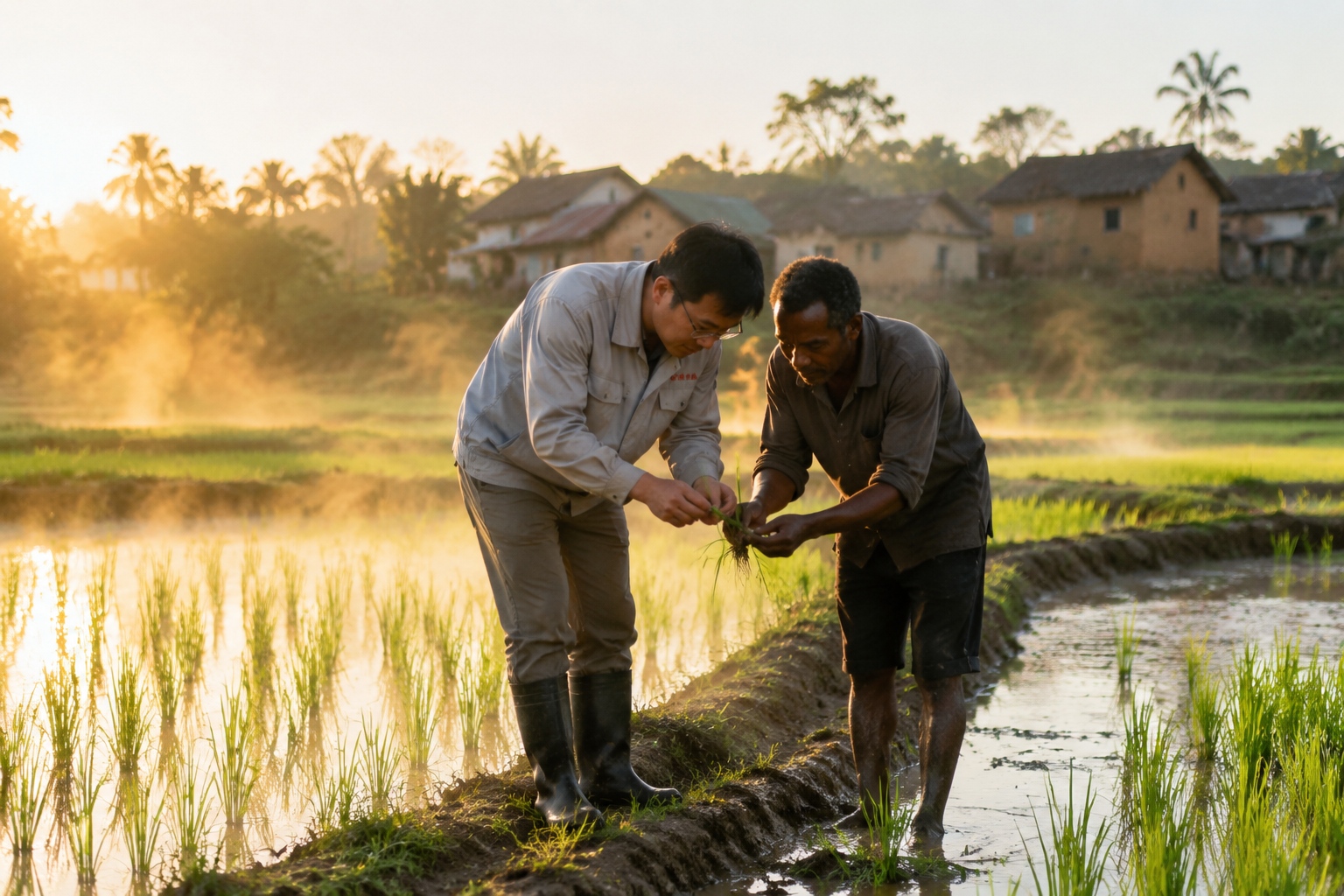

Early morning. The rice paddies of Mahitsy, a tiny village about 30 kilometers northeast of Antananarivo, are still wrapped in a thin mist. The air smells of wet earth and green leaves. A flock of small birds darts across the water. Liu Wei, a 38-year-old agronomist from Hunan, China, walks along the narrow ridge between fields, his rubber boots sinking slightly into the mud. He stops, crouches down, and gently pulls a young rice plant from the water.
He turns the seedling in his hand, examining the roots. There’s a slight yellowing at the tip. He looks up at the farmer standing next to him, a man named Jean Ralantoarison, who has been growing rice on these fields for more than twenty years. “Too much water needs to be drained,” Liu says in simple French, pointing at the field. “When the tillering stage comes, keep the soil moist, not flooded.” Jean nods, rubbing his chin. It is a routine morning.
But if you step back, this scene is part of a much larger shift across Africa. Hybrid rice varieties developed in China are now being grown in at least 20 African countries. In Madagascar, where this variety was imported and adapted, hybrid rice yields are two to three times that of traditional rice. And behind each project, there are people like Liu Wei—Chinese technicians who spend months away from home, living in rural villages, working in the mud beside local farmers.
A Field in Madagascar
Madagascar has been growing rice for centuries. Rice is the backbone of the island nation’s diet, and yet for years the country has struggled to feed itself. Inefficient traditional cultivation methods, poor soil management, and climate shocks have kept yields low. The average rice yield in Madagascar is around 2.5 tons per hectare. In comparison, China’s average rice yield is close to 7 tons per hectare. The gap is enormous.
That’s where hybrid rice comes in. Developed by Chinese plant breeder Yuan Longping and his team in the 1970s, hybrid rice harnesses heterosis—the phenomenon where cross-bred plants are stronger and more productive than their parents. In Africa, hybrid rice has been adapted to local conditions. In Madagascar, the Chinese hybrid variety can produce 6 to 9 tons per hectare under good management.
Since 2007, China has sent agricultural technicians to Madagascar through a series of bilateral cooperation projects. The government-backed program is part of China’s broader agricultural aid to Africa, focused on food security and rural development. Today, more than 4,000 rice farmers in Madagascar have participated in these demonstration plots and training sessions.
But the numbers don’t tell the whole story.
The Technicians Who Get Their Hands Dirty
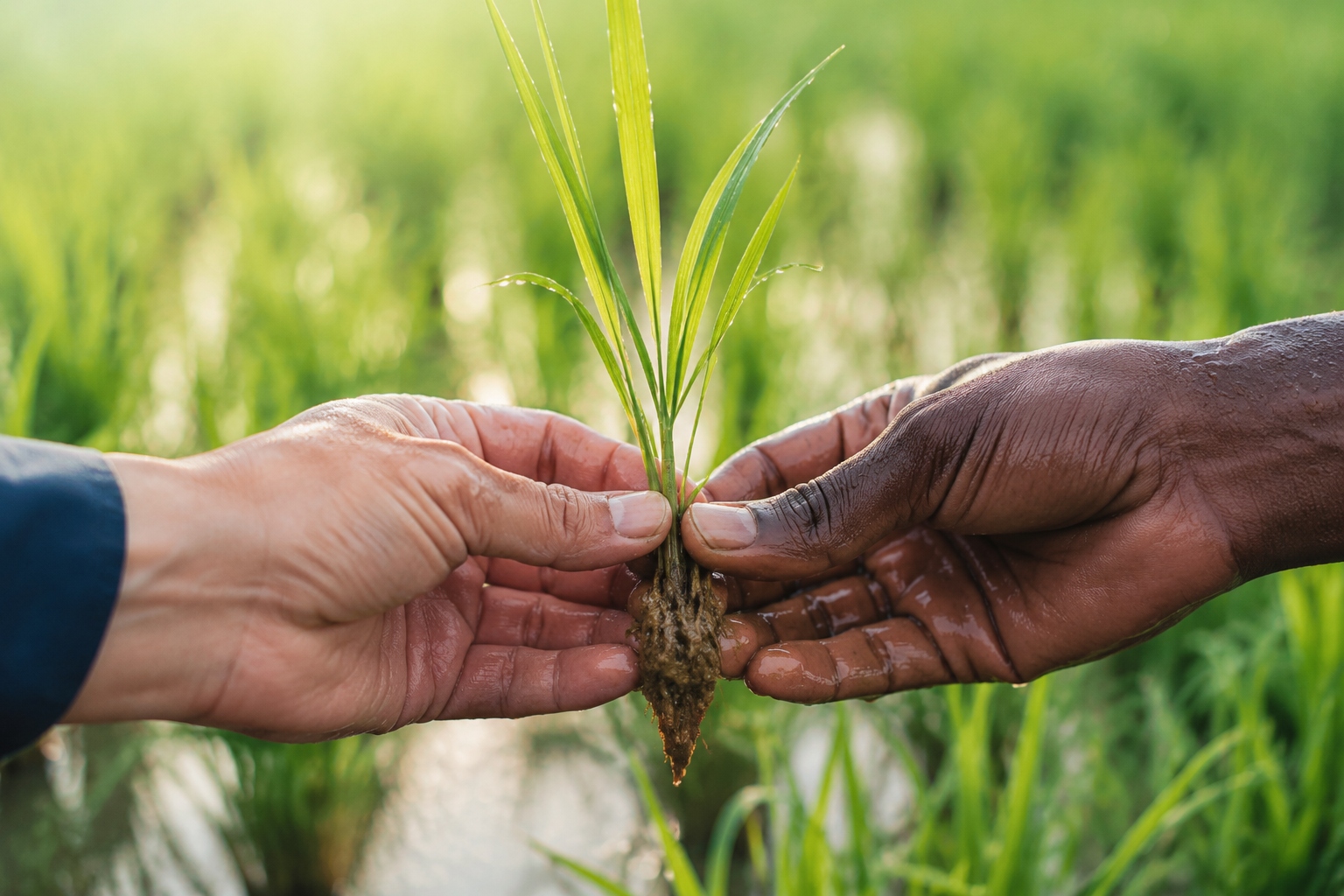
Liu Wei is one of a small army of Chinese technicians who work in African villages. He arrived in Madagascar in 2019, part of a two-year mission. His job is not to sit in an office or to fly in for inspections. It’s to live in a modest house near the project site, wake up at 5:30 in the morning, and walk to the field with the farmers. He speaks French with a heavy accent, but he’s learned enough Malagasy to say “good morning” and “this one is good.”
In the beginning, communication wasn’t easy. Jean Ralantoarison, 56, remembers the first time Liu came to his plot. “He kept touching the soil and pointing at the water,” Jean said. “We thought he was mad.” But over time, the two men developed a rhythm of hand gestures, broken French and shared knowledge.
“Local farmers know their land better than I ever will,” Liu says. “My job is to bring new seeds and new planting methods. But I’m not here to tell them everything. I’m here to work with them.”
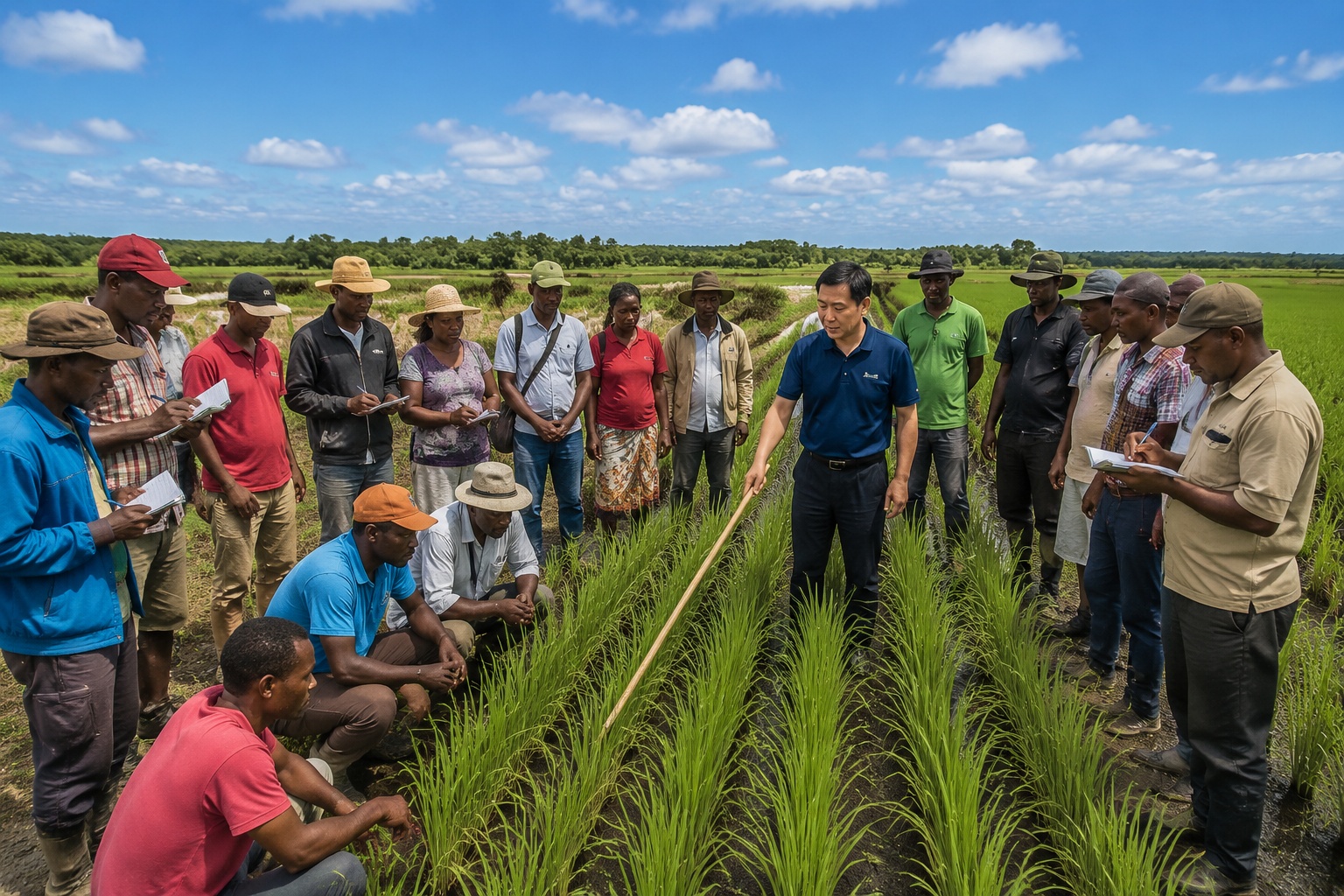
That working method is visible in the fields. Liu shows Jean how to set a proper water level, how to recognize the sign of nitrogen deficiency, and how to space the seedlings evenly. He also introduces a simple technique called “rice intensification”—planting just one seedling per hill, which allows more light and air, leading to stronger plants and bigger yields. It’s a method that Western researchers have also promoted, but in this case it’s delivered through a Chinese lens.
Sometimes the work is physically hard. The sun is brutal in the dry season, and the rain in the wet season floods the roads. Liu has had malaria twice. But he stays focused. “When I see farmers smile at harvest time, that’s enough,” he says.
What Hybrid Rice Changes for Farmers
For Jean Ralantoarison, the change was dramatic. In 2018, before joining the hybrid rice project, Jean harvested about 2.2 tons per hectare from his two-hectare farm. In 2020, with hybrid rice and the new techniques, he harvested 7.4 tons per hectare. “I couldn’t believe it,” he says. “The bag of grains was much heavier. My wife thought I was cheating.”
The extra yield means more than just food at home. Jean now sells a portion of his crop to the local market. He used to buy rice in the lean season, now he has his own surpluses. He’s used the extra income to buy a bicycle and to replace the thatched roof on his house with tin sheets.
But not everything is easy. Hybrid rice seeds are more expensive than traditional seeds. A farmer needs to buy new seeds each season because the hybrid offspring does not remain true to type—a fact that challenges traditional practices where farmers save seeds from their own harvest. To address this, the project subsidizes seeds in the first year, and the savings from higher yields usually cover the extra cost in subsequent years.
Another challenge is the management requirement. Hybrid rice responds well to good management, but it can be sensitive to drought or poor fertilization. It demands discipline. That’s why the role of technicians like Liu is crucial. They stay in the field, train farmers in a systematic way, and help them understand the logic behind each step.
In the village, opinions are divided. Some older farmers are cautious. They fear the new method might fail. But those who tried it have become ambassadors. One farmer, Soa Rabe, said, “Before, I used to tell everyone that only the ancestral way is safe. Now I tell them to look at my field. I have never had such a harvest.”
Beyond the Field: Food Security in Africa
The Madagascar project is just one piece of a much larger puzzle. Across Africa, many countries face a recurring food crisis. The continent is home to about 20% of the world’s arable land, but food insecurity remains widespread. In 2020, around 235 million people in Africa were undernourished. The reasons are complex—climate change, conflict, weak infrastructure, and outdated farming practices.
In this context, hybrid rice and better agricultural techniques are not a magic bullet, but they are a critical tool. Rice is the most rapidly growing food staple in Africa, especially in sub-Saharan Africa. Since 2008, rice imports to Africa have more than doubled, costing billions of dollars in foreign exchange. If Africa could increase its own rice yields, the continent would not only save money but also build resilience.
China has positioned itself as a partner in this area. Since the 1990s, China has set up more than 20 agricultural technology demonstration centers in Africa. In Madagascar, a team from China has helped local scientists breed a variety called “Magic Rice” that is adapted to the island’s climate. The hybrid rice varieties are also used in Nigeria, Burkina Faso, Egypt, and Tanzania, among others.
Yet the cooperation is not purely altruistic. It also opens markets for Chinese seed companies and strengthens China’s relationship with African governments. It’s a long-term geopolitical investment disguised as aid. Still, for the farmers who can double their yields, the benefits are real.
The Long Harvest
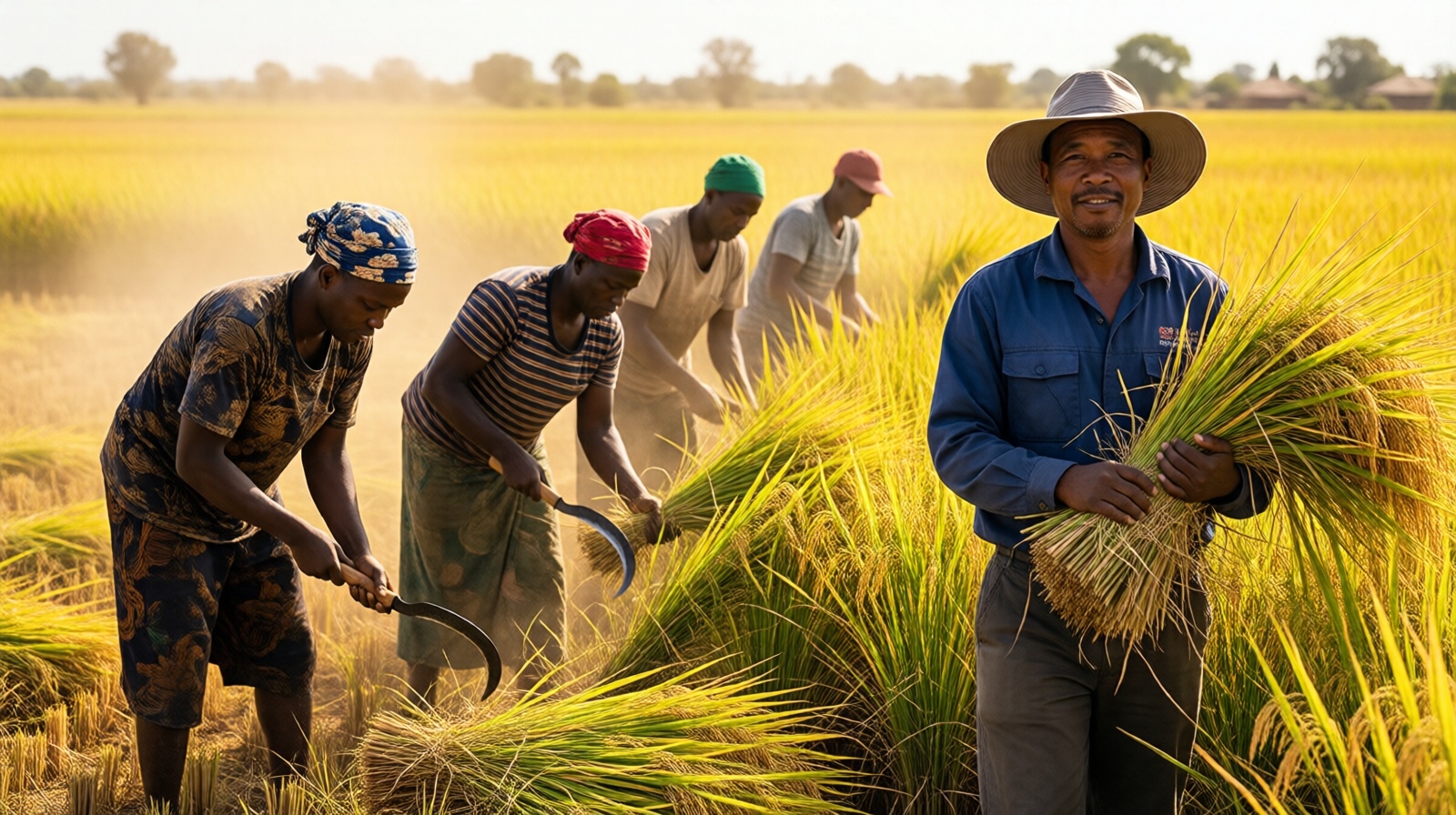
By the end of his two-year mission, Liu Wei has trained over 400 farmers in the Mahitsy region. He has helped set up demonstration plots that serve as visual evidence of what is possible. When he finally returns to China, he says he will carry with him memories of the smiling faces of farmers and the smell of fresh rice at harvest.
Jean Ralantoarison still works in his fields, but now he uses what he learned. He plans to expand his farm and hire a young couple to help him manage the growing business. He likes to tell his neighbors: “It’s not just the rice that’s hybrid. It’s the farmers who are becoming hybrid too—learning new things, mixing old and new.”
The sun reaches its midday peak, and Liu walks back to his house for a simple lunch. The field is quiet except for the sound of water trickling and the wind moving through the rice stalks. In a few months, there will be another harvest, and another moment of truth. This is not a fairy tale. It’s hard work, done together.
Start the discussion at forum.chinacomes.com