

A Morning Live Stream in an Ancient Town
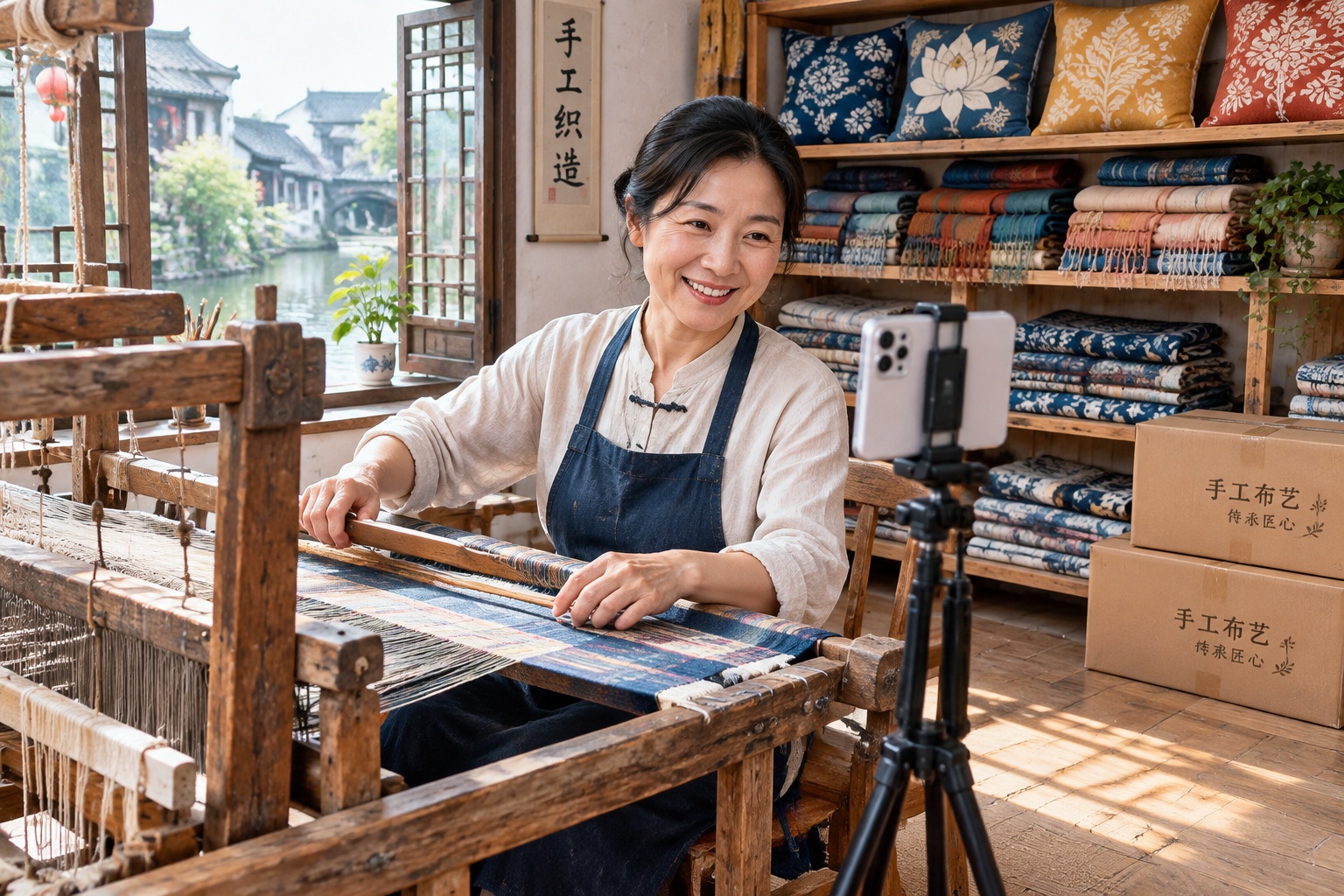
The alarm rings at 6:30 a.m., but Li Xiulan often wakes up before the sound. Today, she checks the weather—a sunny day in the canal town of Zhenze, in eastern China’s Jiangsu province. By 8 a.m., she is already in the room that serves as her studio and warehouse. It’s a century-old house with whitewashed walls and dark wooden beams, where she keeps the loom her grandmother left her.
Sitting down, she does a quick sweep of the floor and turns on a ring light. She grabs her smartphone and opens Douyin, the Chinese version of TikTok. She has scheduled a live-stream at 10 a.m., but she wants to rehearse what to say about the new batch of silk threads she has dyed with natural plant pigments.
“Good morning, friends! Welcome to my studio,” she says, smiling into the camera. On average, only a couple of hundred viewers join each session. But many of them are loyal customers who say they enjoy the slow, steady rhythm of the loom after a busy day. They ask questions about colors, sizes, and delivery. Li answers while her fingers keep working, displaying the same calm patience she learned over decades of weaving.
Behind her, on a wooden shelf, sit dozens of neatly folded throws and cushion covers, each one tagged with a price and a QR code. A few boxes are already wrapped with tape, waiting for a courier pickup. In a small town like Zhenze, the logistics network is surprisingly efficient: if an order is placed before 4 p.m., it usually reaches Shanghai or Hangzhou by the next day.
From Factory Floor to the Online Marketplace
Li’s hands are used to work. In the mid-1990s, she was an “iron rice bowl” worker at a state-owned textile factory in nearby Huzhou, where she operated heavy machines that produced synthetic fabrics. It was reliable employment, but the salary was never high. When the factory downsized in 2001, she lost her job.
Trying to reinvent herself, she sold breakfast rice rolls on the street and later ran a small grocery shop. Both failed. “I wasn’t bad at hard work, but I had no sense for business,” Li admits. “I was used to following orders, not making decisions.”
Eventually, she returned to her hometown and thought about what she could do that no machine could replace. Her grandmother, who had learned weaving from her own mother, had taught Li how to set up a loom, spin threads, and create intricate patterns. It was a skill that had brought in extra income for her family in the 1980s, when handmade textile products were sold at rural markets.
Li decided to try again. She set up the old loom under a tarpaulin near the town’s tourist area, where visitors sometimes watched her weave. A few bought small items, like coaster sets and table runners. But the income was inconsistent, and she felt trapped.
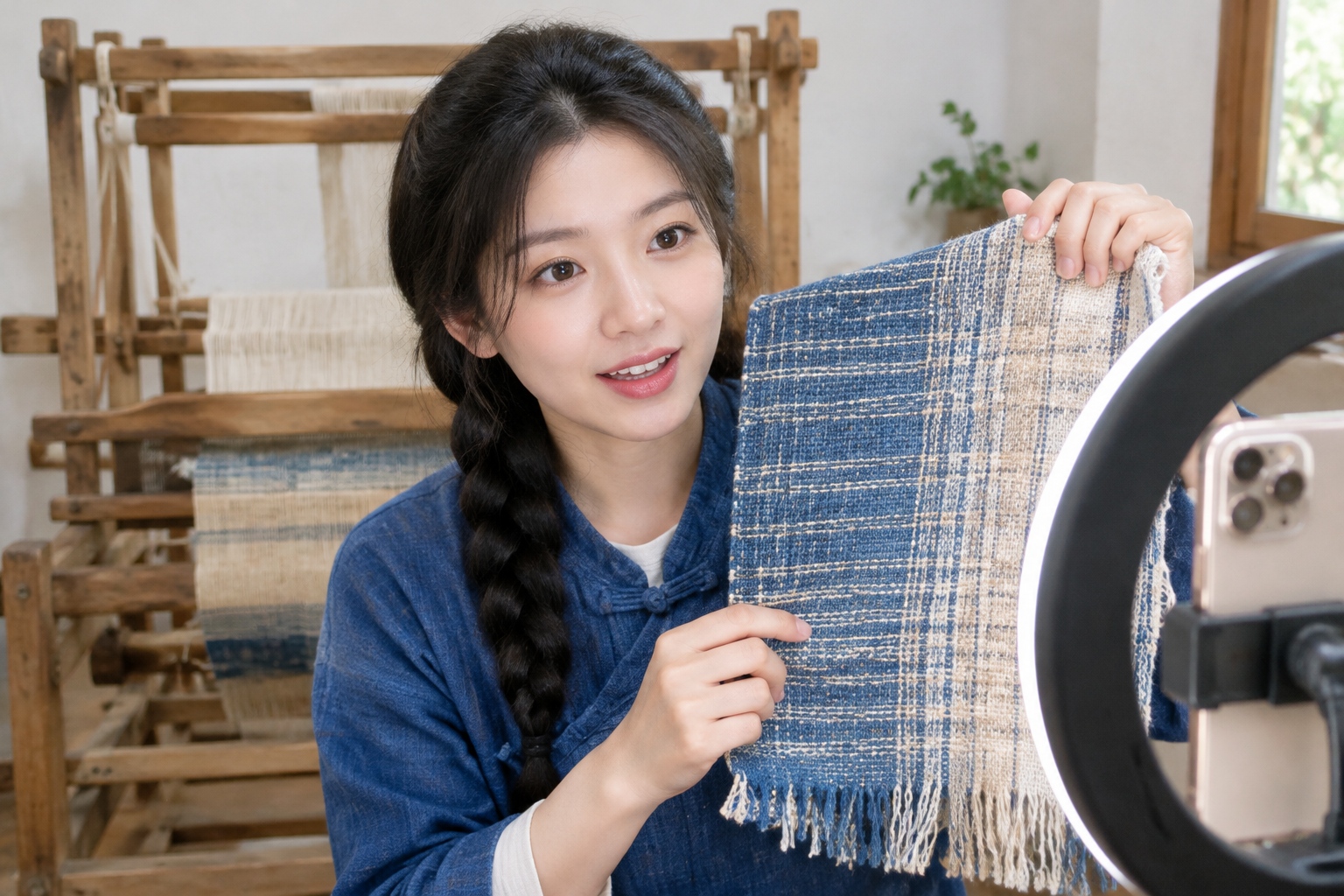
In 2015, her daughter, a university student in Suzhou, introduced her to e-commerce. Taobao, launched in 2003, had already turned millions of Chinese into online shoppers. Li was skeptical: “I said, ‘Who will buy handmade things on the internet? People can’t touch them.’” But her daughter insisted and set up a shop for her. The name was inspired by her grandmother’s nickname, “Grandma Yun.”
The early years were tough. Li had to learn how to take good pictures, describe her products, and manage orders. Her daughter walked her through the basics on video calls, but Li’s hands often trembled with nervousness when she typed on a smartphone. She made many mistakes: wrong shipping labels, missed chat messages, and one angry review about a late delivery.
But slowly, the shop began to attract attention. The reviews praised the quality and the story. Some customers asked about the patterns—swallows for spring, bamboo for resilience, and a lattice design called “corn pattern” that farmers believed brought a good harvest.
Learning to Sell a Story, Not Just a Product
By 2018, Li’s shop had passed 300 orders, but she knew she had a ceiling. Machine-made fabric from factories could always be cheaper. She needed a differentiator.
The answer came when her niece posted a short video of Li weaving on Douyin. It was a simple clip: the creaking loom, her hands moving, and the sound of the shuttle. To Li’s surprise, it got over 200,000 views. Comments from strangers expressed wonder: “I grew up seeing my grandma weave, but now I don’t know where to find such things.”
Li realized that people were not just buying a product—they were buying a connection to a disappearing world. She decided to become her own storyteller. She started a new project: posting “a minute in the workshop” clips every day. Each was short, under 60 seconds, showing a real moment: adjusting a thread, dipping silk into plant dye, or folding a finished piece. She did not use fancy editing or catchy music, because she wanted the experience to feel genuine.
As her followers grew, she started to see a pattern: urban customers were interested in the process, not just the outcome. A Hong Kong interior designer once bought ten cushion covers because she wanted to tell the story of custom-made textiles to her clients. A woman in Beijing ordered a scarf for her mother’s birthday, saying it reminded her of her grandmother’s room.
These stories were powerful. In 2020, when the COVID-19 pandemic forced many people to stay at home, live-stream shopping surged. Li, who had been hesitant about appearing on camera, decided to begin streaming. Her daughter helped set up the phone and lighting and taught her how to interact with viewers.
At first, she felt awkward. “I talked to the viewers as if they were in my living room,” she says. “I didn’t know how to promote myself.”
Live Streaming: The Old Craft Meets the New Attention Economy
Today, Li streams at least four or five times a week, usually in the afternoon or evening. She talks about the dyes, demonstrates how a pattern appears, and sometimes hums local folk songs that her grandmother used to sing. If a thread breaks, she shows it and fixes it. The unpolished, authentic feel has become her trademark.
Live-streaming e-commerce is now a massive industry in China. According to the state-run China Internet Network Information Center, as of December 2023, there were over 150 million people working in the digital economy, with livestream sales a major component. Platforms like Douyin and Taobao Live offer training to rural sellers from different backgrounds. Li herself is now a local trainer, teaching a small class of other village women who want to try their luck online.
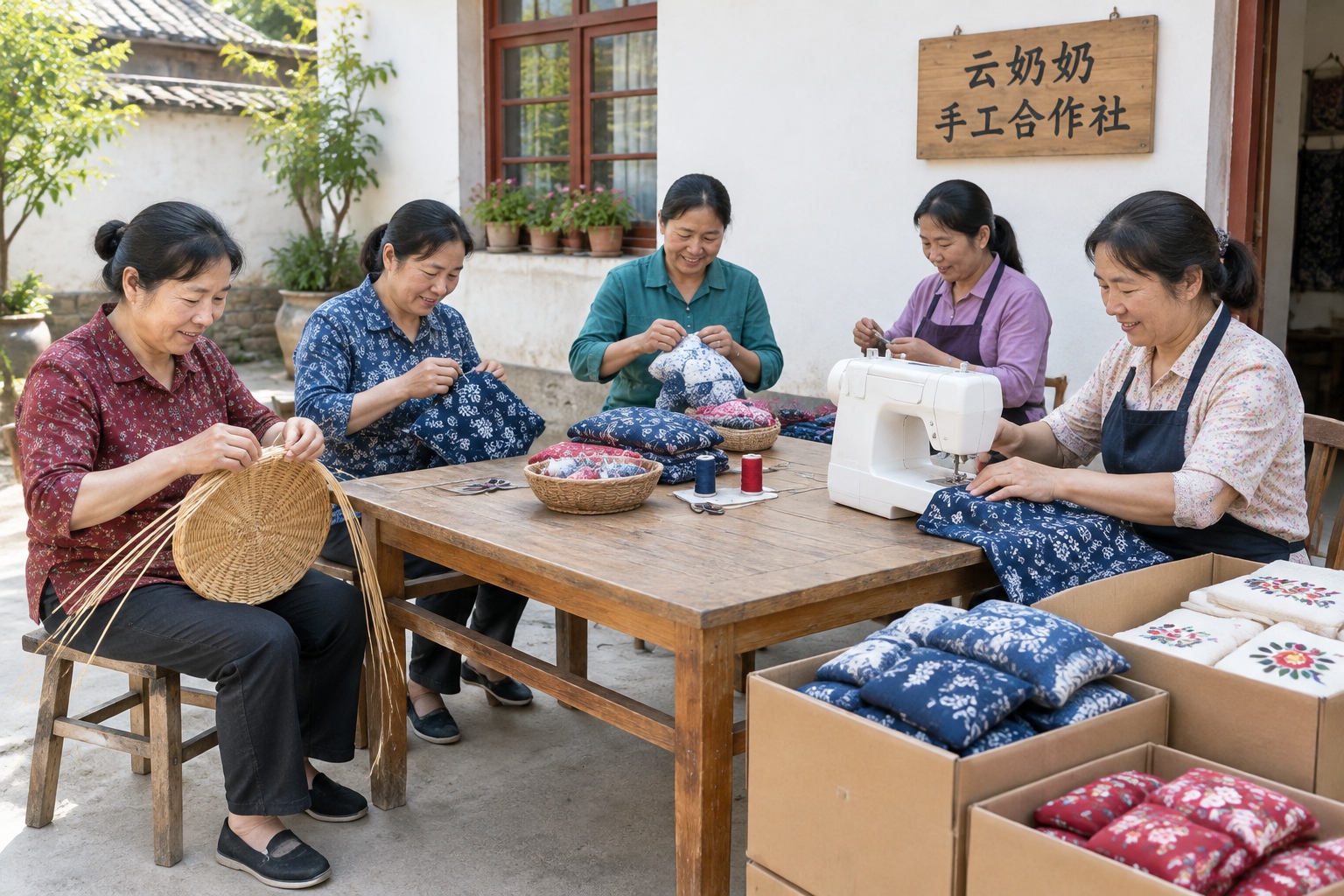
Her business has grown from a one-person operation to a micro-cooperative. She works with six other women in Zhenze, most of whom are also former factory workers. They produce fabric and finished goods, while Li handles the digital side: She edits videos, writes product descriptions, and even uses translation apps to communicate with international buyers.
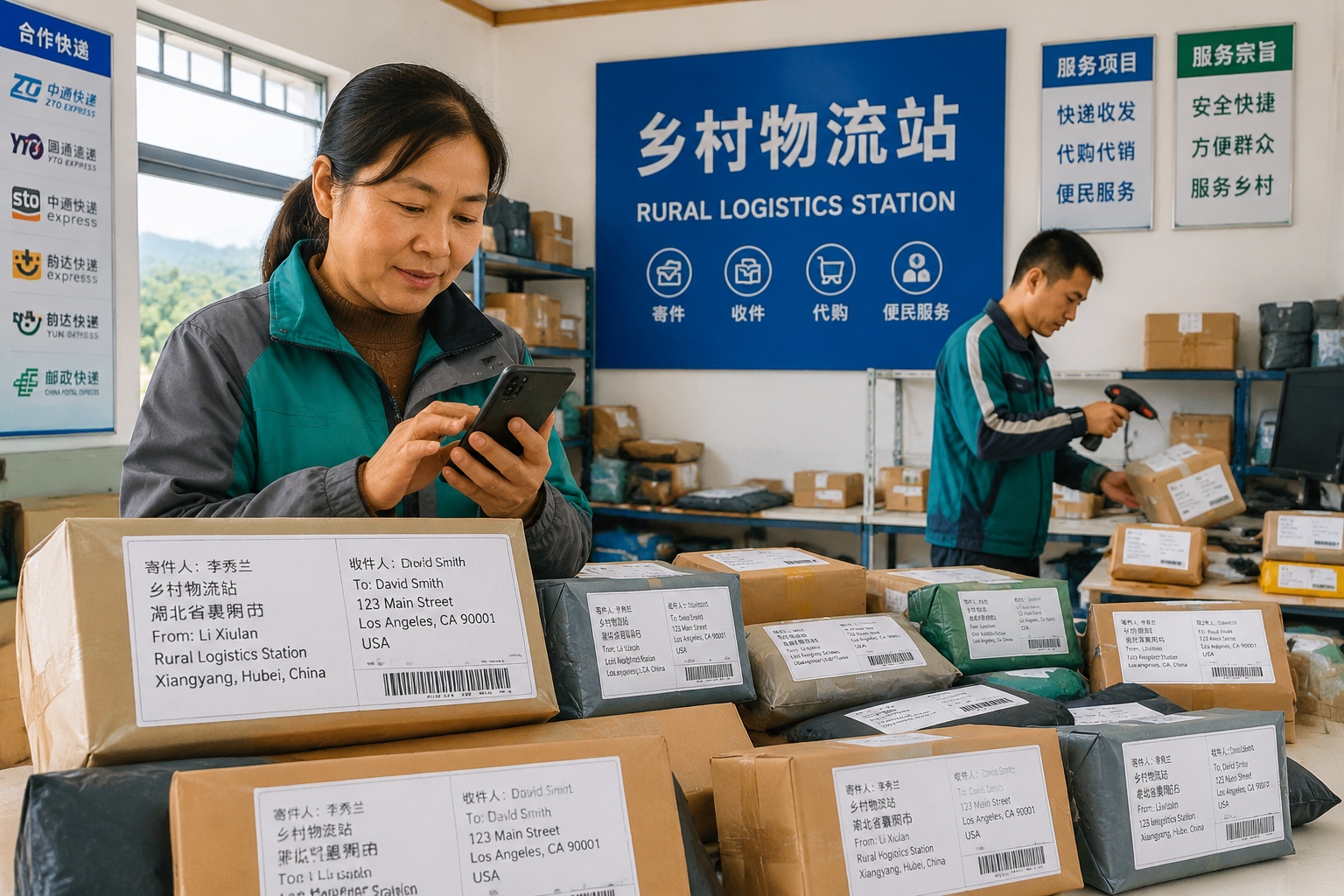
Earlier this year, she shipped a set of linen tea towels to a woman in the United States who had found her through a YouTube video (a friend posted an English-subtitled clip). The buyer later emailed to say that the towels were “a piece of heritage.” International orders now make up about 15 to 20 percent of her monthly revenue, sent through third-party shipping agents in Shanghai.
Challenges and Boundaries
This digital life is not a fairy tale. Li faces hard competition from larger companies that can replicate patterns at a fraction of the price. She updates her designs regularly, but there is no way to copyright a traditional weaving pattern. She has seen her own work photos appear on other sellers’ pages.
Platform costs have also risen. On some e-commerce marketplaces, she has to pay for ads to ensure her products appear in search results. In the past year, her ad spending has doubled. “I cannot stop paying, or I disappear,” she says.
The work is physically hard. Weaving for hours strains her back, and her knuckles are often sore from the rough threads. Some days, she feels the lure of easier money. But then she remembers what happened to a friend who closed her handicraft shop because of pressure. “I think, at least I have something that I enjoy making. It is my own thing.”
Another issue is talent. The young people in Zhenze prefer to work in cities, and no one wants to learn the painstaking old technique. Li’s own daughter, who now has a job in a tech company in Suzhou, does not plan to take over the business. Li accepts this with a sigh. “The internet gives me a way to keep going, but I don’t know how many years I will be able to keep weaving.”
Why This Matters for the Future
Li Xiulan’s path may be unique in its details, but it reflects a broader trend in China’s changing economy. Traditional handicrafts are being reborn as “cultural products” with emotional resonance. Digital tools—from e-commerce to short video and livestream—have made it possible for a middle-aged woman in a small town to reach urban consumers and even customers abroad.
For women in particular, the internet has opened a new door to entrepreneurship. They do not need a large startup fund or a physical office. A loom, a phone, and a story can be the starting point. According to a 2022 report by Alibaba, the number of female-owned stores on its platforms exceeded two million, and many of them were in rural areas.
It would be easy to romanticize this as a simple victory of technology over tradition. The reality is more nuanced. Li’s craft is still slow, paid work is still modest, and the competitive pressure is real. But there is a quiet optimism in her words: “My grandmother’s hands did this work to keep the family alive. We are still alive, and the craft is still breathing. That is enough for now.”
Start the discussion at forum.chinacomes.com