
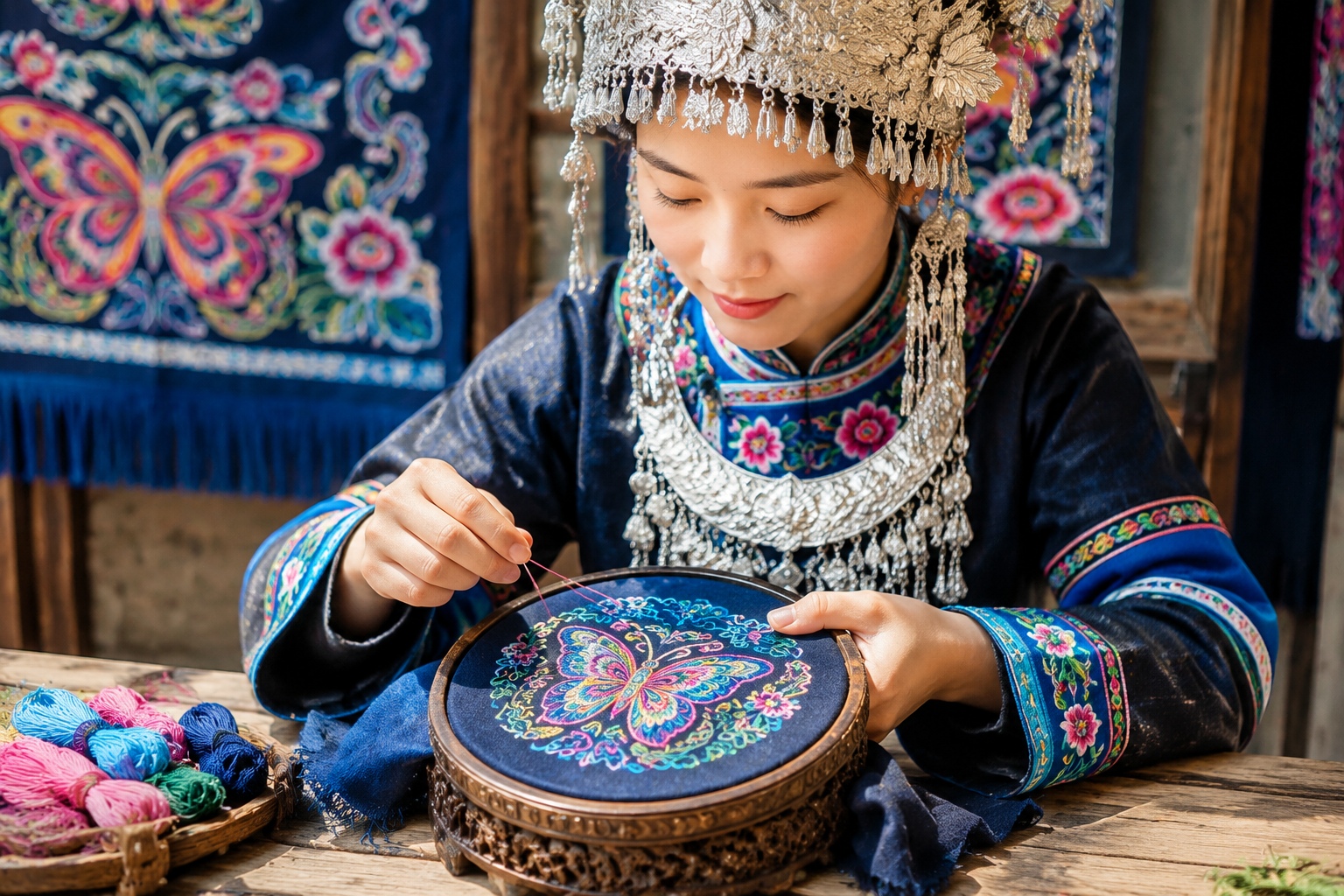

A Fabric That Tells a Story
In a wooden house in Leishan County, Guizhou Province, I sat across from an elderly Miao woman as she bent over a piece of indigo cloth. Needle in hand, she was stitching a small butterfly, its wings spreading over a red sun. Around us, bolts of embroidered fabric were stacked like manuscripts. “Every pattern has a reason,” she said, her needle pausing. She pointed to the butterfly: “This is our mother.” I had come to rural southwest China to understand how a people without a system of writing preserved their history. The answer, I soon learned, is not in books but in thread.
For the Miao ethnic group — China’s sixth-largest minority, with a population of about three million — embroidery is far more than decoration. It is a visual language, a chronicle of migration, and a map of the cosmos. When Han Chinese historians were writing chronicles, Miao women were encoding their worldviews on fabric, sometimes with as many as a dozen stitches in a single square inch.
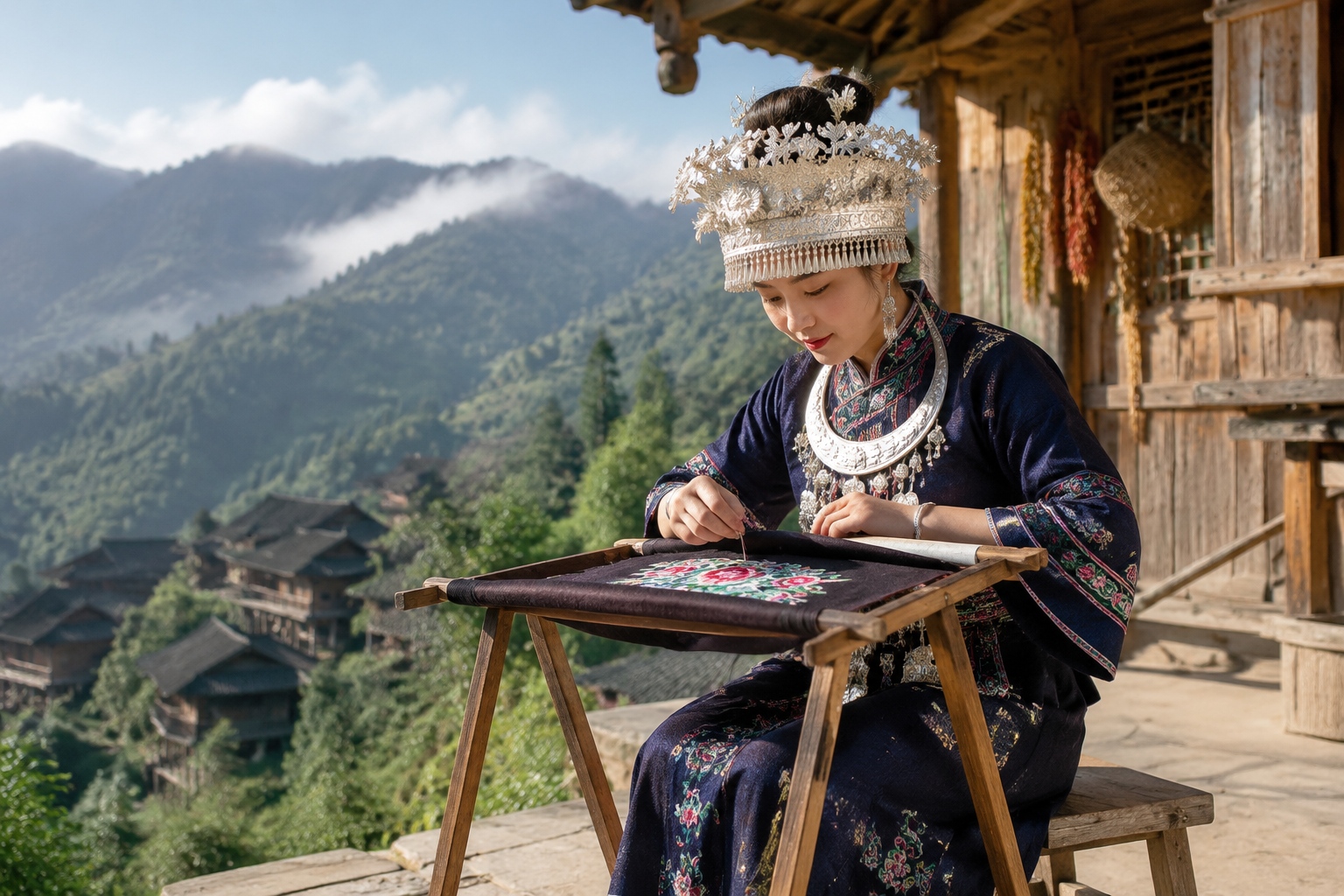
The Butterfly Mother and the Cosmic Tree
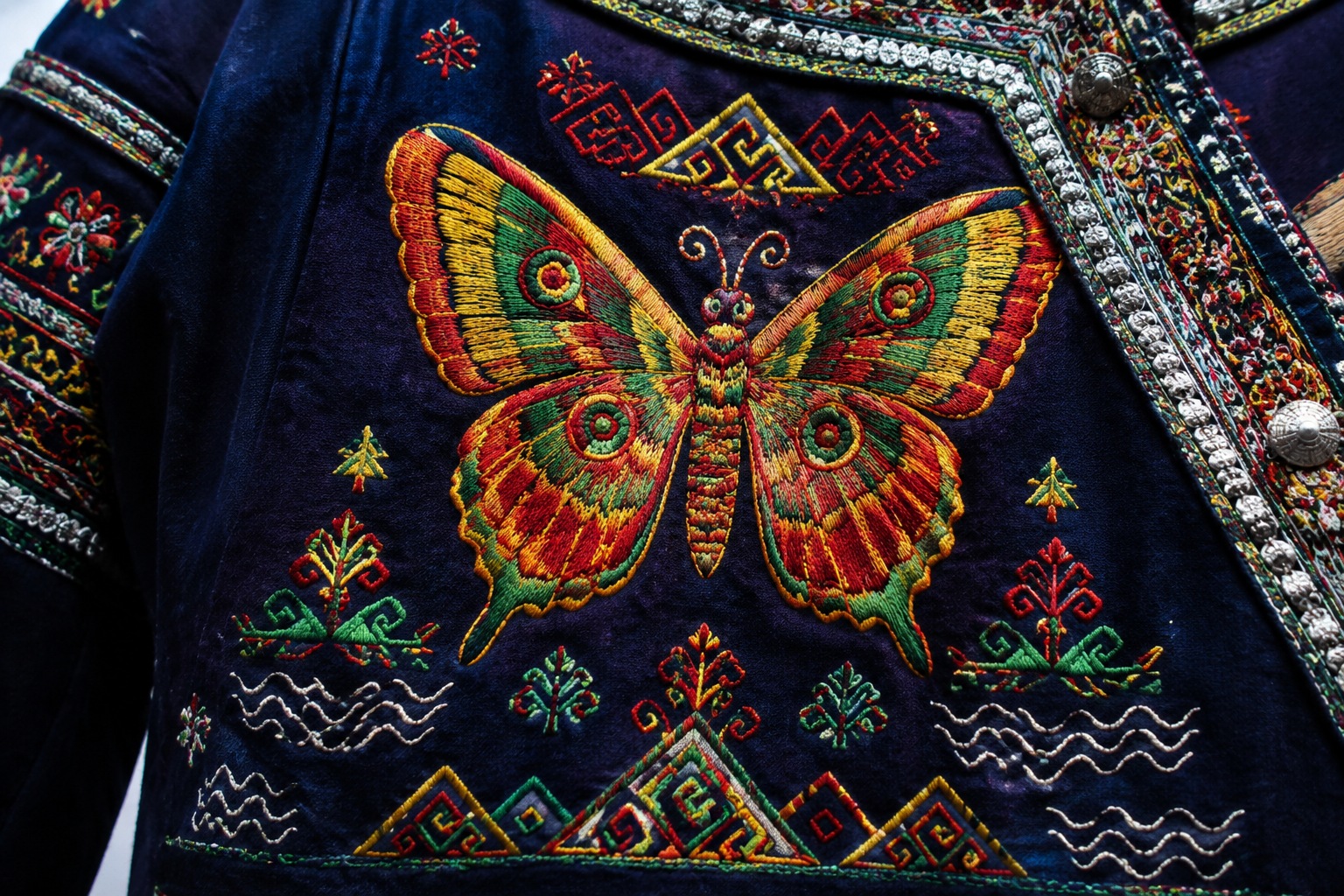
To untangle the cosmology hidden in Miao embroidery, you have to start with the most recurring motif: the butterfly. In Miao mythology, the universe began with a maple tree. From its trunk grew a caterpillar, which transformed into a majestic butterfly, known as “Mother Butterfly” (Mux). The butterfly then laid eggs that hatched into the first human, the Miao people, and a host of animals. This creation story — similar to the Norse myth of the world tree Yggdrasil, which connects the nine worlds — sees nature not as a collection of separate species but as one interwoven family. The butterfly is not just an insect; it is an ancestor, a guardian of life, and a symbol of renewal.
Look closely at an old Miao festival jacket. You will often find the butterfly paired with flowers, fish, or birds. These aren’t random choices. Fish represent abundance and fertility, partly because they lay eggs by the thousands and partly because they thrive in the rice paddies that sustain Miao villages. Birds, especially paddy birds, carry prayers between earth and sky. Even the maple tree itself appears, often abstracted into a spiral or a leaf shape, signifying the root of all life.
Dragons, Snakes, and the Power of Nature
Dragons appear often in Miao embroidery, but they are not the celestial authorities of Chinese court art. Miao dragons have no whiskers, no fiery pearls, and no hierarchy. Some are made of fish scales, others of silkworms’ bodies; some swim like snakes, others crawl like frogs. In one pattern, a dragon carries a child on its back; in another, a dragon wraps around a rice stalk. This isn’t mythology frozen in time. It reflects an egalitarian, ecological worldview. In the Miao cosmos, the dragon represents the raw energy of rivers, rain, and mountains. It is a helper, not a ruler. The same goes for the phoenix, which appears not as an empress but as a companion of the butterfly, voicing lament for lost homelands and dreams of reunion.
Reading Geometry: Mountains, Rivers, and the Shape of Home
Westerners often interpret abstract patterns through Greek geometry — zigzags become lightning, circles become energy. Miao geometrical motifs are more rooted in their terrain. A diamond with concentric inner diamonds is a mountain seen from above. A broken zigzag is the terraced fields after rain. A series of overlapping triangles is the roof ridges of a Miao village. An X in a square, known as the “spider pattern,” is both a marker of land ownership and a reminder of the spider that once hid a Miao ancestor from a pursuing enemy.
The famous “Miao star” — a twelve-pointed star formed by angles and fine hatchwork — repeats across skirts and cuffs. It represents the sun, which Miao people worship not as a god but as an equal partner in the agricultural cycle. The sun is described in folk songs as “the lamp of the rice,” a practical necessity rather than a distant deity. Unlike European astrology, which assigns cosmic power to celestial bodies, Miao embroidery uses celestial images to mark time for planting and harvesting.
A Living Text, Not a Dead Art
Many Western museums display Miao embroidery as “folk art” or “ethnographic artifact,” but in China today, this ancient craft is making a surprising leap into modern life. In cities like Guiyang and Shanghai, designers are collaborating with Miao embroidery cooperatives to create jackets, handbags, and even sneakers with traditional motifs. Some high-end brands have used Miao-inspired patterns in their luxury collections. The Chinese government has also recognized the art as part of the national intangible cultural heritage, establishing training centers in Guizhou where elderly artisans pass down their knowledge to younger women and men.
But the transformation is not purely commercial. On TikTok and Xiaohongshu (China’s Instagram), young Miao users upload videos of their grandmothers embroidering, explaining the meaning behind each stitch. One 22-year-old Miao fashion student I spoke with in Kunming told me she learned to embroider from a video posted by her aunt. “I used to think it was old-fashioned,” she said. “Now I see it like a map of my identity.” Her graduation collection used the butterfly mother as a central motif, but stitched onto sheer, translucent organza — an old symbol in a new register.
Why This Matters Beyond China
What can a butterfly on a sleeve teach a Western reader? It challenges the assumption that human cultures progress along a single linear path. The Miao worldview, embedded in embroidery, suggests a different way of relating to nature—not as a resource to be mastered but as a family to which we already belong. This is not a romanticized cliché. In an era of climate change and ecological anxiety, the notion that a tiny insect could be an ancestor carries a radical ethical weight. It de-centers humanity and places us in a web of mutual responsibility.
At the same time, the story of Miao embroidery is a reminder of the diversity inside China. The country is often represented by the Great Wall, the Forbidden City, and modern skylines, but it is also a collection of 56 ethnic groups, each with a distinct vision of the universe. When you look at Miao embroidery, you are looking at one of those visions, preserved not in marble but in thread.
As I left the mountain village, the old embroiderer folded her work carefully. “People ask me why I stitch so slowly,” she said. “But the butterfly also took a long time to be born.” The patterns she makes will outlast her, carrying the sky of her ancestors into a future that none of us can predict. Maybe that is exactly what a cosmology is—a system of meaning that turns the unknowable into something you can carry on your back, or wear around your shoulders, so you never walk alone.
Start the discussion at forum.chinacomes.com