
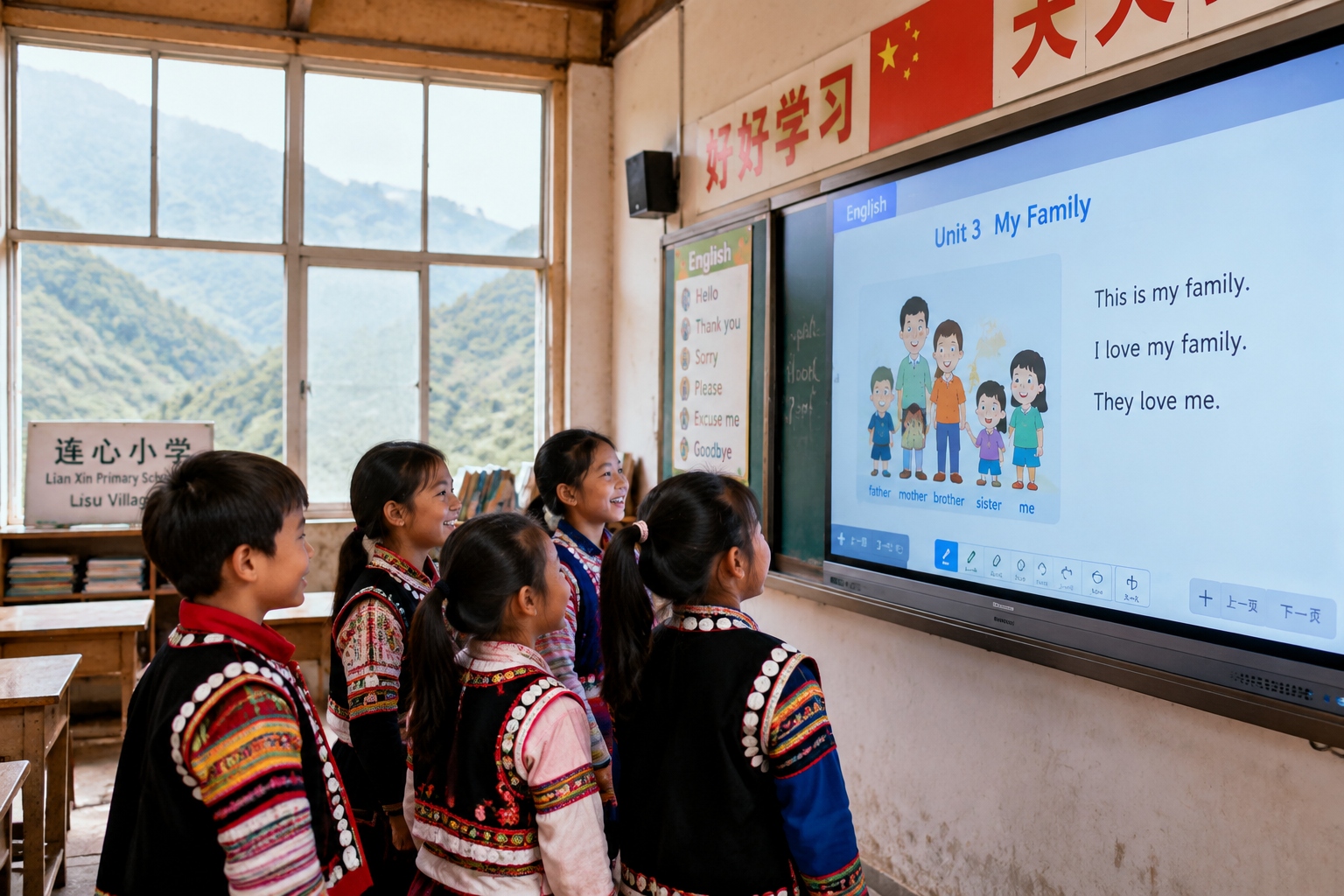

A Morning Lesson in the Mountains
In a small primary school in Nujiang Lisu Autonomous Prefecture, Yunnan Province, the morning sun throws long shadows over the playground. Inside a classroom, 10-year-old A Pu stands in front of a large interactive screen. She wears a traditional Lisu vest, but her eyes are fixed on a digital character that says, in clear American English: “What’s your name?”
A Pu repeats the phrase. The screen shows a waveform and a star rating. Three stars. She grins. Her classmates clap.
This is not a scene from a futuristic city school. It is happening in one of China’s most remote mountain areas, where Lisu children used to learn English, if at all, from a teacher whose own pronunciation was uncertain. Today, “smart classrooms” are rewriting that story.
Who Are the Lisu?
The Lisu are one of China’s 56 ethnic groups, with their own language and culture. Many live in the steep valleys of the Hengduan Mountains, in villages that are still hard to reach. For decades, children here grew up speaking Lisu at home, learned Mandarin at school, and rarely encountered English. For them, a foreign language felt as distant as the nearest city.
What Is a Smart Classroom?
A smart classroom is not a school building that looks like a spaceship. It is a practical upgrade: a large touchscreen, a teacher’s tablet, student response devices, and an AI-powered pronunciation evaluation system. Connected by the internet, these tools bring high-quality teaching materials into classrooms that once had only a chalkboard and a few worn textbooks.
The setup varies, but the core idea is simple: technology bridges distance. In a smart classroom, a child in a mountain village can hear perfect pronunciation, practice speaking, and get instant feedback.
English Class, Reimagined
Sitting in on an English lesson here feels different from a traditional class. The teacher starts with a cartoon about a birthday party. Words and sentences pop up on the screen. Students press buttons on their response clickers. The system instantly shows who answered correctly and who is confused.
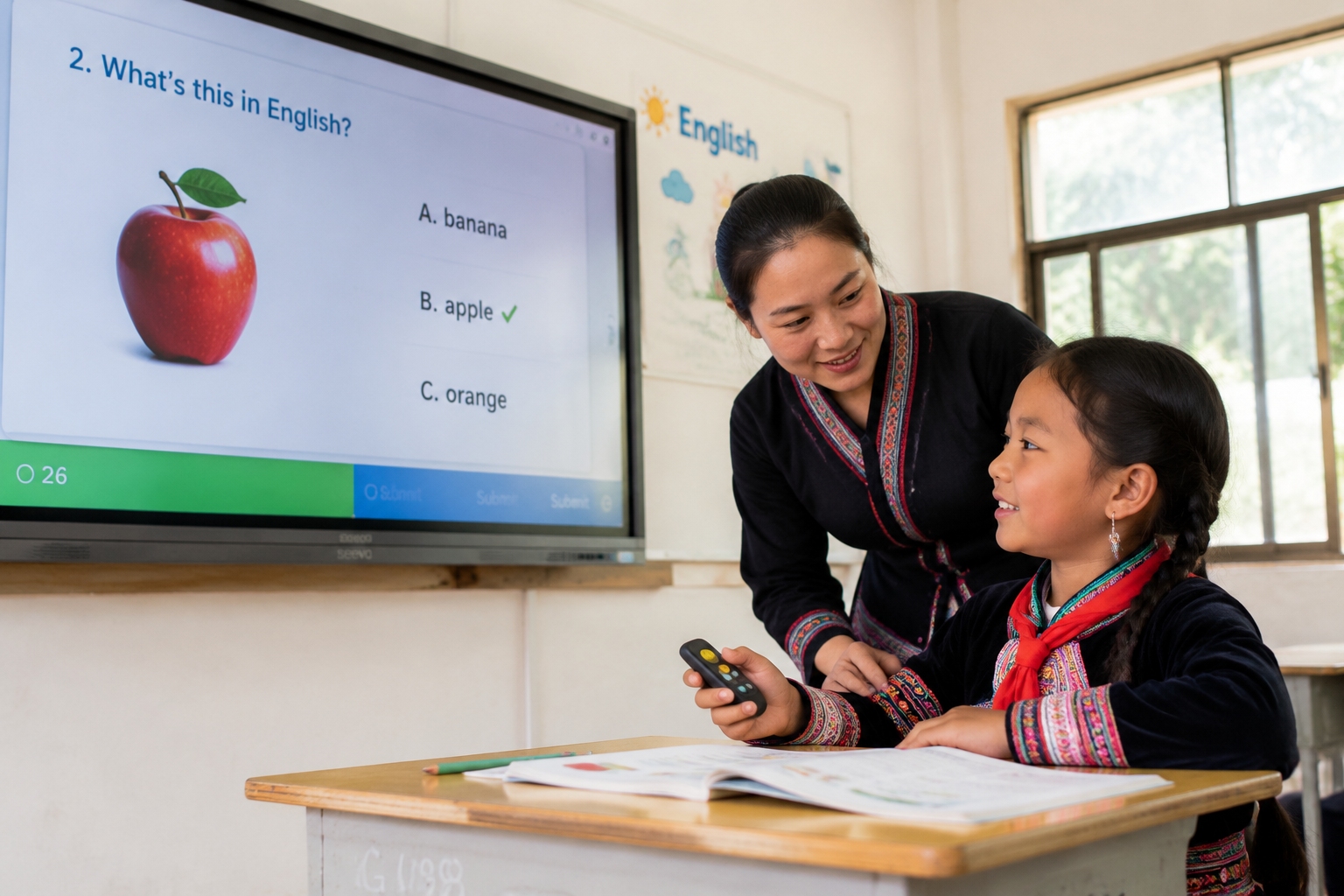
Then comes the most exciting part for the kids: speaking practice. Each student takes a turn speaking into a microphone. The AI listens, scores their pronunciation, and displays a simple visual. If they hit the right sound, the screen shows a happy face. If not, it shows a gentle reminder.
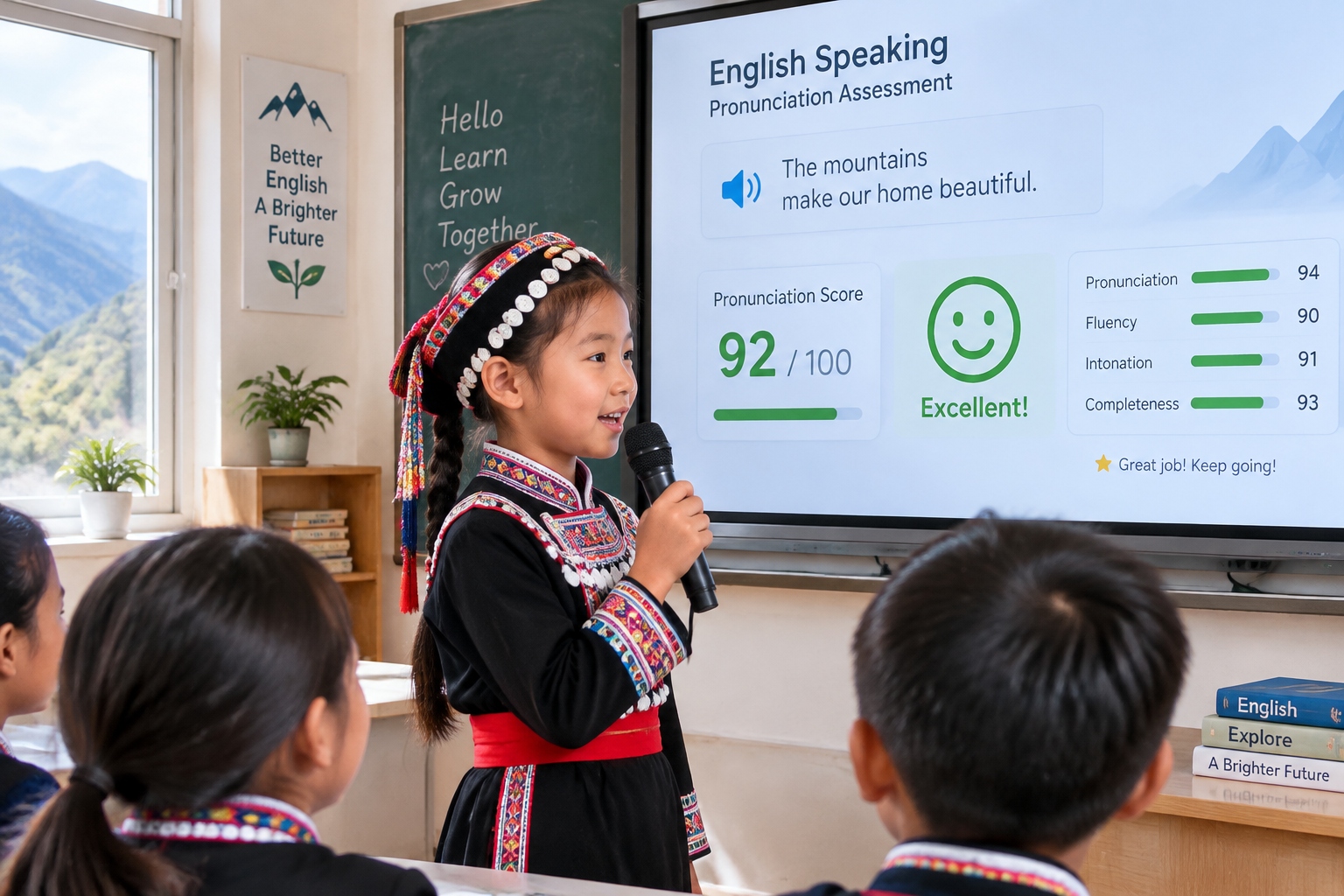
“Before, when I asked them to say ‘Good morning,’ they would mumble,” says Li Min, a teacher at the school. “Now they actually want to be the first to speak. They see the score and they want a better one.”
Why Is This a Big Change?
Ten years ago, teaching English here was a struggle. Many schools had no dedicated English teacher. A math teacher might play an audio tape. Students repeated words they didn’t fully understand. “We were just repeating whatever the teacher said, and the teacher’s pronunciation was not standard,” a local teacher recalls.
Smart classrooms change the equation. The technology doesn’t replace the teacher, but it gives the teacher better tools. It also gives students something they never had: a model of standard pronunciation that never gets tired.
Visible Progress, New Confidence
The change is not just about equipment. It is visible in the children’s faces. A Pu, who was too shy to speak in front of strangers, now confidently introduces herself in English. Her favorite phrase is “My hometown is beautiful.” She hopes to one day travel and explain to the world where she comes from.
According to local education officials, more than 200 primary and secondary schools in Nujiang Prefecture have installed smart classroom systems. Over 30,000 students benefit from the program. The technology is part of a broader push to bring quality education to every corner of China.
Challenges Remain
Life here is not a smooth app demo. The mountains are hard on any device. Internet connections can be slow, especially in rainy season. Power outages happen. Equipment breaks. But local technicians have been trained to maintain the systems, and the project is designed to be sustainable.
Some children had never touched a computer before. For them, even moving a mouse was new. Teachers say the first few weeks are always a mix of confusion and excitement. But children learn fast. The screen doesn’t judge them for making mistakes. It waits.
More Than English
The smart classroom is not just about learning a language. It is about showing children that the world is larger than the valley they live in. Lessons include science experiments, geography videos, and stories from other countries. A Pu’s class once watched a live feed of a coral reef expedition. The children were silent for minutes, absorbed.
This is also part of China’s larger story. In recent years, the government has invested heavily in rural education. Smart classrooms are one piece of that investment. Better internet connections, new schools, and generous subsidies for students have all followed.
What the Future Looks Like
The future for Lisu children is brighter than it was. Some will go to high school in the county town. A few may make it to university in Kunming or even Beijing. For the first time, English is not an impossible mystery. It is a skill they can practice with an AI assistant, like a friend who lives inside the screen.
As the sun sets over the mountains, A Pu is still practicing sentences. She wants to say more than just “My hometown is beautiful.” She wants to describe the green terraces, the sound of the river, and the way the mist moves in the morning. And she will have the words to do it.
Start the discussion at forum.chinacomes.com