

Breakfast on Moji Street
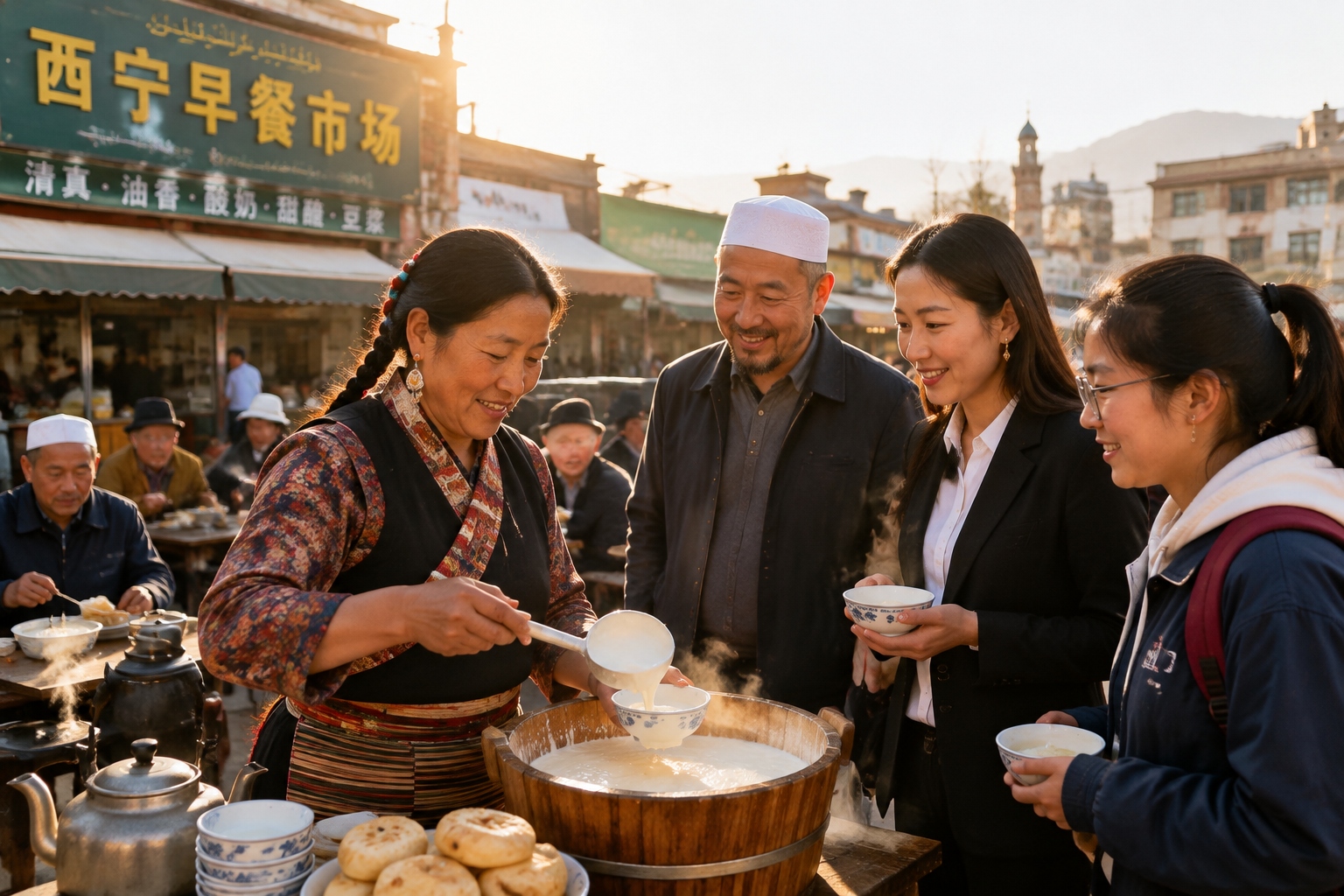
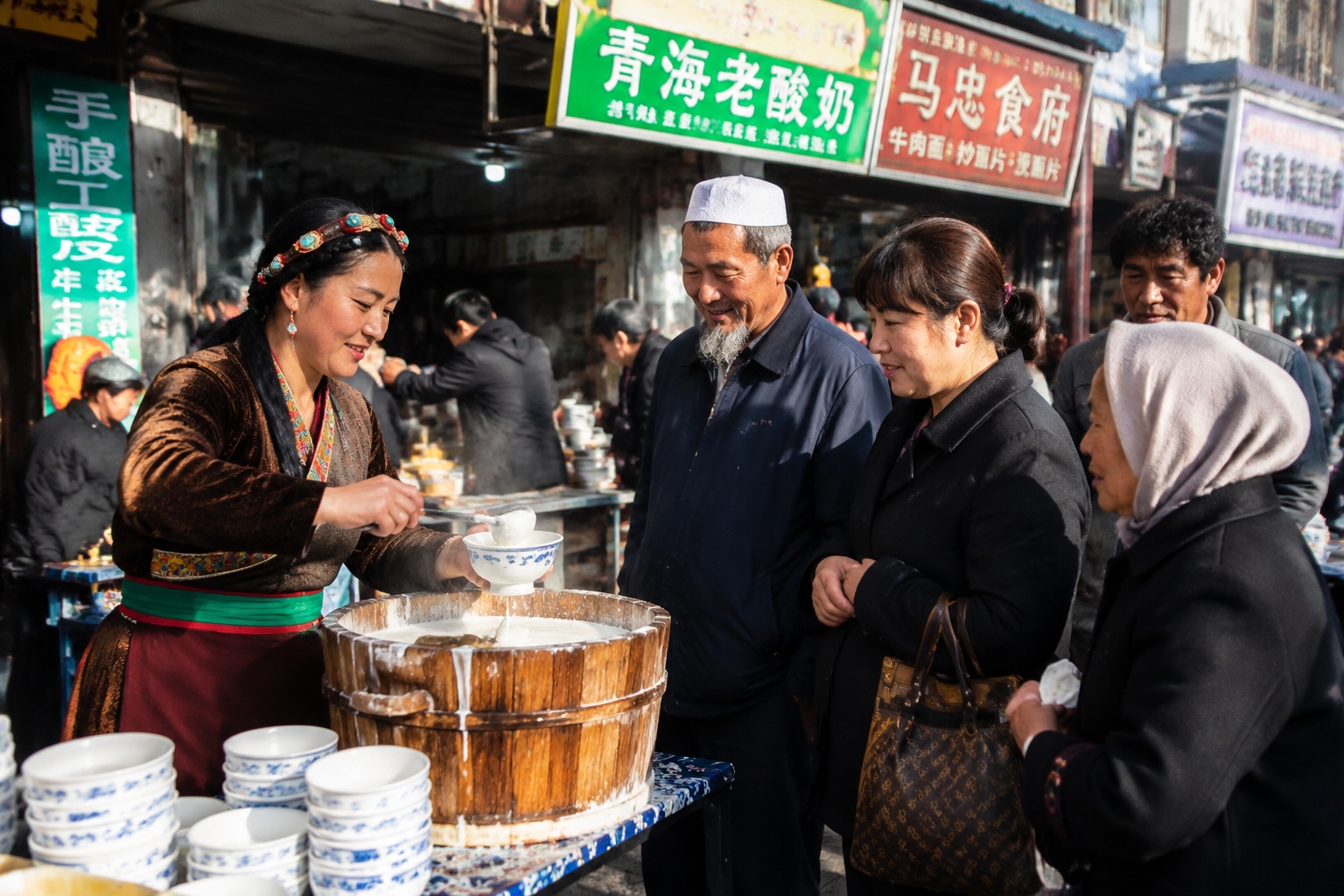
At 6:30 a.m., the first light touches the stalls along Moji Street in Xining, the capital of Qinghai Province in western China. Tenzin, a Tibetan woman in her late forties, lifts the lid off a large wooden bucket. Inside, thick yogurt sits under a golden layer of cream. She scoops it into bowls with a wooden ladle, working quickly as a small queue forms.
A Hui man in a white skullcap buys two bowls, one for himself and one for his wife. A Han office worker in a pencil skirt sits on a low stool and sprinkles white sugar over hers. A Tibetan college student orders his yogurt with a handful of roasted barley flour, called tsampa, and stirs it into a thick paste.
For an outsider, this might look like a carefully arranged stage scene of ethnic diversity. But for locals, this is simply what a normal morning looks like. Yogurt is almost everywhere on breakfast tables in this high-altitude part of China – and the version here is made from yak milk. It doesn’t matter whether you’re Tibetan, Hui, Han, or Mongolian. The bowl in front of you is the same, except for what you choose to mix into it.
Why Qinghai Starts the Day with Yogurt
Qinghai is a vast province bordering Tibet. Much of it sits above 3,000 meters, with cold winters and short summers. For centuries, herders have moved yaks and sheep across the grasslands, and milk has always been a core part of the diet. But fresh milk spoils quickly. Yogurt solved that problem: letting milk ferment at warm room temperature keeps it edible for days, while adding a pleasant sourness that cuts through rich, greasy breakfast foods.
In the capital Xining, the morning streets are lined with stalls selling noodle soup, deep-fried dough sticks, flatbreads, butter tea, and, of course, yogurt. You won’t find the sweet, runny yogurt from a Western fridge. This is thick, sour, and rich – more like a custard than a drink. A layer of yellow butterfat often settles on top, evidence that it was made with full-fat yak milk. The taste is bracing: it hits your tongue with a sharp tang, followed by a creamy, milky finish. That sourness is why it goes so well with breads and fried foods.
Most vendors still follow the traditional method. The day’s milk is warmed to body temperature, a spoonful of the previous batch is stirred in as a starter, and the mixture is left to ferment overnight in a wooden barrel or clay jar. There’s no fridge involved, no stabilizers. By dawn, the yogurt is ready — silky, dense, and slightly effervescent. Some spoon it into bowls; others pour it into small clay jars.
What Makes Tibetan Yogurt Different
Tibetan yogurt, known as “sho” in Tibetan, is a direct product of the yak herding life. Yak milk contains almost twice as much fat as ordinary cow milk, giving the yogurt an extra-thick texture and a distinctive, rich flavor. It’s also more acidic than most commercial yogurts. Locals often call it “suannai” in Chinese, literally “sour milk.”
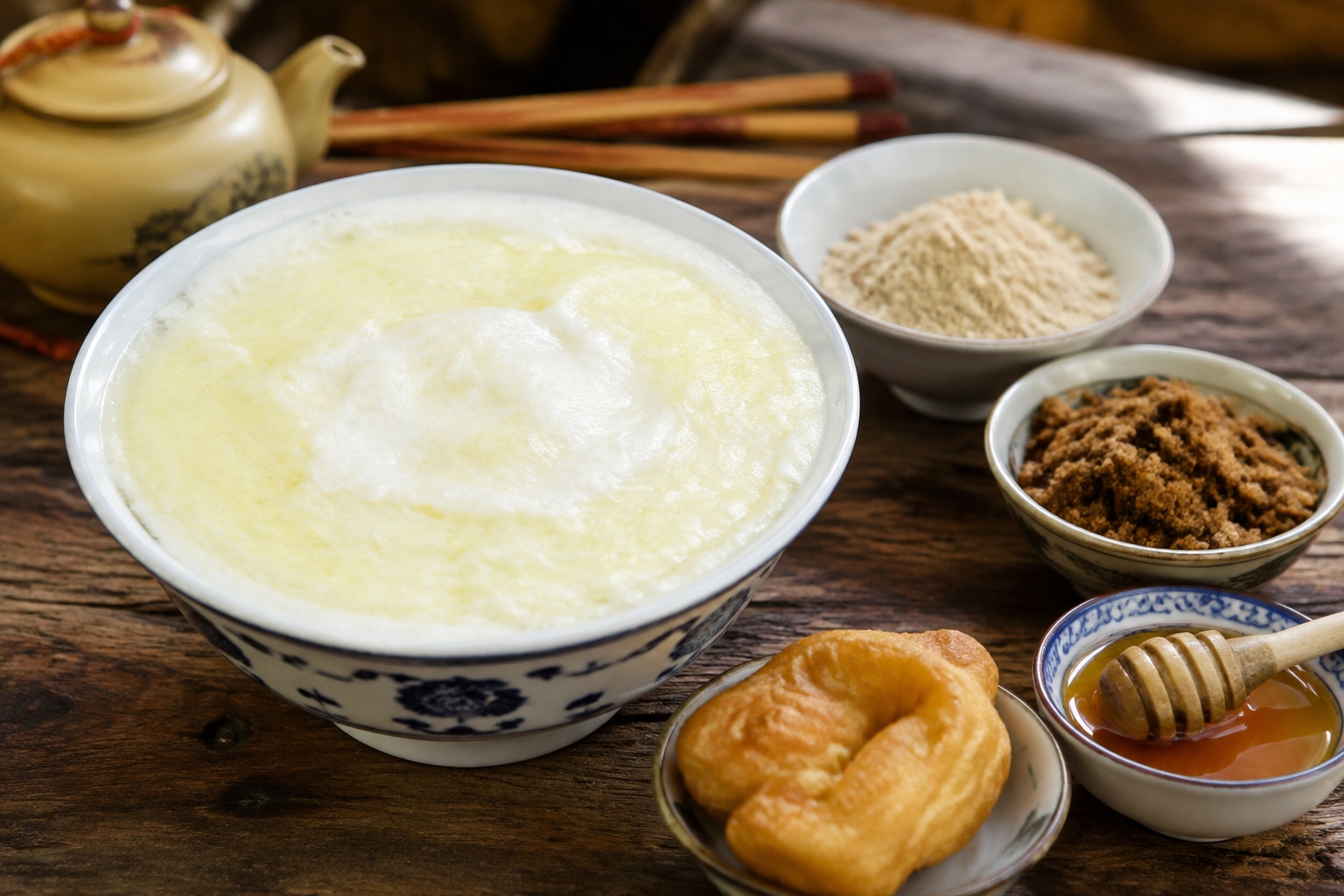
In herding regions, yogurt is not just a snack. It’s a way to store surplus milk and a source of probiotic bacteria that help people digest heavy butter and meat. Traditionally, it’s eaten with tsampa (roasted barley flour) and a cup of Tibetan butter tea. In cities, the presentation changes: sugar, honey, sweet fermented rice, even crushed biscuits are added. But the base remains the same.
Travelers driving around Qinghai Lake often see stalls selling yogurt in small clay bowls with a cardboard lid. It’s a favorite roadside break, both for the taste and for the chance to rest in the shade. Many families buy several jars to take home.
A Shared Taste Across Ethnic Lines
Here’s the key reason yogurt works as a common food: it fits everyone’s food rules. Hui Muslims follow halal dietary practices, meaning they avoid pork and alcohol, but dairy is entirely allowed. For Han Chinese, there are no such restrictions. For Tibetan Buddhists, dairy is a traditional staple. So a simple bowl of yogurt crosses culinary and religious boundaries without any friction.
At Tenzin’s stall, toppings are a small window into culture. Tibetan customers usually ask for tsampa mixed in, sometimes with a little sugar. Hui customers often order a piece of youxiang (fried dough with a soft inside) or a savory pancake to dip into the yogurt. Han customers, especially younger workers, might ask for honey or fresh fruit to balance the tartness. Tenzin knows every regular’s preference. “I don’t need them to tell me,” she laughs. “I see them coming, and I get their bowl ready.”
This blending isn’t staged. In Qinghai’s market towns, you’ll find Tibetan-owned yogurt stands operating next to Hui noodle shops, and during morning breaks, construction workers of all backgrounds sit together around low tables, a bowl of yogurt in one hand and a piece of bread in the other. During our conversation, a Han woman at a nearby table says, “My grandmother made yogurt too. When I moved here, I was happy to find the same taste.”
Food historians would say this is a classic pattern on the ancient trade routes. Qinghai sat at the crossroads of the Silk Road and the Tang-Tibet road, where tea, horses, sheepskin, and grain moved between civilizations. Trade meant that ingredients and cooking styles traveled too. Yogurt itself probably came to the Tibetan Plateau from Central Asian nomads. It has been shared for so long that no single group can claim it as exclusively theirs.
A Quiet Symbol of Coexistence
A bowl of yogurt isn’t going to solve deep-rooted social issues. But it’s a useful reminder that difference doesn’t automatically mean separation. When you share a market, a bus stop, and a morning schedule, you find small ways to get along. Food is the easiest one.
Locals don’t romanticize it. A Han bus driver named Mr. Wang put it simply: “We grew up eating this. I don’t think we even call it ‘Tibetan yogurt.’ It’s just yogurt. We all know how good it is.” A young Tibetan woman who works in a bank adds, “Some people call it ‘minority food,’ but to us it’s regular breakfast. It’s like asking whether rice is a Han food or a Chinese food – it’s both.”
That viewpoint may sound simple, but it’s the kind of simplicity that comes from daily contact, not from official slogans. In a place where outsiders often expect tension, the shared breakfast table offers a different story: one of quiet, unforced cooperation.
Yogurt Beyond the Border
In recent years, Tibetan yogurt has found its way into trendy cafes in Chengdu, Xi’an, and even Beijing. Investors call it “plateau superfood,” and some brands sell it as a luxury product. Tourists from overseas often post photos of yogurt bowls with colorful fruit toppings, comparing them to the thick, sour yogurt of Central Asia or Greece.
But locals will tell you the real thing is best eaten early in the morning, on a plastic stool at a street stall, with the smell of oil and spices around you. “It wakes you up,” Tenzin says, filling another bowl. “It’s not just breakfast. It’s the day starting the right way.”
Maybe the most impressive part of this breakfast culture is that it doesn’t try to make a statement. There is no banner, no slogan, no official ceremony. Just a woman scooping yogurt into bowls, and a line of neighbors standing in the morning light. For anyone who has ever wondered whether people with different traditions can actually live together, that is a small, delicious answer.
Start the discussion at forum.chinacomes.com