
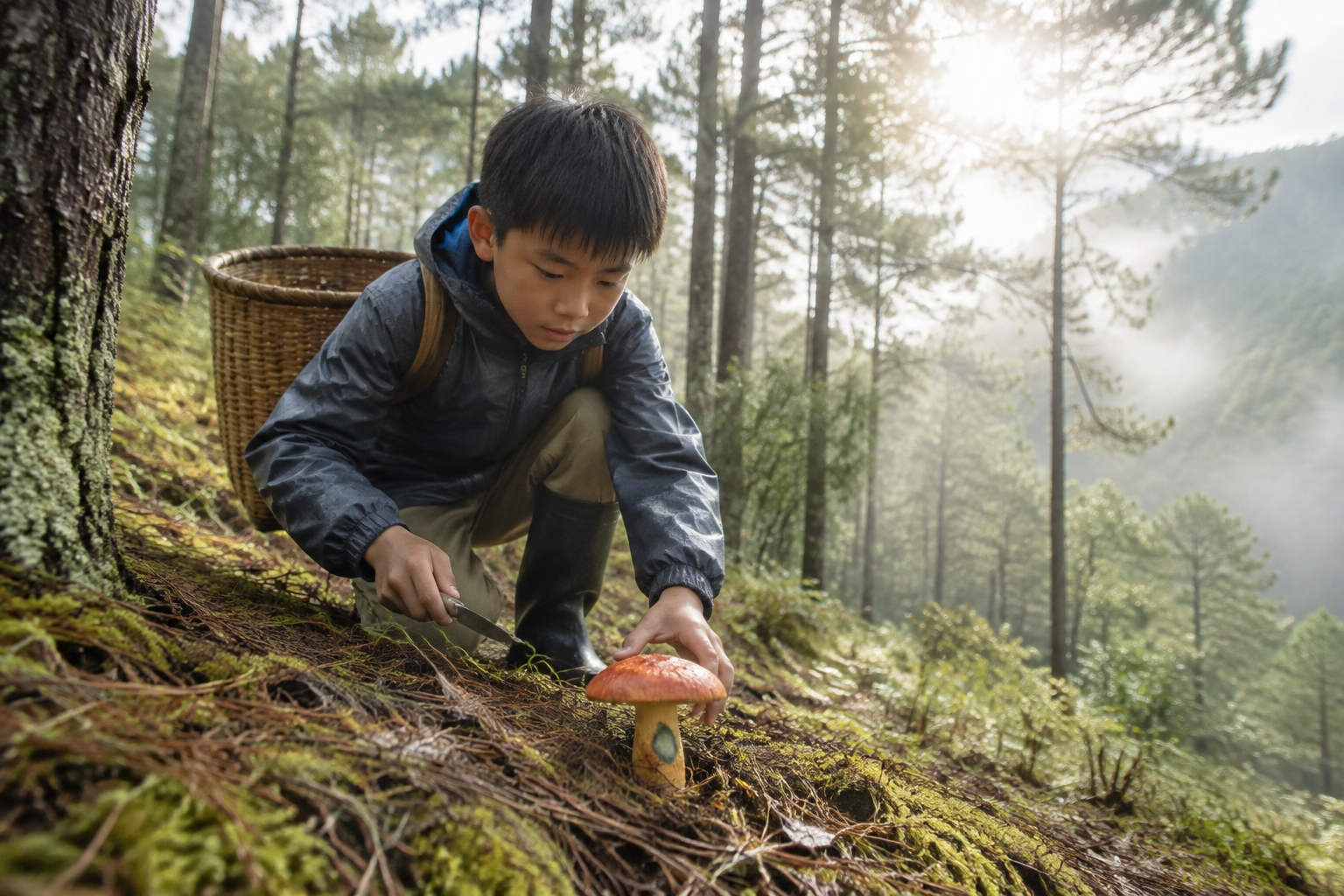

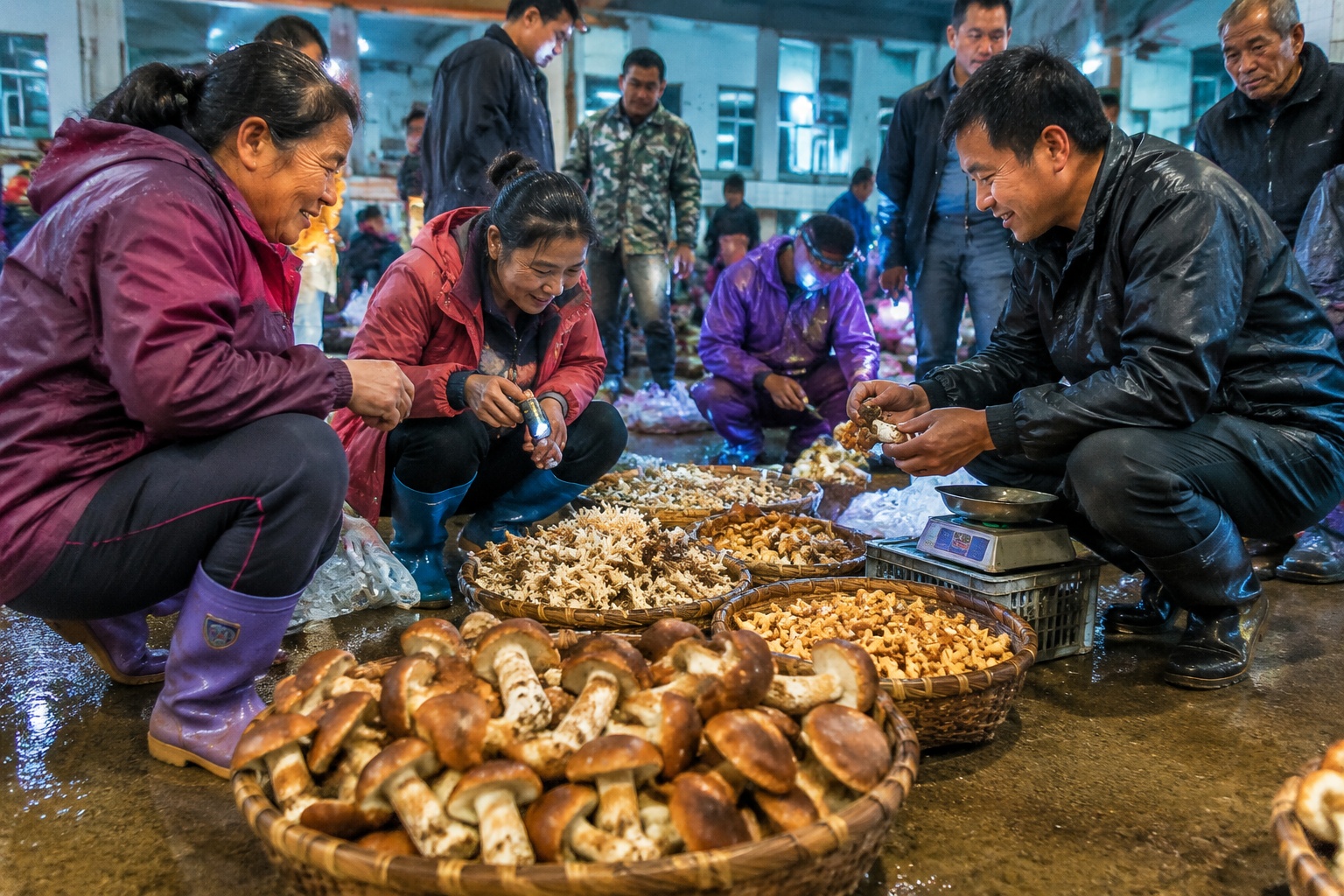
At 4 a.m., the largest wild mushroom market in Southwest China is already awake. Under the yellowish fluorescent lights of Kunming’s Muxihua market, buyers crouch beside woven baskets, brushing red-brown soil off porcini-like stems. They turn the mushrooms over, sniff the gills, and argue in rapid Yunnan dialect. Nobody is entirely sure whether the pile in front of them is “see hand qing” – a dangerous but delicious bolete – or a harmless cousin that looks similar in the dim light. The atmosphere feels less like a weekly grocery run and more like a high-stakes treasure hunt.
Every summer, the monsoon lures millions of mushrooms out of the forest floor, and their arrival turns Yunnan into a gastronomic theatre full of color, aroma, and risk. For people outside China, this may sound like a food trend. For locals, it is a season of balancing desire and caution.
Why Yunnan is a Mushroom Paradise
Yunnan is an ecological anomaly. The province spans snow mountains, subtropical valleys, and alpine meadows, creating microclimates that produce an extraordinary diversity of fungi. Researchers have recorded more than 900 edible wild mushroom species in Yunnan, and the province supplies a significant share of China’s wild edible mushroom production. Local names often sound poetic, but their meanings are practical. The “chicken fir” (鸡枞) is prized for its sweet, smoky flavor; the “dried bamboo fungus” looks like lace dripping from a stalk; the “matsutake” – known as songrong in Chinese – can fetch astronomical prices in Japanese high-end restaurants.
The trade has its own rhythm. In the early morning, pickers bring conical bamboo baskets to small mountain trading posts. By noon, trucks speed toward Kunming’s wholesale market. By dinner time, the mushrooms appear on home tables, in town hot pots, and in elegant hotel kitchens. Mushrooms here are not just vegetables from a farm; they are wild, unpredictable guests.
The Fine Line Between Feast and Poison
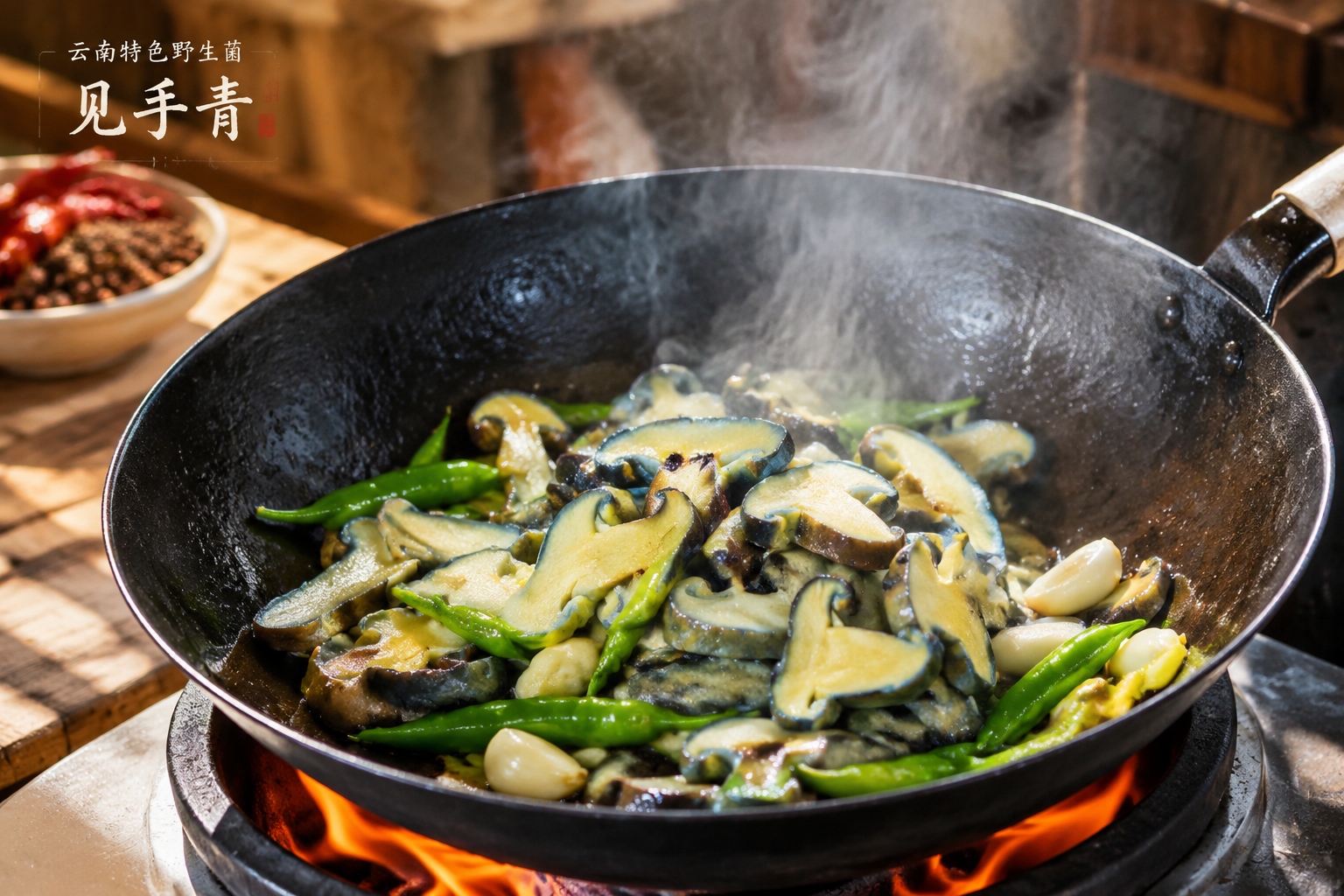
The most famous – and most feared – of Yunnan’s mushrooms is “see hand qing” (见手青), a bolete that turns blue the moment you press your finger against its cap. It smells sweet and tastes wonderfully nutty when thoroughly cooked. Cook it too briefly or eat too much, and you may experience a condition locally called “medium poison”: hallucinations, dizziness, and a feeling that small animals are crawling under your skin. In severe cases, liver failure sets in. Every year, the Yunnan Health Commission publishes warnings and local hospitals set up special emergency procedures for the mushroom season.
Still, people do not stop. “You don’t quit eating mushrooms just because a few people end up in the hospital,” says Wu Xiaolei, a Dali resident in her forties. “You refuse to be careless.” She repeats a familiar saying: “A Yunnan person needs to be familiar with three things: the mushroom, the cooking, and the route to the hospital.” The joke contains a genuine truth: most locals don’t rely on luck. They rely on experience, repetition, and a set of unwritten safety rules.
A Mushroom Feast: My Own Test Run
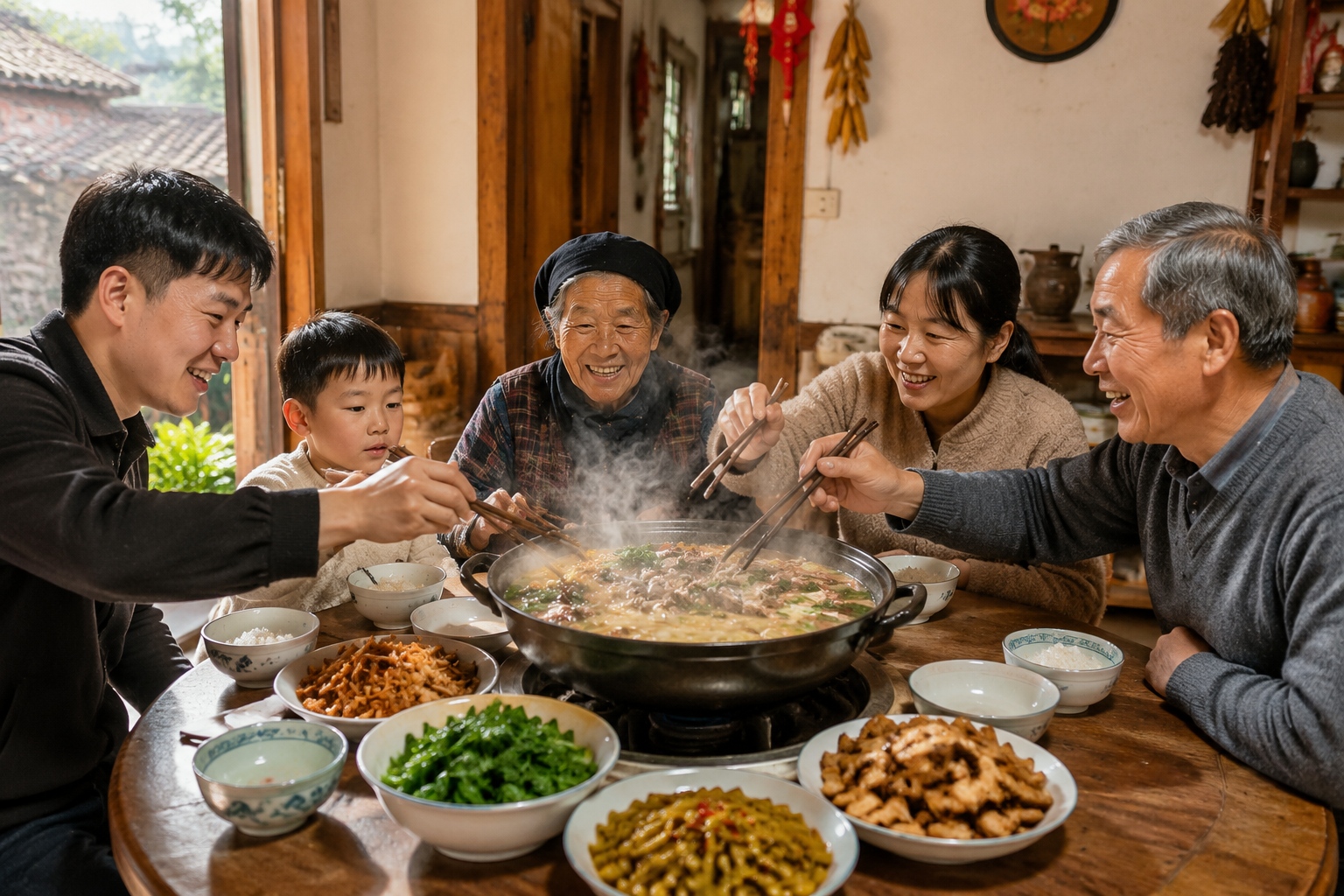
One August evening, I joined a family gathering in a small town outside Kunming. The table was crowded with colorful plates and a steaming pot of chicken soup. My host, Uncle Zhou, is a retired forest ranger who has collected mushrooms from the same slopes for 40 years. He picked a dark, brown-capped mushroom from his basket and pushed a thumb into the flesh. The exposed part immediately turned navy blue. “See hand qing again,” he said, smiling. “Don’t worry, I know this spot.”
That evening we ate garlic-fried see hand qing with green chilies, dried mushroom fried rice, and one precious slice of matsutake cooked in hot oil. Uncle Zhou’s wife placed a bowl of rice in front of me and told me not to leave the table for the next hour. “Symptoms appear quickly,” she said, without drama. “The hospital is only 15 minutes away.” There was no fear in her voice, only routine. For them, this is how you eat a wild forest: with respect and a watchful eye.
The meal itself was unlike anything I had tasted in a restaurant. The bolete was buttery and garlicky, with a deep, earthy scent that filled the room. Each bite came with a story: Uncle Zhou talked about the mountains where he had found the mushrooms, the weather that year, and how he taught his granddaughter to tell a poisonous twin from the real thing. This was not just dinner. It was a ceremony of knowledge passed down through generations.
How Local Families Stay Safe
Behind the casual courage lies a set of practical rules that locals rarely question. First, wild mushrooms are cooked for a long time. Boletes are usually fried for at least 20 minutes; some families even boil them twice. Second, families often put a few garlic cloves in the pan. Scientists will tell you garlic does not neutralize toxins, but many old cooks still believe that if the garlic turns green or gives off a strange smell, the mushrooms are dangerous. Third, most experienced cooks only serve one wild species per meal. If something goes wrong, they know exactly which dish caused it. Fourth, they buy mushrooms only from familiar vendors or from people who pick on the same mountains year after year.
Another rule, repeated often, is to avoid drinking alcohol when eating wild mushrooms. Alcohol can accelerate the absorption of certain toxins and make symptoms worse. Locals are not always strict, but this is one rule they take seriously.
What a Visitor Should Know
If you visit Yunnan during the rainy season, you should absolutely try wild mushrooms, but you should let professionals handle the cooking. Well-established restaurants source mushrooms directly from local suppliers who work with health authorities. Ask the waiter about the freshest seasonal species and trust their suggestions. Avoid eating raw wild mushrooms unless the restaurant clearly states that they are safe for raw consumption. In most cases, the only species treated as sashimi-safe is matsutake, appreciated for its firm texture and pine-like aroma.
If you decide to buy mushrooms at a market and cook them yourself, prepare seriously. Photograph your mushrooms, compare them with the visual guides from the Yunnan Center for Disease Control, and never improvise. If a mushroom turns blue when you cut it, ask yourself whether you really know what you are doing. If you cannot identify every lookalike, the wisest decision is to enjoy wild mushrooms only at the dinner table of people who have done this all their lives.
And one more thing: if you start seeing things that are not there, or if the room seems to breathe, do not wait. Tell someone immediately, and call the local emergency number. The hospitals in Yunnan are familiar with mushroom poisoning. They have antidotes and experienced doctors, but they need you to arrive quickly. In such moments, the province’s dark humor becomes clear: the first rule of eating wild mushrooms is knowing the way to the hospital.
Conclusion
Wild mushroom season in Yunnan is not just about food. It is a window into how people relate to the land, to risk, and to one another. It shows how a culture takes a dangerous part of nature and turns it into a shared source of joy. The thrill is real, but so is the restraint. The pleasure is intense, but it is bought with knowledge. Every summer, the mushroom pickers go back to the forest, the markets fill up, and families gather around steaming pots. They hold their breath for a second, then raise their chopsticks.
Start the discussion at forum.chinacomes.com