
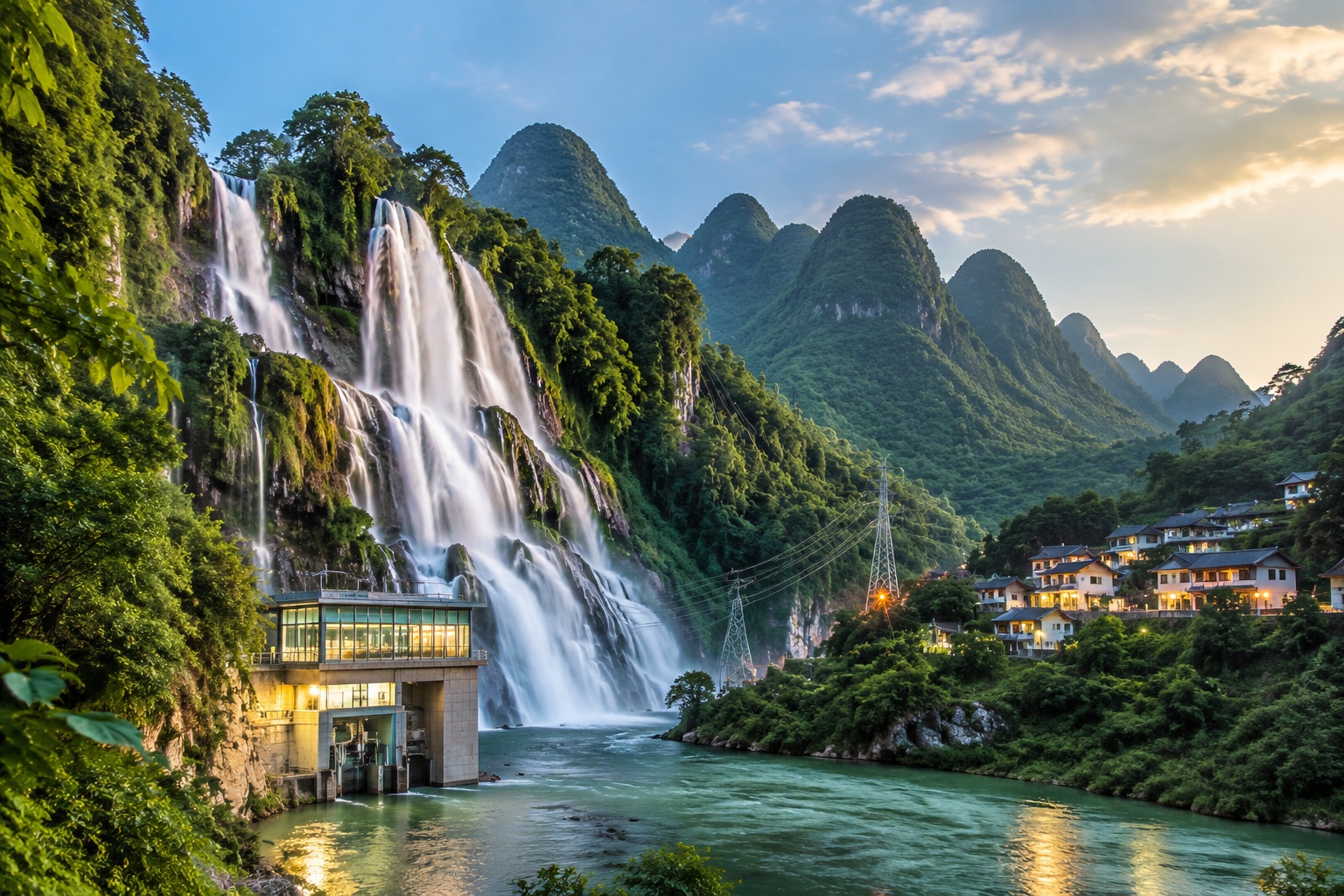

A Village Lit by a Waterfall
Deep in the misty mountains of Guizhou province, a small concrete building sits beside a rushing river. Inside, a turbine spins as water thunders through a narrow channel. On the hillside above, lights begin to glow in half-timbered houses as the evening darkens. This is a familiar pattern in rural Guizhou: communities powered by the streams and waterfalls that shaped their landscape. For these villages, hydropower is not just an abstract energy source—it is the pulse of everyday life.
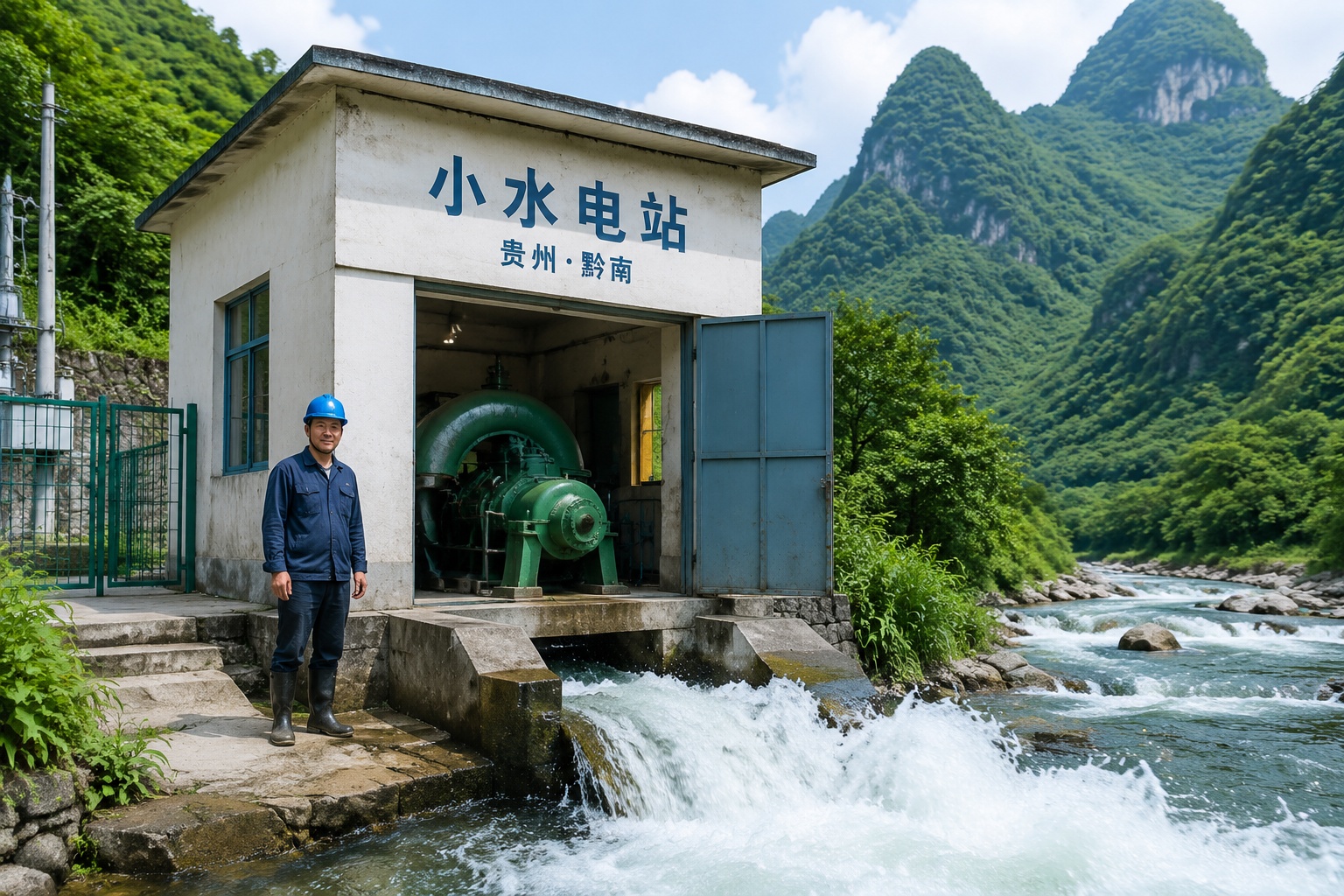
China is the world’s largest hydropower producer, but most of its capacity comes from massive dams like the Three Gorges. What is less known is the role of small hydropower in China’s countryside. Tens of thousands of mini plants, many no bigger than a house, supply electricity to millions of people who live far from the bustling eastern seaboard. Guizhou, one of China’s poorest provinces, has embraced these installations with particular success.
Why Guizhou? Mountains, Rain, and Waterfalls
Guizhou is a landscape of startling verticality. Karst limestone peaks rise abruptly from flat basins, and rivers plunge through steep gorges, creating some of the most spectacular waterfalls in the world. The province receives abundant rainfall—between 1,200 and 1,500 millimeters each year—and its average altitude of about 1,100 meters provides a consistent drop for water to gain speed.
Yet for decades, this natural endowment was not fully utilized. The rugged terrain made grid extension slow, and many villages remained in the dark, relying on candles or diesel generators for several hours a day. Building a national grid through 1,400-meter peaks is costly; it is often more practical to generate power on-site using the very water that surrounds the villages.
How Small Hydropower Works
The underlying physics is straightforward. Water stored or flowing at a height has gravitational potential energy. When it flows downhill, that energy becomes kinetic energy, which can spin a turbine connected to a generator. In a run-of-river design, no large dam is needed; instead, a weir deflects a portion of the stream into a channel or pipe, which leads the water to the turbine. After passing through, the water returns to the river. This approach minimizes land use and environmental disturbance.
Most of Guizhou’s small stations are of this type. A typical station may have an installed capacity between 200 and 5,000 kilowatts. To put that in perspective, a 1,000-kilowatt plant can supply about 1,000–1,500 rural households, assuming average household consumption of roughly 1,800 kilowatt-hours per year. In practice, many stations feed into the local grid, and their output is distributed across a wider area, adding resilience to the regional power supply.
Maintenance matters. The turbines need regular cleaning to clear debris, and the channels must be kept free of silt. Many stations now employ local villagers as operators—an arrangement that both creates jobs and ensures quick response to problems. Training is provided by county-level hydropower companies, which also manage the larger network.
The Ripple Effect on Rural Life
The arrival of reliable electricity transforms nearly every aspect of village life. In schools, children can attend evening study sessions instead of doing homework by candlelight. In clinics, vaccines are safely stored, and simple medical devices like ultrasound machines can operate. In homes, electric lighting replaces smoky kerosene lamps, and rice cookers, washing machines, and televisions become appliances people actually use.
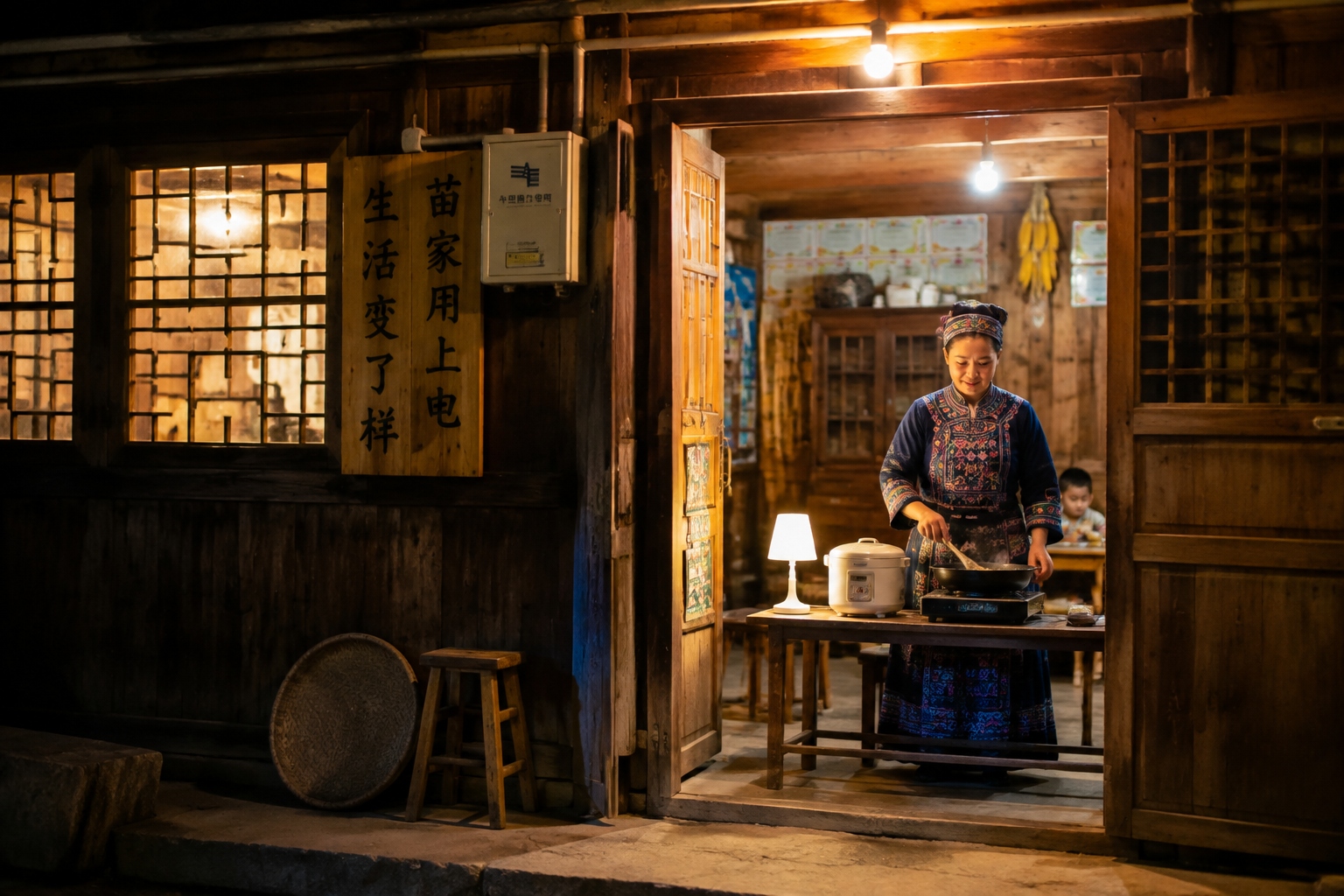
The economic impact is equally visible. Small food-processing businesses—rice mills, tea-leaf dryers, peanut roasters—have sprung up in many villages. In the past, such equipment required diesel, which was expensive and noisy. Electric machinery is cheaper to run, cleaner, and can be used for more hours. Some villages have even started small manufacturing workshops that produce textiles or bamboo crafts for tourists, thanks to a stable power supply.
Tourism is another beneficiary. Guizhou has become a popular destination for its waterfalls and hiking trails. Homestays in villages near the scenic spots rely on electricity for hot water, Wi-Fi, and electric lights. In many cases, the power flows from the very waterfalls that visitors come to see. This creates a feedback loop: tourism revenues fund the upkeep of small power stations, which in turn support more tourism.
Consider a village perched near the Zangke River in the province’s southwest. A few years ago it suffered from daily blackouts. After a 1,500-kilowatt hydropower station was refurbished with support from a government poverty-alleviation program, the village now enjoys 24-hour electricity. It has started a small rice-processing business and a guesthouse, both economically dependent on the constant power supply. The power station also contributes to the village’s collective fund, which helps pay for school fees and road maintenance.
Numbers That Tell the Story
An inventory of China’s small hydropower is illuminating. According to the Ministry of Water Resources, there are about 45,000 small hydropower stations across the country, with a combined installed capacity of more than 80 million kilowatts. That is roughly equivalent to three times the installed capacity of the Three Gorges Dam. Guizhou alone has over 1,000 such stations, totaling about 3 million kilowatts. They generate around 9 terawatt-hours each year—enough to meet the annual needs of more than 8 million households at the national average consumption level.
But the significance is not just scale. The social benefit is particularly pronounced in poor regions. Since 2015, China’s Ministry of Water Resources has run a ‘small hydropower to support poverty alleviation’ program in several provinces, including Guizhou. Participating villages receive a share of the electricity sales revenue, which is often used for infrastructure improvements. In many places, the program has raised village incomes by 5–10% within three years.
Also crucial is the environmental benefit. Rural families once relied on firewood for cooking and heating, resulting in forest loss and indoor air pollution. With cheap and plentiful electricity, they have switched to electric stoves and water heaters. The ‘small hydropower replacing fuel’ initiative, introduced in the early 2000s, has helped preserve large areas of forest. In Guizhou, the share of rural households using electricity as their primary cooking energy has risen dramatically in the past twenty years.
Challenges and a Greener Path Forward
Small hydropower is not a silver bullet. Critics point out that even small weirs can block fish migration and reduce stream oxygen levels. Sediment buildup can alter riverbeds. In response, China has tightened regulations. Since 2018, all small stations must meet environmental requirements, including maintaining a minimum ecological flow—a quantity of water that stays in the river to protect aquatic life. Many older plants have been retrofitted with fish ladders and sediment sluices. The national ‘green small hydropower’ initiative is encouraging operators to adopt modern monitoring and automation technology.
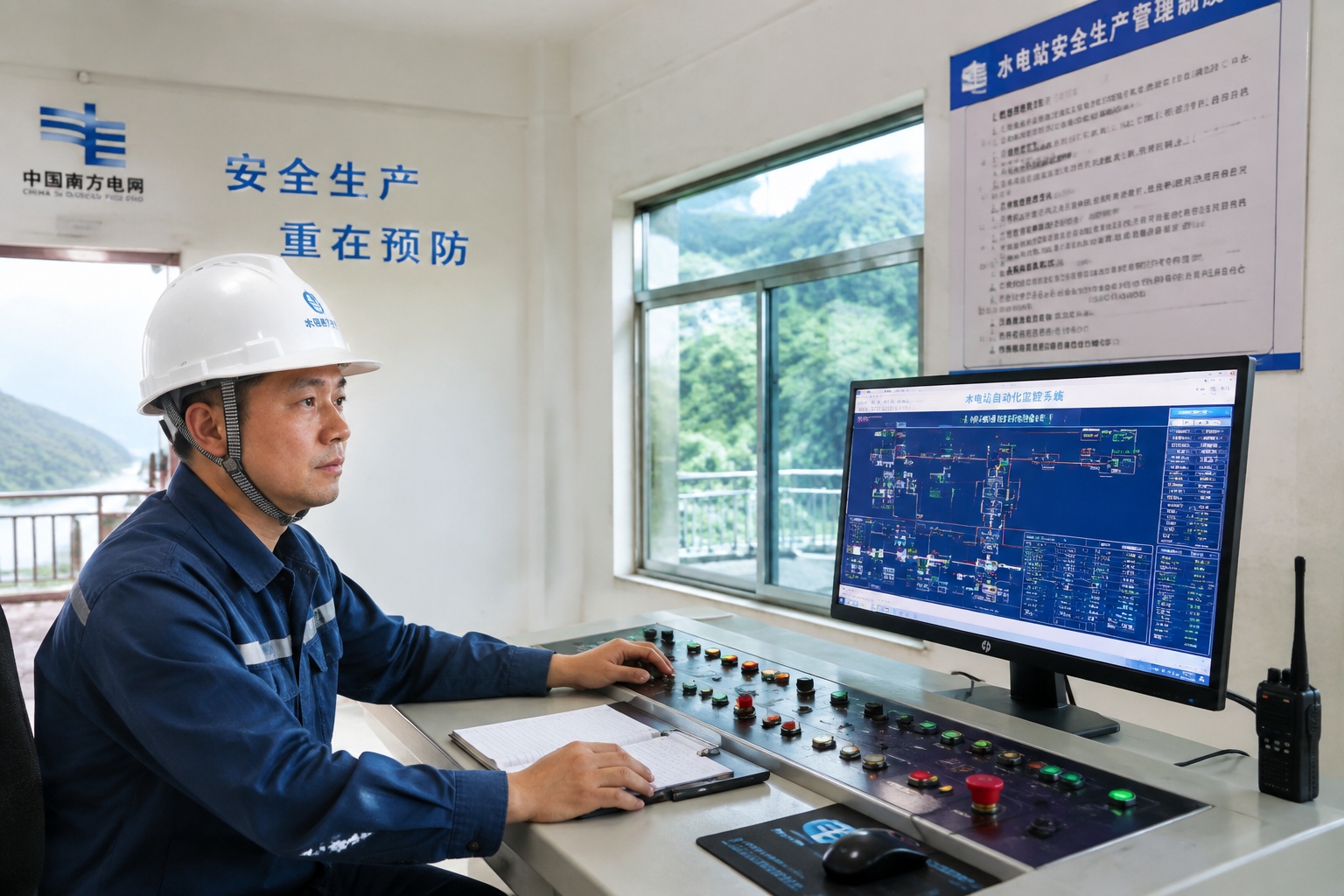
In Guizhou, hundreds of stations have undergone modernization. Remote-control systems allow engineers to adjust power output from a central office, reducing the number of on-site staff. Some plants have been decommissioned when their ecological footprint outweighed their benefit. The result is a smaller but healthier fleet.
Climate variability is another test. Prolonged droughts in recent years have lowered river levels, cutting generation in some areas. To build resilience, planners are integrating small hydropower with other renewables. For instance, a village may combine a mini hydro plant with rooftop solar panels, using a small battery to store excess energy. Such hybrid systems can smooth out seasonal fluctuations and provide backup in emergencies.
Conclusion
In the end, what stands out about Guizhou is not a single grand project but the widespread presence of small, community-owned power stations. They are easy to underestimate—a concrete box near a stream, a pole with a few wires, a transformer humming on a hillside. Yet together, they light up thousands of villages, power classrooms and clinics, and enable local economies to grow. As China transitions to a low-carbon future, these modest stations are as important as any giant dam. They show that sustainability is not always about the biggest technology; it is about fitting clean energy into the rhythm of real places and real people.
After all, the waterfalls of Guizhou have always been a source of wonder. Today, they are also a source of power—for the people who live in their shadow.
Start the discussion at forum.chinacomes.com