
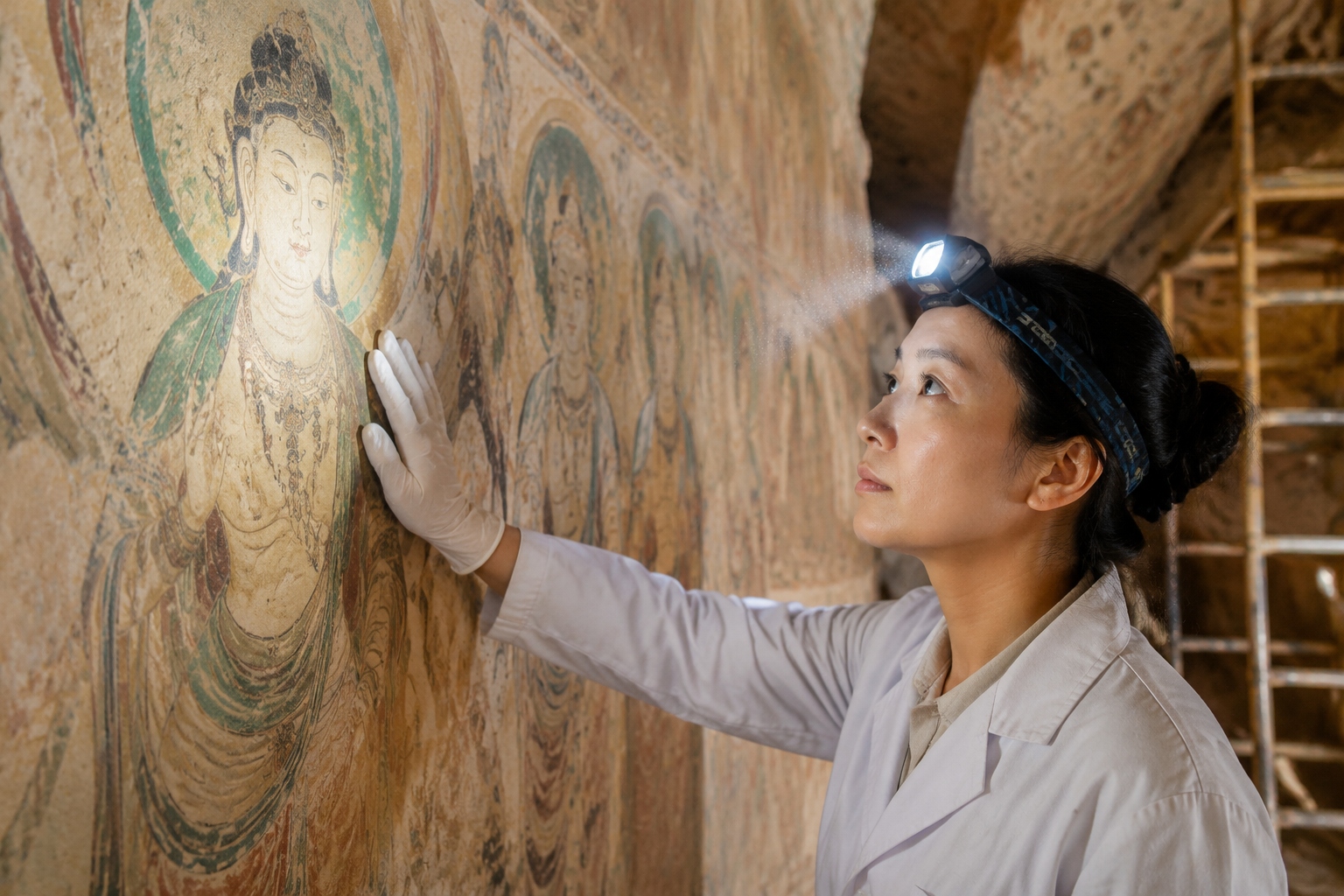

A Morning Inside Cave 158
The beam of a headlamp cuts through the cool, dark air. It’s 8 a.m., and the temperature inside the cave is still below 15 degrees Celsius. Fang Li, a mural conservator at the Dunhuang Academy, kneels on a mat, her eyes inches from a face painted more than a thousand years ago. She isn’t looking at the serene Buddha. She’s looking at the cracks—the fine, spider-web lines that threaten to erase it.
As an experienced professional, she speaks softly. “We need to stabilize this area first.” Her gloved hand holds a syringe, and with a slow, precise movement, she injects a clear liquid into the wall. A faint hiss. Then silence. It’s a ritual repeated thousands of times, each action a quiet negotiation with time.
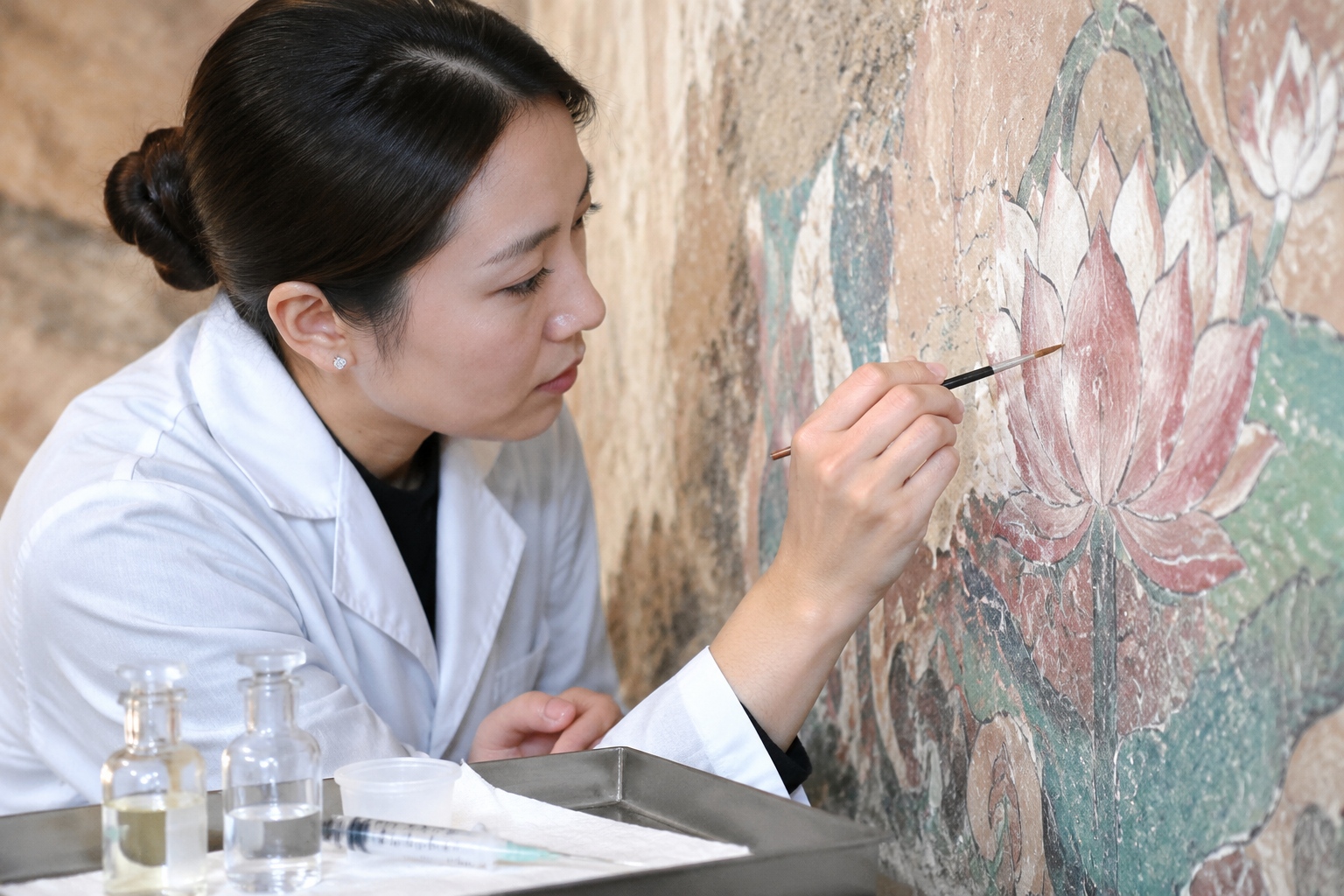
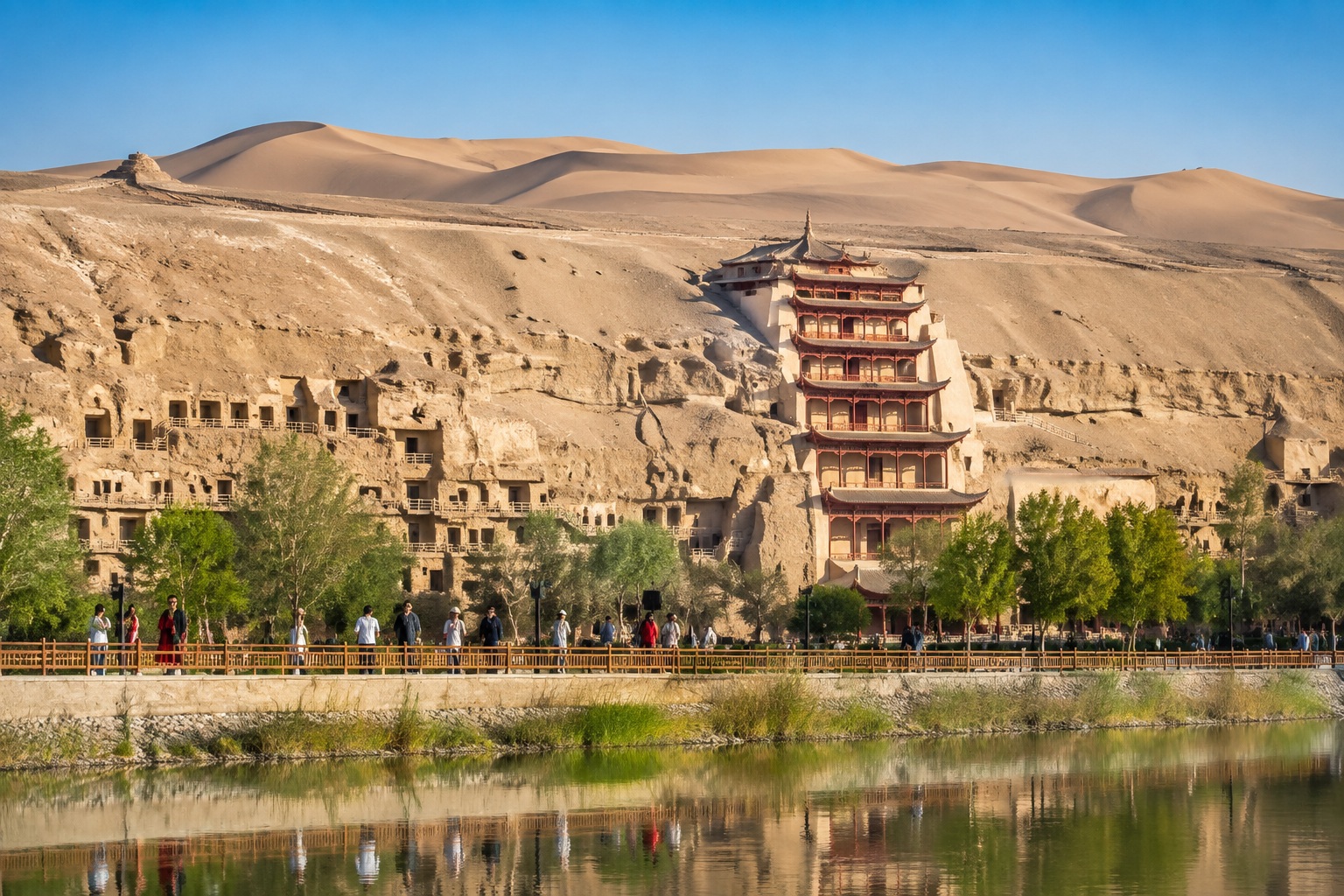
Fang Li is one of a growing number of women working in conservation at the Mogao Caves, a UNESCO World Heritage site in the remote Gobi Desert. High above the desert floor, hidden in the cliffs, are 735 caves filled with over 45,000 square meters of murals. They were created between the 4th and 14th centuries, and they are among the greatest artistic treasures of Buddhism in the world.
The Cave as a Time Capsule
For over a millennium, merchants, monks, and pilgrims along the Silk Road passed through this desert oasis. They sponsored the carving of temples and the painting of walls, leaving behind a vivid record of spiritual life across hundreds of years. The sheer scale is staggering: the murals depict not only Buddhist deities but also everyday scenes—travelers, musicians, dancers, farmers, even early soccer players.
Yet time has been unkind. Windblown sand, groundwater, and earthquakes have caused painted plaster to blister and detach. In the late 19th century, foreign explorers carried away scrolls and paintings, and local looters also took their toll. By 1944, when the official research institute was founded, many frescoes were on the verge of disappearing forever.
Today, the institute employs over a hundred researchers. About half of them are women. Their work is a fusion of archaeology, chemistry, art history, and a deep, personal patience.
A Delicate Art
Conservation isn’t just about painting over cracks. It begins with observation. Millimeter by millimeter, conservators map every imperfection. They measure the moisture in the rock, the salt content, the pH of the pigments. They use ultraviolet light to reveal hidden layers, and infrared cameras to see under drawing. But in the end, it is the human hand that does the deed.
“We work with the smallest brushes. Sometimes we apply a few drops of adhesive and then wait for hours. It’s like surgery, but the patient is a wall,” explains Zhang Mei, a senior conservator who has spent 23 years in the caves. Her favorite tool is a scalpel with a razor-sharp edge, used to flatten tiny detached flakes of pigment.
The materials are as old as the art itself: local clay, saliva, lake water, and pigments ground from minerals. Modern chemistry has added newer time-tested polymers, but the philosophy remains: “Do no harm.” Every treatment must be reversible, because future generations will undoubtedly develop better techniques.
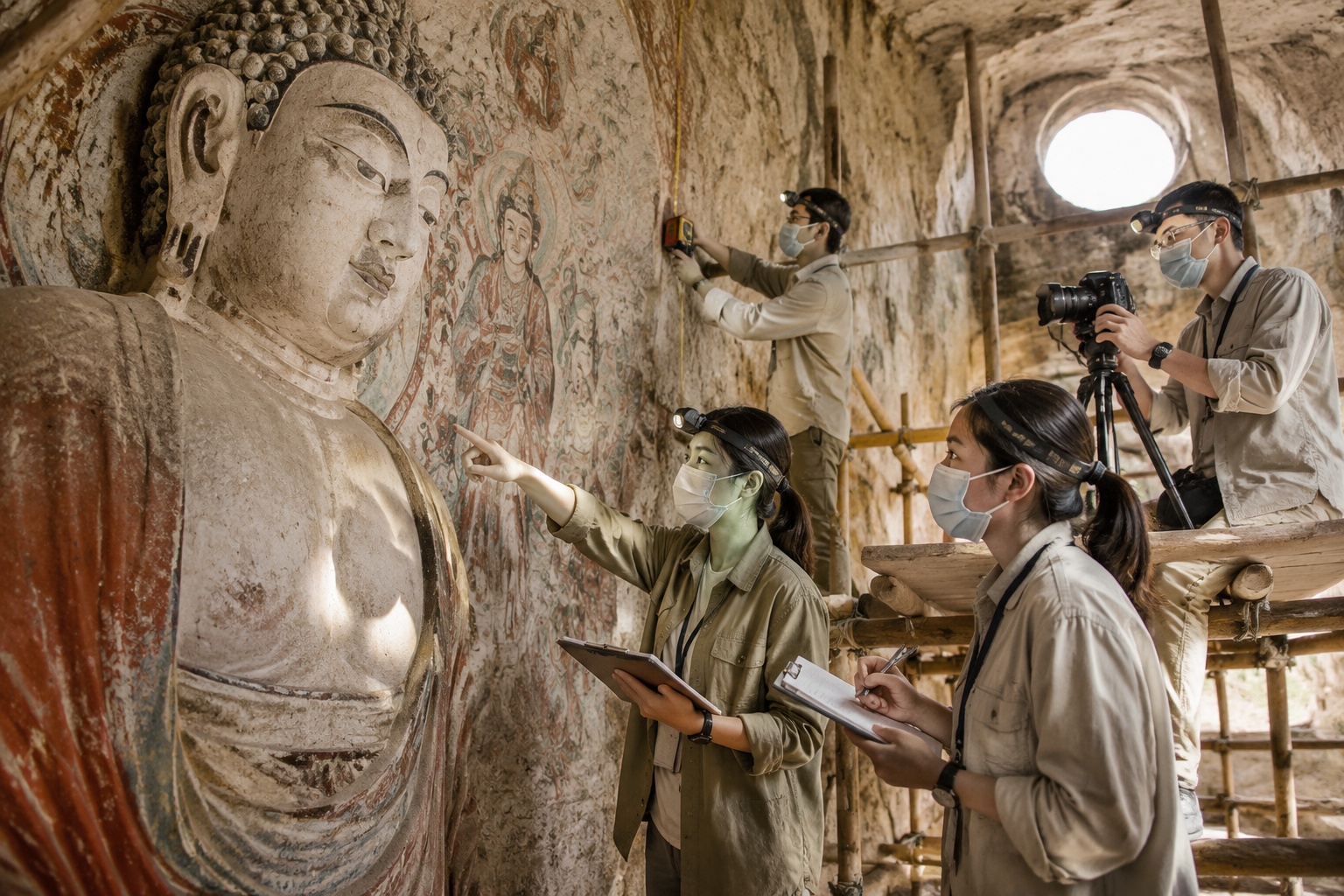
In some caves, conservators are creating full-scale 3D scans using laser scanners and high-resolution photographic stitching. These digital twins are not meant to replace physical reality but to aid in precise recording and to allow researchers to test solutions virtually before applying the real thing.
The Women Behind the Brushes
Several women have led major conservation projects. One is Su Baimin, who has worked on the repair of the giant Buddha statue in Cave 96. Another, Guo Qinglin, is the director of the conservation institute. But the unsung heroes are the many young women at the entry level, who spend months in a dark cave, breathing dust, lighting only their headlamps.
They come from all over China. Some studied at the Academy of Fine Arts or top universities, but they all share a peculiar disposition: a willingness to be forgotten, to work in obscurity for years. “We can’t be too famous,” says a young technician, cleaning a mural with a cotton swab. “If a restorer is famous, then the painting is in trouble.”
The physical conditions can be harsh. In winter, the caves are freezing; in summer, they are suffocatingly hot. The researchers wear masks, goggles, and often work hunched over. Their hands must be steady, even when the body aches. And yet, there is a quiet joy.
Many of these women have families in nearby Dunhuang city. They leave home before dawn and return after dark. The work demands a monastic focus, but it also offers a rare, intimate connection to the past. “When I touch the wall, I can feel the hand of the artist who painted it centuries ago,” says Fang Li. “We are both working on the same surface. It’s a conversation across time.”
Reversing Time, One Brushstroke at a Time
Perhaps the most famous restoration challenge came in Cave 320, a grotto known for its breathtaking flying Apsaras (heavenly spirits). Over the centuries, a thick layer of grime and soot had covered the paintings, making the spirits nearly invisible. A team of women spent three years cleaning the surface, using a custom method of cotton swabs and alcohol. Layer by layer, the colors returned: the warm red lead, the deep emerald, the delicate gold.
“The most critical moment is when you see the original line appear,” recalls Zhang Mei. “It’s like a writer finding a lost phrase. The whole painting starts to make sense again.”
Not every project is so glamorous. Some work involves consolidating fragile plaster with adhesives injected by syringes. Another daily task is repairing historic inscriptions damaged by wind and salt. The conservators keep detailed journals, recording every drop of adhesive and every cotton swab used. These notes are part of the accumulated knowledge of Dunhuang Studies, a field that draws scholars from all over the world.
Balancing Preservation and Access
The Mogao Caves are also a major tourist destination, with thousands of visitors every day. But each person brings in carbon dioxide, moisture, and heat—all enemies of the murals. Visitors are now limited to a selection of caves, and even those are rotated to give the art a rest. The tourist path is routed through clear corridors, and photography is banned to prevent flash damage.
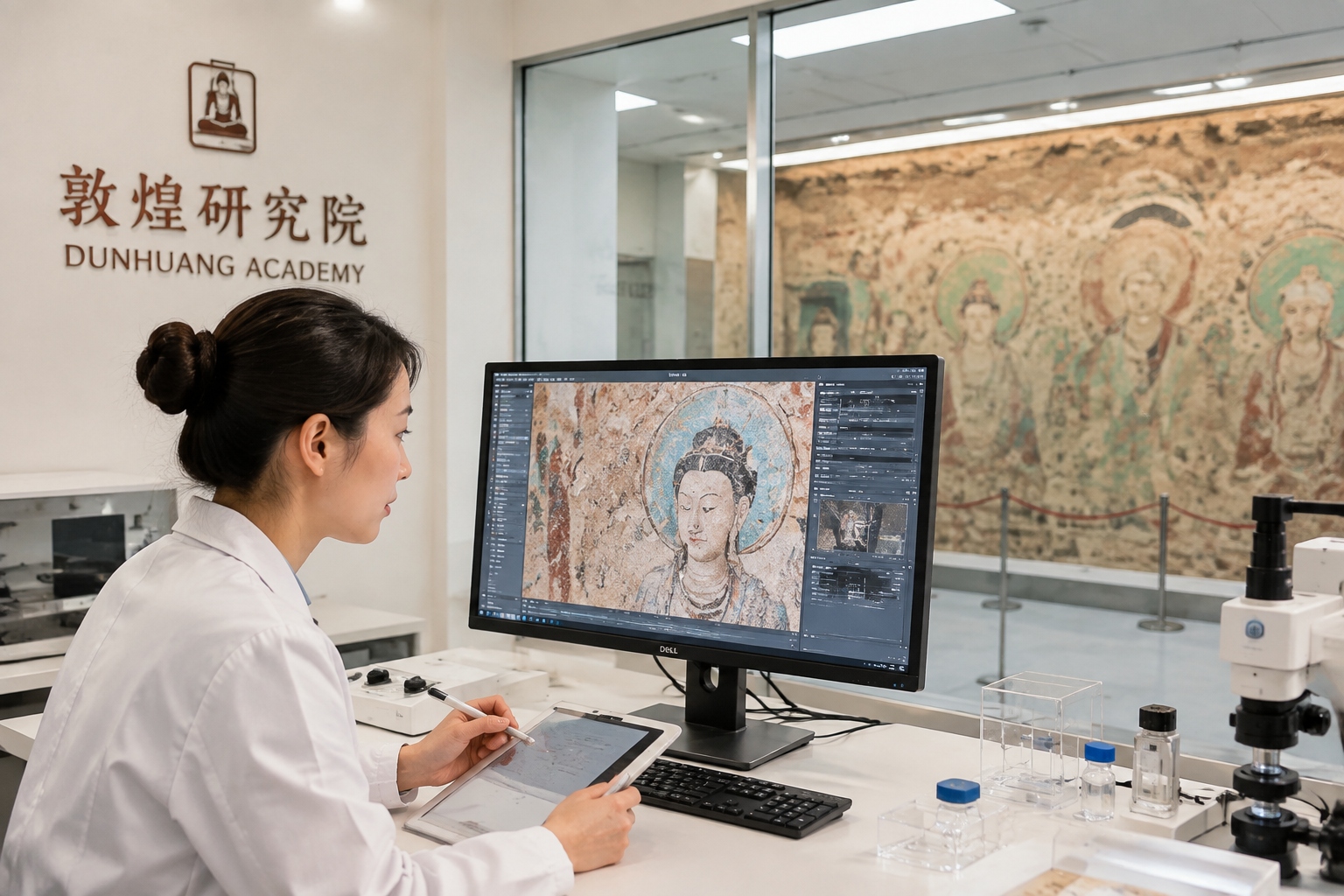
Digital technology has become a crucial ally. The Dunhuang Academy has digitized many of the iconic caves, offering a virtual tour that allows people from anywhere to see the details without adding to the environmental load. The academy also publishes its high-resolution images on an open platform, allowing art historians to study brushstrokes from afar.
Yet the physical, hands-on preservation continues, often hidden from view. When I visited, a glass panel protected a small section of Cave 85 where a conservator was working. Visitors passed by, unaware that just a few centimeters away, someone was saving the treasure.
A Legacy in Their Hands
As I leave Cave 158, the sun is blinding. A group of tourists waits outside, their cameras ready. They will see the Buddha, but they won’t see Fang Li, still kneeling in the dark, still repairing a damage that no one else can see. She will spend years there, perhaps a decade or two, and then leave her work for the next generation.
This is the unseen story of Dunhuang: a place where a group of dedicated women, armed with nothing more than brushes, syringes, and patient hearts, are slowly, gently reversing the march of time. Their names may not be remembered, but the walls they saved will stand forever.
Start the discussion at forum.chinacomes.com