

An Ordinary Evening in a Chinese Neighborhood
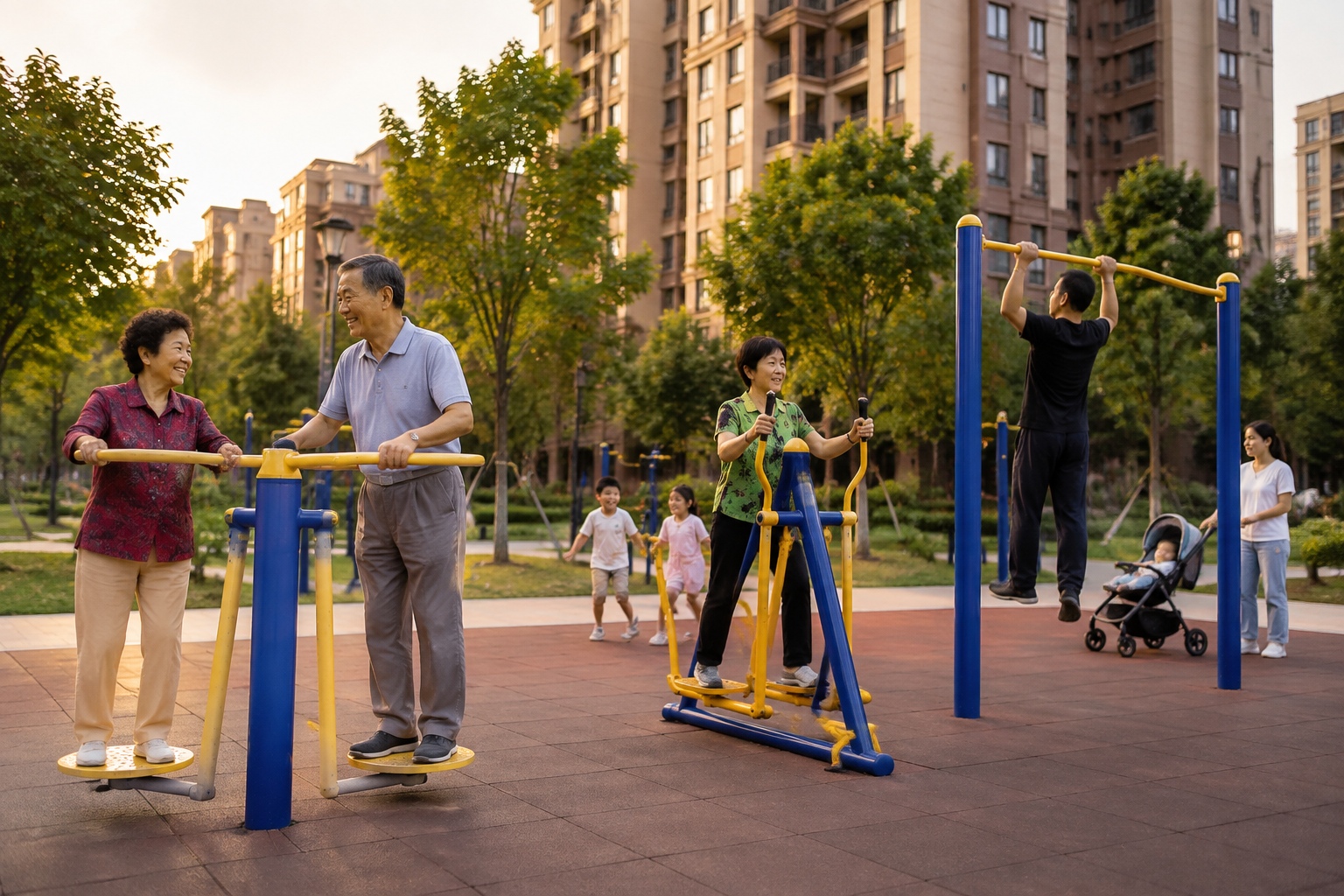
It’s just after 7 p.m. in a residential compound in Chengdu, southwestern China. A group of retirees are chatting while gently rotating their hips on waist-twisters, a piece of equipment that looks like a three-spoke steering wheel mounted on a pole. A few meters away, a young mother helps her three-year-old daughter hang from a set of parallel bars. An elderly man is using a back-stretcher, while a teenager, earbuds in, walks briskly on a self-propelled elliptical trainer.
None of this is remarkable to anyone who lives here. Outdoor fitness equipment is as much a part of the neighborhood as the playground slides and the shaded benches. Walk through virtually any Chinese residential community built after 2000, and you’ll see a cluster of bright blue and yellow machines tucked into a corner of green space. Some are well used, some rusting in places, but all are simply… there. This wasn’t always the case. Just two decades ago, these machines were rare.
The ‘Great Leap’ in Community Fitness
China’s outdoor gyms didn’t just appear by accident. They are the result of a deliberate, decades-long government push to get the nation moving. In 1995, the State Council issued the first National Fitness Program, aiming to improve the health of the population. But concrete reality didn’t catch up until after the 2008 Beijing Olympics. That year, the government committed to building more public exercise facilities, and 2009’s National Fitness Day (August 8) further boosted the movement. Municipalities and districts then had a clear task: install exercise equipment in every neighborhood, or suffer lower scores in performance evaluations.
The most visible outcome is what planners call the “15-minute fitness circle.” In urban China, the goal is that every resident should reach a public exercise facility within 15 minutes on foot. Walk around any city, and you’ll see why it often feels true. Beside apartment blocks, on riverbanks, under highway bridges, and in small parks, you’ll find clusters of pull-up bars, treadmills, and vertical leg presses—all free to use, open around the clock, and maintained by the local property company or street office.
A Concrete Policy, Backed by Numbers
The scale is impressive. According to China’s General Administration of Sport, by the end of 2023, the country had 4.59 million sports venues of all types, a massive jump from 1.69 million in 2013. Per capita sports area reached 2.89 square meters, up from about 1.46 in 2013. Outdoor community equipment accounts for a hefty share of new installations. In 2021 alone, the administration allocated 500 million yuan (around $70 million) from central sports lottery funds to buy fitness equipment for grassroots communities.
But the story isn’t just about state mandates. It’s also about how the real estate industry adopted fitness equipment as a selling point. Beginning in the 2000s, developers realized that a well-equipped “fitness plaza” made a residential complex more attractive. New compounds now routinely include it as standard. When older neighborhoods are renovated—a huge national program called old community renovation that began in earnest in 2019—installing exercise equipment is one of the first box-ticking items checked off by local governments.
What Locals Actually Do with Them
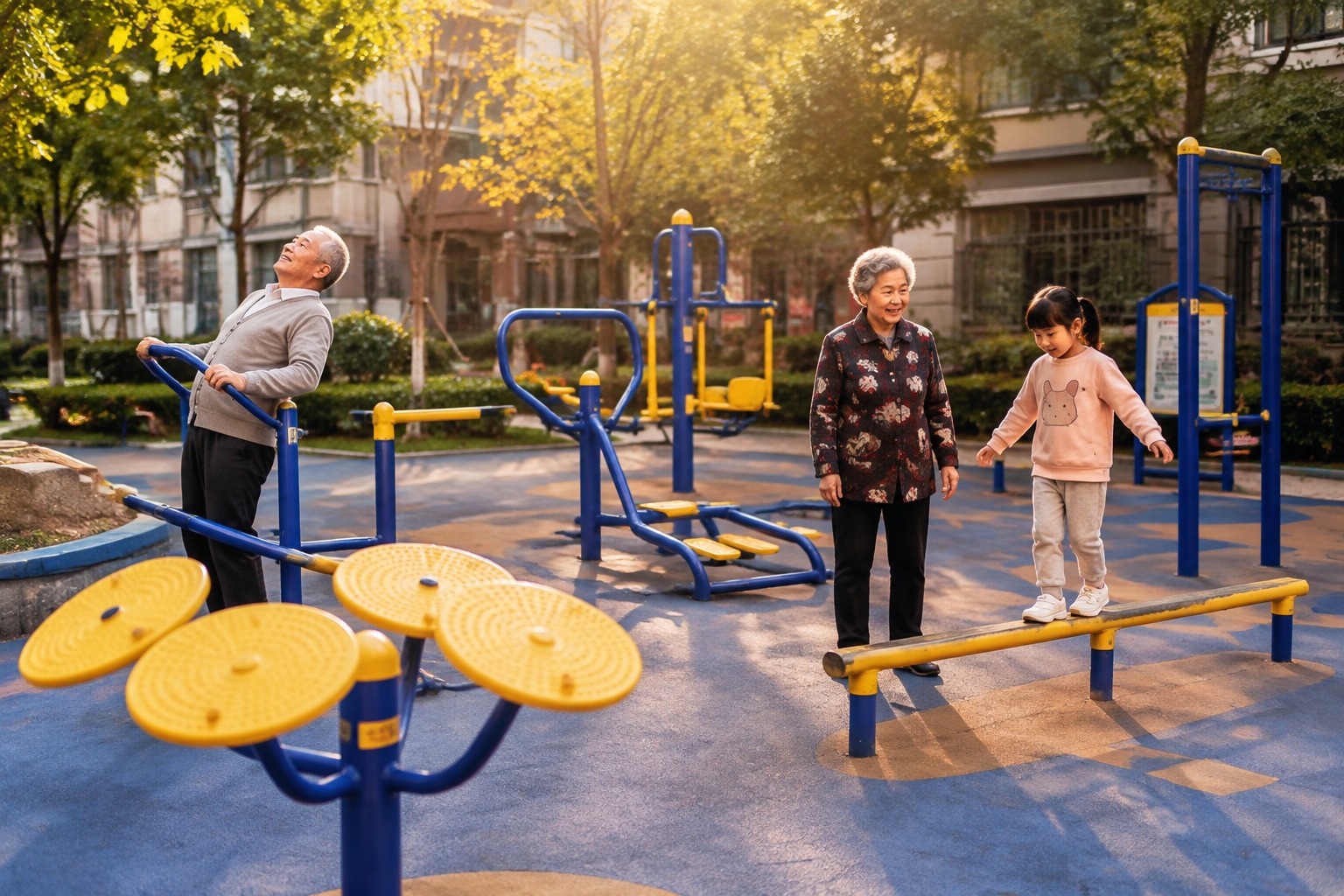
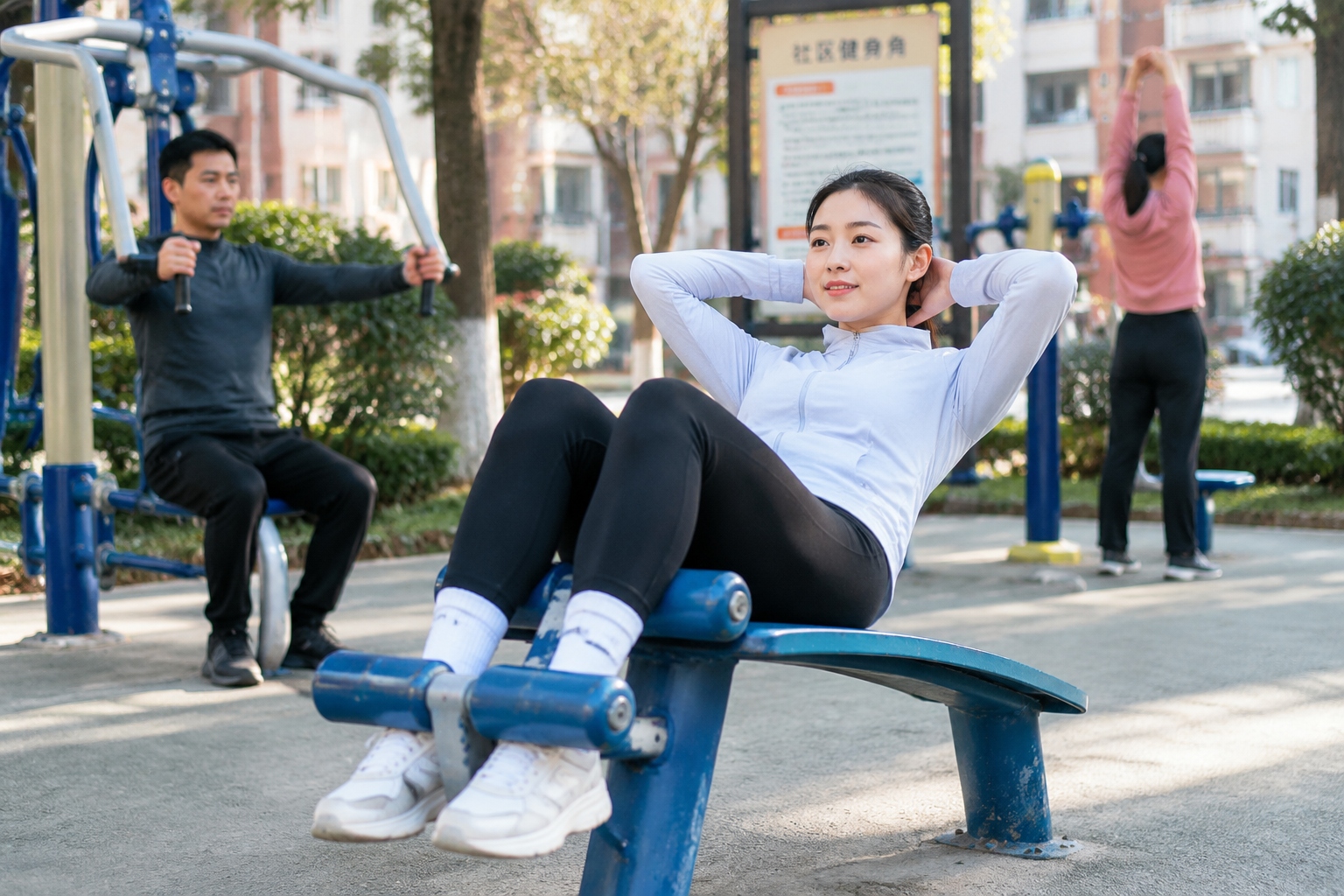
Walk into a Chinese community gym corner at different times of day and you’ll see a cross-section of society. Morning belongs to seniors: they use the equipment to stretch joints and loosen muscles, often hanging their birdcages on a nearby branch. Around 4 p.m., grandparents bring kids after school. The small climbing ropes and balance beams double as playground equipment. After dinner, young office workers might do a quick set of sit-up benches or pull-ups before a late night of work.
“I use the leg stretcher almost every day,” says 68-year-old Zhang Weihong, a retired factory worker in Wuhan. “It’s free, it’s outside, and I can chat with neighbors. The gym costs money, and I’m not comfortable there. Here, I know everyone.”
That social aspect is key. Unlike an indoor gym, the community workout point is a public square of sorts. It’s where people exchange news, complain about inflation, and watch grandchildren. The machines are just props for a daily ritual of being outside.
Not All Smooth Sailing: Wear, Tear, and Misuse
It would be dishonest to suggest everything is perfect. The equipment gets heavy use, and some devices aren’t designed for that kind of abuse. A nationwide survey from 2020 found that roughly 12% of outdoor fitness equipment in cities showed damage needing repair. In rural areas, where installation surged later, the figure was higher. Some equipment is used in ways manufacturers never intended—children swinging on walking poles, teenagers doing tricks on the pull-up bar—which shortens its lifespan.
Maintenance varies. In wealthy districts, property companies inspect regularly and repaint rusted joints. In poorer neighborhoods, a broken pedal might stay broken for months. Locals often make do, or give up, leaving the machine to become a decorative metal skeleton. There have been accidents too. In 2021, a child in a Guizhou community suffocated after getting his head stuck in a rotating wheel part—a tragedy that prompted a nationwide safety review of outdoor children’s play and fitness equipment.
Yet such incidents are rare relative to the scale of use. That’s partly because China has issued national standards for outdoor fitness equipment (GB 19272-2011), covering structural safety and installation requirements. Manufacturers must pass testing, and local regulators conduct spot checks.
The Deeper Meaning: A Community of Care?
Why does this matter beyond China? The ubiquity of such equipment says something about how Chinese cities view public goods. Fitness corners are not a private luxury or a trend—they are considered basic infrastructure, like streetlights and sidewalks. They are also a lens into how China manages public health: instead of building expensive healthcare systems for lifestyle diseases, the government tries to prevent them by encouraging exercise at the neighborhood level.
For a foreign visitor, the sight of seniors using chest presses in the open air might seem odd, even comical. But after a few days, you realize it’s part of the social fabric. It’s not about getting swole. It’s about a daily rhythm, a cheap and accessible way to stay healthy, and an excuse to interact with your neighbors. While gym memberships in cities like Shanghai can cost hundreds of dollars a year, this equipment is free. It’s open to everyone, of every age and income.
In a country where space is precious and private housing is stacked vertically, these small outdoor corners are also a quiet answer to a simple question: if you live in a 50-story tower, where do you go to stretch your legs? The answer is right downstairs, almost always.
Conclusion: Not Just Equipment, But a Statement
Next time you’re in a Chinese city, pay attention to a small patch of blue and yellow machines. They represent one of the most tangible, street-level results of China’s policymaking. The equipment may not be glamorous. Sometimes it’s rusty, sometimes it’s occupied by a napping dog. But the fact that it’s there—on nearly every block, waiting to be used—is a quiet statement about what the state thinks its citizens deserve: the right to stay healthy, for as long as possible, close to home.
So when a foreign friend asks why every Chinese neighborhood seems to have sprouted fitness equipment, you can say: “It wasn’t accidental. It was planned, funded, and built to make sure that staying active costs nothing, and is always just a short walk away.”
Start the discussion at forum.chinacomes.com