

The Night the Music Went Mute
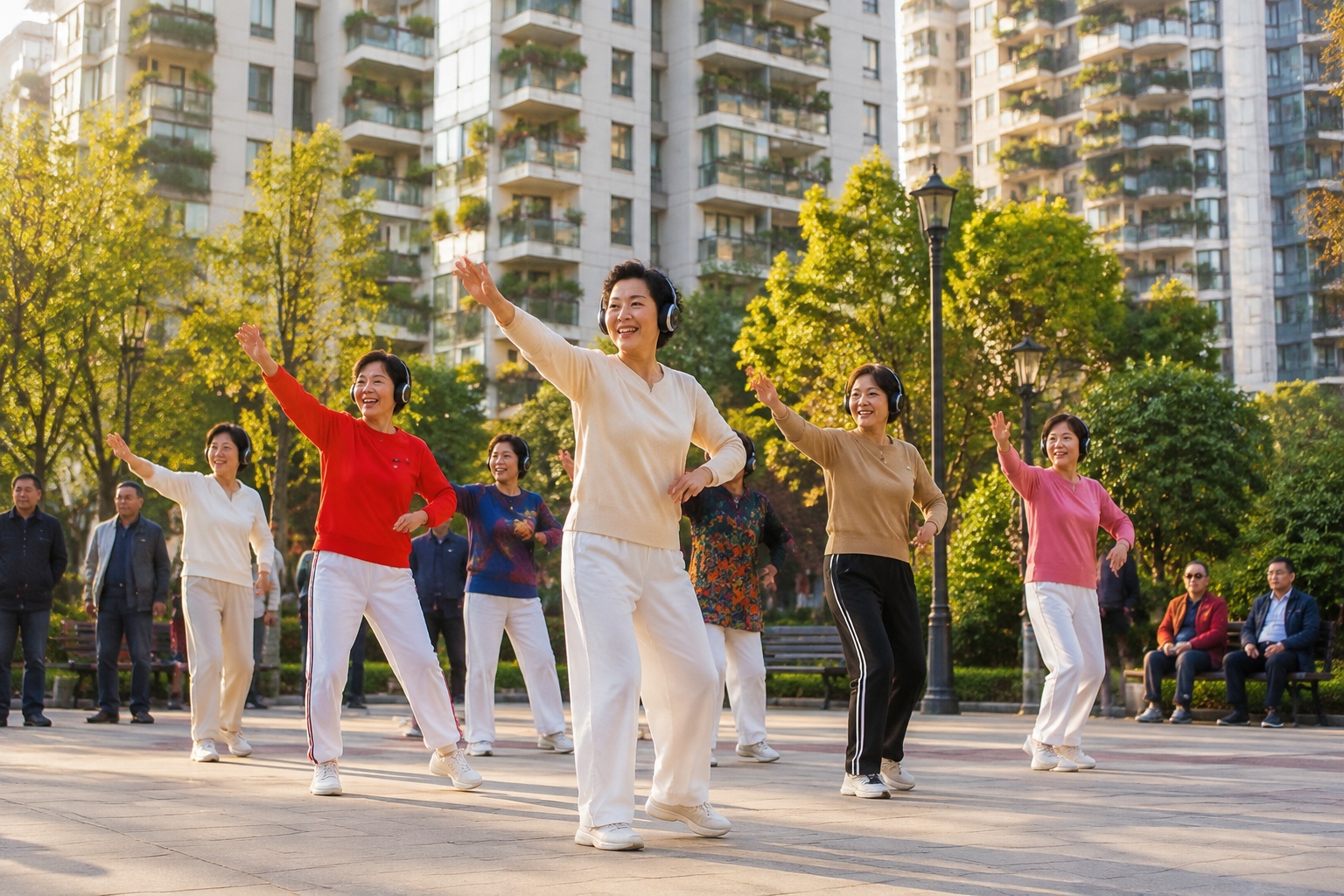
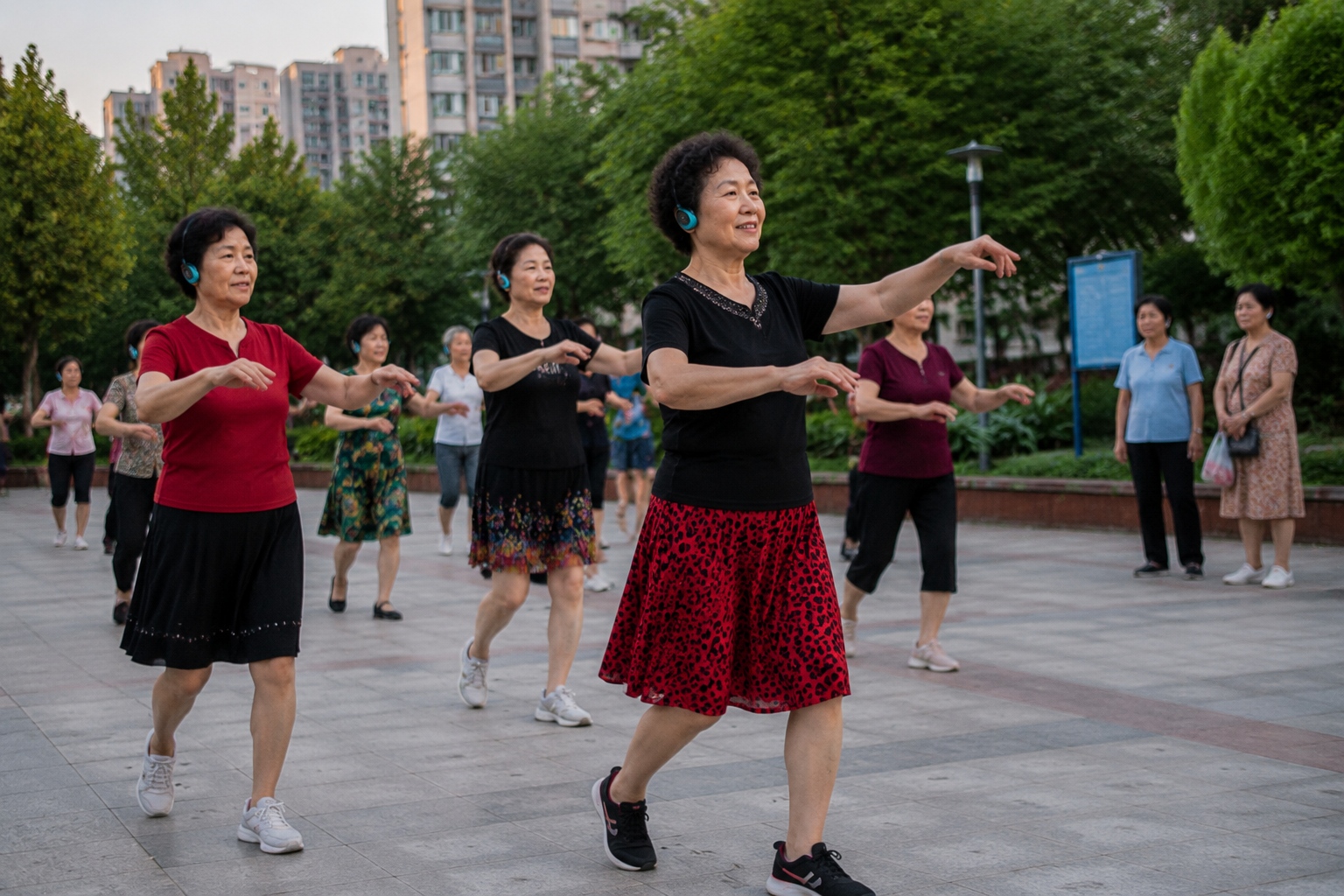
It’s 7:30 p.m. in the Caoyang New Village neighborhood in Putuo District, Shanghai. The summer air is warm and sticky. A group of around 60 people, mostly women in their 60s and 70s, stand in neat rows on a basketball court that has been repurposed for dancing. They wear colorful T-shirts and comfortable sneakers. In their ears, each has a small wireless headset, similar to the ones you see at a gym. Their movements are synchronized, but there is complete silence in the open space.
A passerby jogs past, glancing at them with mild curiosity. A father pushes a stroller a few meters away, chatting with his wife. Elderly residents sit on benches, playing chess or shaking a fan. The only audible sounds are the occasional chatter and the soft thud of sneakers on pavement. This is ‘silent square dancing,’ a scene that has become increasingly common across Shanghai.
Why Square Dancing Became a Headache
Square dancing, or guangchang wu, is a beloved ritual for millions of Chinese seniors. It’s a mix of folk dance, aerobics, and social outing. Every morning and evening, retirees gather in parks, plazas, and open lots to dance to Chinese pop songs, old hits, and even Western disco. It keeps them healthy and happy, and it’s a vital part of their social life.
But the music was always a problem. In dense Chinese cities, public squares are often just meters away from apartment buildings. Speakers pumped out beats at 80 to 90 decibels, easily drowning out TVs, reading, and sleep. A 2019 survey by the Chinese Ministry of Ecology and Environment found that noise complaints from square dancing accounted for a significant portion of all urban noise complaints—though exact figures vary by city.
Conflicts turned ugly in some places. In 2017, a man in Chengdu fired a shotgun at speakers. In Nanjing, a resident threw a bag of excrement at dancers. More commonly, arguments escalated into fights. Local governments responded with temporary bans and designating specific ‘dance zones,’ but enforcement was tricky. Dancers didn’t feel they were doing anything wrong—it was their only form of outdoor enjoyment.
The Simple Tech Leap: Headphones
The idea of using wireless headphones for square dancing didn’t come from a corporate boardroom. It emerged from a community committee in Baoshan District around 2016. The committee had been looking for a way to let residents dance without disturbing neighbors. Someone suggested borrowing the concept of a ‘silent disco,’ a party where people dance to music on individual headsets. It sounded unusual, but they decided to try.
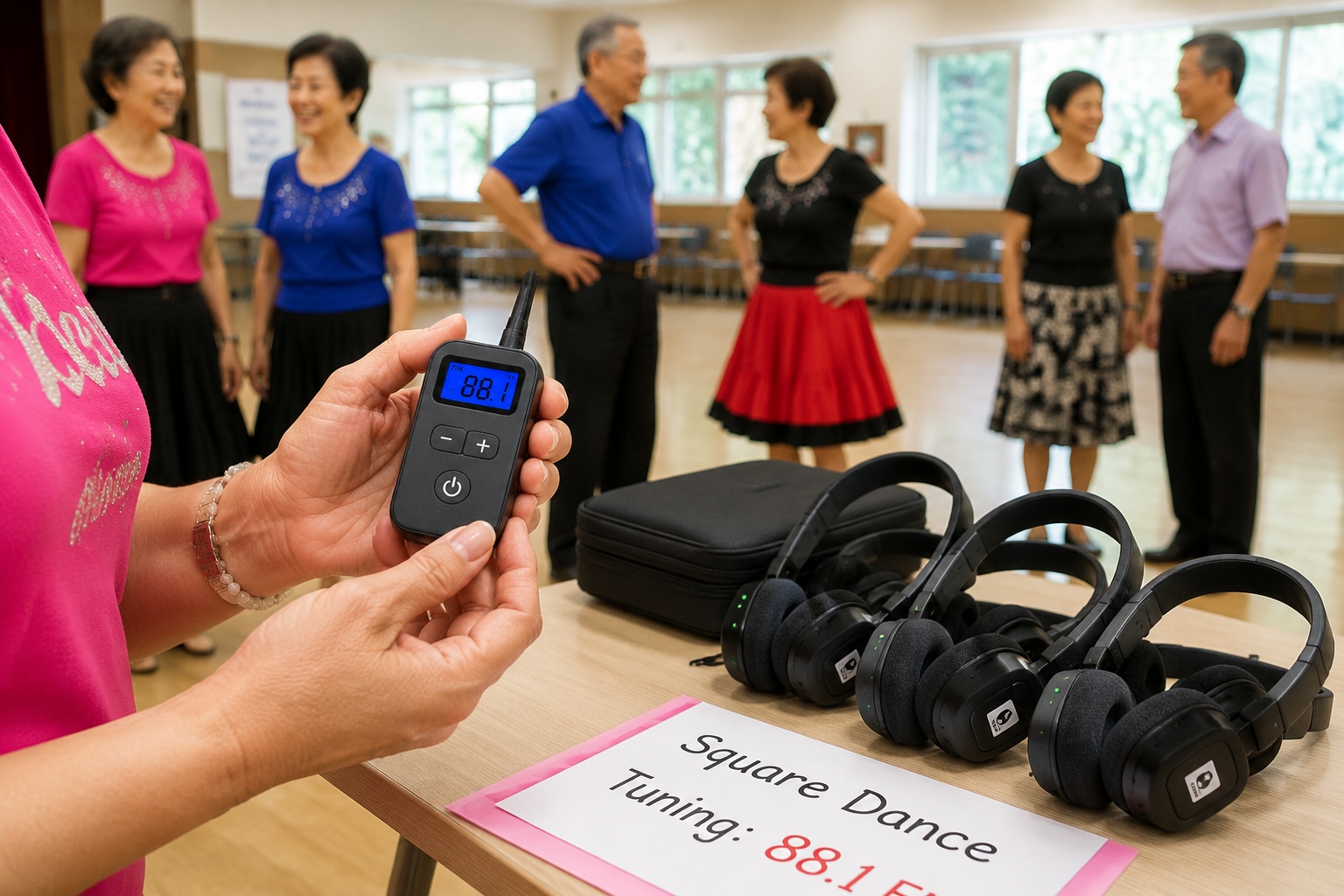
The setup is surprisingly simple. A dance instructor uses a small transmitter—roughly the size of a cable box—to broadcast music over a local FM frequency. Each dancer wears a headset receiver that tunes into that frequency. The audio comes through wirelessly, with no delay. The headsets are compact, weighing about 100 grams, and have a range of about 200 meters. They run on rechargeable batteries that last about eight hours.
The cost isn’t prohibitive. A quality headset costs around 300 to 500 yuan (roughly $40–70), and a transmitter costs about 1,000 yuan ($140). Community committees often use their small annual budgets or accept donations from local businesses. Some parks have even set up shared charging stations where dancers can plug in their headsets once they arrive.
What It Feels Like to Dance in Silence
At first, many dancers were skeptical. ‘I thought it was strange, like I was in a bubble,’ says 72-year-old Wang Aimei, who has been dancing for 20 years. ‘But after a few minutes, I got used to it. The sound is actually clearer because there’s no traffic or crowd noise. I can hear every beat perfectly.’
The headphones have another advantage: adjustable volume. Each dancer can turn the sound up or down based on their hearing. This is especially beneficial for older people with hearing loss. Some communities even produce special ‘dance audio tracks’ that include verbal cues for beginners.
For the community, the change has been transformative. ‘We used to close all our windows at 6 p.m.,’ says 45-year-old resident Pan Jie. ‘Now the park is quiet. I can hear my daughter practicing her piano. It feels like a different neighborhood.’ Property values in buildings facing the park have even been reported to stabilize, though real estate agents are quick to point out that many factors are at play.
How It’s Spreading Across China
Shanghai’s experiment quickly attracted attention. In 2018, the district government of Putuo published a ‘no-noise square dancing guidance’ encouraging all dance groups to use headphones. By 2021, more than 300 parks and public squares in Shanghai had implemented headphone-based dancing, according to the city’s environmental bureau. The approach has been adopted in more than 20 cities, including Beijing, Shenzhen, Guangzhou, and Chengdu.
Tech companies have also joined in. Several Chinese audio brands now sell dedicated square dancing headsets with features like long range, noise cancellation, and even move-your-head alerts to prevent neck strain. Prices have dropped as demand grows. A search on Taobao, China’s biggest e-commerce site, returns thousands of options, from basic models to high-end ones with Bluetooth connectivity.

Challenges and Limitations
The solution isn’t perfect. Some elderly dancers miss the ‘feeling of sound in the air’ and fear that dancing in silence makes the activity less fun. The headsets can feel uncomfortable during hot summer months or when worn with glasses. And not every community can afford the equipment. In poorer neighborhoods, dance groups have had to raise money themselves, which can drive away members.
There’s also the question of enforcement: What if some dancers still bring speakers? In most pilot locations, community volunteers help manage the transition, politely reminding newcomers of the headphone policy. The system works because it’s voluntary and peer-supported, not a police crackdown.
A Lesson for Urban Living
The silent square dance is more than a neat device. It’s an example of how Chinese cities handle what Harvard sociologist Daniel Bell calls ‘the tension between the right to the city and the right to a quiet home.’ By involving all parties—dancers, residents, and local officials—the community found a solution that respects everyone’s needs.
This kind of grassroots innovation doesn’t make global headlines. It doesn’t involve skyscrapers or high-speed rails. But it shows that practical problem-solving can happen at the street level. It also proves that older generations are not stuck in their ways.
As the evening wraps up at Caoyang, Wang Aimei takes off her headphones and chats with her friends. They’re already planning tomorrow’s practice. ‘We used to rely on the speakers to bring us together,’ she says, smiling. ‘Now the music is in our heads, but we’re still dancing to the same beat.’
The silence, it turns out, is the sound of a city learning to listen to everyone.
Start the discussion at forum.chinacomes.com