


Australian engineer Mark has lived in Beijing for five years. He has a new job waiting in Melbourne and a farewell dinner on Friday. But when he handed in his resignation, his HR manager gave him a checklist that contained one unfamiliar item: “tax clearance before leaving China.” Mark thought his employer had already deducted income tax from every paycheck, so why did he need any extra clearance?
His confusion is shared by many foreign professionals who have worked in China, taught a course, rented out an apartment, or received consulting fees during their stay. The short answer is: China’s tax law expects taxpayers with unpaid tax to settle it before they leave the country. In certain situations, that expectation turns into a formal requirement, and the “clearance” becomes a document you need to show.
This guide explains who must actually go through the exit clearance process, how the tax bureau decides whether you can leave, and what you should prepare if you are asked to produce a certificate.

What is “tax clearance” and why does Chinese law require it?
The legal basis is Article 44 of the Law of the People’s Republic of China on the Administration of Tax Collection (税收征收管理法). Under this article, any taxpayer who owes unpaid taxes and leaves China must first settle the tax due and related late fees, or provide approved security to the tax authority. If the taxpayer fails to do either, the tax authority can notify the immigration authorities to prevent the departure.
The law does not single out foreigners. It applies to any person with a tax obligation under Chinese law, including Chinese citizens who attempt to leave the country with unpaid taxes. The system is basically a tax exit guarantee. The “clearance” is a way to confirm that there is no outstanding balance in your tax account.
For most salaried employees, personal income tax is withheld monthly by the employer. When your salary is the only China-source income, the withholding records are generally enough to prove you have fulfilled your obligations. You probably do not need a separate tax-clearance document, no matter how many years you have worked in China.
Is exit tax clearance mandatory for every foreigner?
No. It is not a departure tax or a mandatory exit formality for every foreign resident. The trigger is an unsettled tax liability, not the act of leaving itself. In the normal case, an employed expat who has no other China-source income simply gets the last payslip and flies out. No tax office appointment is necessary.
However, clearance becomes relevant in a number of real-life situations:
- You have rental income from a Chinese apartment that you own or sublease and the monthly or annual tax has not been paid correctly.
- You did freelance work, consulting, public speaking, or any activity that produced China-source income without an employer withholding tax.
- You are a shareholder or legal representative of a Chinese company, and the company is undergoing a tax inspection or deregistration.
- You sold stocks, a property, or a business interest in China and the capital gains tax has not been settled.
- The tax bureau sent you a notice about an unreported item or a discrepancy between your bank records and your tax returns.
If you fall into any of these categories, the tax office may put a “tax arrears” flag on your file. When you appear at the airport, the system can show that you are on a list of taxpayers who owe money. In that case, you will not be allowed to leave until the matter is resolved.
How large an unpaid tax bill can block your departure?
There is no one-yuan trigger. The tax authority uses guidelines to decide which cases justify a departure ban. According to national guidance issued jointly by the State Taxation Administration and the Ministry of Public Security, an individual taxpayer is generally listed for departure restriction when the outstanding unpaid tax reaches RMB 100,000 or more; for a company, the threshold is RMB 1,000,000 or more. Local offices may apply different operational standards, so always check with the district tax bureau that covers you.
For smaller amounts, the file does not normally lead to an airport ban. You will probably receive a reminder by phone, email, or through the “Individual Income Tax” app. It is never a good idea to ignore reminders, because late fees accrue automatically and the small amount can eventually grow, or the case can be escalated if you do not respond.
A separate rule also allows border officers to stop you if you are listed as a “tax evasion suspect” in a criminal case, but that is rare and is handled by the tax police rather than through routine clearance.
Step-by-step guide to getting tax clearance before you leave China
If you are asked to produce a tax clearance certificate (清税证明), or you simply want to be certain that no old tax debt will follow you home, here is the practical sequence.
Step 1: Run a check of your personal tax account
Use the “Individual Income Tax” app (it has an English version) or log into the Natural Person Electronic Tax Service (自然人电子税务局). You can view your annual income summaries, tax withheld, any unpaid balances, and outstanding filing obligations. Print the relevant pages or take screenshots. If you have no unpaid balance and no irregular records, you may not need to do anything more.
Step 2: Gather the paperwork
Prepare the documents listed in the next section. It is better to bring extra copies than to queue twice.
Step 3: Book an appointment at the tax service hall
In large cities such as Shanghai, Beijing, Guangzhou and Shenzhen, you can book a tax service appointment on the official WeChat mini-program of the local tax bureau or on the electronic tax platform. Search for keywords like “预约办税” or “办税服务厅预约”. Some tax service halls accept walk-ins, but you may wait an hour or more.
Step 4: Submit your application
At the front desk say you need “离境清税” (tax clearance for departure). The staff will give you a short form to fill in, or direct you to a self-service machine. The counter officer will run a check across your files. You may need to visit a different counter for taxes other than personal income tax, for example property tax if you own a Chinese apartment.
Step 5: Pay what you owe or start a refund
If you owe tax, you can usually pay immediately with a Chinese bank card or via Alipay/WeChat. If you are owed a refund, the tax office will ask for your Chinese bank account details and process it within a few working days. Do not expect cash on the spot.
Step 6: Receive your clearance certificate or confirmation
If your records are clean, the tax office may issue the document on the same day. In complex cases involving corporate income or capital gains, expect anywhere from two to ten working days. Ask for both the original stamped document and a photocopy if you need to submit it to your employer or an overseas tax authority.
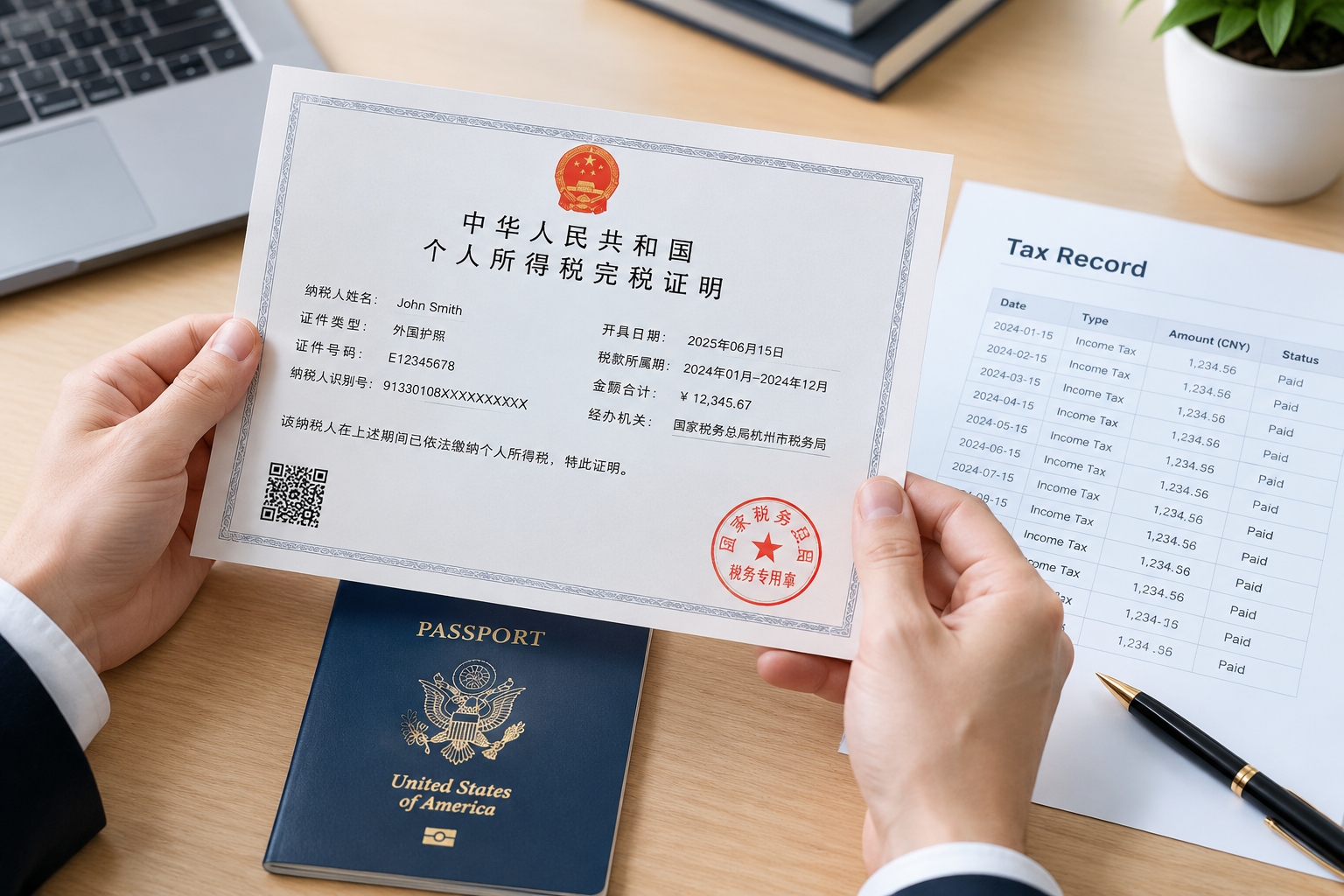
What documents do you need for exit tax clearance?
Be prepared to show the following, in original plus a photocopy:
- Passport main pages and the current residence/work permit page.
- A letter from your employer showing you have ended your employment, if you were employed.
- Your last monthly payslip or the final tax withholding certificate issued by your employer.
- Individual income tax payment records downloaded from the “Individual Income Tax” app.
- Rental contracts, service contracts or share transfer agreements, if you have non-employment China-source income.
- Proof of address, such as a property registration certificate or rental contract, because your tax file is linked to a district.
- If an agent handles the application for you, a signed power of attorney plus the agent’s ID and passport copy.
Do not rely on memory. If you changed employers in China, check your entire tax record with the app, not just the current employer’s records. A former employer might have forgotten to remit your withheld tax, and you would not know until the check.
What happens if you skip the clearance process?
If you truly owe no tax, skipping the process has no direct consequence. If you owe tax that has not been settled, the possible outcomes are serious:
- You can be blocked at the border. The immigration officer sees the tax bureau’s “restricted exit” notice and does not let you board.
- Late fees and penalties grow. Unpaid Chinese tax carries accruing late fees and, in some cases, fines of 50% to 500% of the unpaid amount for false declarations.
- Your name may appear in a public dishonesty list. In severe cases, tax authorities publish a list of “major tax violations” that includes foreigners; this can affect banking and future visa approvals.
- Returning to China becomes harder. If you are a former legal representative of a Chinese entity or a shareholder in an asset sale, an unsolved tax record will remain in the system and may emerge when you reapply for a work permit or open a new business.
If you have already left China and later learn that you owed tax, you should not simply ignore it. You can authorize a Chinese tax agent to pay the debt and obtain the clearance document for you. Personal income tax cases can also be resolved through the electronic tax system with an overseas mobile phone number or by contacting your former employer.

Practical tips for a smooth departure
- Start early. Begin checking your tax records at least three weeks before your planned departure date.
- Use the free tax app. Do not rely on HR or a paid agent when you can see your own balance in five minutes.
- Ask about the annual reconciliation. Chinese residents and taxpayers must file an annual income tax reconciliation between March and June each year. If you leave before April, you may need to perform an early settlement before the standard filing season.
- Keep your documents. Even after you leave, keep the tax clearance certificate, payment receipts, and contact details of your local tax office. They will be useful if an overseas tax authority asks about double taxation.
- Local practice can vary. Shanghai, Beijing, Guangzhou and Shenzhen all have slightly different service hall procedures. If a friend tells you their experience in another city, double-check with the tax hotline 12366 (English service is available in larger cities).
For Mark, the app showed five years of correct withholding and no extra income. He stopped by the tax hall near his office, got a confirmation stamp from the counter in about 30 minutes, and was able to enjoy his farewell dinner without worrying about an airport surprise.
The tax-clearance process is not a punishment. Think of it as the final line-item check before you close your Chinese chapter. When you know before you fly, it is just one more step in an already long checklist.
Start the discussion at forum.chinacomes.com