


Maria Needs to Send Money Home. Now What?
Maria, a British lighting designer, has been living in Hangzhou for three years. Her mother’s birthday is coming up, and she wants to send £5,000 as a gift. Back in London she would simply press ‘send’ in her banking app. In China, she has to do two steps first: convert her yuan into pounds, and then transfer the pounds to her mother’s UK bank account. As she opens the mobile app of her Chinese bank, she wonders: is there a limit? Do I need to prove the purpose? How long will it take?
If you are an expatriate in China, you have probably asked the same questions. The good news is that China’s personal foreign exchange rules are easier to handle than they seem. Here is what you need to know about the annual USD 50,000 equivalent quota, what you can use it for, and how to move money abroad safely and legally.
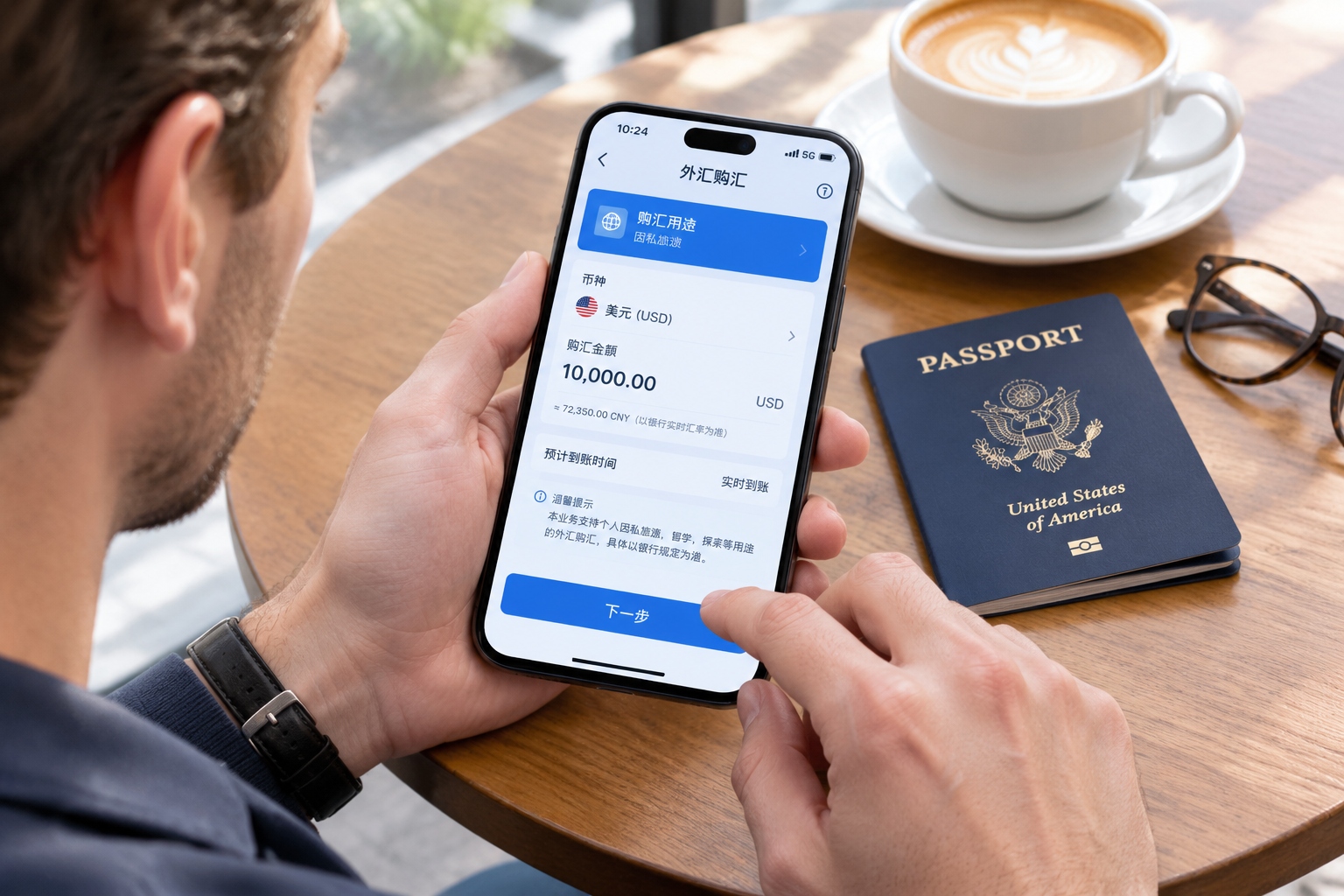
What Exactly Is the USD 50,000 Annual Quota?
Under China’s foreign exchange regulations, each individual is allowed to buy and sell foreign currency within a simplified annual quota of up to USD 50,000 (or the equivalent in another currency) per calendar year. This is called the personal convenience quota (年度便利化额度) and it resets every January 1.
The quota covers two operations:
- Buying foreign currency (购汇) – turning your yuan into US dollars, euros, British pounds, Japanese yen or another currency.
- Selling foreign currency (结汇) – converting foreign currency back into yuan.
The limit is combined. If you buy the equivalent of USD 30,000 in March and later sell USD 15,000 in June, you have used USD 45,000 of that year’s allowance.
Who Can Use This Quota?
The convenience quota is not only for Chinese citizens. In practice, foreigners who are lawfully resident in China and hold a bank account can also use the same annual quota when purchasing currency at a counter or through a mobile app. A valid passport with a work or residence permit is usually enough. If you hold a Chinese Permanent Resident ID (the so-called China green card), the bank treats you as a domestic individual and you get the full application of the quota.
Short-term visitors on tourist visas may face stricter checks, but most expatriate residents use the quota each year without handing in employment contracts or tax slips.
What Can You Legally Use Your FX Quota For?
When you buy foreign currency, the app asks you to state a purpose. These are the standard lawful personal non-investment reasons:
- Overseas travel – paying for flights, hotels, meals and shopping while abroad.
- Studying outside mainland China – tuition fees and living expenses at a foreign university or language school.
- Medical treatment abroad – hospital bills or clinical care outside China.
- Family support (赡家款) – sending money to relatives who live overseas.
- Other personal expenses – conference registration, association membership, legal fees, visa fees and similar.
Not allowed: investing in overseas stocks, funds, bonds, buying foreign real estate or purchasing offshore insurance policies. Those are capital-account purposes, and the convenience quota cannot be used for them.
When Do You Need Extra Paperwork?
Within the USD 50,000 annual amount, you usually do not need to show invoices or contracts. You simply submit the electronic application.
However, you may be asked for supporting documents in these situations:
- You exceed the yearly quota. Purchasing more than USD 50,000 equivalent in one year requires a visit to a branch and genuine proof, such as an admission letter and fee schedule for tuition, or a medical bill. The bank checks and then handles the extra amount.
- Your transaction is flagged by compliance. If you often buy FX, receive wire transfers from several countries in a short period, or send funds to a person whose name does not obviously match your reason, the bank may ask you to explain the source and use of funds.
- You want to take out foreign cash. Daily cash withdrawal rules are stricter than the annual quota. Branches may need advance notice for cash above the equivalent of USD 1,000.
Keep records linked to your declaration for at least five years in case the bank or State Administration of Foreign Exchange carries out a spot check.
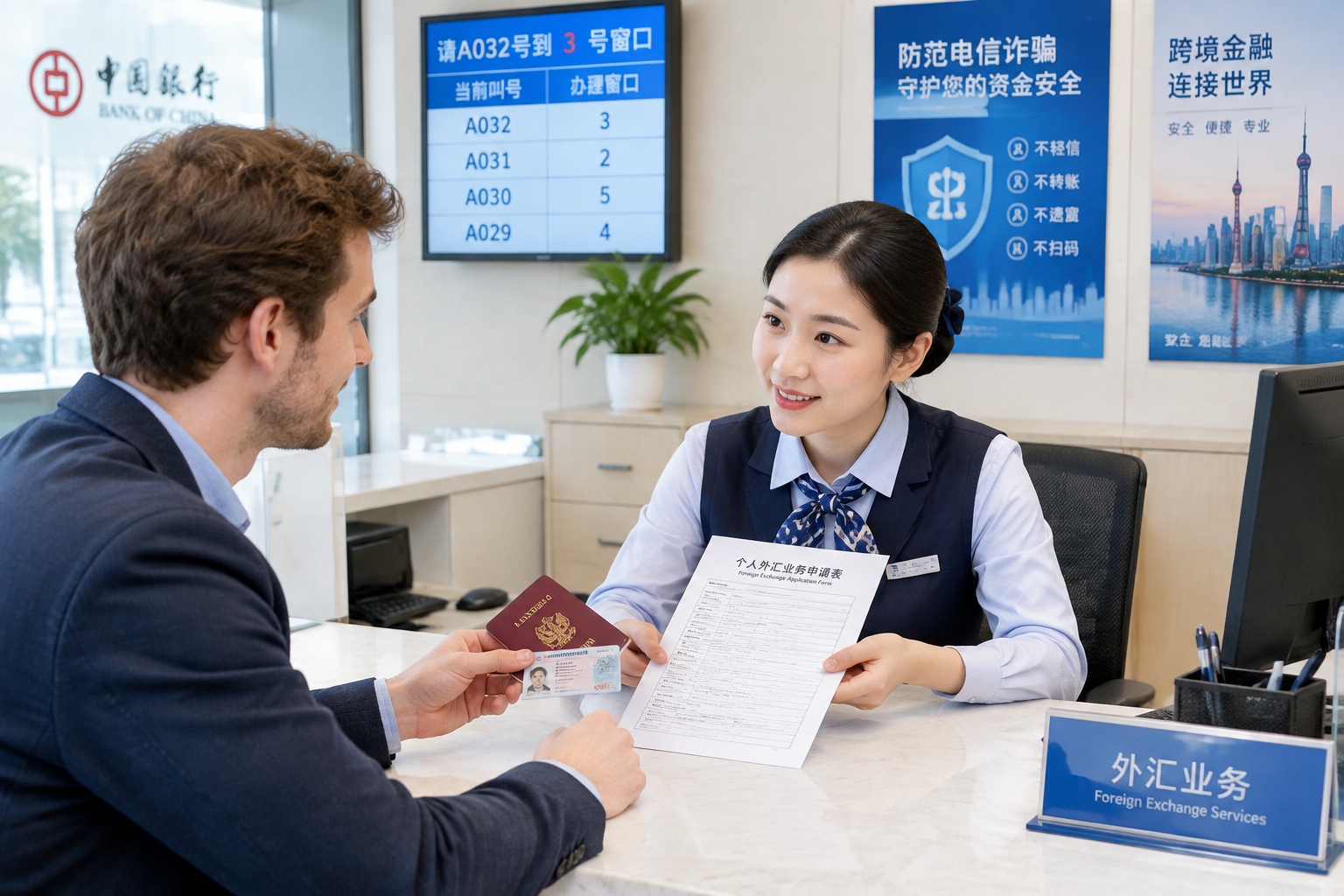
Step-by-Step: Buying FX and Sending Money via Mobile Banking
Most expats use mobile banking to buy foreign currency and make international transfers. The basic flow at major banks such as Bank of China, ICBC and China Merchants Bank looks like this.
Step 1: Activate cross-border functions on your account
If your account was opened for local use only, turn on multi-currency features. You can do this in the bank’s app or at a branch, and you will need your passport, residence permit and sometimes a local address.
Step 2: Open the foreign exchange section
Log in to the mobile app and look for ‘Cross-Border Finance’ or ‘Foreign Exchange’. Tap ‘Buy FX’ or ‘结售汇’. The first time you buy, the bank may automatically create a foreign-currency account for you.
Step 3: Choose the currency and amount
Select the currency you need, for example British pounds, and enter the amount. The screen shows the exchange rate and your remaining annual quota. If you plan to send the money overseas, make sure you are buying FX in account form (现汇), not cash (现钞).
Step 4: Complete the electronic application
An application form appears. It reminds you that the purchase must be for personal current-account needs and cannot be used for investment. Pick the correct purpose and type the confirmation sentence if required. Be accurate – this declaration is legally binding.
Step 5: Confirm and hold the currency
Double-check the exchange rate and the exact yuan amount, then confirm. The foreign currency is now deposited in your FX account.
Step 6: Send the international remittance
In the same app, go to the ‘Remittance’ or ‘Overseas Transfer’ menu. Fill in the beneficiary’s name, their account number (for the UK use sort code and account number; for the US use ABA number; for Europe use IBAN), the receiving bank’s SWIFT/BIC code, and sometimes the bank address. Select your FX account as the debit source, enter the amount and submit. The bank will do the regulatory reporting for you, so you only need to provide accurate details.
Fees and Timelines
The exchange rate displayed on mobile banking already includes the bank’s spread, so there is usually no separate purchase fee. For an international wire, banks charge roughly CNY 30–150, and if you choose shared costs, intermediary banks may deduct USD 10–30 from the transferred amount. To make sure the right sum arrives, consider sending a little extra.
Transfers typically arrive within 1–2 business days. Submit before 4 pm on a working day to speed things up and avoid weekends, when many foreign banks do not process payments.
Common Pitfalls to Avoid
- Do not split your purchase. Asking several friends to buy FX and send money for you is illegal. The system sees the pattern and may freeze your account.
- Never lend your quota to someone else. Buying FX for a third-party remittance violates the rule that the quota is for your own lawful use. Break it and you can be blacklisted for five years.
- Avoid putting ‘investment’ as your purpose. It will be rejected immediately.
- Type the beneficiary details carefully. A wrong account number can cause lost funds or require expensive recovery.
- Keep your remittance consistent with your reported income. If the amount is unusually large for your salary level, the bank may ask for payroll evidence.
What If You Need to Send More Than USD 50,000?
The quota is a convenience lane, not an absolute limit. For a genuine purpose above USD 50,000, visit a branch with written evidence such as tuition invoices or a medical estimate. For salary remittance, bring your employment contract and salary slips for the period. The bank will process the excess after an internal review.
Another route is to ask your employer to remit part of your salary directly to your overseas account through their corporate channel. Not every firm offers this, but multinational companies often do.
Final Thoughts
The annual USD 50,000 facility is designed to make life easier for individuals who need to handle money across China’s borders. For foreigners, the system is workable: get a bank account, always state an honest purpose, stay within the quota when you can, and use the formal banking system. You do not need black-market money changers or risky workarounds.
As Maria discovered, buying the pounds she needed took less than five minutes, and the funds reached her mother’s account in two days. The rules are clear once you know where to look – and now you do.
Start the discussion at forum.chinacomes.com