


Standing in the arrivals hall at Kunming Changshui International Airport, I read the departure board without meaning to: flights to Bangkok, Vientiane, Hanoi, and Kathmandu. Around me, Thai tour groups compare notes with Chinese traders, while a family heading to Laos drags luggage stacked with tea boxes. The airport itself is a clue to Yunnan’s position: a clean, mountain-set gateway that feels closer to Southeast Asia than to Beijing or Shanghai.
I came to Yunnan to understand how a single Chinese province can be both an economic corridor and one of Asia’s most captivating travel destinations. I stayed for ten days, walking through old towns, riding new railways, and talking with entrepreneurs who divide their time between Kunming and Bangkok. What I found was a province that moves easily between headquarters-style efficiency and cloud-shrouded villages, often in the same week.

Kunming: The “Bridgehead” City
Yunnan’s capital has always served as a meeting point. Ancient caravan routes from Sichuan and Tibet crossed here on their way to Burma. During the Second World War, the Burma Road made Kunming a lifeline for allied supplies. Today it is the logical opening of China’s Belt and Road cooperation toward Southeast Asia. The city hosts the annual China-South Asia Expo, where Vietnamese coffee exporters, Thai EV parts makers, Myanmar energy firms, and Malaysian tech founders set up booths. In the business districts around Dianchi Road and Green Lake, it is normal to hear Mandarin mixed with English as brokers chat about freight rates to Chiang Rai or logistics delays in Manila.
Leisure visitors usually start at Green Lake Park (Cuihu). On a sunny weekend, parents sell soap bubbles to toddlers, retired opera singers perform above the lotus pond, and black-headed gulls winter over from Siberia, begging for bread next to students practicing badminton. Just behind the lake, the old neighborhood of Wenlin Street has become a coffee quarter. Yunnan coffee is a side of China that surprises many outsiders. The province produces over 98 percent of the country’s coffee, mostly in the subtropical hills near Pu’er and Baoshan. Boutique roasters in Kunming buy from small farms and sell pour-overs at prices that downtown Tokyo cafés would envy. It is the perfect place to hold a pitch meeting or catch your breath.
The New Railways Tipping the Map
Until a few years ago, getting from Kunming to the Mekong countries meant a long flight or a bumpy mountain road. That changed when the China-Laos Railway opened in December 2021. High-speed trains now run from Kunming to Mohan on the Chinese border, cross into Laos, and continue to Vientiane. The travel time from Kunming to Vientiane is around ten hours, and the rail line cuts freight time from weeks to days. After this, plans are underway to extend the line toward Thailand and eventually to Singapore, connecting Yunnan to much of Southeast Asia.
This rail project matters for travelers, too. You can wake up in Kunming, eat lunch in the border town of Xishuangbanna, and sleep in Luang Prabang in Laos. For business travelers, it means you can inspect a supply chain in Kunming’s high-tech zone, then hop south to visit a processing plant in Vientiane—all in the same trip. Inside Yunnan, the rail network is just as efficient. Bullet trains reach Dali in about two hours, Lijiang in three, and the area around Shangri-La in the north in roughly four.
Dali: Where the Mountains Meet the Lake
I took the first morning train from Kunming to Dali. The carriages were quieter than expected—families, backpackers, a businessman answering emails on his phone. As the train passed between red-soil hills and white-washed villages, glimpses of Erhai Lake appeared, a rectangle of blue so still that it looked like a flooded rice field.
Dali old town sits between the lake and the Cangshan mountain range. Its alleys are packed with cafes selling banana-coconut parfaits, jewelry workshops, and stores selling fresh-squeezed fruit juice. For all the tourism, the Bai ethnic identity remains strong. Prayer flags, hand-cobbled lanes, and the traditional “front house, back garden” architecture are on full display. Near the West Gate, I watched a Bai woman in a white-and-red headdress set up a stall of pickled pears, and talked to her about her family’s hillside orchard. Not far away, a group of young Chinese remote workers laughed over flat whites inside a community-run guesthouse.

For businesspeople, Dali is not just a leisure detour. The region has become a hub for eco-agriculture, organic flower growing, and wellness tourism. Several international investors I met were looking at Yunnan’s ginger, mushrooms, and specialty fruits. A few days here can help you understand the source of many ingredients that end up on tables in Shanghai or Singapore.
Lijiang: An Old Town with a Living Heritage
Lijiang lies another hour or two north by road—close enough that many travelers visit as a day trip from Dali, but it deserves a slower look. Its UNESCO-listed old town is a labyrinth of canals, stone bridges, and wooden houses with heavy doors. During the evening, the square fills with tour groups, but the crowds fade by the time the lanterns come on. The most interesting part is the network of lanes leading to Baisha, a quieter market town ten kilometers away. This is where you can see village murals, listen to elderly Naxi women bargaining in their own dialect, and perhaps watch an artist use the Naxi script—one of the few pictographic writing systems still in use.
Lijiang’s famous Jade Dragon Snow Mountain rises over the old town’s eastern edge. The summit, at almost 5,600 meters, is a photogenic backdrop even when you don’t plan on hiking it. The mountain has a cable car for those who want to get close to the glacier—though altitude sickness is a real consideration above 4,000 meters.

Ethnic Mosaic and a Tropical Southerly
If you only follow the classic Yunnan route, you might leave with the impression that Yunnan is all mountains and cool lakes. Head south, and you enter a different world. A one-hour flight from Kunming drops you into the tropical basin of Xishuangbanna, where the Dai people celebrate the Water Splashing Festival every April, and temples with curved roofs echo Thai architecture. Business travelers with an interest in agro-industry or tea often make the short hop to meet smallholders in the famous Pu’er tea mountains or explore rubber plantations that supply global tire makers.
Yunnan itself is the most ethnically diverse province in China. More than 25 officially recognized minority groups live here, each with its own language, dress, cuisine, and festivals. In the course of a few days, you can go from Bai architecture in Dali to Tibetan prayer flags near Shangri-La and Dai Buddhist temples by the Mekong. For business visitors, this diversity is not just a tourist attraction—it also means a rich supply chain of local knowledge and skilled craftsmanship, much of it increasingly exported.
Natural Marvels: Stone Forest and Rice Terraces
One of the most popular day trips from Kunming is the Stone Forest, a 350-square-kilometer maze of karst pillars that rise from the ground like petrified trees. The local Sani people have legends about the forest, and it is easy to see why it inspired them: the stone columns are set at angles that look entirely impossible.
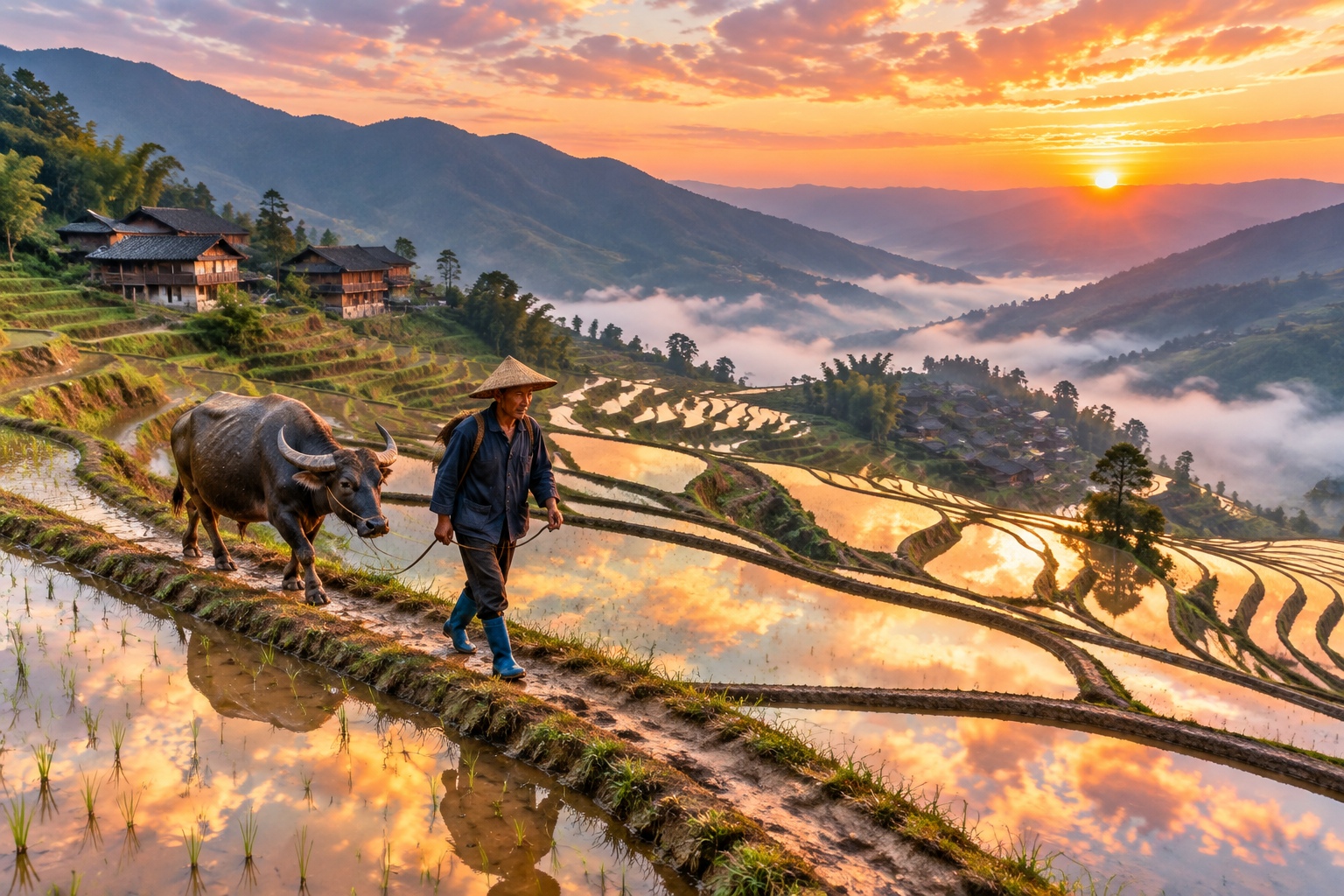
In the southeast, near the Hani villages of Yuanyang, the landscape changes again. There, rice terraces cascade down hillsides for thousands of meters. In winter and spring, water fills the paddies, turning the slopes into mirrors that catch the sunrise. The terraces are more than a beautiful photo spot—they are a functioning farming system, used continuously for centuries, and they have been named a UNESCO World Heritage site.
Designing a Business-and-Leisure Itinerary
Based on my own travel and conversations with people who combine work and holidays here, a five-day route is the sweet spot. Here’s a practical plan:
Day 1: Arrive in Kunming. Spend the afternoon at Green Lake, eat and meet at Wenlin Street. If you are attending a conference or an expo, schedule it for a later day or give yourself an extra day.
Day 2: Take a slow morning, visit the Stone Forest, and return by evening. You can pack a short meeting or a factory visit around this trip if you are comfortable with a longer day.
Day 3: Board the bullet train to Dali (2 hours). After checking in, cycle part of the Erhai Lake path, then have dinner in the old town.
Day 4: Spend the morning visiting a Bai organic farm or a local cooperative, or simply hike into the Cangshan foothills. Take the afternoon train to Lijiang (2–3 hours).
Day 5: Dwell in Lijiang’s quieter lanes, take a half-day trip to Baisha, and fly or take the train back to Kunming in the evening. If you have an extra day, use it for the Jade Dragon Snow Mountain cable car or a flight to Xishuangbanna.
Good to Know for a First Trip
- Best time to visit: April to October are warm, but the most stable skies arrive in October–April. For the rice-terrace reflections, come between January and March.
- Getting around: High-speed trains connect Kunming with Dali, Lijiang, Shangri-La, and other towns. Xishuangbanna is easier by plane. Renting a car with a driver is common for remote areas.
- Language: Mandarin is the common language. In rural minority areas, English is less common; it helps to have key phrases in your phone or a bilingual colleague.
- Visa: You will need a valid visa to enter China. For cross-border trips into Laos on the railway, make sure your passport has enough blank pages and carry a Lao visa or e-visa printout.
- Health and altitude: Yunnan’s plateau cities are at 1,500–2,400 meters above sea level. Most visitors adjust within a day or two. Stay hydrated, avoid alcohol in the first 24 hours, and take altitude symptoms seriously.
Returning for the Other Reason
By the time I reached the viewpoint outside Dali at dusk, I had visited a coffee roastery, a logistics terminal, a rural monastery, and a lake that looked like a sheet of blue mirror. Yunnan leaves you with a rare duality: it feels like an underrated business post and a postcard that keeps on giving. If you come to negotiate deals, you’ll leave with photographs that make your friends jealous. If you come to escape the city, you’ll probably still find yourself jotting down prices and contacts for the next idea. That’s the trick of this region—it connects your business mind to the kind of calm that usually comes only after a long vacation.
Start the discussion at forum.chinacomes.com