
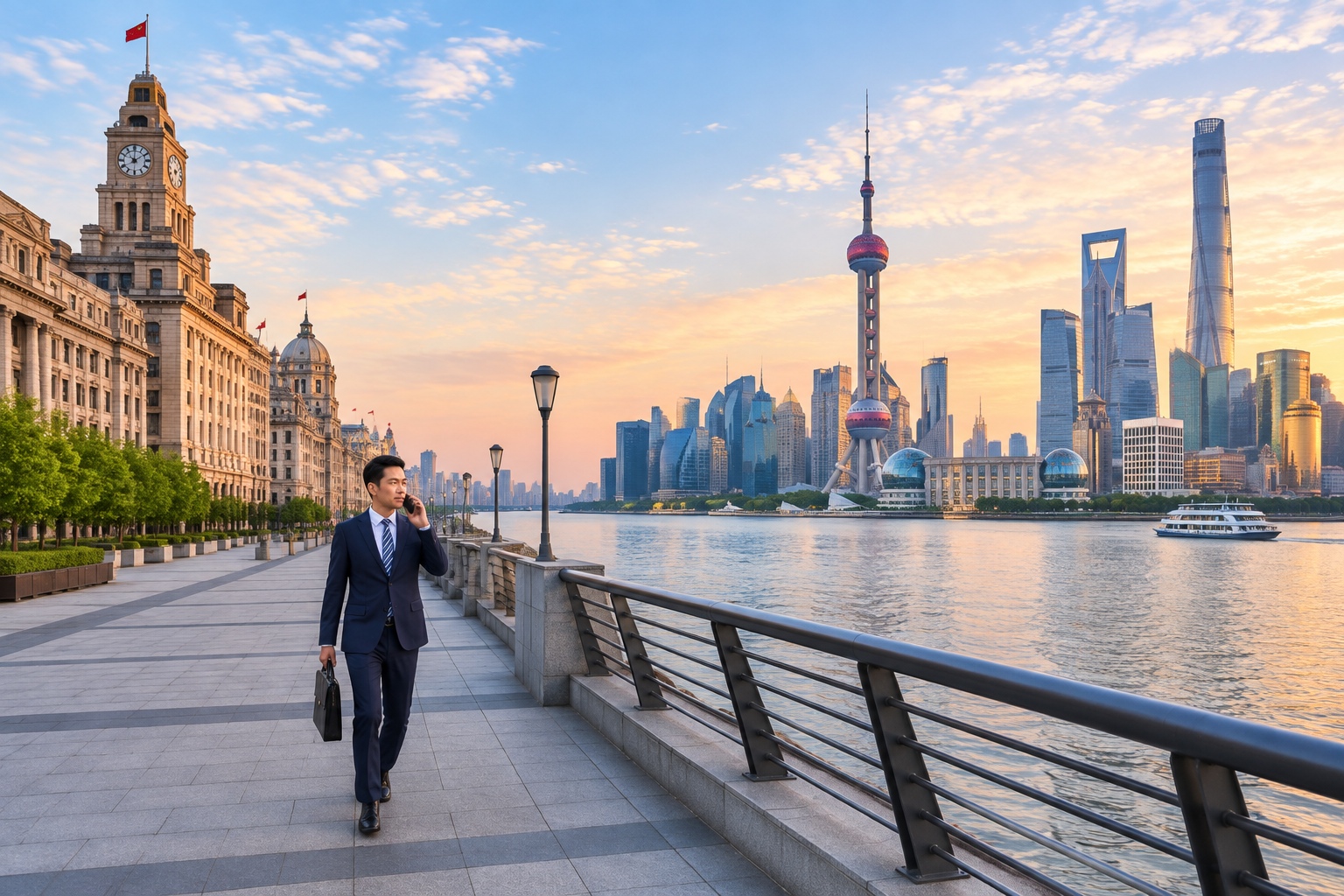

Mid-afternoon in Shanghai. You have just left a meeting on the 40th floor of the Jin Mao Tower, and now you’re standing on the walkway outside, briefcase in hand. The Lujiazui skyline around you is a vertical financial village; across the Huangpu River, the old granite buildings of the Bund catch the golden light. In one frame you see the reason to travel here: China’s past and its future, doing business side by side.
Lujiazui: The Vertical Financial Village
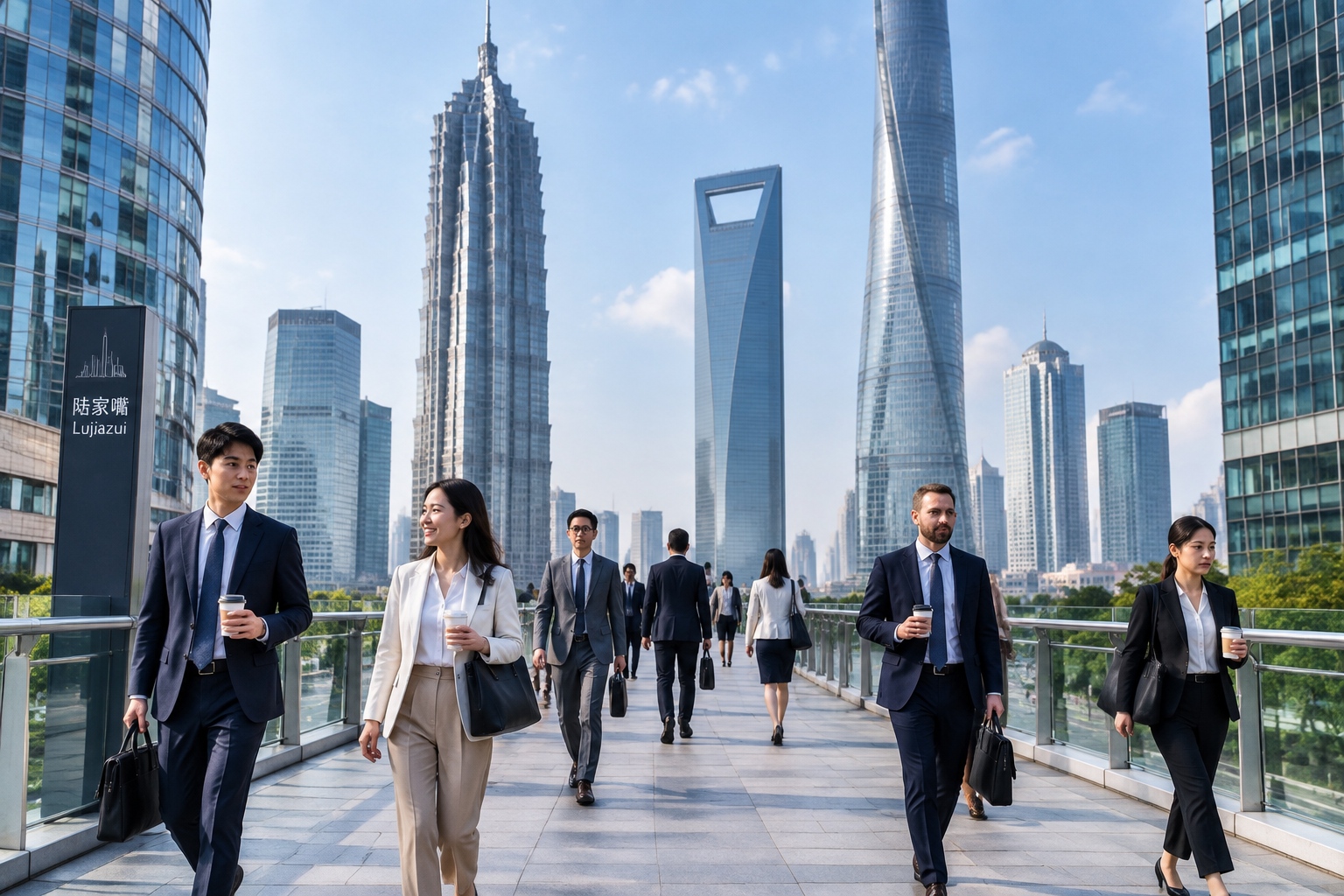
Thirty years ago, Lujiazui was mostly empty farmland. Today it is China’s most concentrated financial district. Banks, asset managers, commodity houses and trading floors fill the Jin Mao Tower, the Shanghai World Financial Center (SWFC) and the 632-meter Shanghai Tower, which is China’s tallest building. The skyscrapers here are not just for postcards. When you enter a meeting room on the 50th floor, you are literally seated at the center of the country’s capital flows.
For client meetings that impress, choose a hotel or lounge in one of the three top towers. The Grand Hyatt lobby in Jin Mao and the coffee bars on the Shanghai Tower’s higher floors have views that will do part of the convincing for you. If your meeting is less formal, use the Lujiazui Overpass — a circular pedestrian bridge that connects the towers and gives you an easy orientation. Between sessions, dine at the IFC Mall or Super Brand Mall, but avoid the entrance queues after noon. If you can spare 20 minutes, walk down to the Binjiang Riverside Park. It’s quiet enough for a return phone call, and you will be facing the old city skyline while talking about the new one.
Jing’an Temple: Old Shanghai as the Middleman
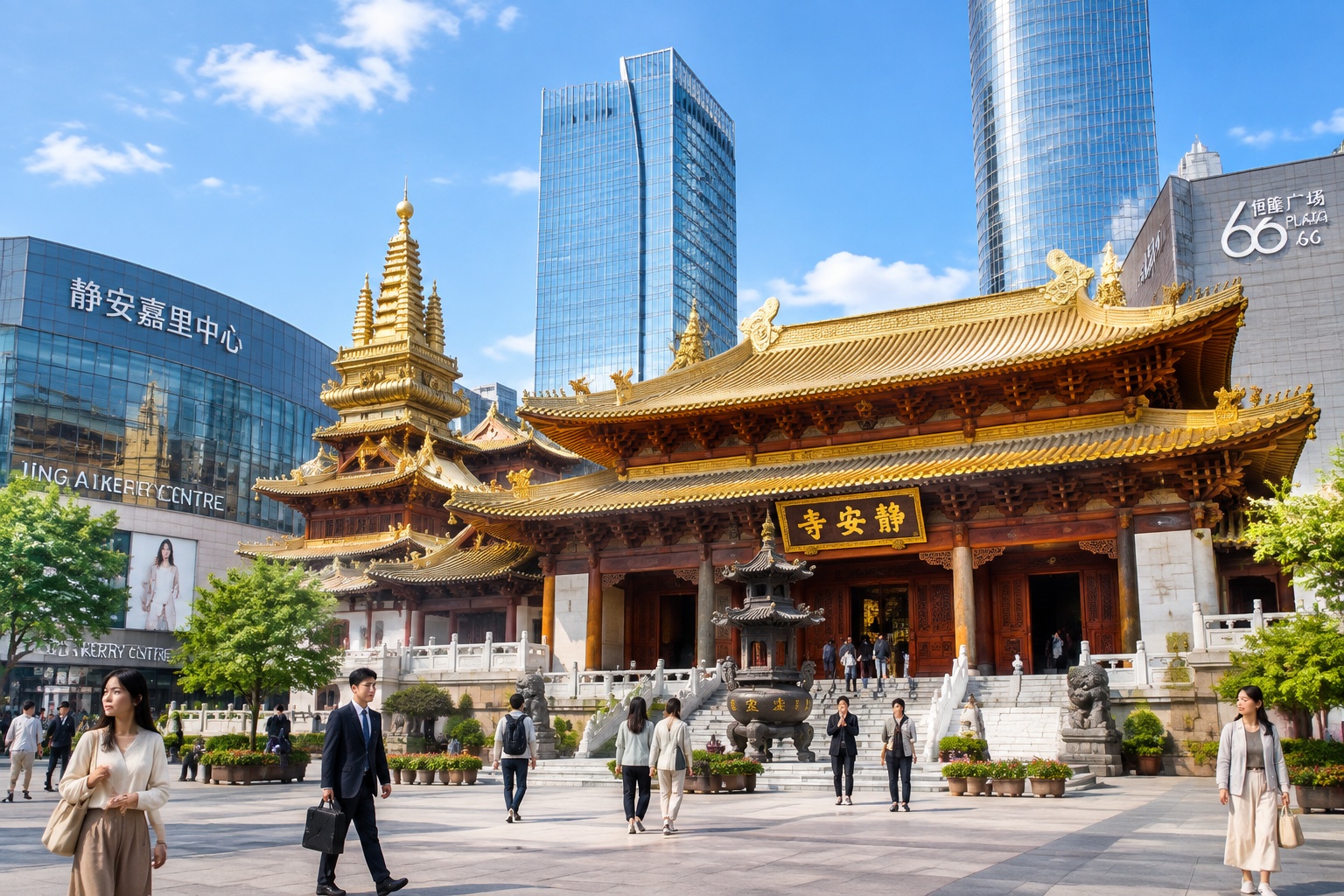
Take Metro Line 2 from Lujiazui to Jing’an Temple — four stops, about twelve minutes, no traffic. The district around West Nanjing Road is Shanghai’s second great business hub. In the glassy malls and office complexes of Kerry Centre, Reel Mall and Plaza 66, you will find the China head offices of many technology, retail and lifestyle companies.
What makes Jing’an an essential business stop is its balance. The actual Jing’an Temple, originally founded more than 1,700 years ago, sits right in the middle of the shopping district. If a local client says, “Let’s meet near Jing’an,” they are choosing a place that is modern, convenient, and still unmistakably Shanghai. After talks, walk through Jing’an Park and head to one of the nearby streets for a relaxed lunch with no office pressure.
Compared to Lujiazui, meetings here feel less hierarchical. Executives from e-commerce, media and consumer brands often prefer the area because it is easier to move from a boardroom to a coffee shop to a dinner table without long transfers.
The Bund: A Wall Street with a River View
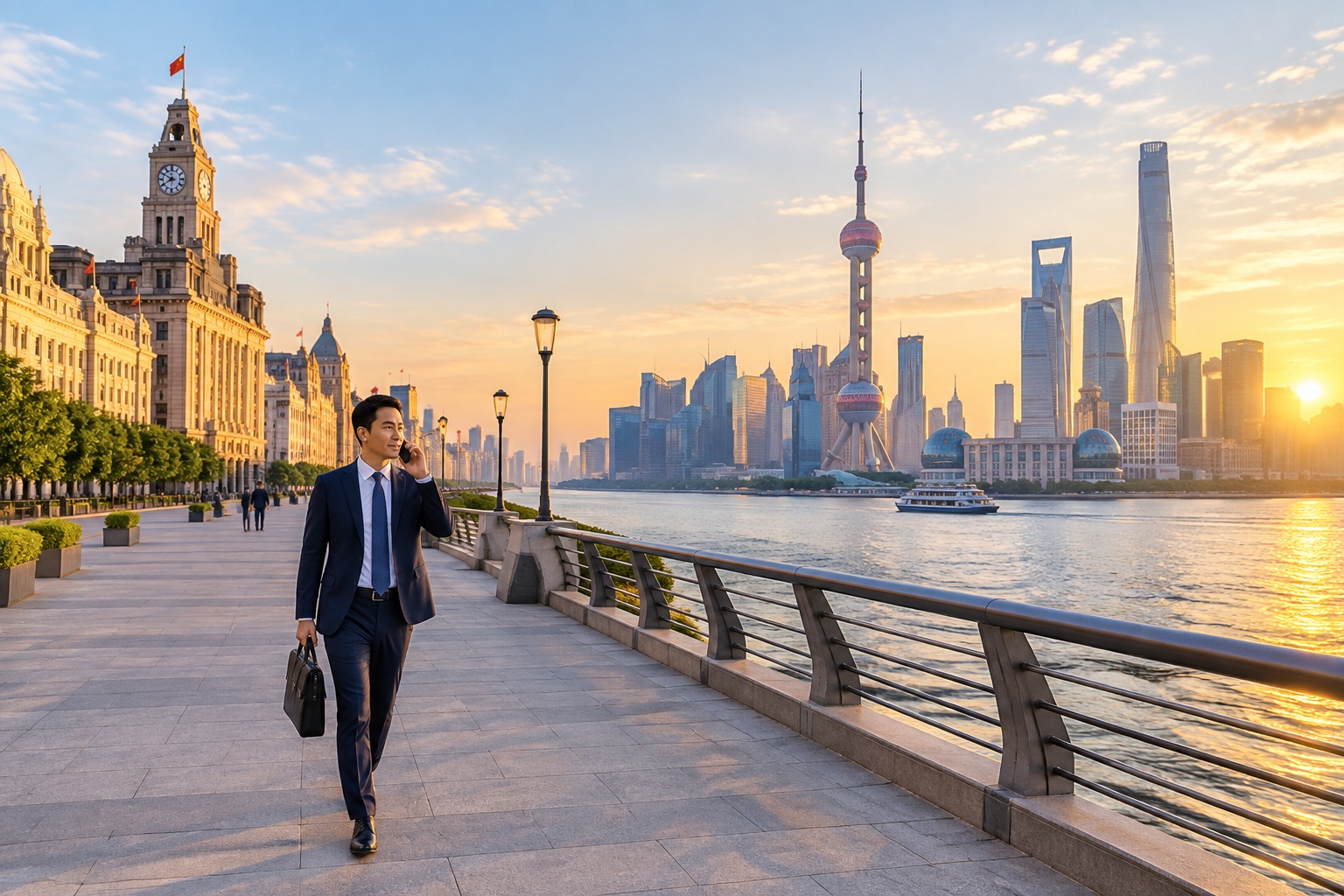
If your schedule permits a late-afternoon break, cross back to the west side of the river and walk the Bund. The grand stone buildings on Zhongshan East 1st Road were once headquarters of British, French, American and Japanese banks and trading houses. They now hold a mix of offices, Chinese banks, government institutions and heritage hotels. But you don’t need an invite to experience the place.
Start at the Waibaidu Bridge, walk south along the river, and as you pass the former HSBC Building — now used by Shanghai Pudong Development Bank — step into its lobby. The dome frescoes are partly covered today, but the building still feels as powerful as it did a century ago. A few blocks down is the Peace Hotel, founded by Victor Sassoon in 1929. Book afternoon tea in its lounge, listen to the old jazz band, and notice how many local businesspeople have chosen this exact spot for a first serious talk.
If you want to keep it simple, the riverside promenade itself is a fine walking-meeting venue. On weekdays, crowds are moderate. In the late afternoon, the sun lights up the glass towers of Lujiazui while it sets behind the old buildings — the city switches on its evening lights while you finish your call.
The Former French Concession: Café Diplomacy at Its Most Civilized
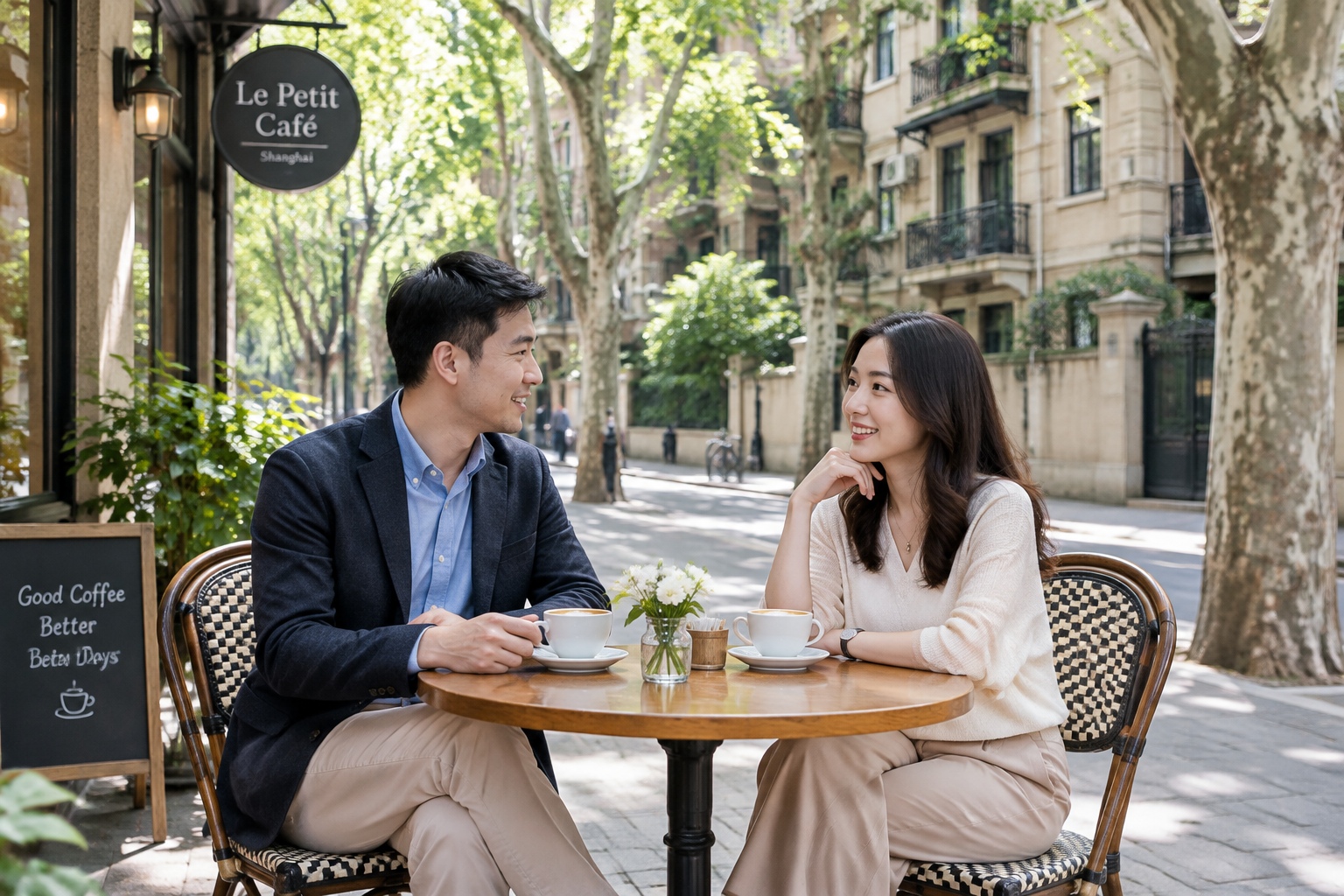
Many first-time visitors think Shanghai is just Pudong plus the Bund. Then they get to the former French Concession and realise there is a third Shanghai — an older, slower, greener one. Roughly bordered by Huaihai Road, Yan’an Road, Shaanxi Road and Lingling Road, this area is filled with plane trees, low-rise European-style houses and independent coffee shops run by people who know where the best beans come from.
For business travellers, the French Concession is the best place for a “non-meeting meeting.” If your counterpart suggests a walk, or just coffee, treat it as an encouraging sign: the relationship is entering a more personal phase. Use the time to talk about travel, family, the art-deco details of the buildings. Most foreign professionals make the mistake of trying to be too formal; in Shanghai, a relaxed stroll gives you more useful information about a partner than a slide deck does.
To find a café, don’t fixate on a single name. Wukang Road, Anfu Road and Fuxing Road are lined with outdoor tables; simply choose one with space. Order a flat white or a local tea. Keep your phone in your pocket. That half-hour might become the most productive part of the trip.
Dinner: Where Trust Gets Served
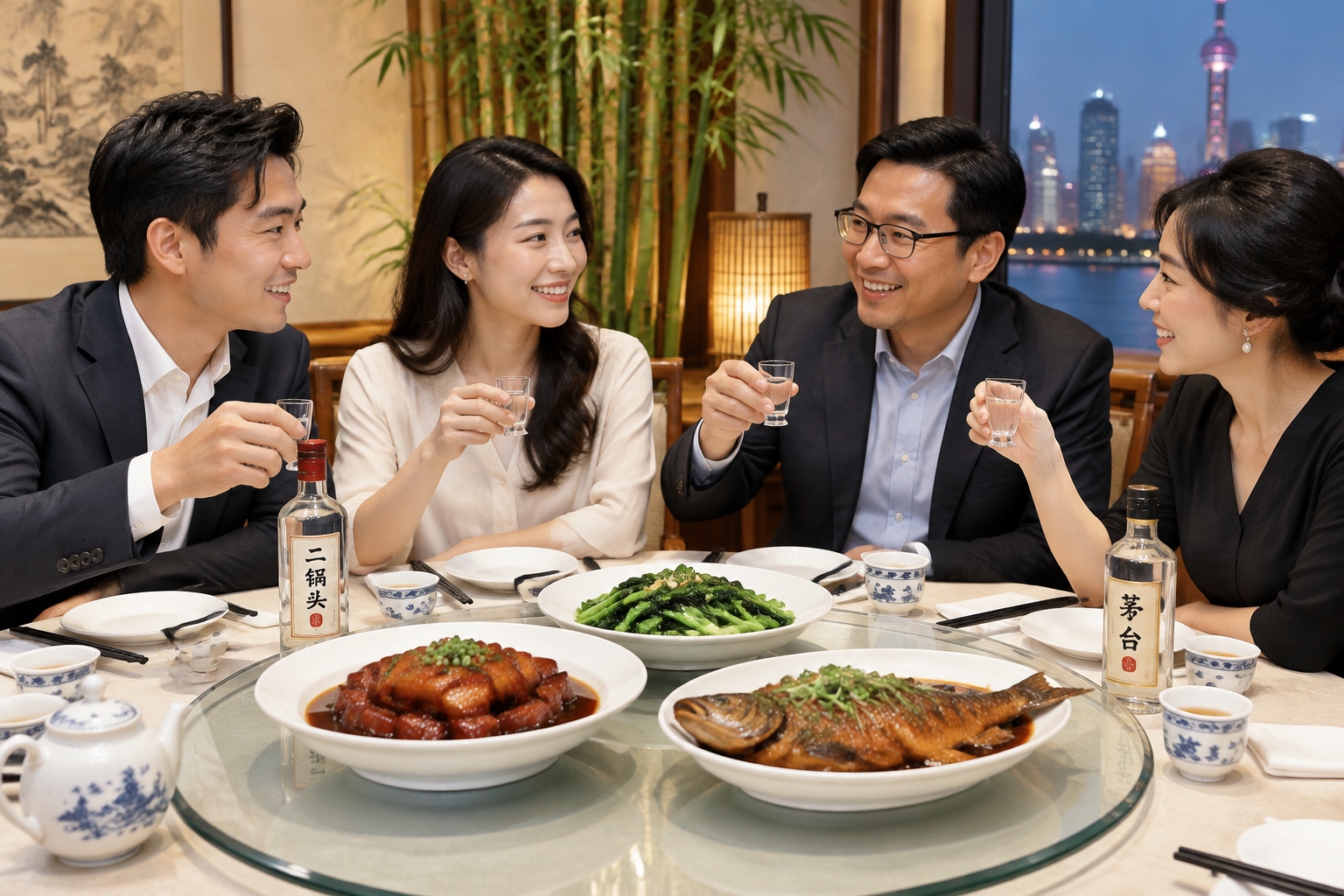
Shanghai-style cuisine, known as benbang cai, is sweeter and richer than Sichuan food, and it is perfect for group dining. Classic dishes include drunken chicken, smoked fish, xiaolongbao (soup dumplings), and red-braised pork. Don’t assume everybody eats spicy food — many Shanghai locals prefer a subtle taste.
If you want a place with old Shanghai atmosphere and serious food, book a table at YongFoo Elite on Yongfu Road. The building is a beautifully restored villa, and the kitchen serves refined takes on Shanghainese classics. Another option is 3 on the Bund, set inside a 1916 neoclassical bank; the view is expensive but the setting is unforgettable. For a more nostalgic but high-quality experience, the Peace Hotel’s Chinese restaurant, Dragon Phoenix, remains a dependable choice.
Private members’ clubs are still part of Shanghai’s business scene, but most visitors do not need a membership. Many restaurant-villas, like YongFoo Elite, offer similar privacy. If a Chinese client invites you to a club-like venue, simply follow their lead; the invitation means you have been taken seriously. At the table, wait for the host to seat you, let them taste the dishes first, and avoid discussing the bill. As a foreign guest, you are not expected to pay — but you should always make a polite gesture, because the refusal is part of the ritual. Bring both English and Chinese business cards if possible; even a small bilingual detail shows respect.
Before You Move: Honest Transport Advice
Shanghai has two international airports: Pudong (PVG), about 40 km east of the centre, and Hongqiao (SHA), much closer to the city, on the west side. Most long-haul international flights land in Pudong, while Hongqiao handles mostly domestic routes and some regional Asian links. Make it a habit to check both maps before booking. Choosing a hotel near your departure airport can save you a stressful morning.
If you land at Hongqiao, take Metro Line 2 or Line 10 into the city. The ride to People’s Square takes roughly 35–45 minutes and costs just a few yuan. A taxi will cost around 60–120 RMB and can take the same amount of time during rush hour. If you arrive at Pudong Airport, use the Maglev train: it covers the 30 km to Longyang Road in about eight minutes, then connect to Metro Line 2. This is faster and more reliable than any car ride. For groups with luggage, app-based cars through Didi or Amap are an easy middle ground — use the bilingual Didi app to get an instant price.
For all metros, use the “Metro 大都会” app or Alipay’s transport module; you scan the QR code at the gate. Mobile payment for restaurants is now almost universal, but the system accepts foreign cards only through the main Alipay and WeChat Pay apps — so download and set up these apps before you travel. Google Maps, WhatsApp and many Western services are partially blocked in mainland China. Download “Amap” (Gaode Maps) and an offline map of Shanghai in advance. Carry a little cash for tiny shops and street food; 200 RMB is enough.
Bring the Two Shangs Back with You
If you have one free morning before your flight, get to a neighbourhood park early. Watch pensioners move through tai chi sequences while office workers grab steamed buns at the gate. That short glimpse ties it all together: the old city has not disappeared; it simply shares space with the new one. Shanghai is not a theme park of “modern China” or “old China.” It is a living place where both versions happen every day, often in the same room. Use the modern side to win deals, and the old side to build trust. Then you will have done Shanghai the way experienced business travel is supposed to be done.
Start the discussion at forum.chinacomes.com