
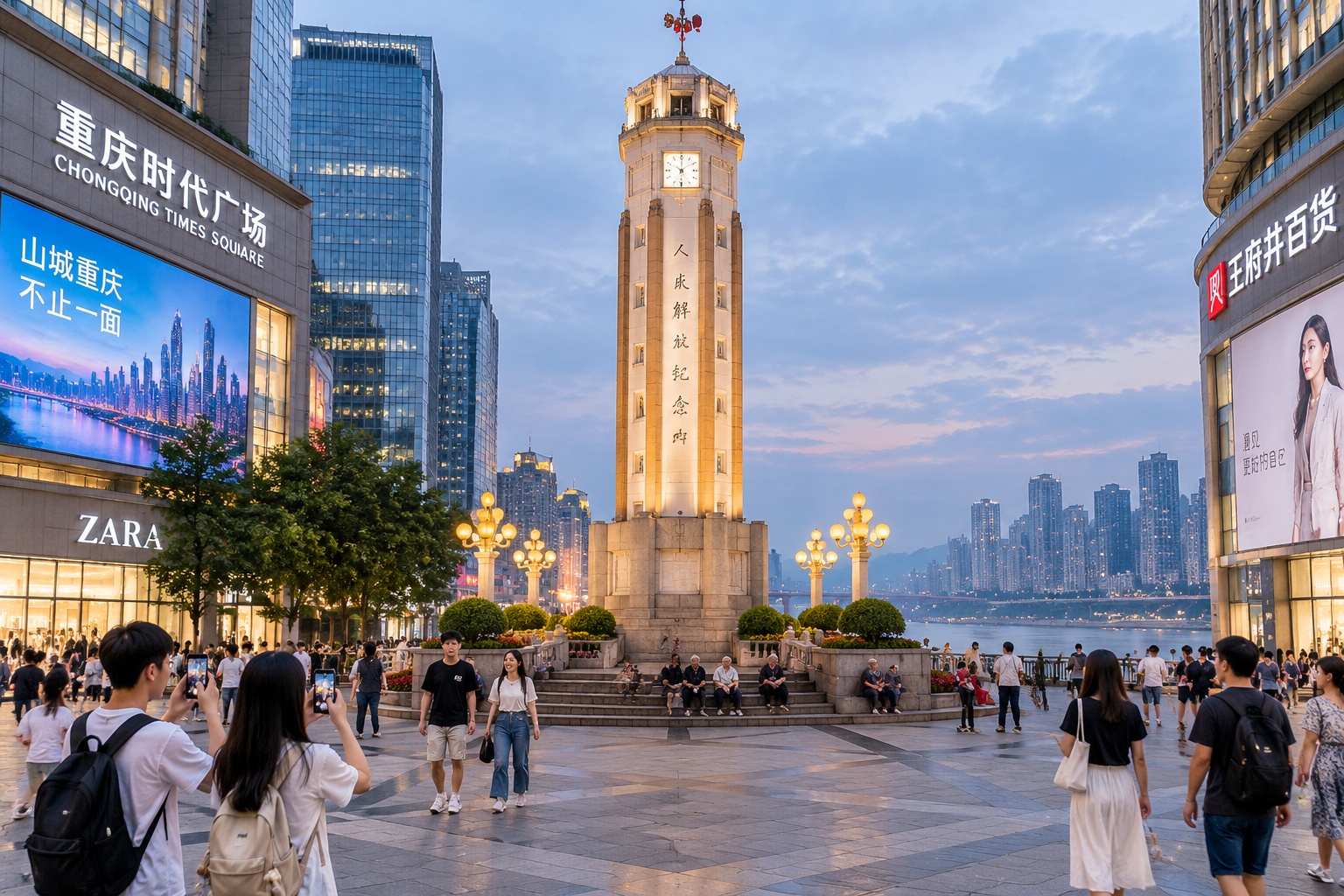

6:40 p.m. in front of the tower
The light turns amber behind the glass office towers at about 6:40 p.m. On the granite plaza at the center of Jiefangbei, a man in his seventies is doing slow arm circles, his jacket rolled up and set on the ground beside him. Three meters away, four teenagers are filming a dance routine on a phone propped against a water bottle, restarting the same eight counts because a delivery scooter keeps crossing the frame. A cleaner in a white uniform works a cloth around the base of the monument, unhurried. A family visiting from Guangzhou lines up for photos with their backs to the clock.
The clock sits on the People’s Liberation Monument: 27.5 meters of stone and concrete that everyone here simply calls Jiefangbei, the same name they use for the whole downtown district around it. In most cities a war memorial stands apart, fenced off, visited once on a school trip and then forgotten. Here it stands in the middle of a shopping crowd — handbags, bubble tea, phone gimbals, boxes of new sneakers wheeled between storefronts.
That overlap is the thing worth understanding about Chongqing. A structure with a military history and a retail district with rent prices have been sharing the same few thousand square meters for more than eighty years, and the arrangement has become ordinary to the people who live with it.
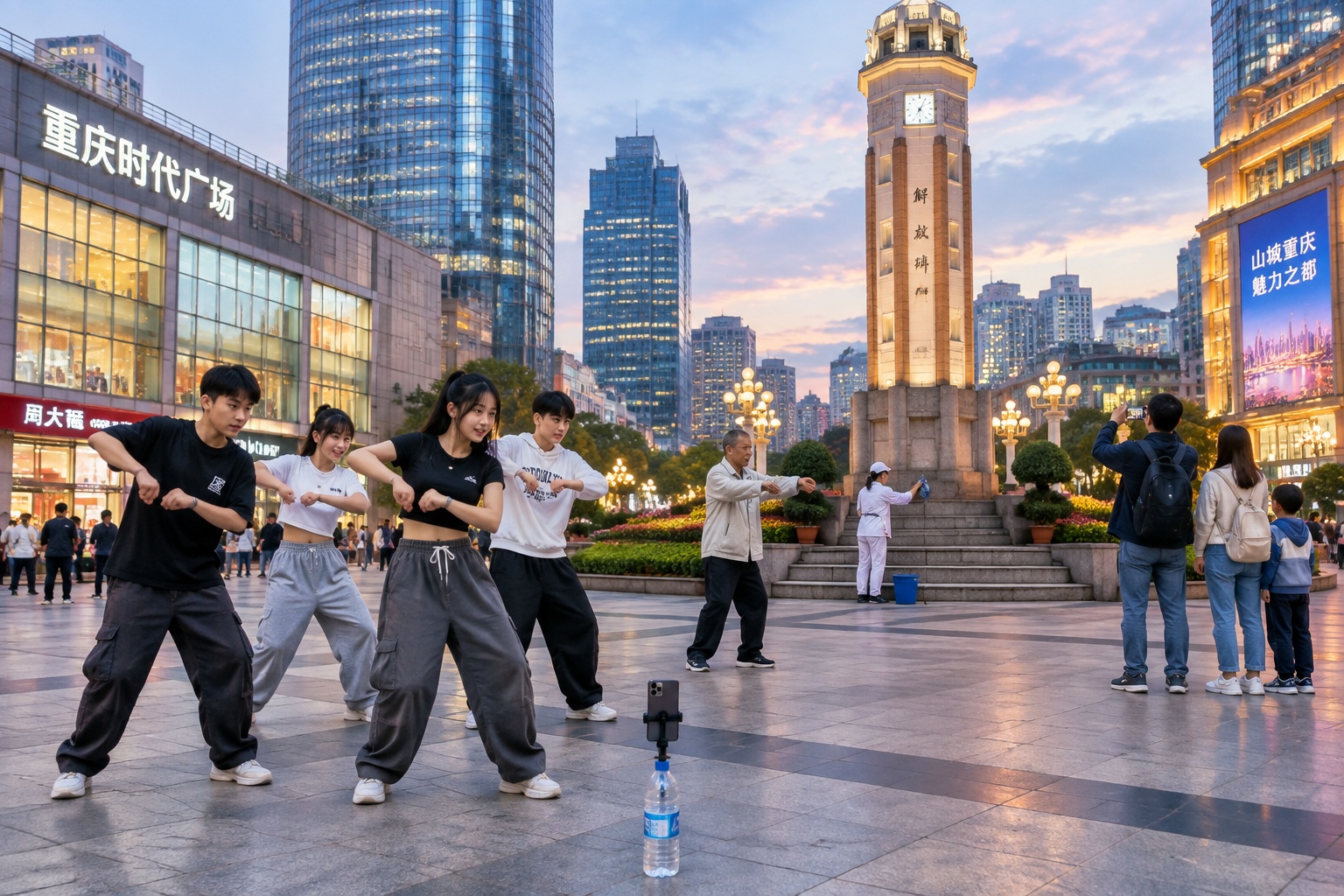
A monument that changed names twice
The first version was not made of stone. In 1940, with Chongqing acting as China’s wartime capital after Nanjing fell to Japanese forces, the city erected a wooden tower on this spot and called it the “Spiritual Bastion” — a marker of resistance rather than victory. Japanese bombers hit Chongqing repeatedly over the following years, and the wooden structure was eventually taken down. After the war ended in 1945, the city rebuilt the monument in stone and dedicated it in 1947 as the Monument to the Victory of the War of Resistance.
The name changed again in 1950, when the new municipal government renamed it the People’s Liberation Monument. The characters on the tower were recarved in the calligraphy of Liu Bocheng, one of the Communist commanders whose forces took the city. So the same structure carries two very different twentieth-century stories: the war against Japanese occupation, and the civil war that followed. Chongqing residents of an older generation still sometimes use the earlier name in conversation.
The city underneath matters too. Between 1938 and 1946, factories, universities, newspapers and government offices were moved upriver from the coast, and Chongqing’s population roughly doubled. The peninsula between the Yangtze and Jialing rivers, where the monument stands, was briefly the political center of the country. That period is why this district feels denser and more layered than its polished surface suggests, and why almost every family in the city has some connection to it.
How a war memorial ended up inside a shopping district
For decades the monument stood in the middle of a traffic roundabout. That changed in 1997, a year that matters in Chongqing’s modern history: the city was separated from Sichuan province and became one of China’s four directly administered municipalities, governed from Beijing rather than from a provincial capital. The same year, the streets around the monument were closed to most vehicles and rebuilt as a pedestrian shopping street, among the earliest in the country.
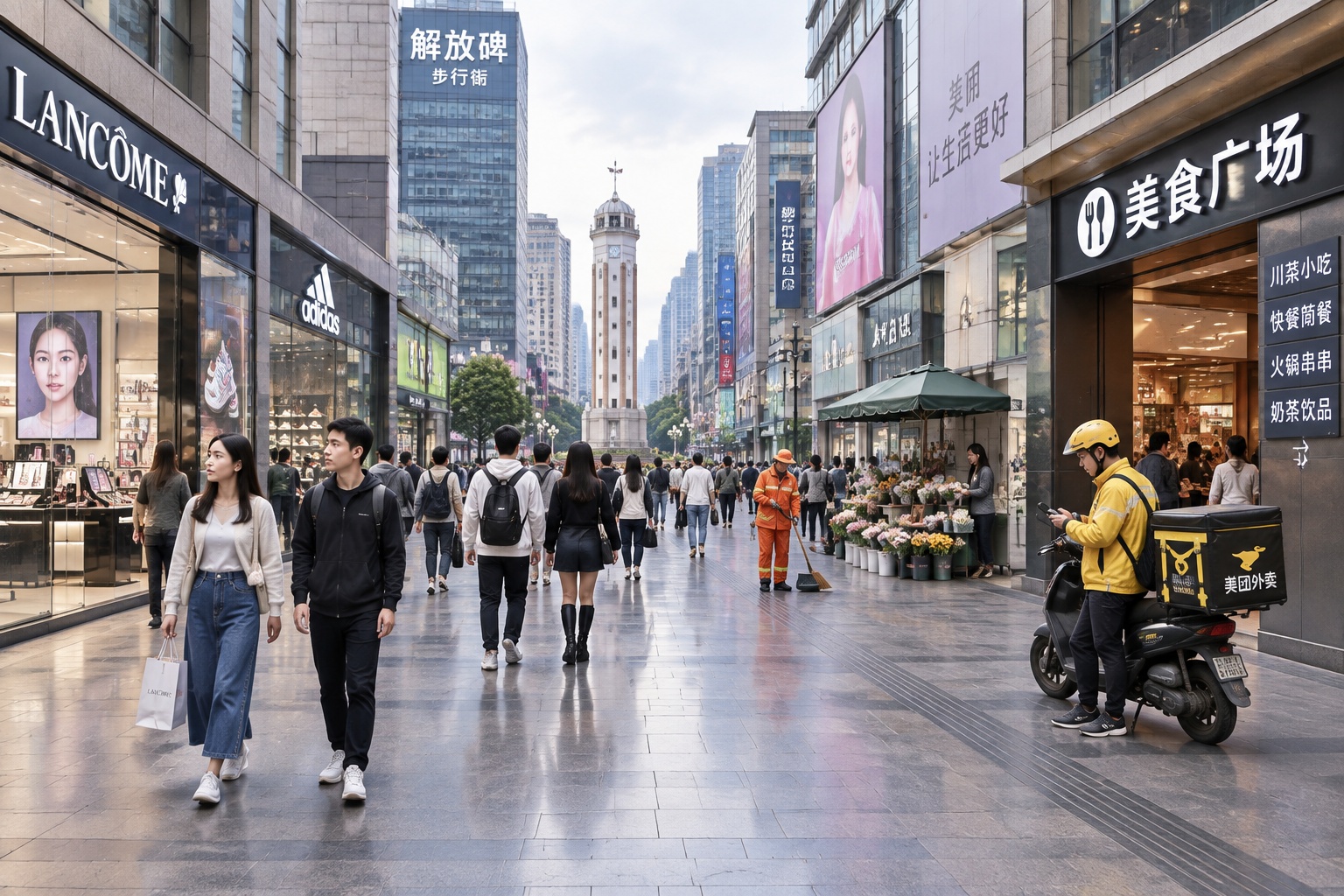
What has grown around it since is a retail district of unusual density. Towers of thirty, forty and sixty floors stand within a few minutes’ walk; the tallest, the Chongqing World Financial Center, is 339 meters. Department stores that were landmarks in the 1990s now compete with flagship stores, cosmetics counters and basement food halls where lunch costs 18 yuan. In 2021, the Ministry of Commerce put Jiefangbei on its first national list of demonstration pedestrian streets, an official acknowledgment that the area works as a showcase as much as a shopping street. On major holidays, district authorities have reported foot traffic in the pedestrian zone reaching several hundred thousand people a day.
Walk five minutes in any direction and the polish thins out. Behind the towers are staircases, alleys and residential blocks from earlier decades — some waiting for renovation, some already converted into coffee shops and small guesthouses. Because Chongqing is built on hills, the street has second and third levels that visitors often miss: escalators down to basements, footbridges, and back entrances where local people buy vegetables and get their shoes repaired.
Who is actually standing in the square
On a typical evening the crowd splits into four groups that rarely mix.
Tourists, mostly domestic, arrive by metro from exits that all point at the monument. Then there are the people who work here: sales assistants on breaks, delivery riders waiting near the food court, cleaners, security guards, and freelance photographers who will shoot and print a portrait for twenty or thirty yuan. Performers make up a third group — a guitarist with a portable speaker, a duo doing Sichuan opera face-changing for phone cameras, teenagers rehearsing choreography for short-video apps, a livestreamer talking to a ring light in the middle of the crowd. And there are residents: older people who have lived in the surrounding blocks for decades and treat the plaza as a living room, exercising, chatting, walking grandchildren.
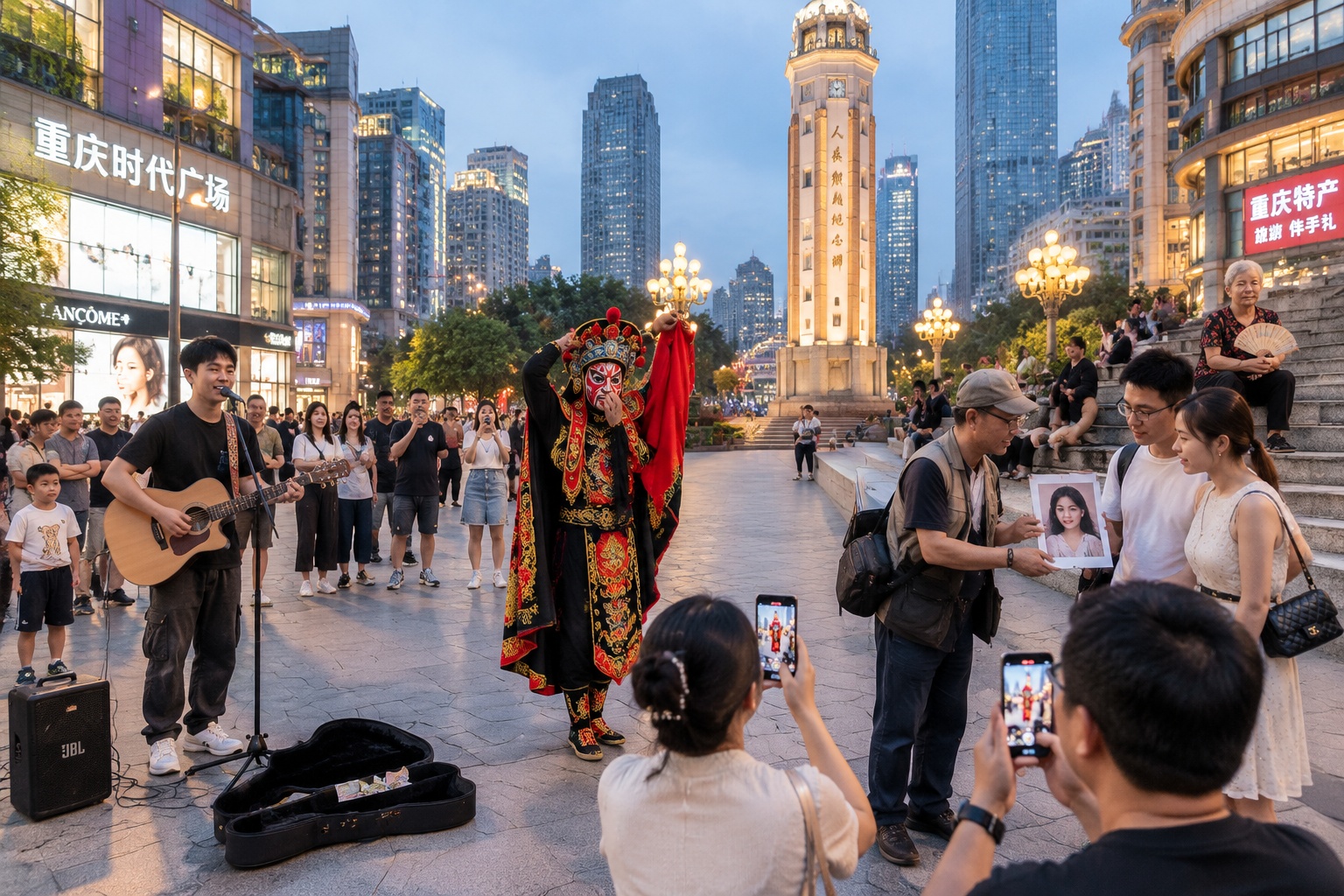
What makes the square work as public space is that none of these groups gets pushed out. The monument’s steps are used as seating. The clock is a meeting point — “under the clock” is the standard way to arrange to meet someone in Chongqing, the local equivalent of naming a station exit. In a country where many downtown commercial districts skew young, this one still has grandmothers in it at nine at night.
Night: hotpot steam, wet stone, and light
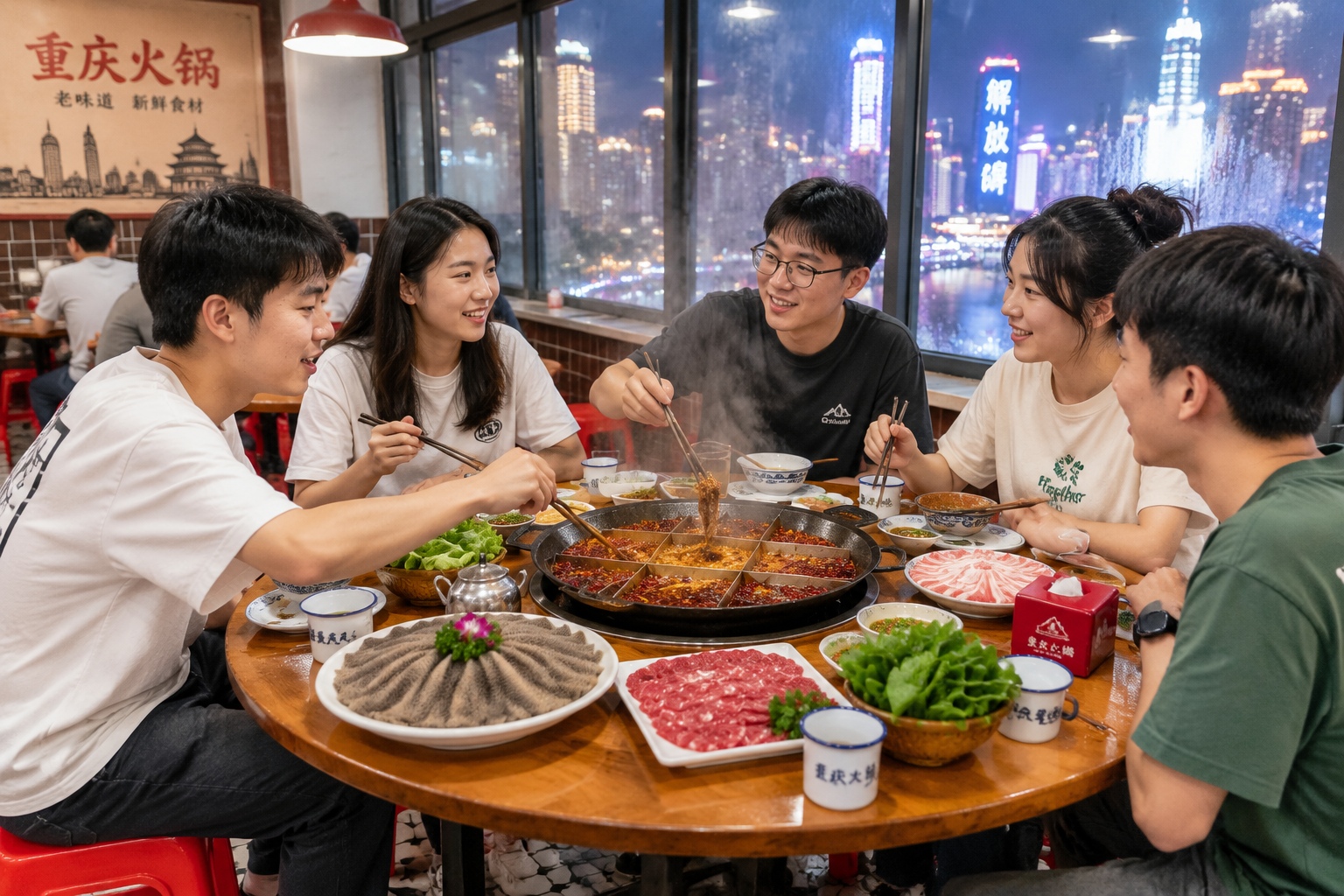
After about 8 p.m. the district changes smell. Chongqing is a hotpot city in a way that is hard to overstate — local counts put the number of hotpot restaurants in the municipality in the tens of thousands, and around Jiefangbei you find them on the second floor of an office building, in a basement, or on a plastic-stool sidewalk setup that appears at ten and is gone by four. The local version uses beef tallow instead of oil, a heavy hand with Sichuan peppercorn, and a nine-grid pot that lets you park tripe in one compartment and vegetables in another. Tripe cooks in about eight seconds. Nobody studies the menu for long.
From the plaza you can walk downhill to Hongyadong, a stilt-house-style complex on the Jialing River that is lit from roughly 6:30 to 10 p.m. and draws crowds thick enough to fill the footbridge above the road. Ten minutes in another direction, the Yangtze River cable car crosses the water in about five minutes. Both are on the standard tourist circuit now, which means queues. Both are also genuinely spectacular after dark, when river fog softens the light and the hillside buildings stack up like an audience.
What has been lost, and what is being rebuilt
Not everything around the monument survived. The steep staircase neighborhood called Shibati, a few hundred meters south, was demolished in the 2010s — thousands of households moved out — and reopened in 2021 as a rebuilt commercial and cultural quarter. It is pleasant to walk through, and it is a reconstruction; some Chongqing residents say plainly that it feels like a film set. That argument runs through much of Chinese urban renewal, and this district is one of the few places where you can see both sides of it within a ten-minute walk.
Commercial pressure has reshaped the small end of the street as well. Rents around the pedestrian area have climbed for years, pushing noodle shops, tailors and repair stalls into the alleys uphill, or out of Yuzhong District altogether. Yuzhong, the central district that contains the monument, has roughly 600,000 residents — a small fraction of the 32 million people in the Chongqing municipality — and its population has been declining for years as families move to newer districts with larger apartments and cheaper parking.
If you go
Metro Line 2 to Linjiangmen, or Line 1 and Line 2 to Jiaochangkou, leaves you a few minutes’ walk from the monument. Late afternoon is the best window: you get the office crowd leaving, school groups arriving, and then the light change. Stand near the clock at 6:40 and watch for five minutes — someone will be filming, someone will be exercising, someone will be sweeping. Then walk downhill south for Shibati, or north for hotpot.
It is not a preserved piece of history, and it is not a theme park. It is a war memorial that a city decided to keep standing in the middle of its busiest shopping district. The most interesting thing about it is how unremarkable that feels to the people around it.
Start the discussion at forum.chinacomes.com