

Morning on Snake Hill
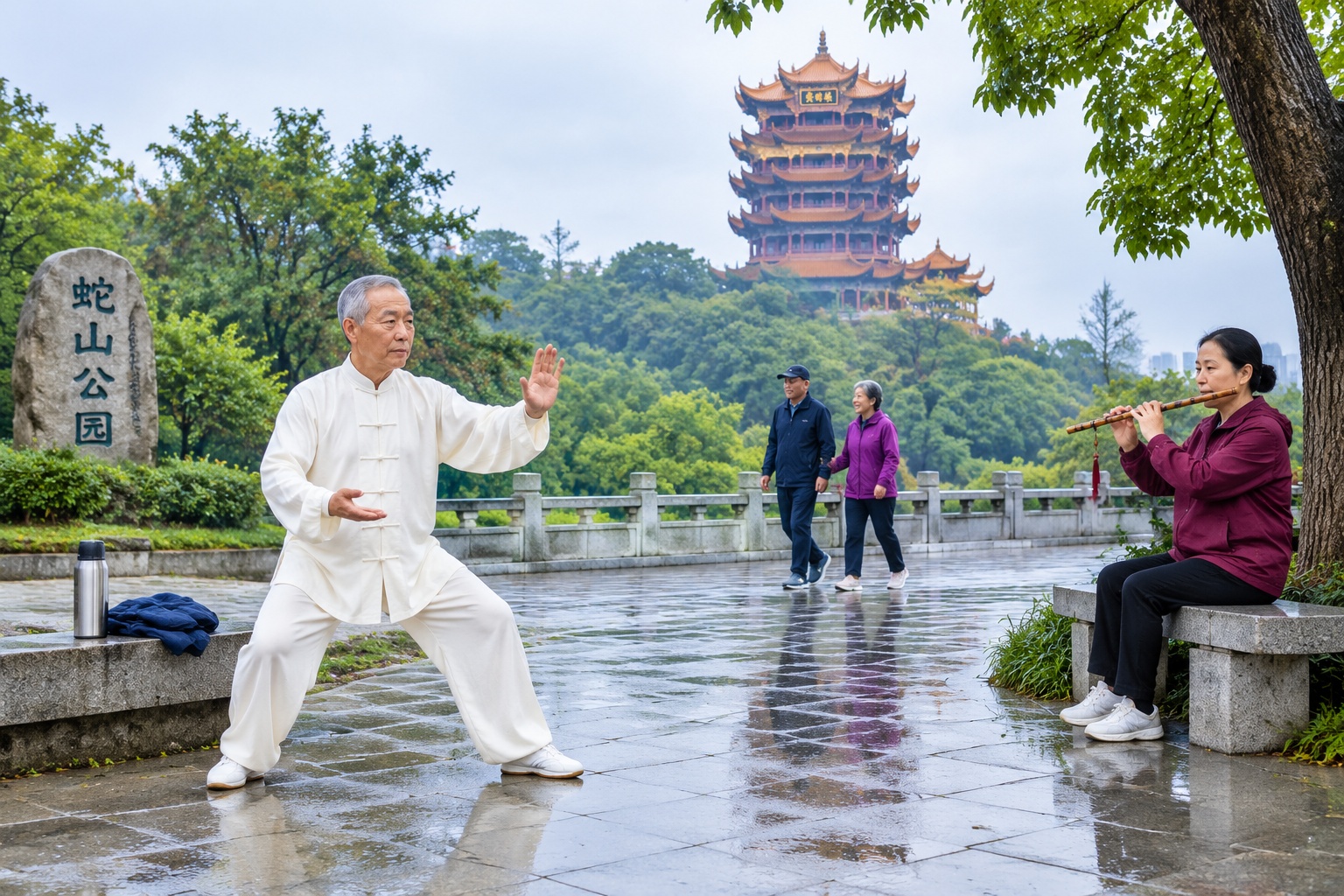
At 7:40 on a Tuesday morning in October, the stone steps up Snake Hill are still wet from overnight rain and the cicadas are already loud. A man in his seventies sets a thermos down on a bench, folds his jacket, and starts his tai chi form. Behind him, five stories of yellow tiles and upturned eaves catch the first light on the top floor. Nobody is taking photographs yet. The ticket gate does not open for another twenty minutes.
This is the hour when the Yellow Crane Tower belongs to Wuhan rather than to tourists. Retired couples walk laps around the base. A woman practices a bamboo flute under a camphor tree. Downhill, the city starts to hum: scooters, a delivery rider checking his phone, and the low rumble of the Yangtze River Bridge, where the first trains of the morning are already crossing the water.
Why a Tower in Wuhan Is Called ‘The First Tower Under Heaven’
The Chinese phrase is tianxia jiangshan diyi lou — roughly, “the first tower under heaven for rivers and mountains.” It sounds like tourist-board language, but there are about 1,800 years behind it.
The first structure here went up around 223 AD, during the Three Kingdoms period, when this stretch of the Yangtze was a front line. It began as a watchtower. Over the centuries it burned, was rebuilt, burned again — the last old version was destroyed by fire in 1884. What stands on Snake Hill today opened in 1985, roughly a kilometre from the original site, in Wuchang district.
That gap matters, and it is the first thing an honest visitor notices. This is not an ancient building. It is a modern one designed to look like one, built from Qing-dynasty paintings and drawings, with a steel-and-concrete core.
Cui Hao’s Poem, and Li Bai’s Silence
The reason a 1985 building can call itself “the first tower under heaven” is a poem written in the eighth century by Cui Hao, a Tang-dynasty official and poet. It is short, and most Chinese adults can still recite the opening lines:
The old one has ridden the yellow crane away;
here only the empty Yellow Crane Tower remains.
The yellow crane never returns;
white clouds drift a thousand years, aimless.
On a clear day the trees of Hanyang stand distinct;
fragrant grass grows thick on Parrot Island.
At dusk, where is my hometown?
The mist on the river makes a man sad.
The legend attached to it is almost as famous as the poem. Li Bai, the most celebrated poet of the dynasty, is said to have climbed the tower, read Cui Hao’s verse on the wall, and put down his brush: “Before my eyes the scene defeats words — Cui Hao’s poem is already there.” Later writers, from Su Shi to Lu You, kept the place alive in the literary record. And a line of poetry from the 700s is why school groups still file up these steps today.
Inside a Forty-Year-Old ‘Ancient’ Building
The interior is where expectations get rearranged. There are two elevators. There is air conditioning, fire equipment, and a gift shop selling postcards and small bottles of Yellow Crane Tower baijiu, the Hubei liquor brand that borrowed the name. On a hot day the whole ground floor smells of varnish and cool air.
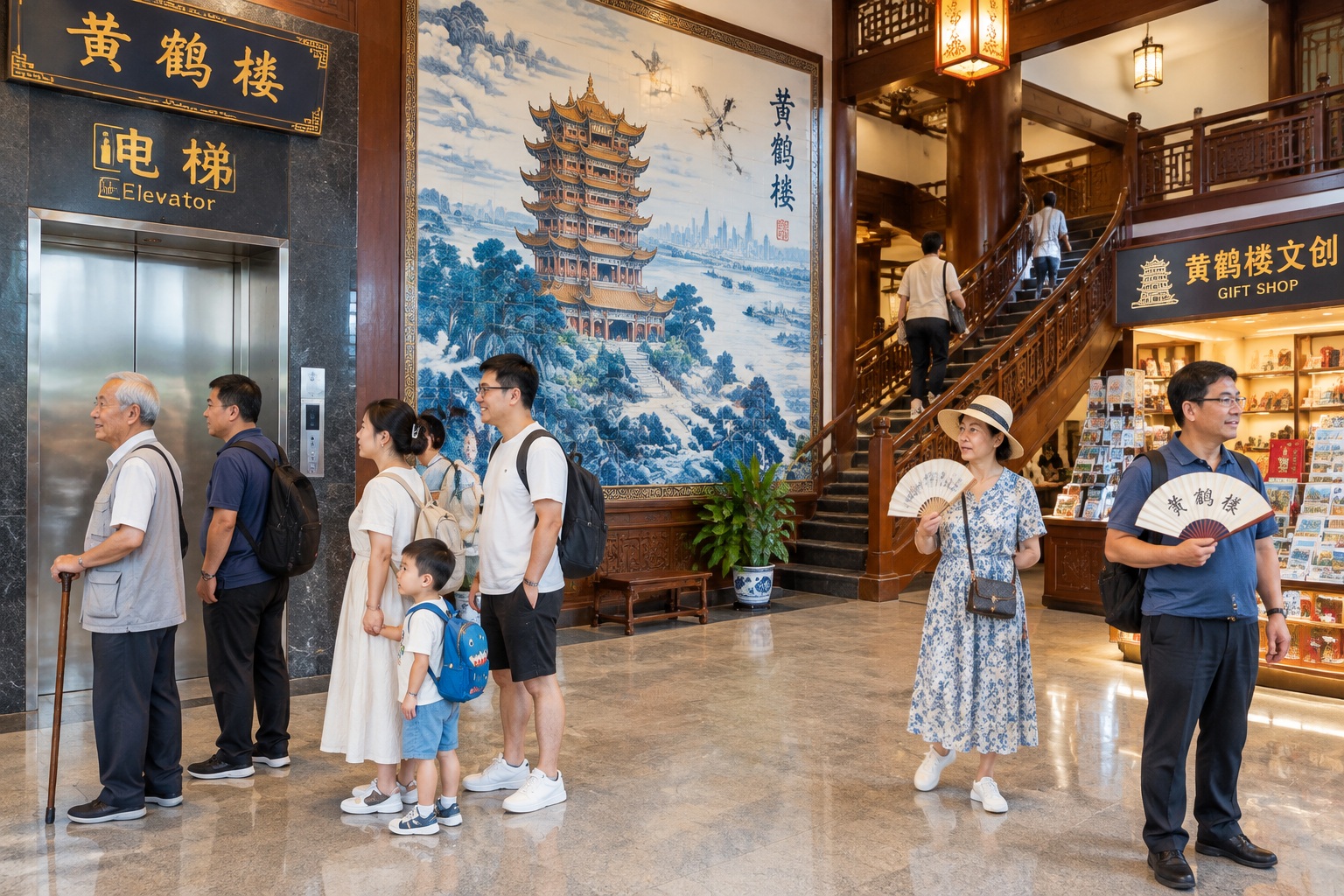
Older visitors are quietly waved toward the lifts; everyone else takes the stairs, which are steep and narrow. On the way up you pass ceramic panels and murals retelling the crane legend — a Daoist immortal, a painted bird, a tavern owner, a wall that came alive. It is storytelling for people who already half-know the story.
Foreign visitors sometimes leave disappointed, and you can see why: they came for ruins and found a working attraction with a queue. But watch the grandparents with walking sticks make it to the top floor, and the calculation changes. Very few genuinely old Chinese towers can handle a thousand people an hour. This one can.
From the Top: One Bridge, Two Rivers, Three Towns
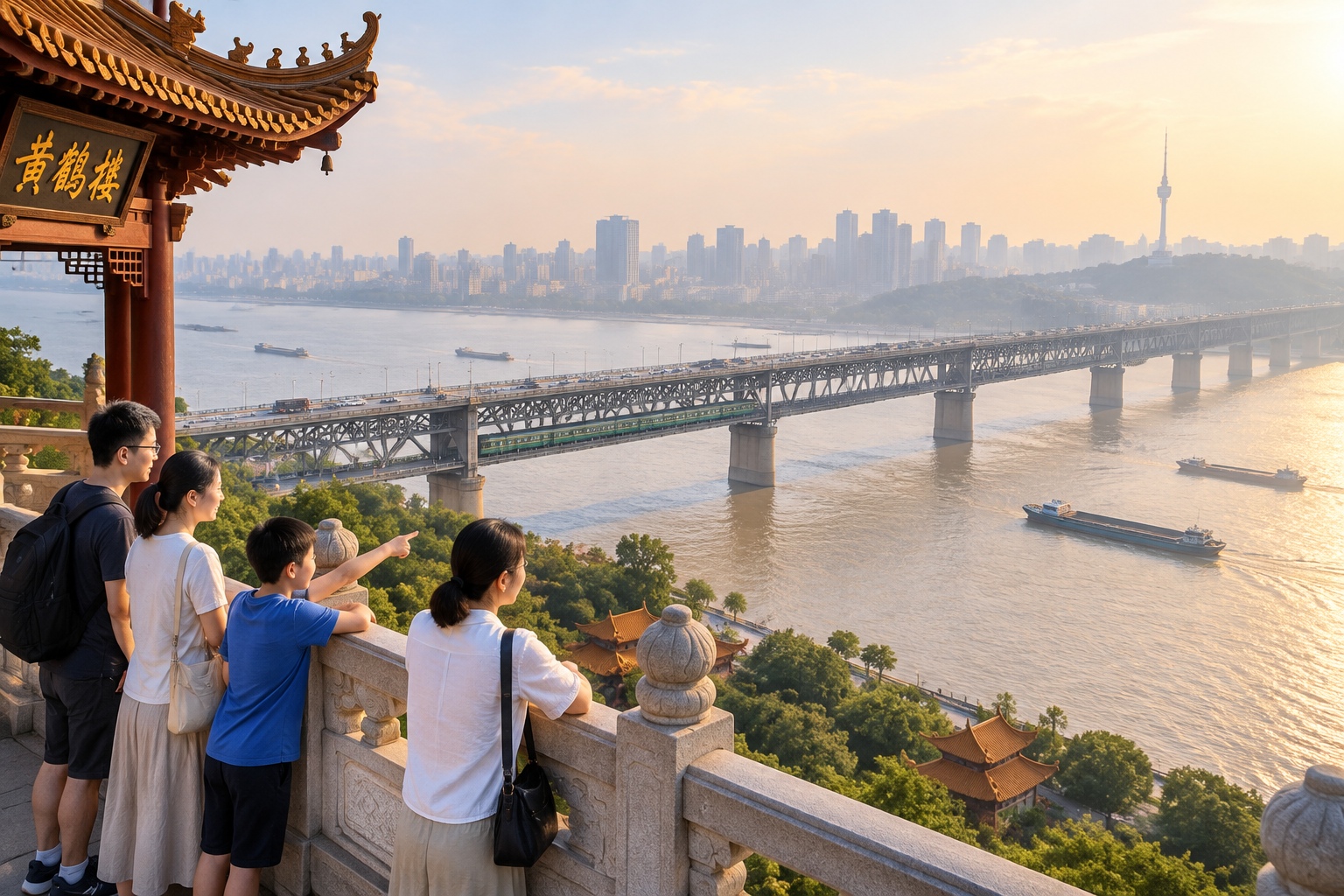
The top gallery is open to the air, and the wind off the river is stronger than you expect. Below and to the west is the Yangtze, more than a kilometre wide here, the colour of weak tea. The Wuhan Yangtze River Bridge — finished in 1957, the first bridge ever built across the Yangtze and still known locally as “the First Bridge” — runs across it on two decks: cars on top, railway underneath. A train crosses every few minutes. Further out, barges and sand dredgers work the current, and ferries shuttle between the banks.
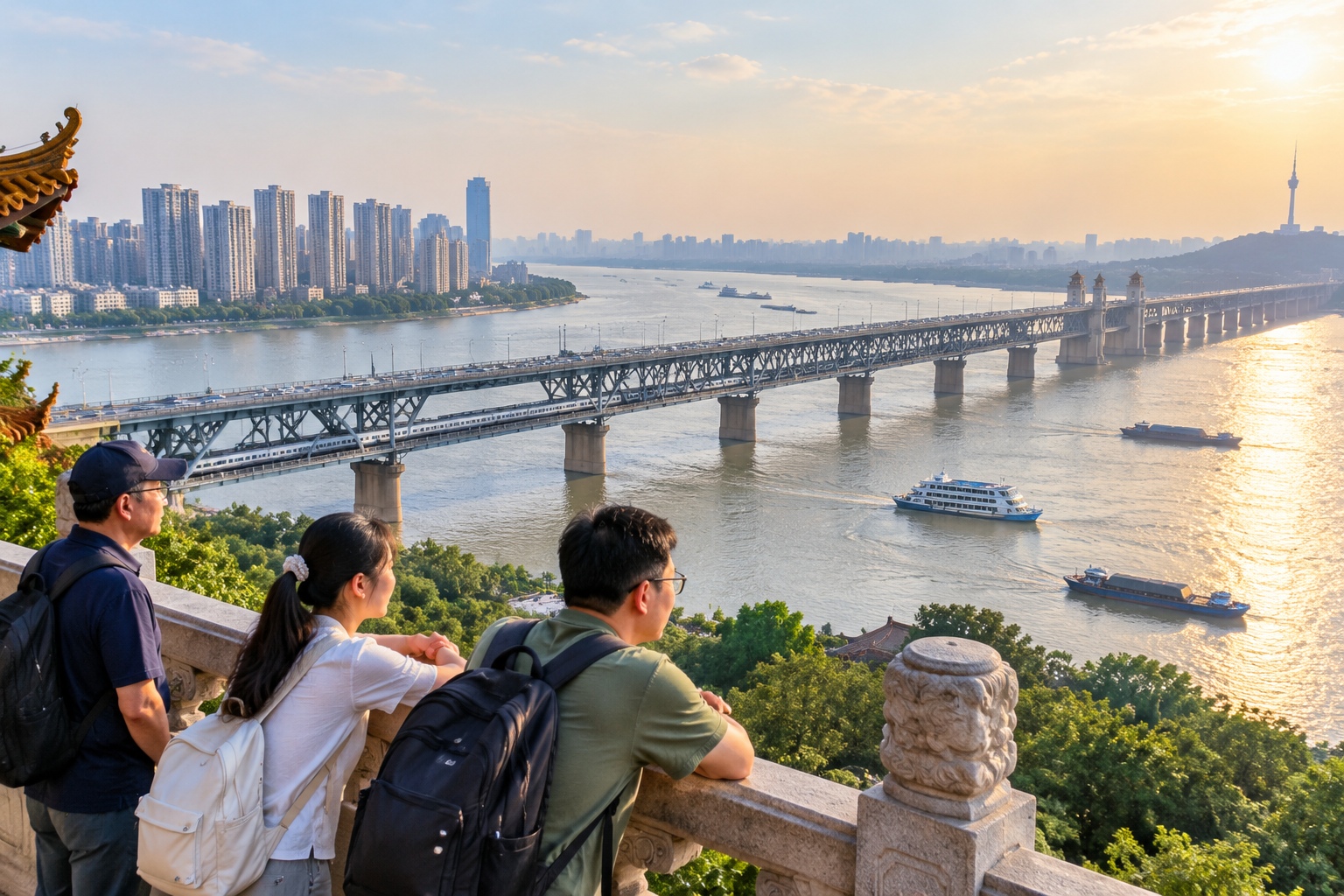
The bridge ties together the three parts of the city. You are standing in Wuchang, the old administrative and university district. Across the water on the left is Hanyang — the “Hanyang trees” of the poem, now a district of apartment towers and factories. Further right, on the far bank, is Hankou, the treaty-port commercial quarter, where the old banks and customs houses still line the waterfront.
Cui Hao’s Parrot Island has silted, shifted, and been renamed more than once; a bridge carrying its name opened in 2000. Hazy air is normal, and the far bank often blurs. After rain, the view opens up, and you can pick out individual buildings on the other side.
Down the Hill: Badminton, Opera, and Breakfast
Come back at six in the evening and the park has changed shifts. A group of women dance to a portable speaker. Two men bat a shuttlecock back and forth across a walkway. Somewhere behind the trees, a small group sings Hubei opera, a little off-key. An old man writes characters on the paving stones with a long brush dipped in water; the sun dries them before he finishes the line.
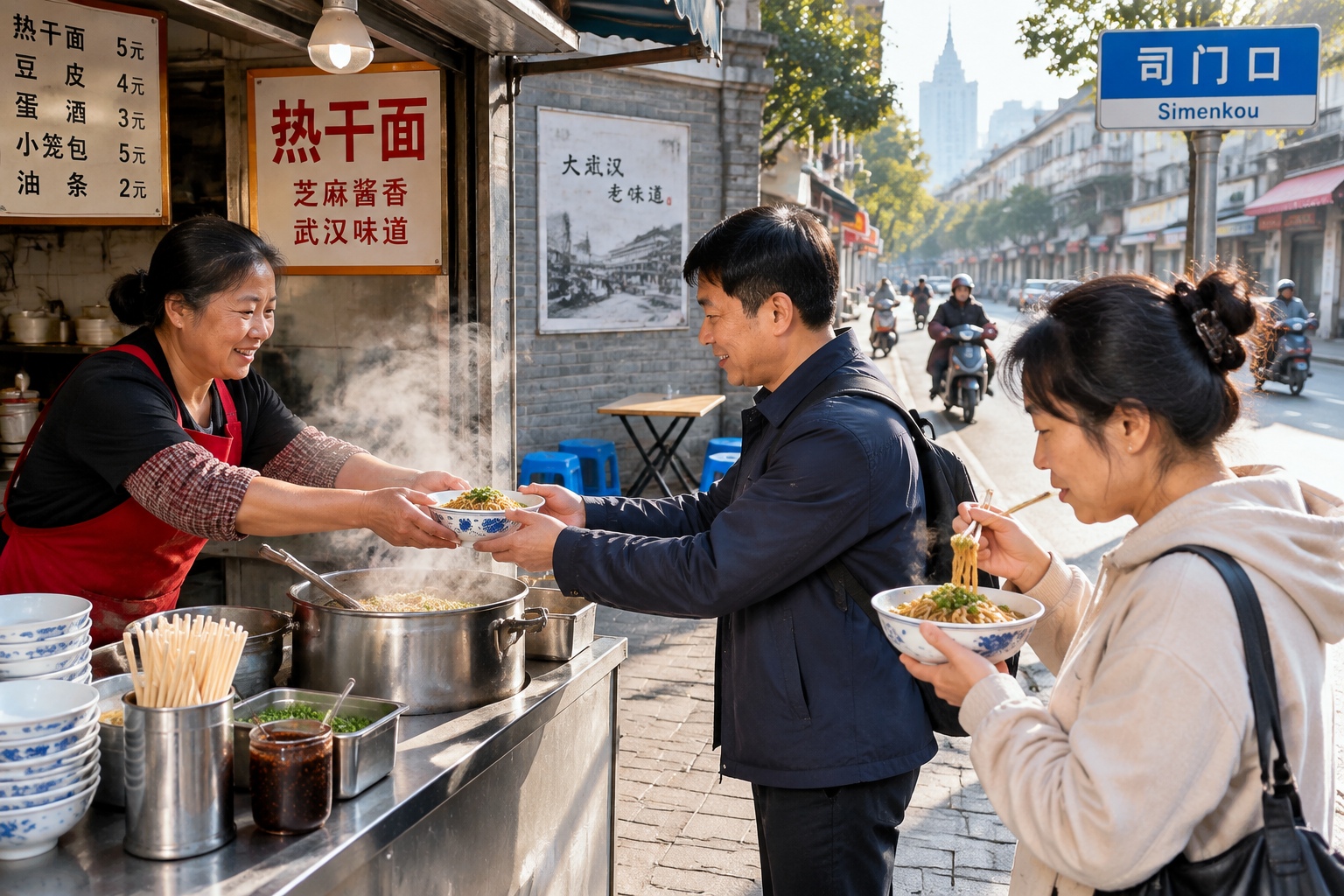
Then walk fifteen minutes downhill into the streets around Simenkou, and you hit the thing Wuhan people actually organise their mornings around. The local verb for eating breakfast out is guozao, and the standard greeting is “Guozao mao?” — have you eaten breakfast yet? Bowls of reganmian, hot dry noodles tossed with sesame paste and chilli oil, cost five or six yuan. There is also doupi, sticky rice and egg folded around pork, and mianwo, a savoury fried rice-flour ring. People eat standing on the pavement at seven in the morning, bowls in one hand, phones in the other.
A city that put its most famous poem on a hill also eats breakfast standing up in the street. That combination is Wuhan.
If You Go: Practical Notes
- Tickets: around 70 yuan for adults, half price for students, free for young children and for seniors over 65 with ID. Prices change — check the park’s WeChat account or the gate.
- Hours: generally 8:00 to 18:00, with seasonal adjustments; last entry is usually 30 to 60 minutes before closing.
- Getting there: Metro Line 5 to Simenkou Huanghelou station, then a 10 to 15 minute uphill walk. Line 4 to Fuxing Road is a longer walk. Taxis usually drop passengers at the south or east gate.
- Best timing: a weekday right at opening, or late afternoon for the light. Avoid the first three days of national holidays, when the queue for the tower itself can take an hour.
- On foot: the elevators are free but slow; many people take the stairs as exercise. The top gallery is outdoors, so bring water in summer and a jacket in winter. Wuhan is one of China’s “three furnaces” — in July and August the stone balustrade is too hot to touch.
- Nearby: the pedestrian walkway on the Yangtze River Bridge, the Hubei Provincial Museum (free, but book ahead with your passport), and Hubu Alley, a busy snack street ten minutes away.
What Actually Lasts
The building you climb is forty years old. It will be repaired, and one day rebuilt again; every version of this tower has been. The poem is twelve hundred years old and has never needed maintenance.
Stand on the terrace at dusk, when the bridge lights come on and the river turns the colour of the sky, and the last line does its work: the mist on the river makes a man sad. Not sad exactly. Homesick, or aware of time. Then a train crosses the bridge, someone’s phone rings, and the moment breaks — which is exactly what the tower is for.
Start the discussion at forum.chinacomes.com