
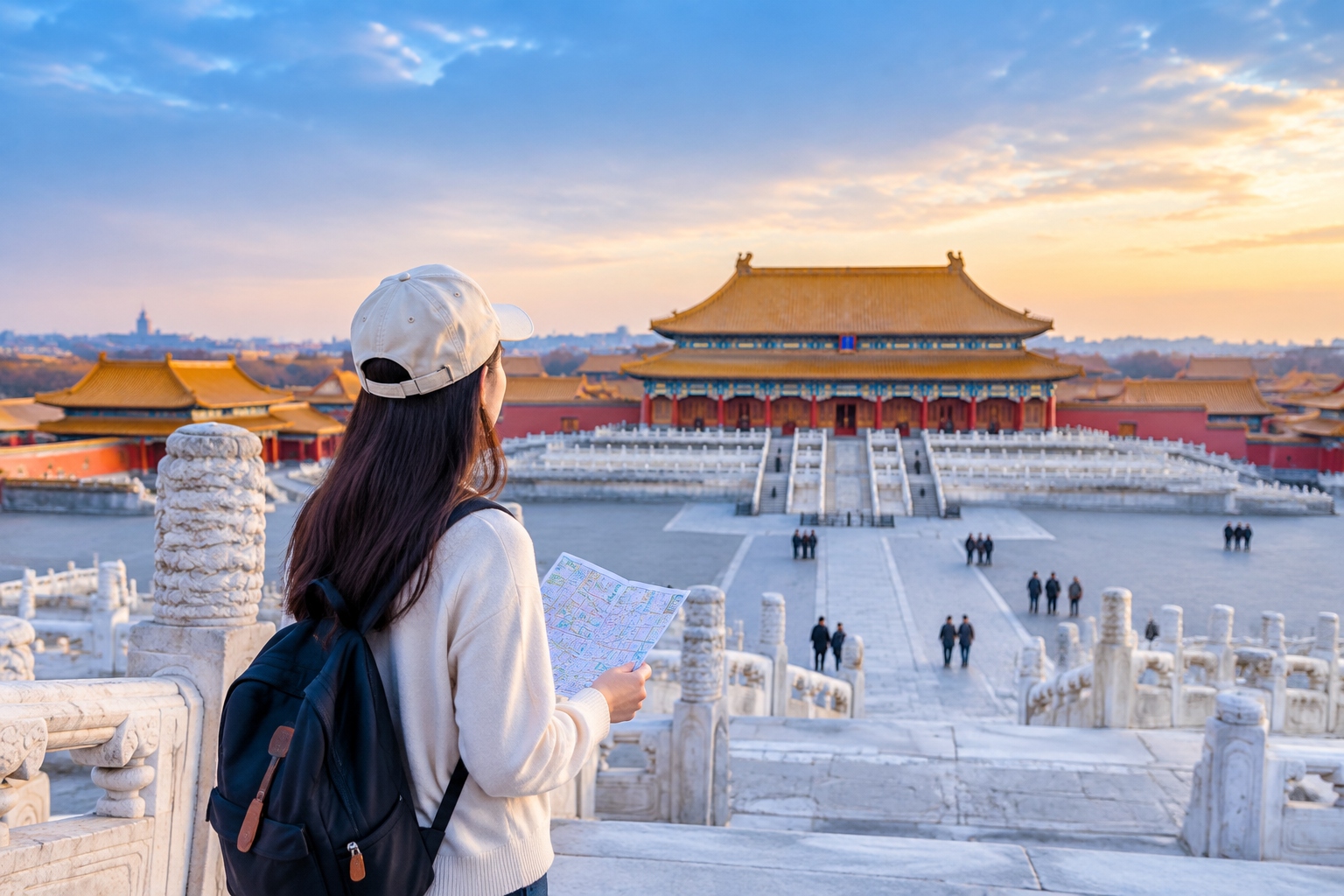

Morning on the Marble Bridge
It is just past 7 a.m. when I step into the Forbidden City through the Meridian Gate. The sky is pale blue, and the golden roofs of the Hall of Supreme Harmony catch the first sun. Around me, a few early visitors are already walking toward the inner courtyards, but it is still quiet enough to hear pigeons flap across the empty square.
That silence is why I keep coming back. The Forbidden City was built in the early 15th century as the seat of the Ming and Qing emperors, but today it is as much a living park as a museum. On the side where the palace walls meet the moat, retirees practice tai chi; they don’t look up at the emperor, but they still measure their days by this old geography of order. A 40-year-old father from Hunan tells me he has brought his daughter to "look at the rooms where emperors had to be careful all the time."
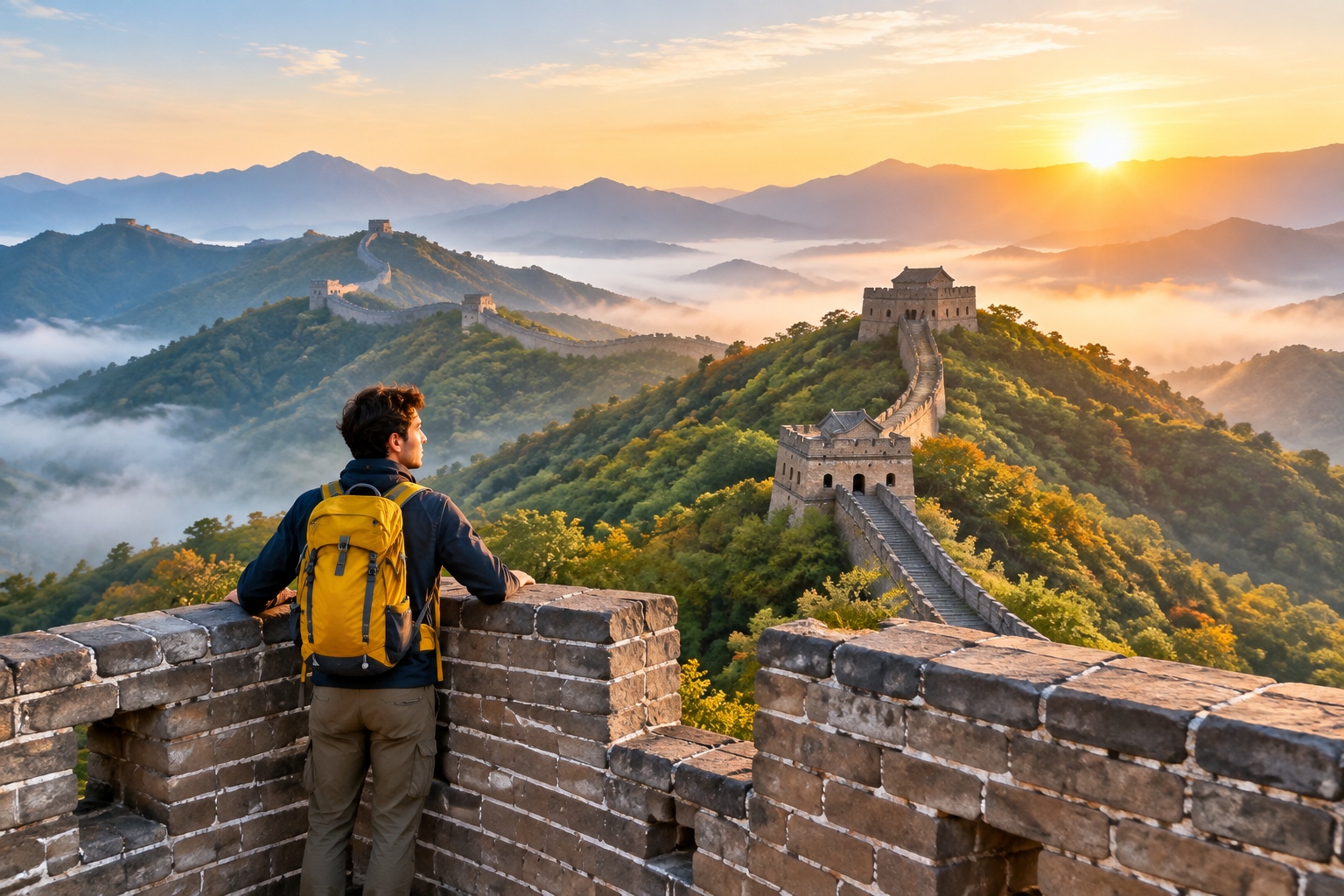
Beijing’s two defining World Heritage Sites — the Forbidden City and the Great Wall — are really two sides of one idea. The palace is about a perfect center, the wall about a clear edge. Together, they shaped how generations of Chinese think about space: where you belong, what boundary protects you, and how to arrange a life so that rule and freedom both have a place.
Xi’an: An Army for the Afterlife
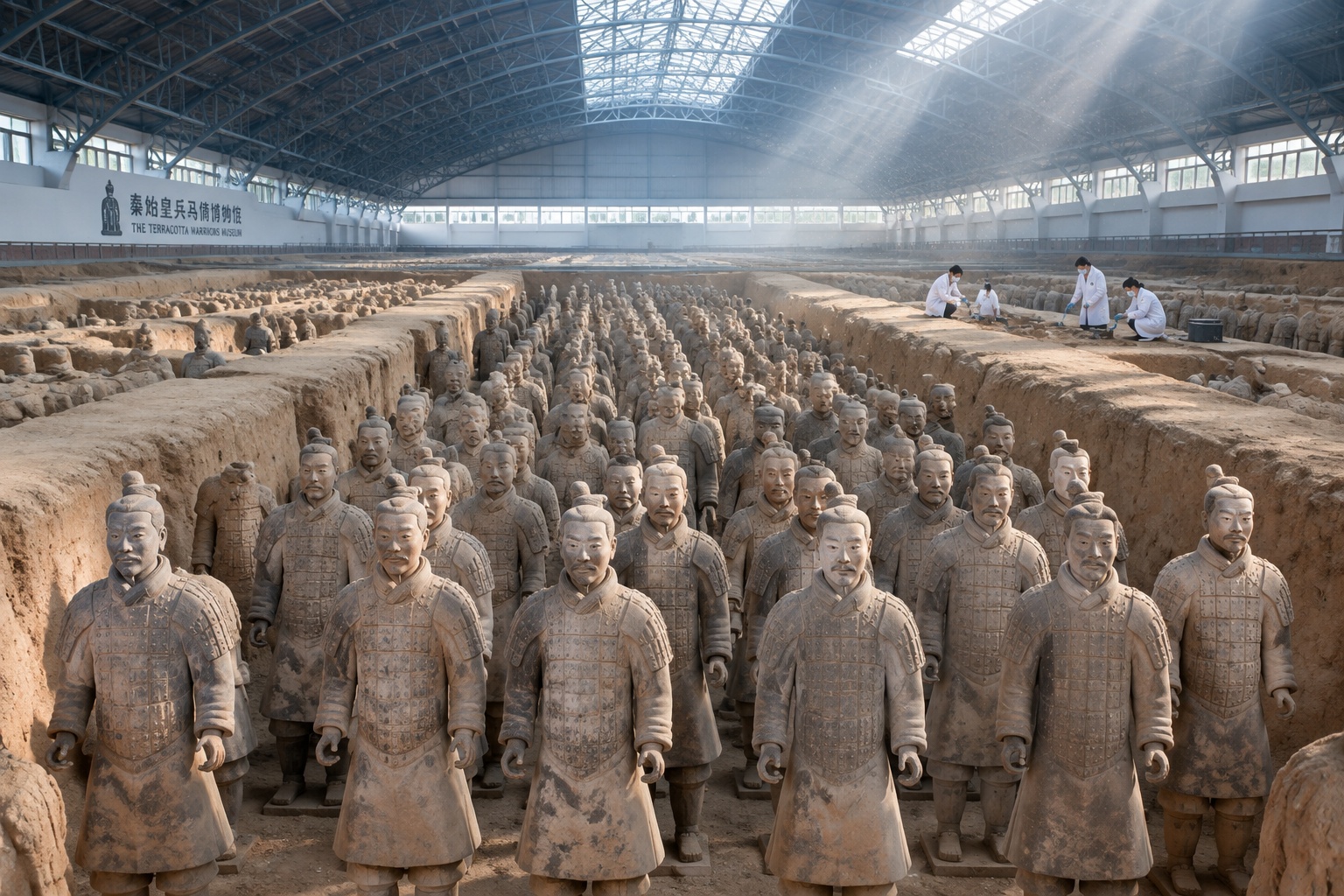
I ride the high-speed train from Beijing to Xi’an in under five hours. When the train pulls into the station, I can already feel the dry wind that once blew across the Tang dynasty capital. Xi’an was the starting point of the Silk Road, and it has always been a town of empire. But nothing prepares you for the place where the first emperor of China buried his personal universe.
Standing at the edge of Pit One of the Qin Terracotta Army, you see more than two thousand clay soldiers staring back at you. Their faces each have different features, their armor is cut with astonishing detail. They were created around 210 BC to protect Qin Shi Huang in the afterlife. For 18 centuries no one knew they existed. Then, in 1974, farmers digging a well in Lintong District hit terracotta shards. Today those farmers are retirees, and their grandchildren sometimes work as museum guides.
What makes the site electric is not the sheer scale — although that is staggering — but how it turns a textbook empire into a human face. A warrior’s brow thickens in concentration; another one seems to be laughing under his helmet. Local archeologists still crawl through the trenches with fine brushes, and from the viewing platform you can see their contemporary lab coats next to 2,000-year-old bronze swords. This is no dusty afterthought; it feels like a live excavation scene, which it literally is.
Suzhou Pavilions: A Gentle Rebellion
As the train pulls in to Suzhou, the scenery changes from imperial plain to willow-lined canals. The classical gardens here are not exactly as old as the Forbidden City, but they have a different claim on the people of this watery region: they are treatises on how to be free inside tight walls.
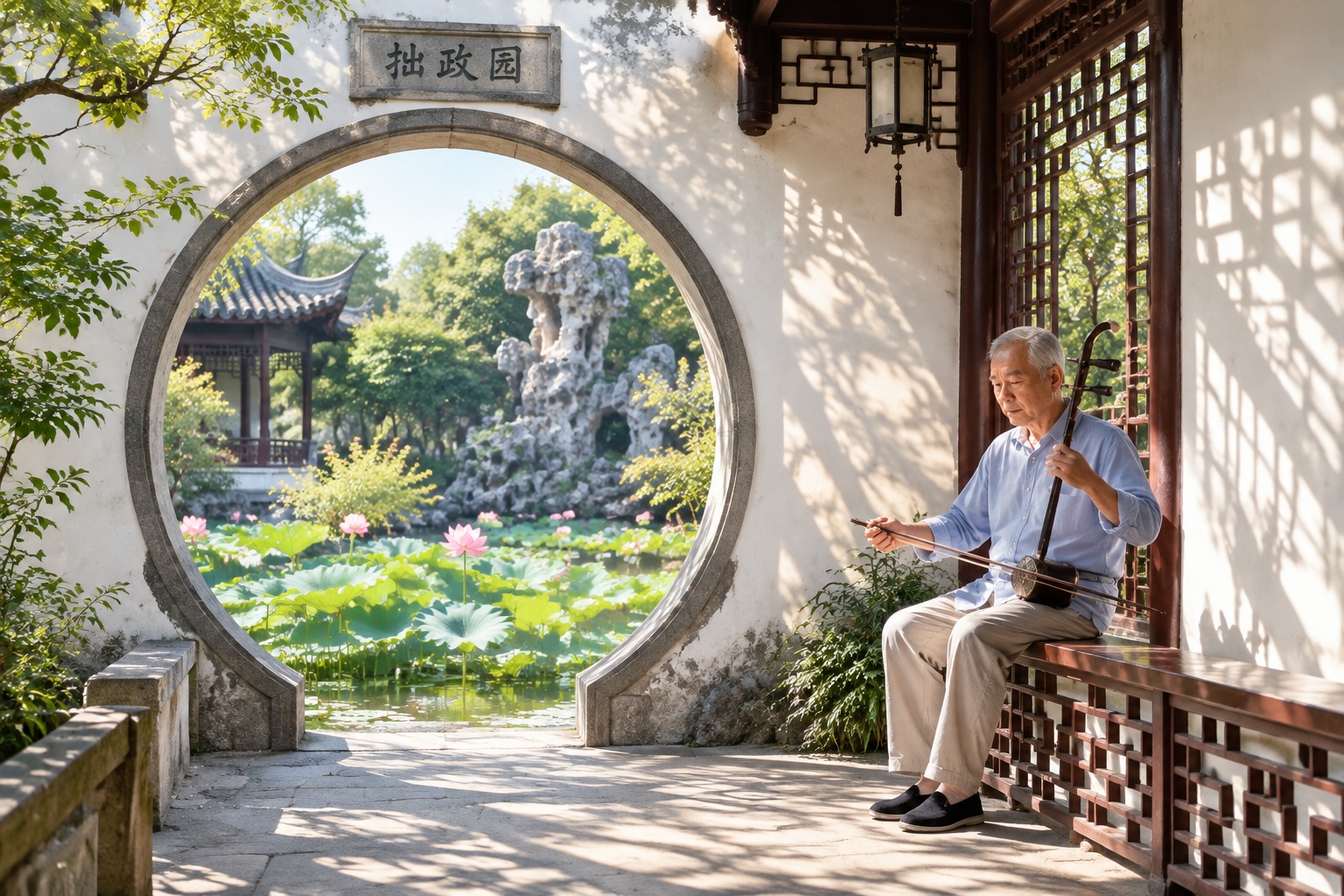
In the 11th century, Chinese scholar-officials who were exhausted by politics built small villas where every rock, pond and moon-gate was planned to imitate wild scenery. The key is a technique called borrowed view: from the window of the Humble Administrator’s Garden, you see a distant pagoda rising over the garden wall, as if it belongs to you. The centerpiece is a pond threaded by a zigzag bridge and surrounded by rockeries made of pierced limestone from Lake Tai. Walk the covered corridors at dawn, before the tour groups arrive, and you can hear a man practicing erhu under a pavilion.
What strikes me today is how Suzhou people still inhabit this frame of mind. On weekends, they come with thermos flasks and a board game, as if the garden were just an extension of their living room. They are not there to learn about Ming-dynasty literati; they are there to taste the same quiet that was invented for them centuries ago.
Guilin and Lijiang: Nature and Culture in a Minor Key
From Suzhou, most travelers take a direct flight to Guilin in Guangxi, about two hours south. The karst peaks of Guilin — short, conical towers of limestone wrapped in mist — will look familiar from hundred-yuan banknotes or Chinese landscape paintings, but no image captures the smell of river mud after rain. I board a bamboo raft at Xingping, where the Li River bends between pinnacle-high ridges. Not far away, a cormorant fisherman in a brown rain cape sits on his slim bamboo craft, using dark birds to catch fish exactly as his grandfather did. His work, now, is as much for visitors as for supper, but his silhouette against those limestone spikes is a rare view of a living heritage.

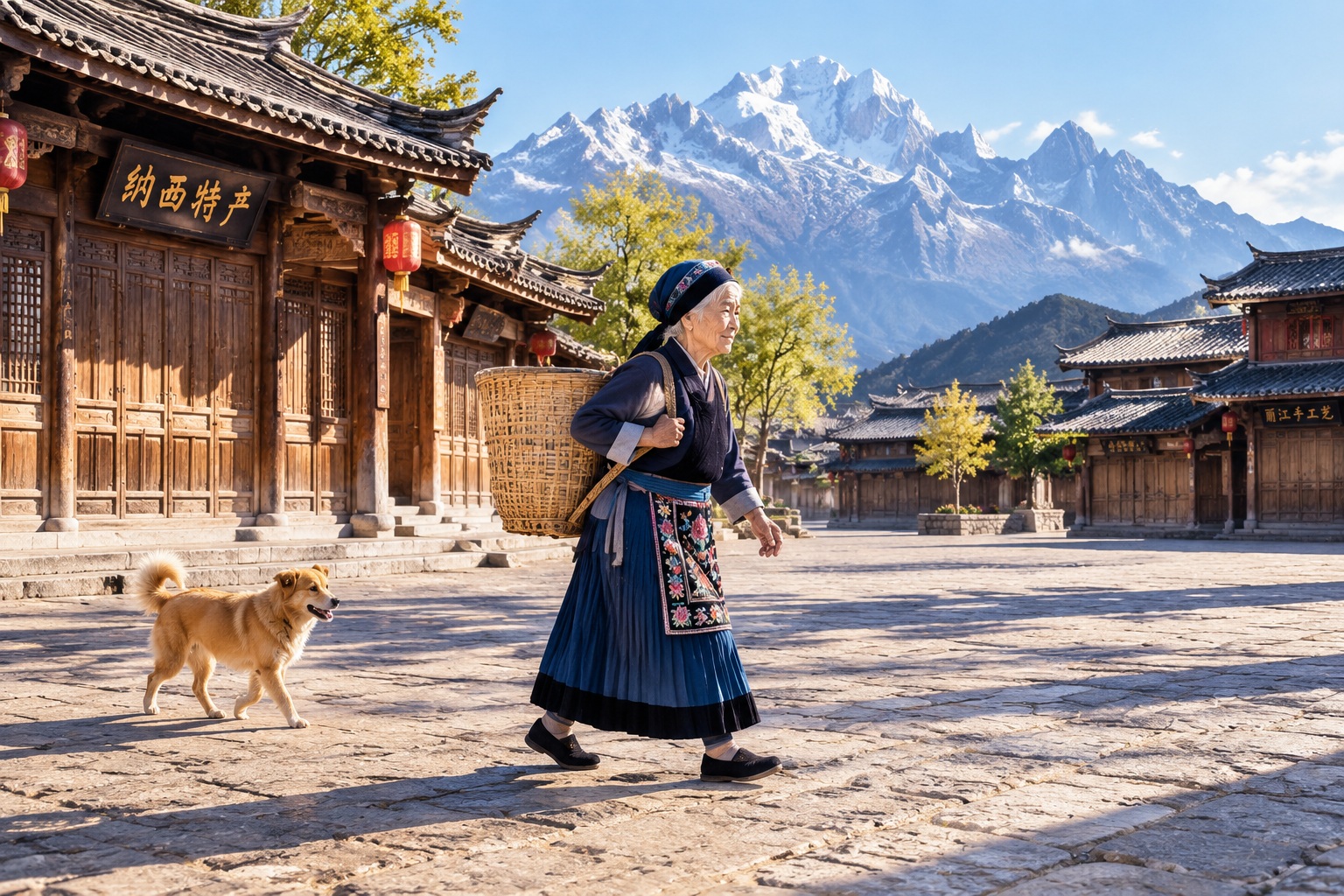
Further west, in Yunnan province, the old town of Lijiang is a different fingerprint of heritage. The town was built by the Naxi people, one of China’s 55 officially recognized ethnic minorities, who created a pictographic writing system where human, mountain, and beast are drawn under a white sun. UNESCO listed the town in 1997, which kept its stone streets and wooden shophouses largely intact. But Lijiang has also changed. Tourists fill Bar Street at night, and the cheap souvenir shops can look like any global tourist trap. What saves it is early morning. Before the shutters roll up, the Black Dragon Pool reflects Jade Dragon Snow Mountain in absolute still water, and Naxi grandmothers in pleated blue skirts cross the square with wicker baskets on their backs.
Linking It Together: A Realistic Two-Week Itinerary
China has 59 UNESCO World Heritage Sites, so a single cultural route has to be an exercise in subtraction. The order above is deliberately chronological: each stop introduces a different layer of Chinese civilization, and they get progressively more intimate. Start in Beijing with imperial architecture, fly to Xi’an for the first empire, then take the high-speed rail to Suzhou for literati taste, fly south to Guilin for landscape awe, and finish in Lijiang for a living minority culture.
This route needs about 14 days. Allocate three full days to Beijing (two for the Forbidden City and the Great Wall, one for Temple of Heaven or the Hutongs), two days to Xi’an, two days to Suzhou (with a possible side trip to Tongli water town), two days for Guilin (one for the river, one for Yangshuo or the Longji rice terraces), and three days for Lijiang so you can ease into its slower rhythm.
With less time, choose South or North: Beijing + Xi’an + Suzhou makes an excellent tight week-long trip focusing on Han Chinese imperial and reticular traditions; Guilin + Lijiang works for lovers of landscapes and minority cultures. For a real taste of China’s ancient past without sacrificing creature comforts, add a high-speed rail pass wherever possible — the Beijing-Xi’an leg is only five hours by train, and Xi’an to Suzhou can be done by an overnight rail or a short flight.
Reservations can make or break your visit. Forbidden City tickets sell out days ahead in peak season, and the Terracotta Army takes passport details at the gate. Book online through official WeChat platforms, or ask your hotel to handle it. Go to the Forbidden City at opening time; walk the Mutianyu section of the Great Wall rather than Badaling if you want fewer crowds and more hills.
Or go after holidays. Chinese public holidays are national movement days, and any heritage site turns into a sea of people. Your best season is late September through November, when northern skies are clear, Suzhou is cool, and Guilin has not yet flooded.

The Cultural Bag: A Quick What-to-Know
Understanding the stamp "World Heritage" in China means understanding two different words. Cultural sites (such as the Forbidden City and Suzhou gardens) tend to emphasize artifice and tradition; natural sites (like the karst land of South China) emphasize geology and ecology. Many Chinese visitors treat them as happy places for weekend outings, not as museums in the Western sense — so don’t be surprised if you hear music or see wedding photo shoots.
Practical notes for a smooth visit:
- Bring your passport and remember that many ticket systems require a real-name reservation before you arrive.
- Wear shoes that can manage stairs. The Great Wall, Forbidden City, and karst trails are long walks.
- Do not touch mural or bronze objects. Even in the open-air sites like the Great Wall, you are expected to stay on the stone path.
- Learn two Chinese words: yùyuē (reservation) and fáng (shop) — though you’ll rarely need them if you use translation apps.
- Keep a small snack bar and water; some spots are remote, but most have cafes with sugar-rich "hot milk tea" tea shops.
These sites are not stage sets. They are locations where Chinese people still practice tai chi, play bridge, gossip under plum trees, and take anniversary photographs. If you walk slowly, you will sense the continuity: the geometry that ordered an empire is the same geometry that organizes a Beijing courtyard; the river landscape celebrated by Tang poets is the same water flow that powers Guilin’s village waterside courts today. That is, perhaps, the most accessible definition of a living heritage: something old that still has a pulse, waiting for you to feel it.
Start the discussion at forum.chinacomes.com