

A Low Ridge of Earth, and a Thousand Kites
The first thing most visitors notice isn’t history. It’s the grass.
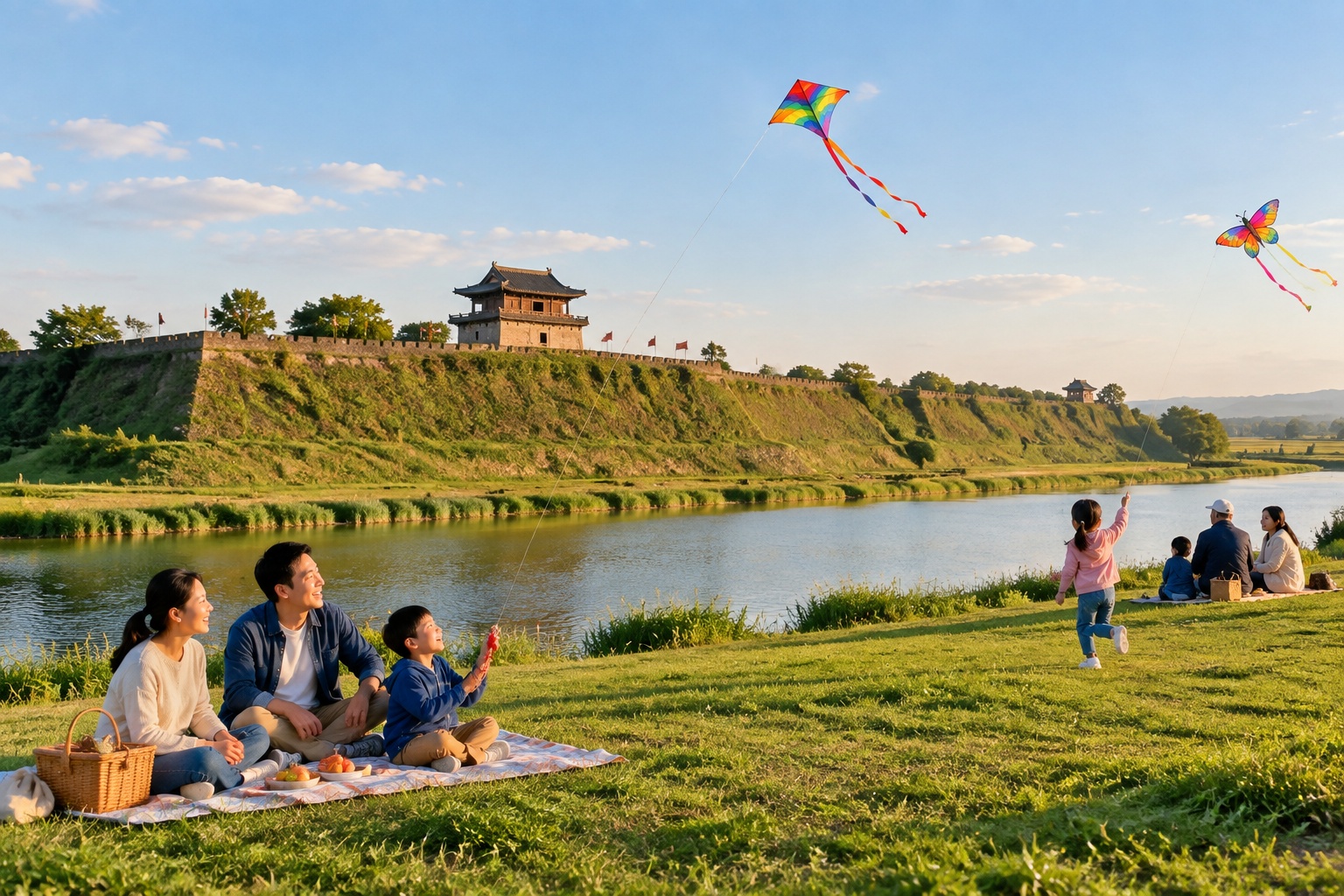
On a spring Saturday, families from downtown Hefei drive about forty minutes northwest, park along a quiet country road and set up pop-up tents on a wide lawn. Grandparents unfold camp stools. Someone is always flying a kite. Tea in thermoses, cut watermelon on a plastic mat, a small speaker playing something soft.
Past the picnic blankets, a low ridge of packed earth runs across the field — two meters high in places, grassed over, easy to mistake for a natural hill.
It isn’t. That ridge is a city wall, built about 1,800 years ago.
Why Hefei Has a “New City” That’s 1,800 Years Old
To understand the park, you need about ninety seconds of history.
China’s Three Kingdoms period, roughly 220 to 280 CE, was a three-way civil war. If you’ve played a Dynasty Warriors game or watched a Three Kingdoms drama, you already know the names: Cao Cao, Liu Bei, Sun Quan. The kingdom of Wei held the north. Wu held the southeast along the Yangtze.
Hefei sat almost exactly on the line between them. For decades it was a frontline town — attacked, abandoned, rebuilt, attacked again. Sun Quan’s armies came up the rivers and tried to take it, repeatedly.
In the early 230s, a Wei general named Man Chong made an argument that sounds oddly modern: the old city was too low, too close to the water and too easy to surround. He proposed building a brand-new fortress about fifteen kilometers to the northwest, on higher ground, with a proper wall and a wide moat.
The court approved. The city was built. Sun Quan attacked it and failed. What you’re looking at in the park today is that fortress — Hefei New City. “New” as of 1,800 years ago.
For Chinese readers this is a famous chapter. For most foreign visitors it’s a surprise. This isn’t the Great Wall or the Terracotta Army. It’s a working archaeological site in the suburbs of a city they’ve probably never heard of.
What You Actually See: Earthworks, Workshops and a Very Good Moat
There’s no reconstructed palace here, no costumed guards. That’s part of the appeal.
What survives is mostly earth and water. The wall is a long, grassy embankment. The moat still holds water and still traces the old outline. Standing on the bank, you can read the logic of the place: high ground, water on three sides, farmland stretching away. It looks like a defensive position because it was one.
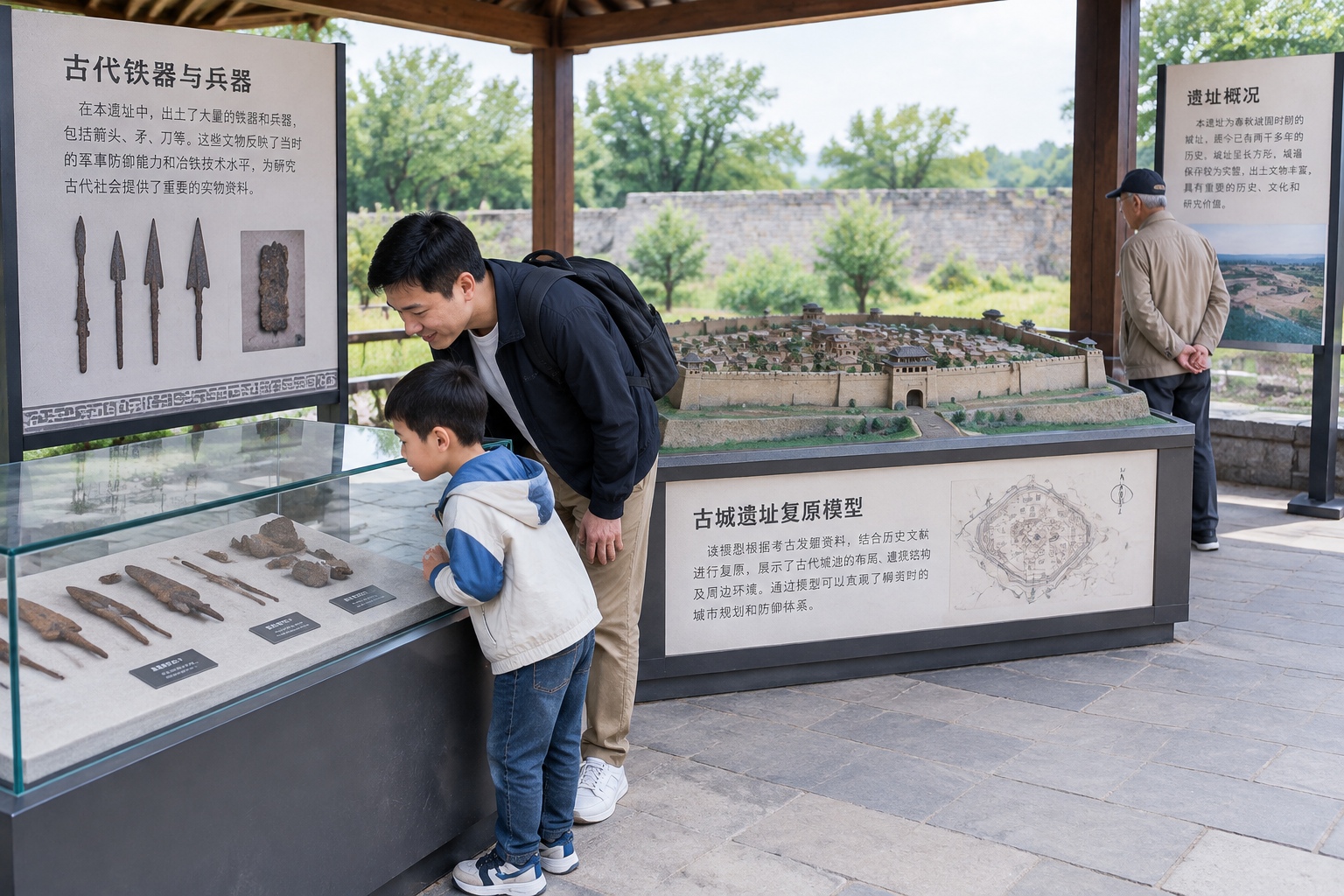
Archaeologists have excavated parts of the site and found the things that keep a garrison alive and armed: wells, kilns, iron-working remains, and what appear to be workshops producing weapons and tools. Some of this is presented in a small exhibition area with models and explanatory panels — a training ground here, a weapons workshop there, arrowheads and iron fragments in glass cases.
It isn’t a multimedia spectacle. Signage is mostly in Chinese, with some English. If you don’t read Chinese, a translation app and a bit of patience will get you through. Budget an hour, two if you have kids who like climbing on things.
Downtown, the Other Three Kingdoms Park
Here’s the useful thing most visitors don’t know: Hefei has a second Three Kingdoms site, and it’s in the middle of the city.
Xiaoyaojin Park sits next to the downtown shopping streets. In 215 CE this was the scene of one of the period’s most famous battles. The Wei general Zhang Liao, badly outnumbered, led a night raid into Sun Quan’s camp with a small force, then fought a rearguard action that nearly trapped Sun Quan himself.
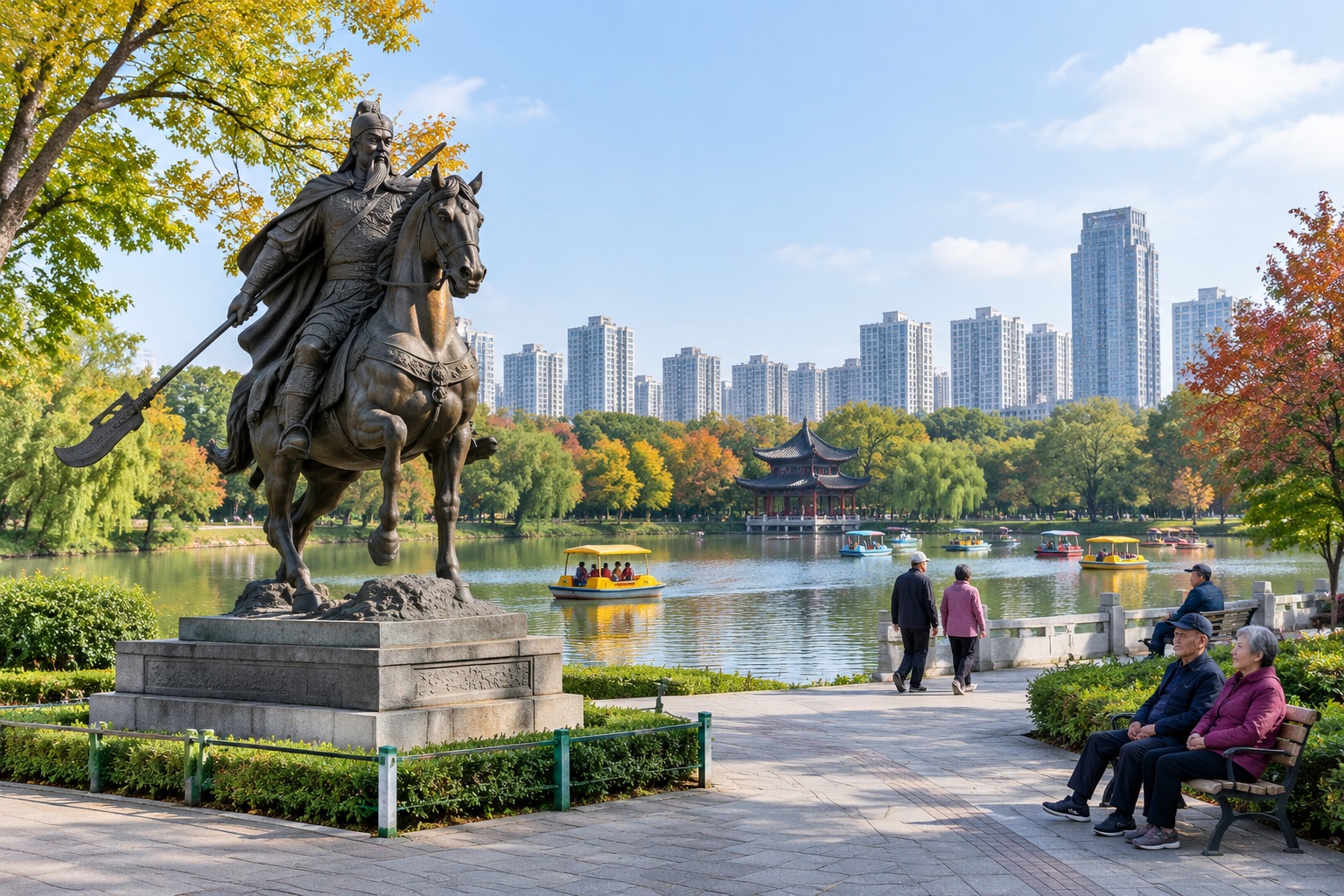
Today there’s a statue of Zhang Liao in the park, a lake, pedal boats. On weekends it’s full of retirees doing tai chi, teenagers eating snacks and couples taking photos. The contrast with the relics park is instructive. One battlefield was preserved as grass and earth. The other simply became a city park, because the city grew around it.
The Other Half of Hefei’s Slogan: Judge Bao
Local tourism boards describe Hefei with eight characters: “the old haunt of the Three Kingdoms, the hometown of Judge Bao.”
Bao Zheng (999–1062) was a Northern Song official born in Hefei. In Chinese popular culture he became the ultimate symbol of the honest official — the man who took on corrupt nobles and imperial relatives, and won. There are TV dramas, operas and a very recognizable look: black face, a crescent moon on the forehead.
Baohe Park, near the old city center, is built around his memory. There’s an ancestral hall, a lotus pond, a small museum and his tomb. It’s calm, shaded and popular with local families. If Xiaoyaojin is the city’s action movie, Baohe Park is its courtroom drama.
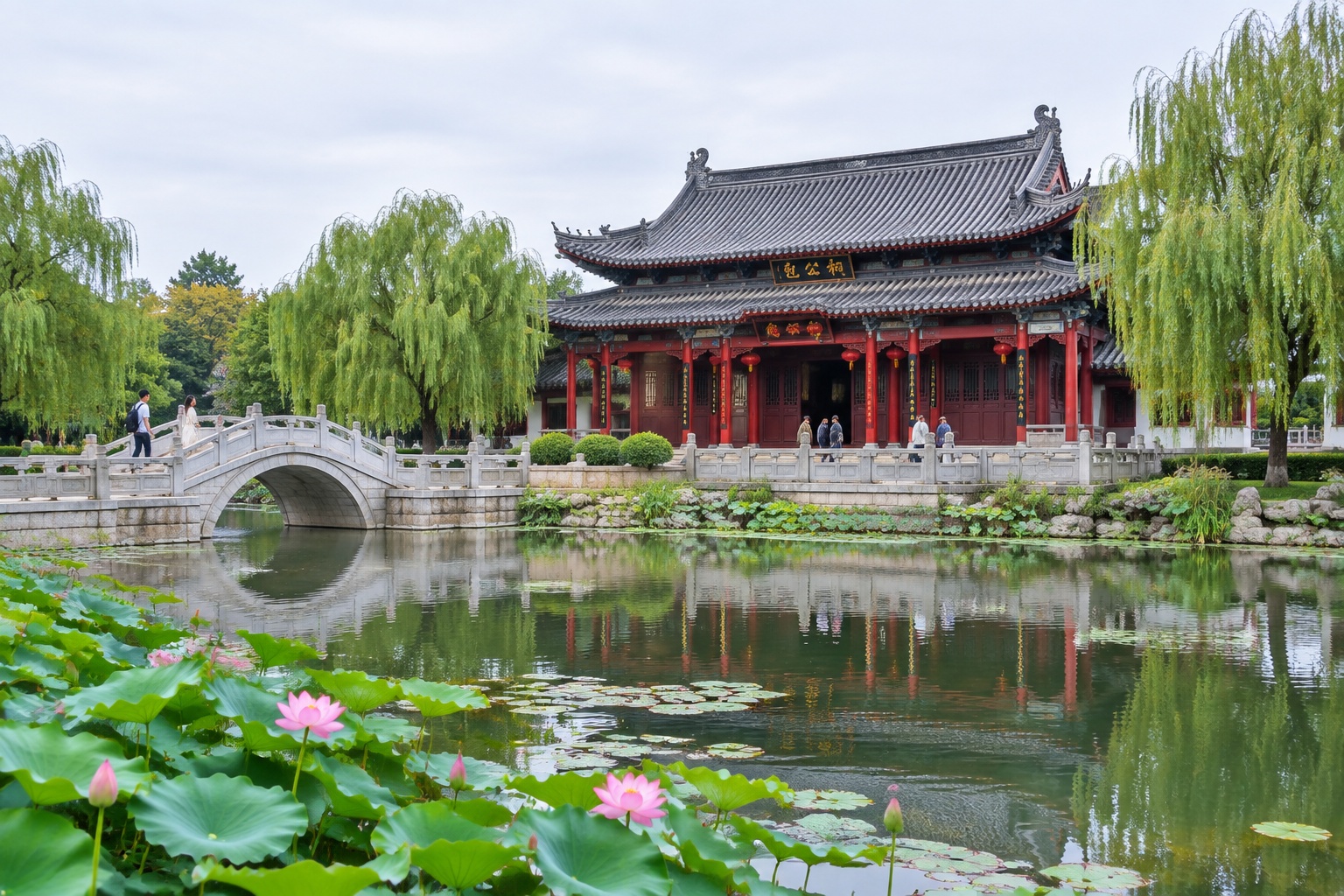
Put the two together and Hefei becomes interesting for a certain kind of traveler: a low-profile city with an unusually high density of names you’ve heard of, none of them on the standard international itinerary.
How a Battlefield Became a Lawn
The most Chinese thing about the Three Kingdoms Relics Park isn’t the ruins. It’s what people do on top of them.
In many countries a site like this would be fenced, ticketed and watched — you look, you leave. In Hefei, the ruins come with a lawn, and the lawn comes with a whole Saturday.
Kids fly kites, mostly the cheap ones bought at the gate. Families don’t grill anything, but they eat constantly: fruit, sunflower seeds, boiled corn, packaged snacks. Older men play xiangqi on a bench. Someone’s drone buzzes overhead. In summer the grass is crowded after 5 p.m., when the heat finally breaks.
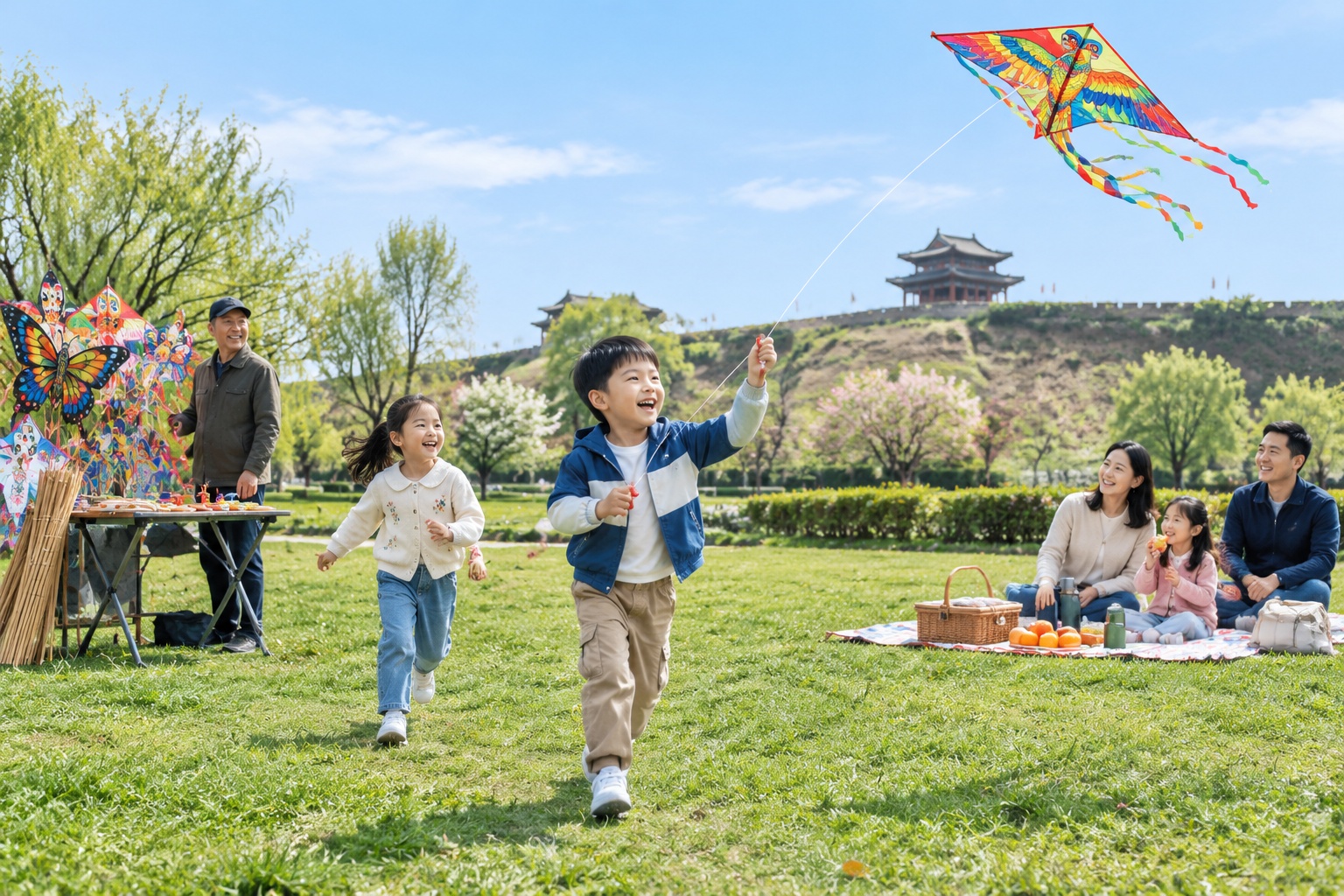
Nobody is being told to respect history, and yet everyone knows they’re sitting inside it. Grandfathers point at the embankment and tell kids about Zhang Liao and Sun Quan — sometimes accurately, sometimes not. That casual, un-museum-like relationship with the past is very common in China, and it’s hard to fit into a brochure.
Practical Notes
- Where: Luyang District, northwest Hefei, near Sanshigang township.
- Getting there: a taxi or ride-hailing car from downtown takes about 40 minutes; local buses also run out that way. There’s no metro station at the gate yet, so plan the last stretch.
- Best time: late March to May for kites and mild weather; October for clear skies. July and August in Hefei are hot and humid.
- Nearby: Dongpu Reservoir, the orchards and watermelon fields around Sanshigang, and Cuigang Art Village, where artists have turned old village houses into studios and small cafés.
- Language and tickets: signage is mostly Chinese and park staff generally don’t speak English. Admission is inexpensive, but prices change — check locally before you go.
Why It’s Worth the Detour
Hefei isn’t a tourist city in the usual sense. It’s a manufacturing and research city of nearly 10 million people — home to the University of Science and Technology of China, to the voice-AI company iFlytek, to factories making flat panels and electric cars, and to a quantum research program that shows up in international science coverage. Its metro opened only in 2016 and keeps growing.
Which is exactly why the relics park is interesting. Ten kilometers from a lab working on quantum communication, there’s an 1,800-year-old moat. And on top of the wall, a kid is trying to get a kite airborne.
You can see both in one afternoon. That’s the version of China that doesn’t make the news — not a museum case and not a slogan, just a city where the past and the weekend happen to share the same patch of grass.
Start the discussion at forum.chinacomes.com