

A 10-Day Route Through Four Very Different Cities
The Shanghai Metro at 11:40 on a Tuesday night was full. Not “a few empty seats” full — standing room only, a woman in nurse’s scrubs asleep against the door, two delivery riders scrolling their phones between stops. Dan, 34, from Columbus, Ohio, on his first trip to Asia, looked up at the route map and said: “I thought it would be quieter.”
That sentence set the tone for the next ten days. Dan arrived with a mental map of China assembled from headlines — pollution, surveillance, copycat factories, maybe some pandas. What he left with was less dramatic and more useful: a picture of how roughly 100 million people in four cities actually spend an ordinary weekday.
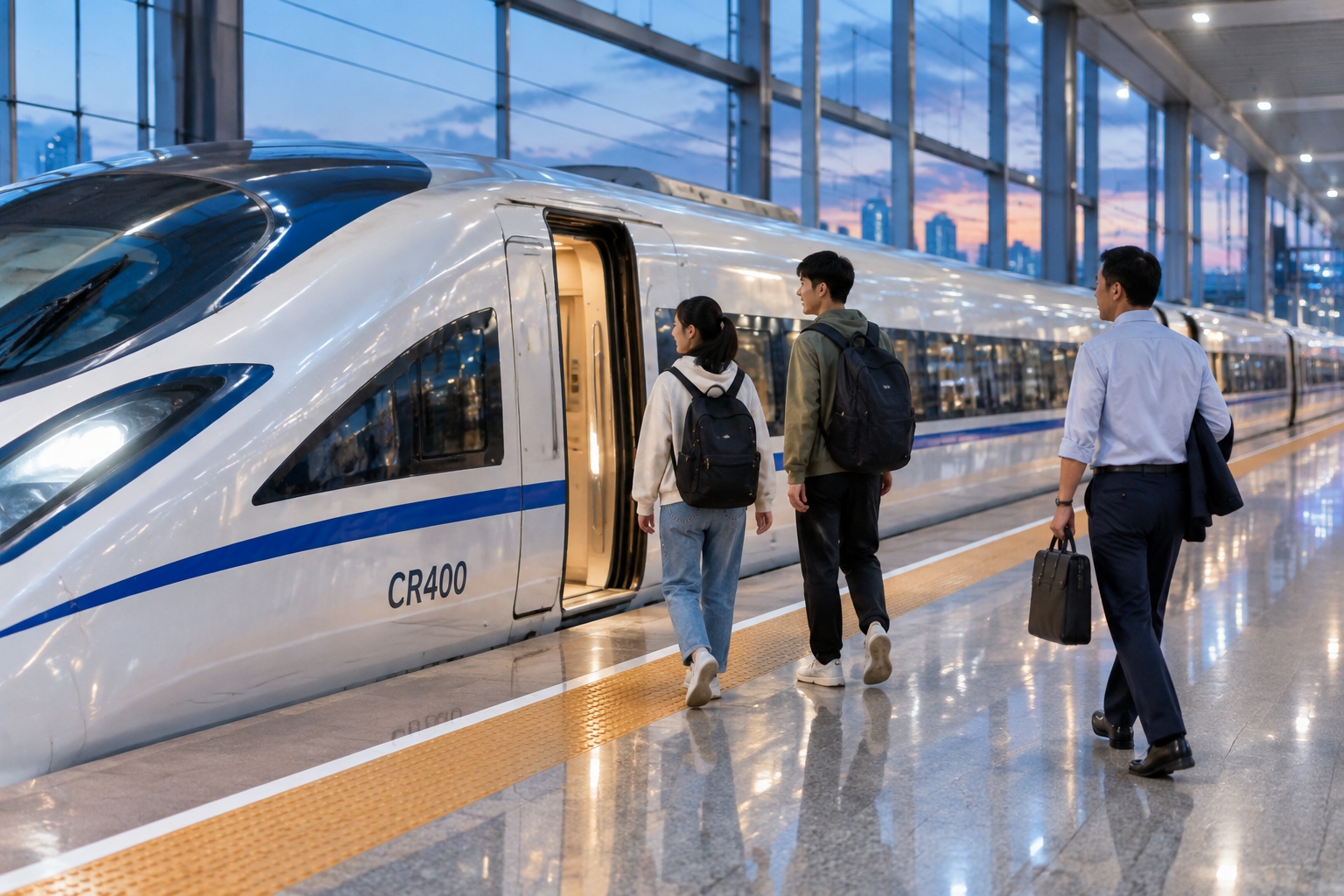
Our loop: three nights in Shanghai, a short flight to Chengdu, 90 minutes by high-speed rail to Chongqing, six hours through the mountains to Wuhan, then four and a half hours back to Shanghai. Four cities with four completely different relationships to geography. Two thousand kilometers of travel. Two backpacks.
This is what actually got rewritten along the way.
Shanghai: A City That Runs on Small Conveniences
We skipped the Bund on day one — not out of rebellion, Dan just wanted dinner. We ended up on a residential block in Jing’an, where an eight-seat noodle shop served us two bowls for 42 yuan (about $6) and the owner apologized for the wait. It had been four minutes.
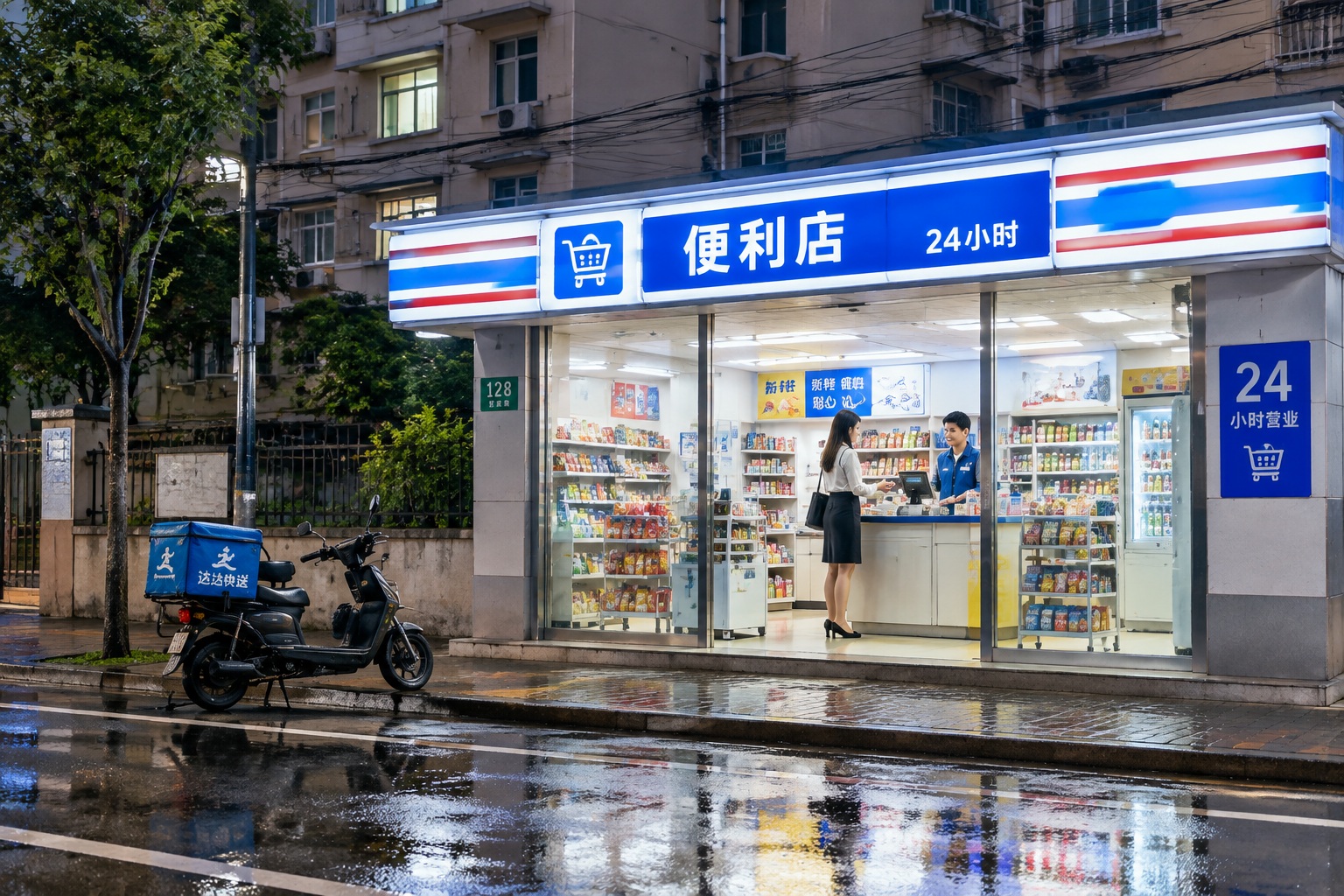
Shanghai isn’t a mysterious city. It’s a logistics city. The metro has more than 20 lines and over 500 stations; a ride anywhere central costs 3 to 6 yuan, and trains run until about midnight. The last one is never empty. Convenience stores — FamilyMart, Lawson, 7-Eleven, plus the local chain Bianlifeng — sit on nearly every corner and stay open around the clock. A delivery app will bring a bowl of soup to your hotel room in 25 minutes, often for less than the ingredients would cost.
What an American notices first
Dan noticed how quiet the difficult parts were: buying a SIM card, paying for coffee, crossing the city at rush hour. He linked his Visa card to Alipay in about ten minutes and never touched cash again. One QR code opens the subway gate, orders the coffee, unlocks the shared bike.
He also noticed what that efficiency costs. Our friend Wei, a 29-year-old product manager, finished work at 9:40 p.m. on the Thursday we met her, a schedule she described as “not bad.” China’s much-discussed “996” culture — 9 a.m. to 9 p.m., six days a week — has been publicly challenged and legally restricted in recent years, but the pressure didn’t disappear. It moved into more careful language. Wei pays 6,500 yuan a month for a one-bedroom outside the inner ring, cooks on Sundays, and orders in the rest of the week.
Chengdu: The Economics Behind the Chill
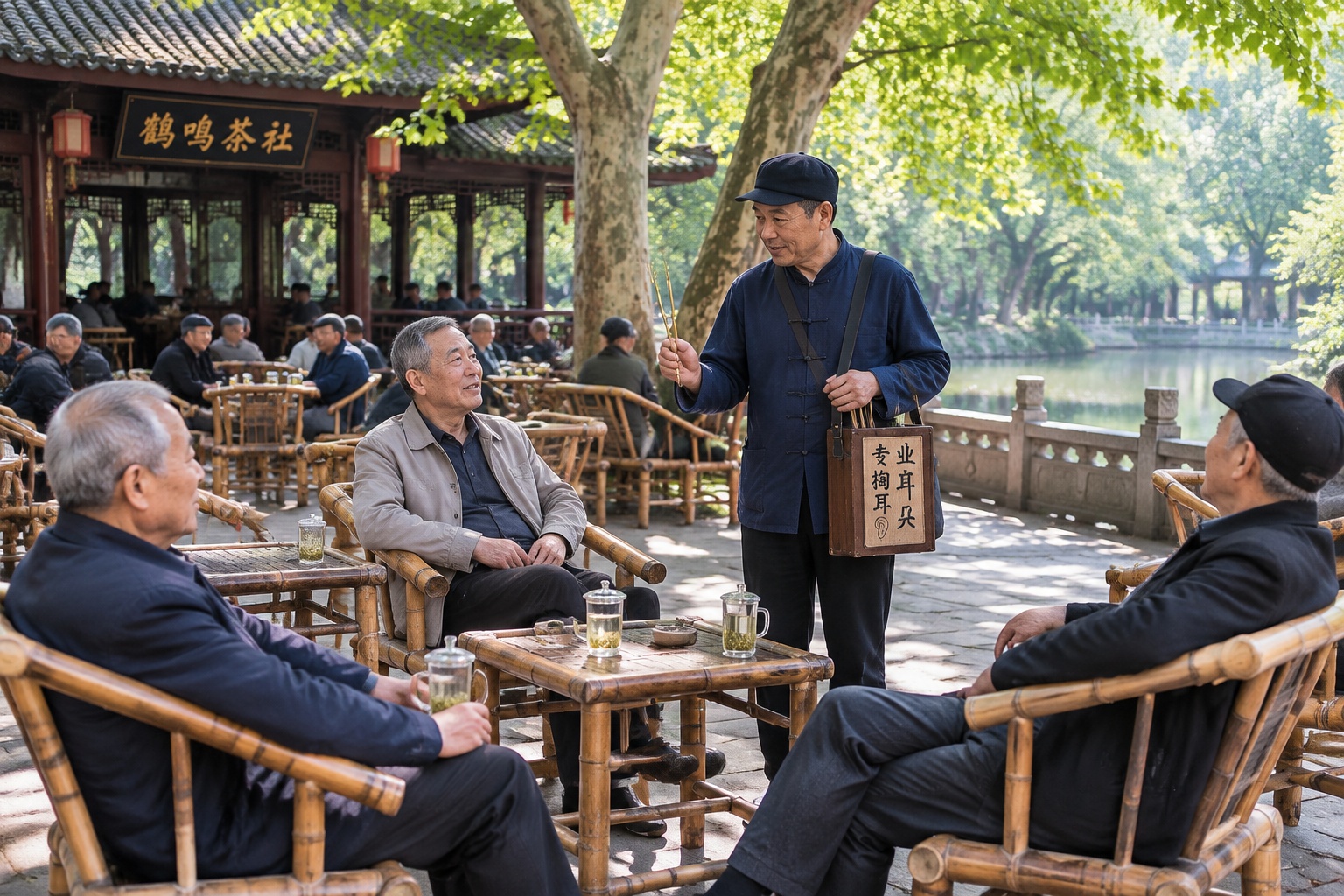
Chengdu is sold to visitors as a city that doesn’t rush. That’s true, and it’s also a business model. In People’s Park, retired men play cards under bamboo awnings at Heming Teahouse, paying 25 yuan for a covered glass of jasmine tea they can refill all afternoon. Ear-cleaning vendors walk between the tables ringing tuning forks: 60 yuan, ten minutes.
What Dan didn’t expect was how young the city feels. Chengdu has around 21 million residents, and after 9 p.m. the streets belong to people in their twenties. At a night market near Yulin we met Lin, 24, selling handmade ceramic cups off a folding table. She has a day job at a design studio, rents the table for 80 yuan a night, and clears maybe 400 yuan on a good evening. “It’s not for the money,” she said. “It’s for meeting people.”
The money still matters, though. Chengdu’s rents and food prices run noticeably below Shanghai’s or Beijing’s, which is a large part of why so many graduates move here from smaller provinces. A bowl of dan dan noodles costs 12 yuan. A room in a shared flat in a decent neighborhood runs 2,000 to 3,000 yuan a month. The relaxed pace is real — and it is affordable in a way that Shanghai’s is not.
Chongqing: Where the Infrastructure Is the Experience
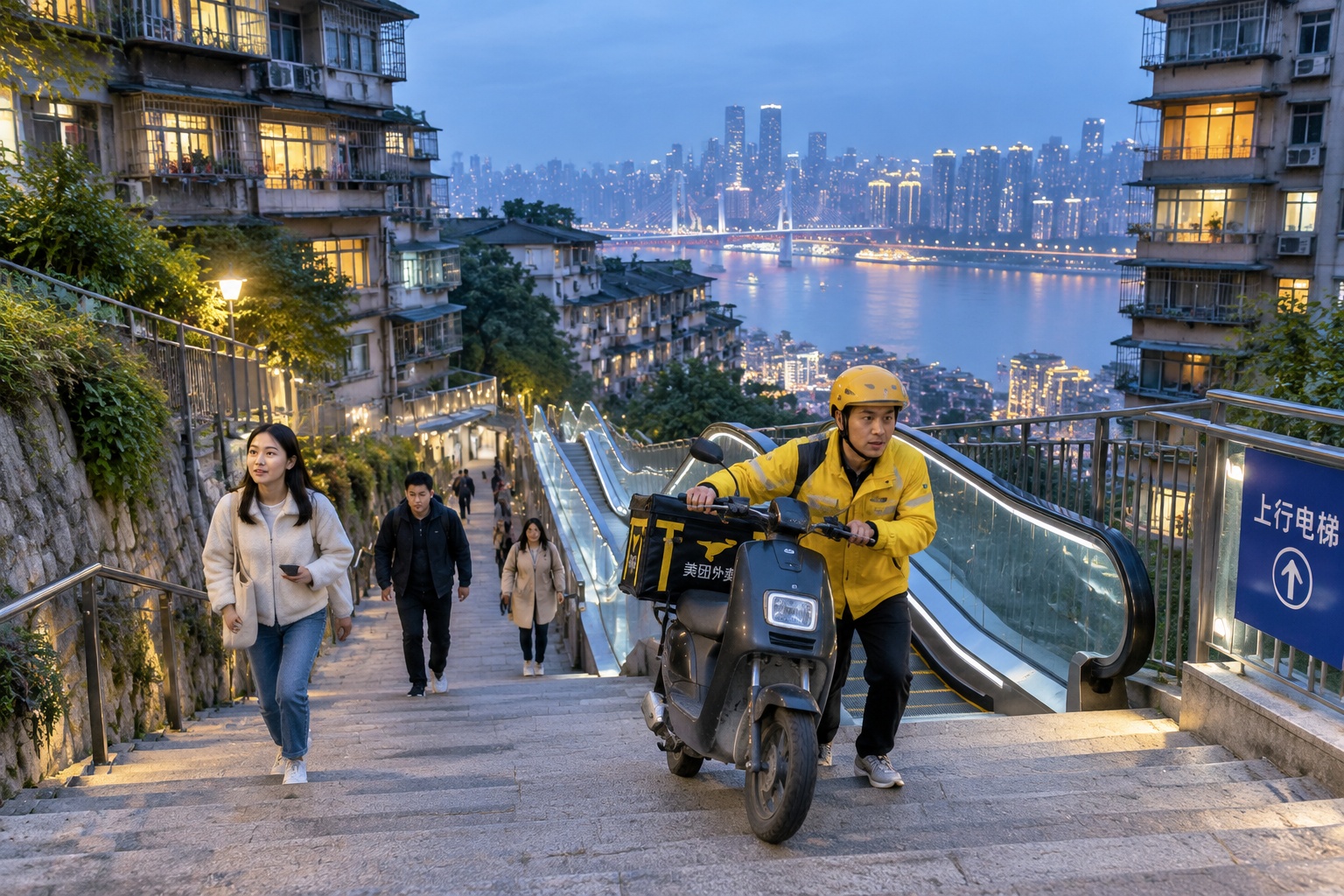
Chongqing broke Dan’s mental model hardest, mostly because it has almost no flat ground. The municipality holds more than 30 million people, and its core is built on ridges above the meeting point of the Yangtze and Jialing rivers. Streets stack on top of each other. “First floor” means very little here — a single building can have entrances at level 1 and level 12.
We rode Line 2, the monorail that passes straight through an apartment block at Liziba station. It’s the photograph everybody takes, but the ordinary version is more interesting: commuters use it the way New Yorkers use the 7 train, and the people living in that building hear it as background noise.
What made the city legible for Dan wasn’t the monorail. It was the escalators. Chongqing has built public escalators and elevators into its hillsides; the Huangguan Escalator alone climbs 112 meters and costs 2 yuan. Delivery riders push electric scooters up staircases that would stop a car. Cash has essentially vanished — a fruit seller on a hillside lane took 8 yuan by QR code without looking up from her phone call.
Dan’s summary: “This isn’t a city that overcame its geography. It’s a city that decided the geography was the point.”
Wuhan: The Hub Nobody Talks About
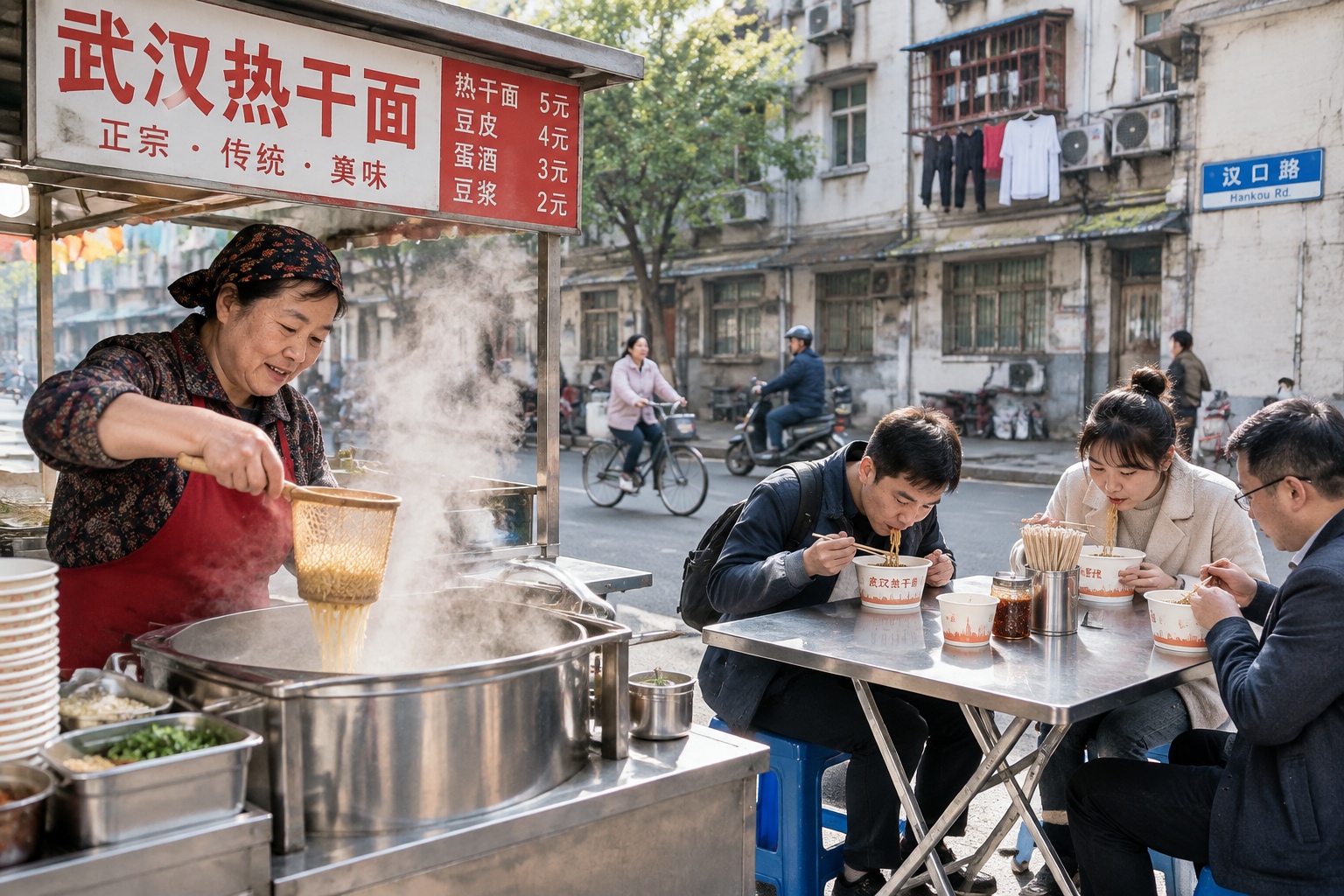
Wuhan gets skipped. It has no single landmark that travels internationally, and it sits in the middle of the country as a place people pass through: 13 million residents, two rivers, more than a dozen Yangtze bridges, one of the largest rail hubs in Asia.
We arrived at 7 a.m. and did what the city does — guo zao, breakfast eaten standing up or on the move. Hot dry noodles with sesame paste, chili oil and pickled vegetables cost 6 yuan from a stall on a back street in Wuchang. The vendor served something like 200 bowls in the hour we stood there. Commuters ate in ninety seconds and left.
Wuhan is also a university city. Around 1.3 million students live here, which is why the coffee shops near Guanggu Square look like Shanghai’s and why the subway at 10 p.m. is full of people under 25. We walked the Number 1 bridge over the Yangtze at sunset, against a current of cyclists and electric bikes. The city felt less polished than Shanghai and less performed than Chengdu — closer to a place where a lot of people simply work.
Four Assumptions That Didn’t Survive the Trip

1. Safety is a lived fact, not a talking point
Dan noticed it before he could name it: women walking alone at 11 p.m., phones held loosely, bags draped over chair backs in restaurants. Street crime in these cities is low by the standards of any large American city. That is not the same as zero risk — scams and theft exist, and traffic is genuinely dangerous for pedestrians, especially scooters.
2. Mobile payments went further than he thought possible
He used cash twice in ten days, both times at a temple. The system behind that — QR codes, app-based transit, digital appointment booking at hospitals — isn’t a novelty here; it’s plumbing. For foreign visitors the friction is real but shrinking: Alipay and WeChat Pay now accept international cards, and setup takes minutes.
3. High-speed rail is not a gimmick
China’s high-speed network has passed 45,000 kilometers. Trains run at 300–350 km/h, leave on time, and cost a fraction of their European equivalents: Shanghai to Wuhan, roughly 800 kilometers, is about 550 yuan in second class. Dan booked on his phone the night before and used his passport as the ticket.
4. Public space is used differently
Parks at 6 a.m. are full. Groups of grandmothers dance, men practice tai chi, retirees sing into portable speakers at a volume that would start a complaint in most American suburbs. Dan found it a little loud and entirely enviable. “In Ohio,” he said, “a park at 6 a.m. belongs to joggers with headphones. Here it’s a living room.”
Ten Days Isn’t Enough
The honest version: ten days in four cities gave Dan a set of specifics and no grand theory. He can tell you what a 6-yuan breakfast tastes like, how a hillside escalator sounds, what a 24-year-old ceramics seller thinks about her folding table. He cannot tell you what China is. Neither can I.
What the trip did was replace a set of abstractions with a set of streets. That’s a modest result, and probably the only honest one. If you’re considering something similar, here’s what actually helped.
If you go: practical notes
- When: late March to April, or September to October. Skip July and August in Wuhan and Chongqing; humidity pushes past 38°C and the heat is punishing.
- Route: Shanghai to Chengdu by air (about 3 hours); Chengdu to Chongqing by high-speed rail (about 90 minutes, departures every 20–30 minutes); Chongqing to Wuhan by rail (5.5–6.5 hours); Wuhan to Shanghai by rail (about 4.5 hours).
- Tickets: book through the 12306 app or Trip.com. Your passport is your ticket; arrive 20–30 minutes early for security checks.
- Money: link a Visa or Mastercard to Alipay or WeChat Pay before you fly, and carry 200–300 yuan in cash for small stalls and temples.
- Connectivity: an eSIM or local data SIM is worth the cost. Google services need a VPN, so download offline maps and a camera translation app in advance.
- Entry rules: many nationalities — including most of Europe, Australia, Japan and South Korea — can currently enter visa-free for up to 30 days. Rules change often, so verify before booking.
Ten days will not teach you a country of 1.4 billion people. But it will teach you what a Tuesday night subway car looks like, what a 6-yuan breakfast tastes like at 7 a.m., and how a hillside street works when nobody bothered to flatten it. That’s where most of it actually happens.
Start the discussion at forum.chinacomes.com