

9:40 p.m. on the 24th floor
The lights on the 24th floor of an office tower in Beijing’s Chaoyang district go off in sections, one row at a time. Zhou Yu, 29, is still at her desk with two monitors and a cup of tea that went cold two hours ago. Somewhere behind her someone is eating instant noodles; the smell of the seasoning packet has been in the air since eight o’clock. Twenty-four floors down, a bicycle bell rings twice and stops.
She orders dinner on her phone. A bowl of malatang, 32 yuan, about $4.50. Eighteen minutes later a rider in a yellow jacket leaves it in a heated locker in the lobby. The building has a wall of these lockers now, glass boxes with numbers, like a vending machine for dinner. She eats while she works and closes her laptop at 9:58.
Home is a rented one-bedroom in Shuangjing. Subway Line 10, then a shared bike for the last 900 meters. Door at 11:05. One episode of a drama series, twenty minutes of scrolling, sleep.
Nothing about this day is unusual. Roughly two out of every three people in China now live in cities, and a very large number of them keep some version of this schedule. In 2024, the average disposable income of urban residents was 54,188 yuan, around $7,500 a year. In Beijing it runs higher, roughly 85,000 yuan.

5:20 a.m., 2,400 kilometers southwest
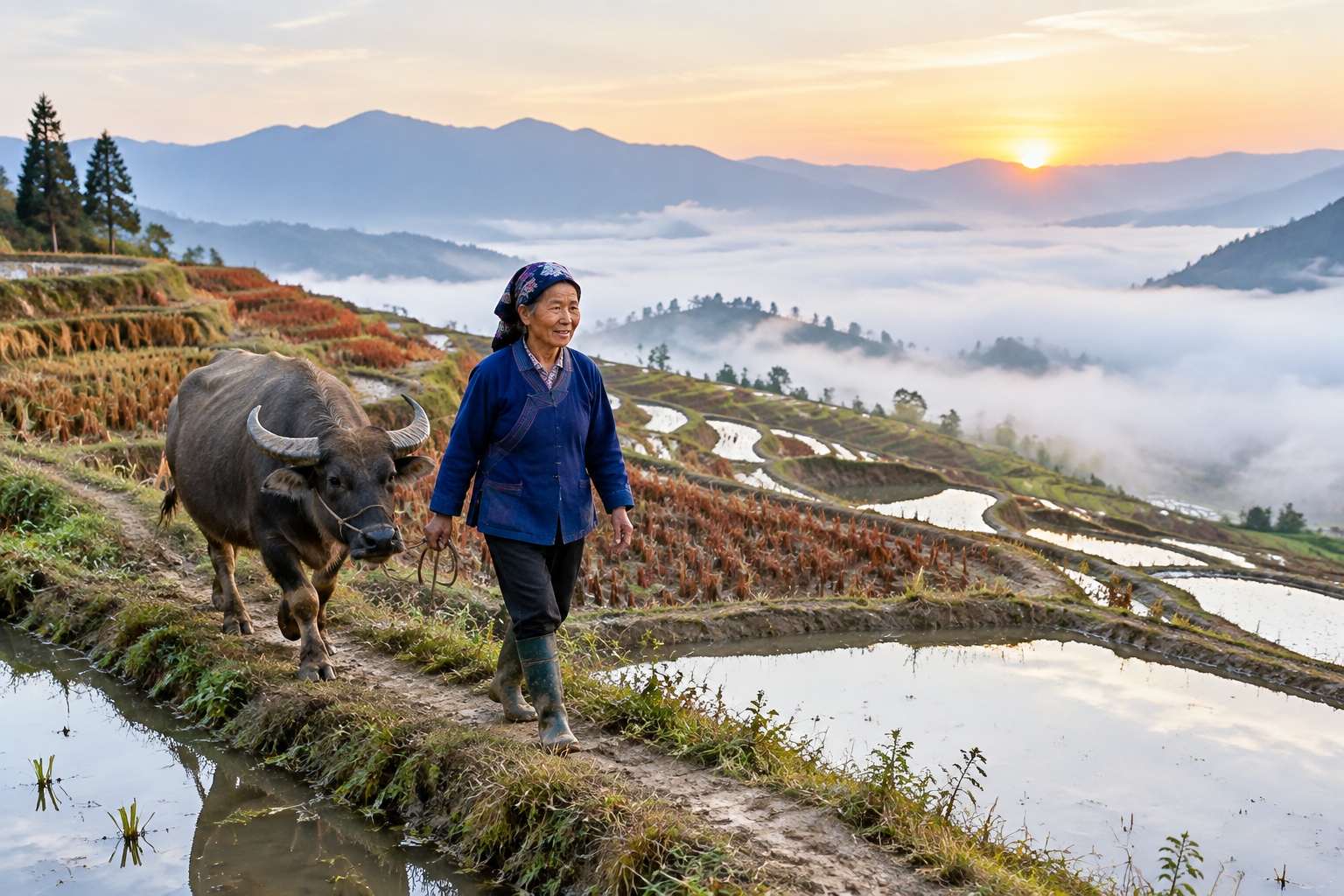
Li Xiufen walks out of her house in Yuanyang county, Yunnan, at 5:20 in the morning with a headlamp and rubber boots. She is 63. Her village sits at about 1,800 meters, in Honghe prefecture, not far from the Vietnamese border. Fog fills the valley below like water in a bowl and will not lift before nine.
The terraces are already awake. For roughly 1,300 years, farmers on this mountainside have cut steps into the slope and moved water down through a lattice of channels, splitting the flow with wooden boards notched to widths agreed by the village. UNESCO listed the Honghe Hani rice terraces as a World Heritage cultural landscape in 2013. The protected core covers about 16,600 hectares, several thousand of which are still farmed by hand.
October is harvest. Li Xiufen cuts red rice stalk by stalk with a sickle, ties it into bundles and leaves them standing to dry. Her water buffalo stands in the mud a few meters away, indifferent. The water under the rice is cold; by noon the sun will be strong enough to burn the back of her neck through a cotton shirt.
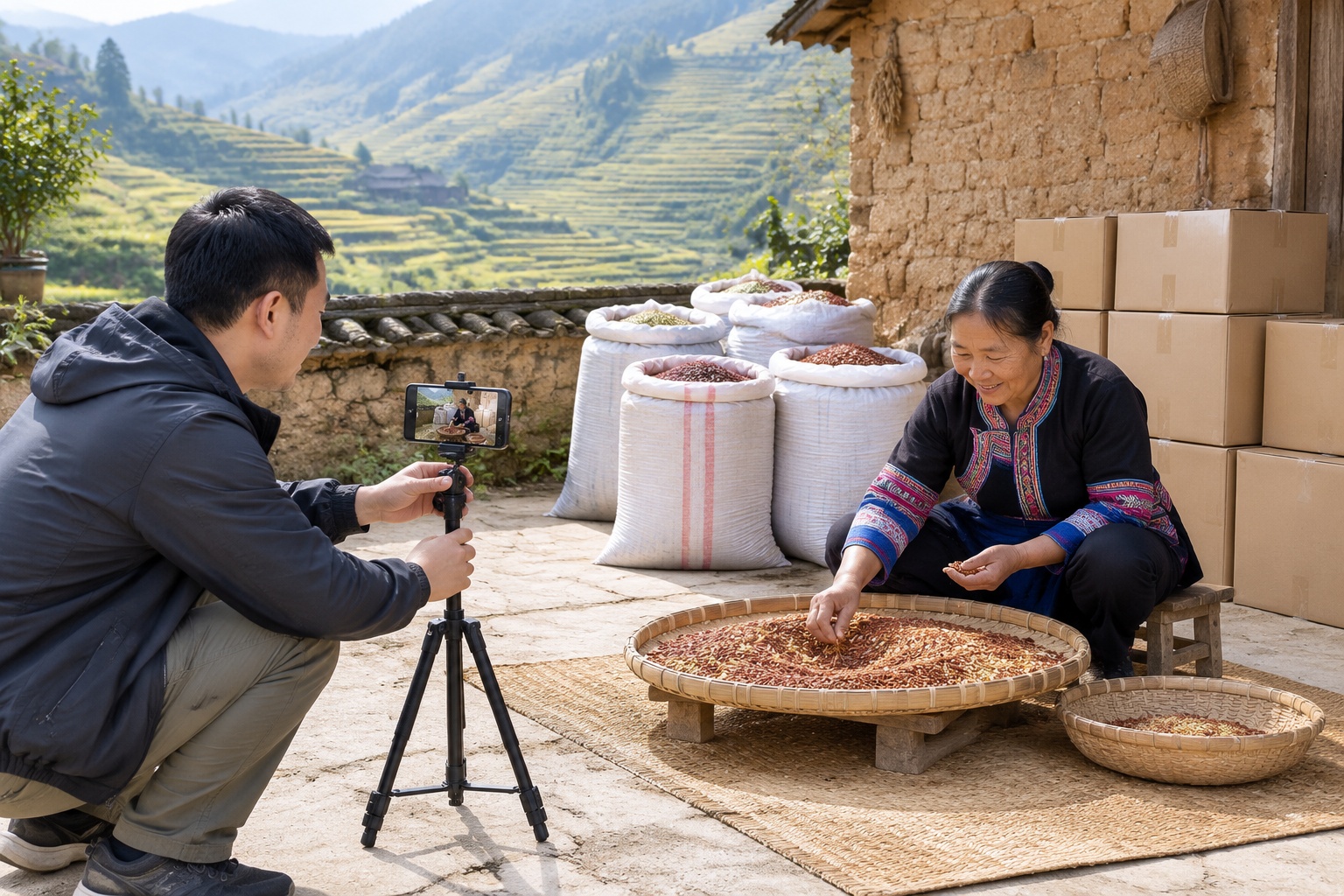
Her son, Li Jianhua, 34, is already in the courtyard by nine. He props a phone on a tripod against a wooden post and films the mist sliding off the terraces for ninety seconds, then talks into the camera about this year’s red rice: the price, the harvest date, when the new batch ships. About 4,000 people follow the family’s account. Most of them have never been to Yunnan.
One country, two clocks
These two mornings are 2,400 kilometers apart. The distance between them is also measured in money and time. In 2024, the average disposable income of rural residents in China was 23,119 yuan, less than half the urban figure. That gap is real, and it is also narrower than it was: a decade ago the ratio was about 2.75 to 1. Now it is closer to 2.3 to 1.
It would be easy to describe this as two Chinas, one running fast and one running slow. That reading misses the important part. The two are wired together, and the wiring is getting thicker.
The thread between them runs through a phone
Li Jianhua’s small cooperative buys red rice from around 120 households in the surrounding villages, mills and bags it, and sells it online: five-kilogram sacks, 39 to 60 yuan depending on grade, shipped from a county logistics hub. A bag ordered in Beijing arrives in two or three days.
That sounds ordinary. Fifteen years ago it was impossible. Farmers here sold to whichever middleman reached the village first, at whatever price he named, because there was no other way to move five tons of rice out of a mountain valley. Today the price is on a screen, and buyers in Guangzhou and Hangzhou can see photographs of the terraces the rice grew on.
None of this is romance. Livestreaming is work: scripting, shooting, answering the same question forty times in an evening, refunding a buyer whose bag split in transit. Packaging and shipping eat the margin. The government built the roads and the 4G towers; the market decides who earns what.
There is a second thread running the other way. The county now receives visitors who once had no reason to come: photographers in November, when the flooded terraces mirror the sky; families in July, when the rice is green; weekenders from Kunming, six hours away by road. Guesthouses are run by local families, and Hani women sell indigo-dyed cloth near the viewpoints. Tourism does not solve everything. The money concentrates in a few villages and stops entirely in the low season. But it gives the terraces a reason to survive that is not tied to the price of rice.
What each pace costs
In Beijing, the price of that 9:58 p.m. finish is argued about openly: the “996” debate, the long commutes, and the fact that the rider who brought Zhou Yu her dinner is probably on hour eleven of a twelve-hour shift, on a scooter, in traffic, for 6,000 to 9,000 yuan a month. The system is astonishingly good at delivering hot food to the 24th floor. Someone pays for that with their knees and their sleep.
In Yuanyang, the cost is written on the hillside. The people who maintain the terraces are old; many of those still working the paddies are in their sixties, and the channels they clean every year are a collective job no single family can do alone. If the channels fail, the fields fail, and a terraced field that stops being farmed does not stay a field. Village schools have closed and children board in county towns. Young people who need cash income mostly have to leave to find it, and tourism money is seasonal and unevenly spread.
For forty days a year, the clocks sync
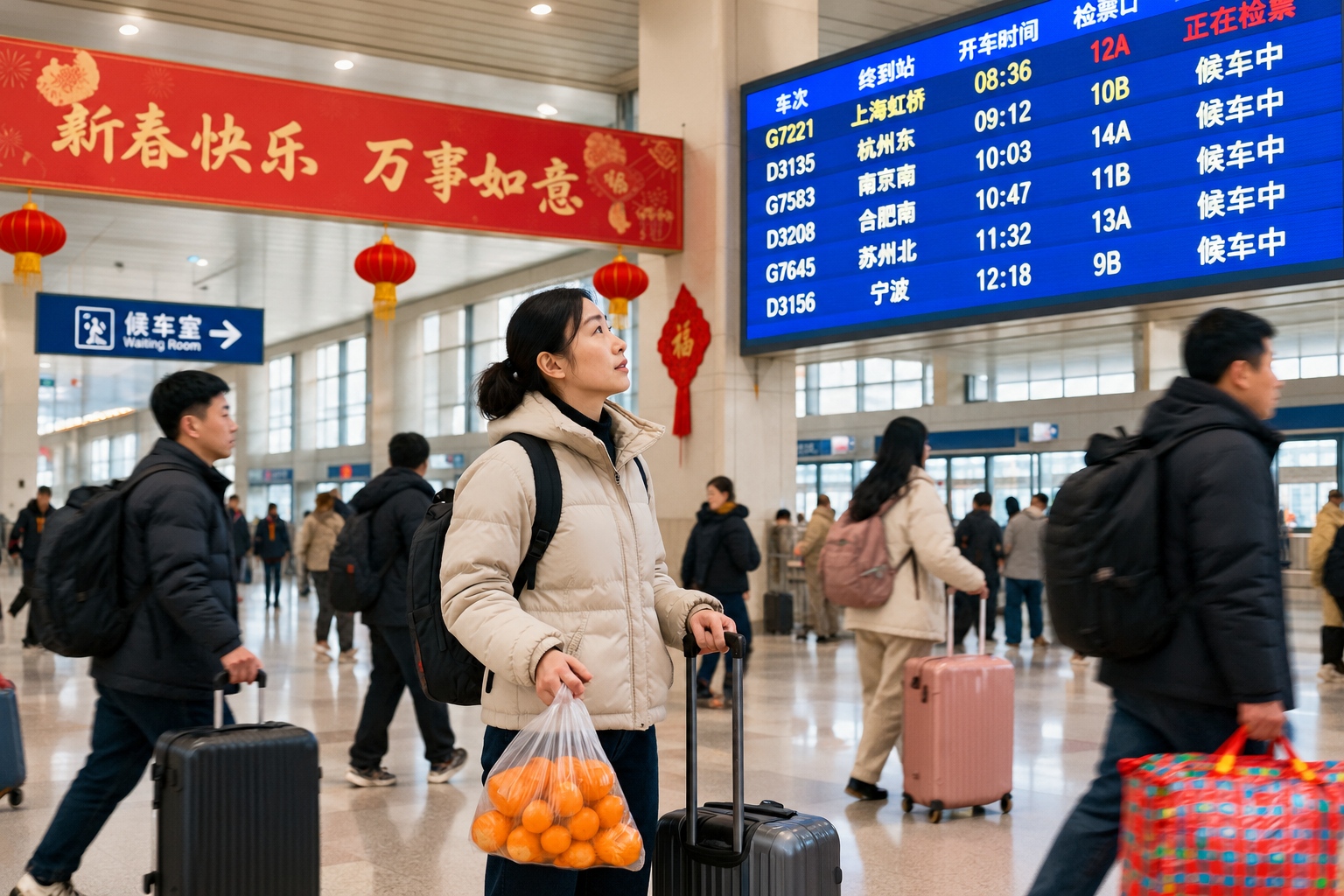
Then comes Spring Festival. In the 40 days around it, China records roughly nine billion passenger trips by train, bus, plane, motorbike and private car, as people who work in cities go home. It is the largest annual movement of human beings on earth, and it is mostly about the distance between the two mornings in this article.
Zhou Yu is from Hubei and takes the high-speed rail. Li Jianhua’s cousin works in a logistics warehouse in Dongguan; he takes a train to Kunming, then a bus. China’s high-speed rail network passed 48,000 kilometers in 2024, and since the Kunming-Vientiane line opened in December 2021 there are stations in Honghe prefecture that cut hours off the trip. Yuanyang still has no station of its own. The last stretch is two to three hours on a mountain road, in a bus that smells of oranges and cigarettes.
11:40 p.m., a five-kilogram bag of rice
On a Tuesday in December, Zhou Yu orders a five-kilogram bag of Yuanyang red rice on her phone before bed. It costs 48 yuan plus delivery. Three days later it arrives at her door in Chaoyang, in a cardboard box with a QR code printed on the side that leads to a video of the terraces.
She has never met Li Xiufen. She has never stood on a terrace or felt how cold the water is in October. But the rice she cooks on Sunday, the rice her mother will taste at Spring Festival and pronounce inferior to Hubei rice, traveled down the same road she rides home once a year: out of the mountains, onto a truck, onto a train, into a city of 21 million people.
Neither of these lives is China’s past, and neither is its future. They are both the present, keeping different hours, running on the same clock.
Start the discussion at forum.chinacomes.com