
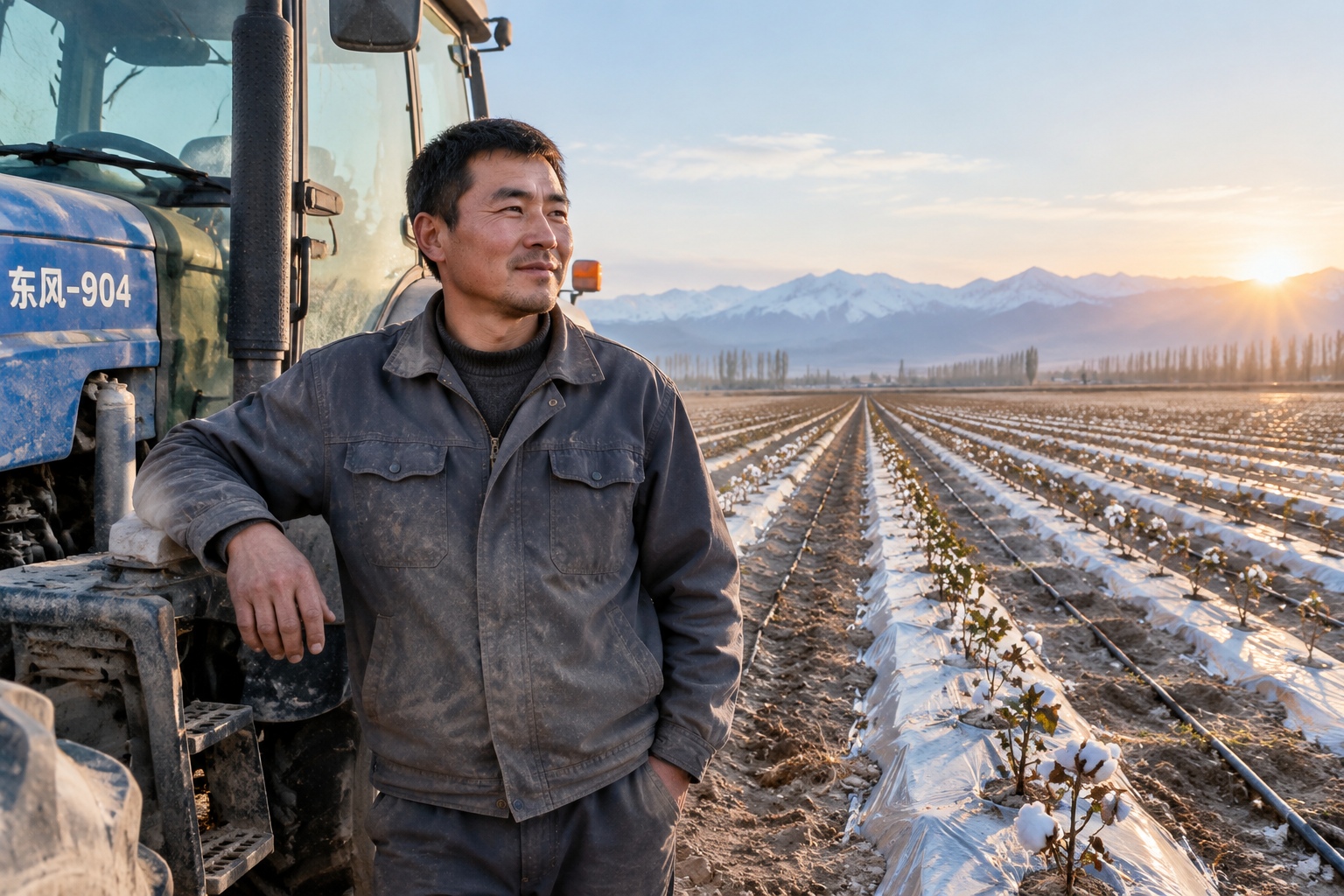

MANAS COUNTY, Xinjiang — At four in the afternoon, Zhao Lei is sitting in a plastic chair at the edge of a cotton field, holding a phone, doing nothing that looks like farming.
He is opening a valve. Twelve kilometers away, water begins moving through drip tape buried under plastic film, and 500 mu of newly seeded cotton starts its evening drink. Then he books a drone, answers a question in a 43-person group chat, and glances at two soil-moisture readings on his screen.
His morning looked nothing like this: six hours on a tractor, hands off the wheel for most of it, watching a satellite-guided screen hold a seeding line straight to within about 2.5 centimeters.
I asked him which half of the day is harder. He thought about it for a moment. “The phone,” he said. “The tractor is easy.”
A sowing day starts at 5:40
The kettle is already hot when his alarm goes off at 5:40. By 6:10 he has drunk two cups of tea, eaten half a naan, and backed a 180-horsepower tractor out of the shed behind his house.
Sowing season here lasts about three weeks. Miss the window and the cotton comes up late, and a late crop is a smaller crop — so the whole village is awake at the same hour.
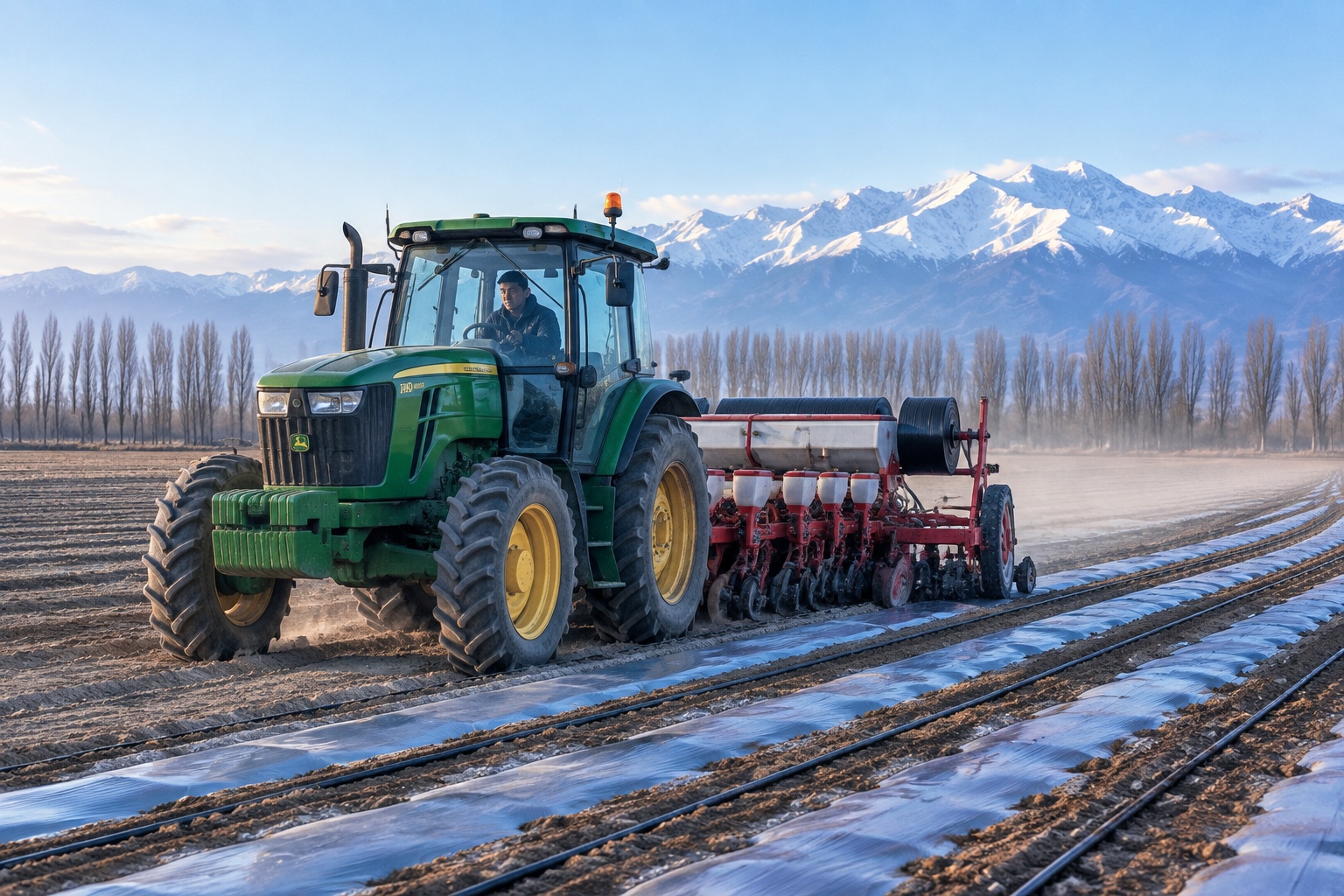
The tractor drives straighter than he does
There is a small antenna on the cab roof, wired to a screen the size of an iPad. It receives China’s Beidou satellite navigation system — the same constellation that runs maps on hundreds of millions of Chinese phones — combined with a ground correction signal that narrows the margin of error to roughly 2.5 centimeters.
The screen shows two parallel green lines. As long as the tractor sits on them, it steers itself. Zhao rides with his hands in his lap, watching the seeder behind him in the mirror.
One pass behind that tractor does four jobs at once: it lays drip irrigation tape, covers the row with plastic film, drops seed through a hole punched in the film, and puts down starter fertilizer. That used to be three people, three machines, three passes over the same ground.
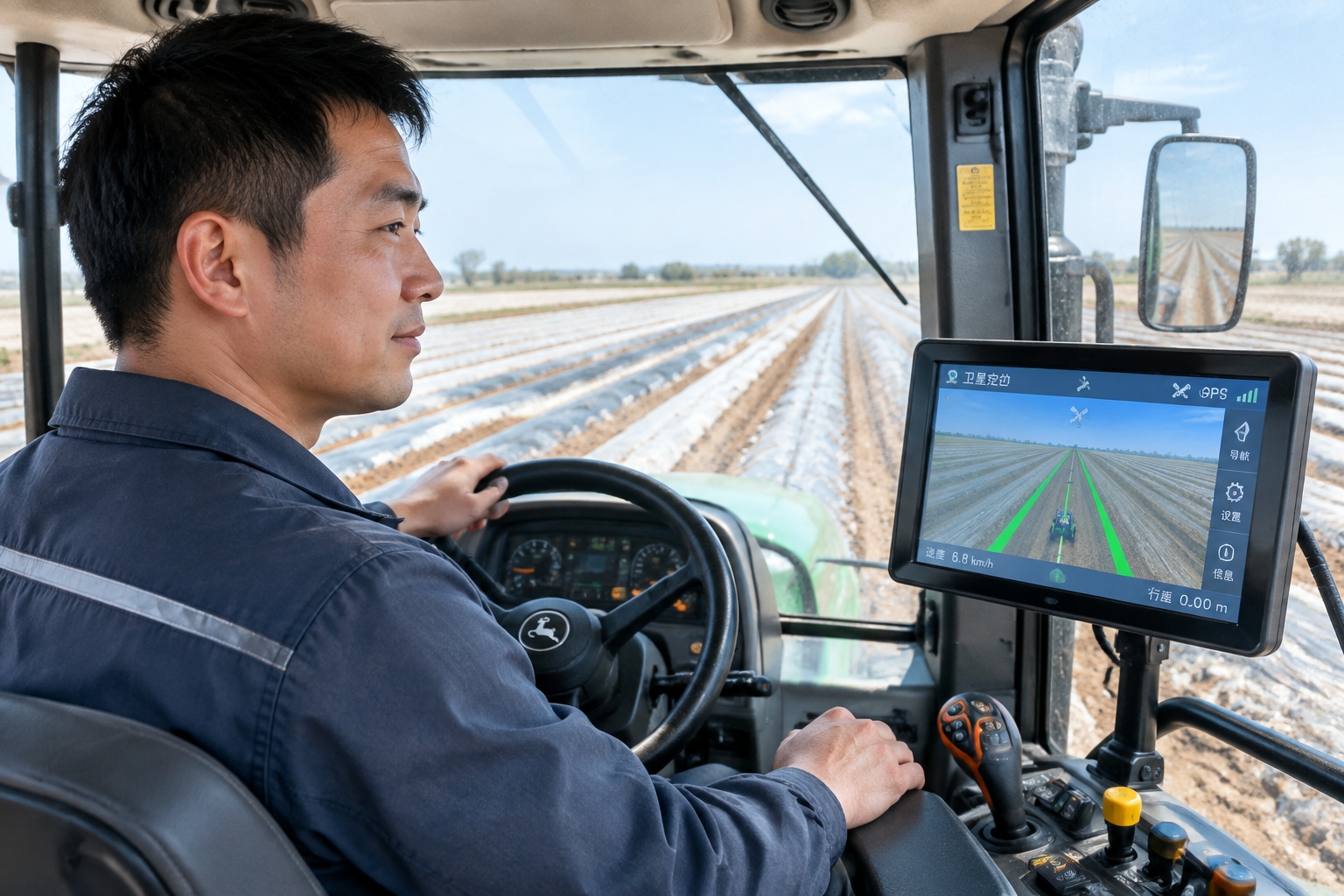
Why does 2.5 centimeters matter? Because a crooked line means overlap — wasted seed, wasted film, wasted fertilizer, and a strip of land at the end of the field that never gets planted. Operators here say the guidance system saves them a few percent on inputs and a couple of percent on land. Over 500 mu, that is real money.
“Ten years ago, if you seeded a field, you had to be a good driver,” he told me. “Now the young guys are better at the screen than I am.”
He still steers the turns himself, and every hour or so he climbs down to check the seed box and clear mud off the tape guide. The machine is clever. It is not self-sufficient.
Lunch, and a nap he refuses to give up
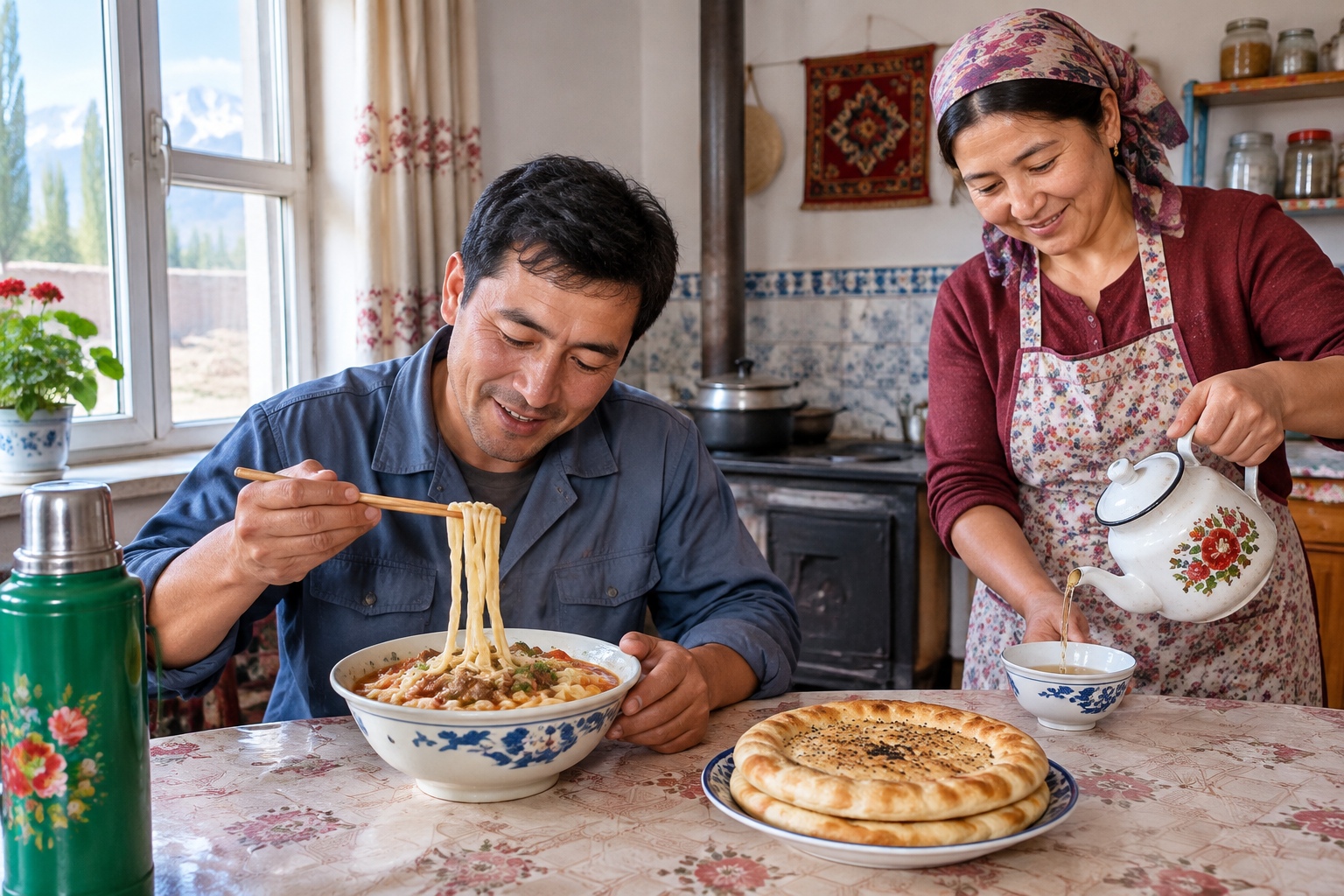
By two in the afternoon the tractor is parked in the shade of a windbreak. Lunch at home is hand-pulled noodles with tomato and lamb. His wife works at the township health centre; his mother lives next door and keeps an eye on the house.
The nap is 40 minutes and non-negotiable. I asked him, half joking, whether a man with a satellite-guided tractor still needs one. He laughed. “The machine doesn’t need a nap. I do.”
The afternoon shift happens on a screen
Around four, the physical work ends and a different kind of work begins.
His 500 mu — about 33 hectares, or 82 acres — sit 12 kilometers from his house, spread across four plots. Twenty years ago, watering that land meant flood irrigation: someone walking the ditches with a shovel, opening and closing earth gates, sometimes at two in the morning.
Now the field drinks through drip tape under the film, on a schedule he sets from a phone app. He taps plot seven, sets a valve to run for six hours, and checks sensors buried 20 and 40 centimeters down. A bag of water-soluble potassium gets mixed into the line at the same time, which is why people here call it “water and fertilizer in one.”
He estimates drip cuts his water use to roughly 300 cubic meters per mu, against 500 or more under flood. That is not only about cost. In Xinjiang, water is allocated — each household has a quota, and going over it is expensive.

Then he books a drone and answers a group chat
The next task is a WeChat group with 43 members: neighbours, the machinery cooperative, a couple of contractors, and an agronomist from the county extension station. A woman posts a photo of cotton leaves with yellow edges. Within twenty minutes someone has answered — likely a potassium shortage after a cold night, add foliar feed before the weekend. Nine people in the group read it. Probably fifty fields benefit.
Then he calls Eli, who is 24 and owns two agricultural drones.
Zhao books 500 mu of pesticide spraying for two days out, weather permitting. A drone like Eli’s can cover 300 to 500 mu in a working day once you count battery swaps and refills. A person walking the rows with a backpack sprayer does 20 to 30 mu, in 30-degree heat, in cotton that is chest-high by July.
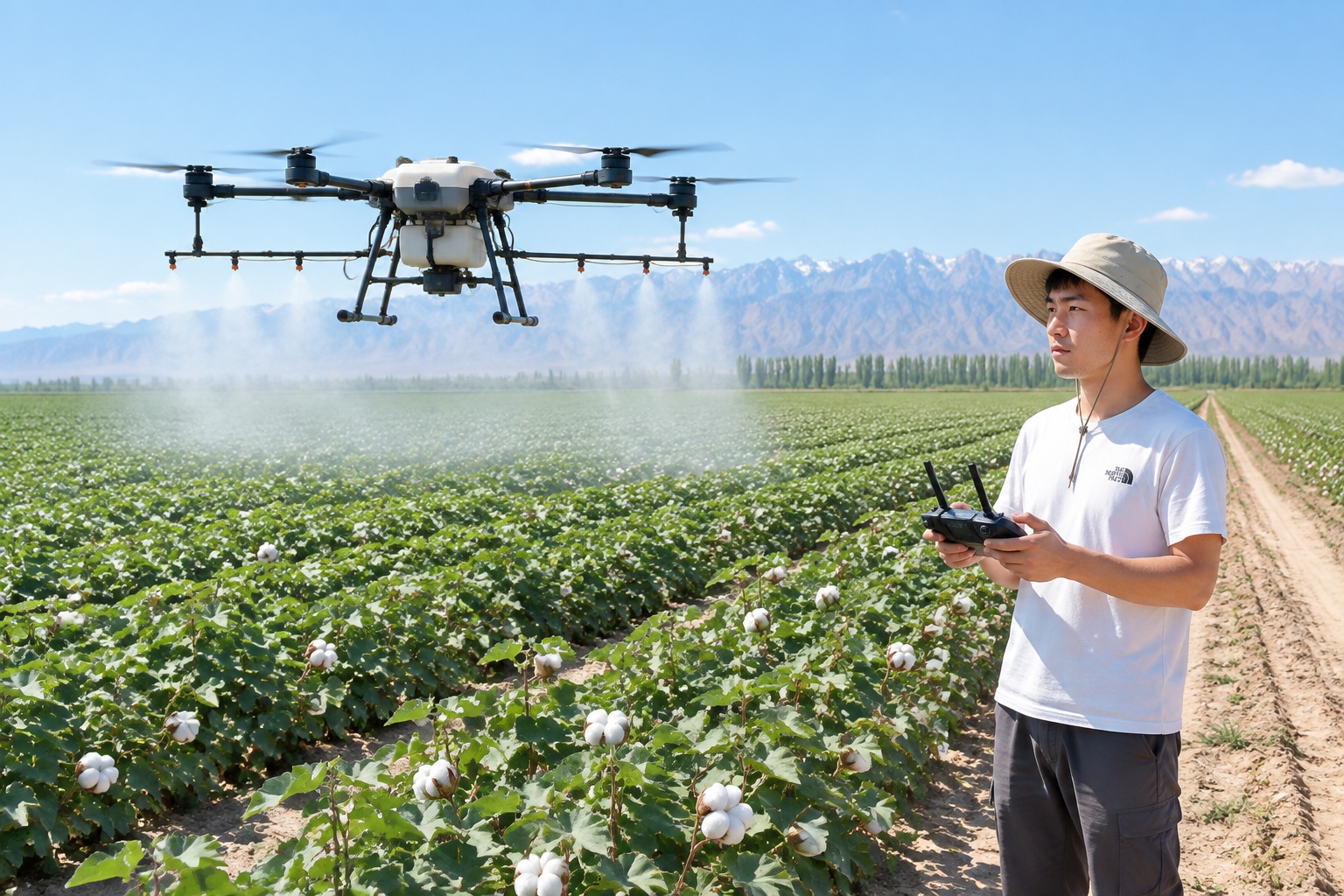
What 500 mu actually means
Five hundred mu is not a plantation. It is bigger than the 10 or 20 mu his parents farmed, and much smaller than a corn farm in Iowa. But it is large by the standards of a Xinjiang village, and it exists because of a quiet change in rural China: the plots don’t move, but the people who farm them do.
He rents the land from about 20 households. Some moved to Urumqi or Korla for work. Some are in their seventies and can’t do the heavy jobs anymore. Some simply prefer a fixed rent to a year of weather risk. The transfer is usually informal and renewed by handshake, though the money is real: roughly 800 to 1,200 yuan per mu per year.
Not everyone loves it. More than one older farmer has told me he feels idle without a field to walk. And rent is a fixed cost — in a bad year, that is the part that hurts first.
Twenty years ago, this field needed a village
Cotton is the reason northern Xinjiang looks the way it does in September. A skilled hand-picker could bring in 80 to 100 kilograms a day. A mu here yields roughly 350 to 450 kilograms of seed cotton, so one mu meant four or five person-days of picking. Five hundred mu meant more than 2,000.
Every autumn, villages filled up with seasonal pickers from Gansu, Henan and Sichuan, plus workers from southern Xinjiang. They were paid by weight, housed in dormitories, fed in canteens that opened at dawn.
Then the machines arrived. Six-row cotton pickers now work their way across the north in late September and October. One of them clears 400 to 500 mu in a day. Official figures put Xinjiang’s cotton harvest mechanization above 80 percent, and closer to 90 percent in the northern fields.
Zhao does not own a picker — a six-row machine costs well over a million yuan, and imported ones several times that. Contractors bring them in, and he pays per mu. He does own the tractor and the seeder, and in spring he takes on custom seeding work for neighbours, which pays per mu and helps cover the year.
The money part
He runs through his numbers the way farmers everywhere do, with the caveat that no two years are the same.
Inputs per mu: roughly 40 to 60 yuan for seed, 60 to 80 for plastic film, 80 to 120 for drip tape, 400 to 500 for fertilizer, plus water fees, pesticide and the harvest contractor at 200 to 300. That lands somewhere between 1,300 and 1,700 yuan per mu before rent.
Seed cotton has sold for roughly 7 to 8 yuan per kilogram in recent seasons. At 350 to 450 kilograms per mu, that is about 2,800 to 3,500 yuan coming in — then rent takes 800 to 1,200 of it.
So a good year leaves money for a new seeder and a bad year does not. He checks the cotton price the way other people check stocks, because it moves with global mill demand and he cannot control any of it.
What the day actually feels like
At 7:30 in the evening the light goes orange and the wind drops. He walks a row and lifts a corner of the film with his thumb. Two-centimeter seedlings, the colour of new grass, are pushing up through the holes.
His son is 15 and wants to study in Urumqi. Zhao says the farm is a business now, not just a way of life, and that his son should be free to choose either one.
Then he says something I keep turning over. “The hardest part isn’t the machine work anymore. It’s the decisions.” When to water. When to spray. When to sell. The tractor is easy. The phone is the job.
If you ever visit
You would probably not notice anything high-tech. There is no control room and nobody in a lab coat. There is a man in a dusty jacket, sitting on a plastic chair at the edge of a field at four in the afternoon, tapping a screen.
Twelve kilometers away, a valve opens. That is the picture. The most convincing side of this country usually isn’t in a headline — it’s in the field, at four in the afternoon, where 500 mu of cotton is getting a drink because somebody pressed a button.
Start the discussion at forum.chinacomes.com