
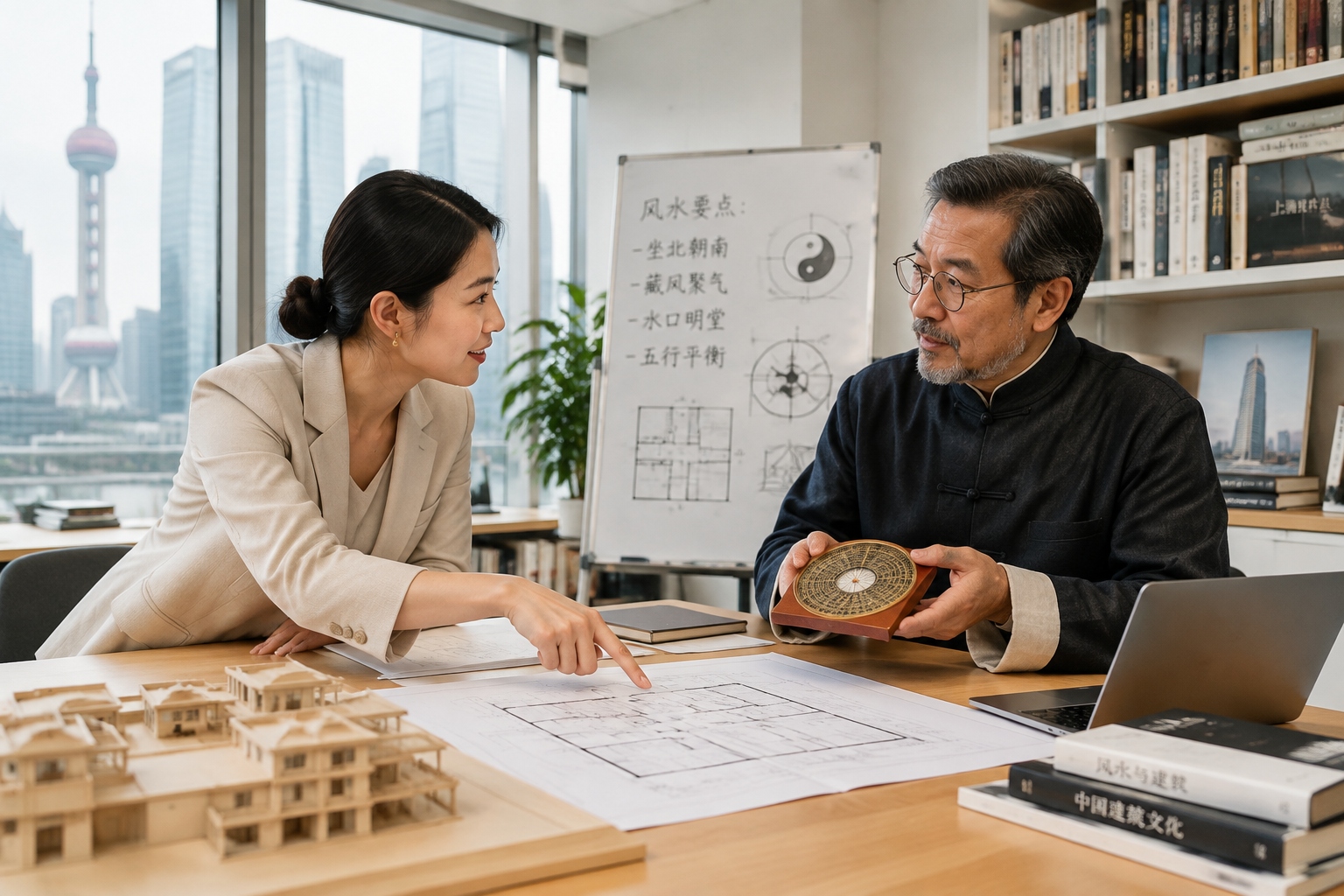

The Meeting
The afternoon light slants through the floor-to-ceiling windows of Lin Yue’s design studio in Shanghai. On the table stands a scale model of a three-story house, its plywood walls still smelling of freshly cut wood. Lin Yue, 34, is explaining to a visitor why she placed the kitchen on the west side. "It’s about flow," she says, tapping the model. "You want the daily route from supermarket to fridge to counter to stove to be as direct as possible."
The visitor is Master Chen, a feng shui master in his late fifties. He wears a plain grey jacket, not a silk robe. He has been consulting on residences in Shanghai for over twenty years, and many of his clients are young professionals who would never call themselves superstitious. "They come to me because their new apartment feels off," he says. "No matter how beautiful the design, something inside them says this isn’t right."
Lin Yue raises an eyebrow. "And your answer is … feng shui?"
Master Chen smiles. "It’s a word. I prefer to call it ‘environmental psychology with two thousand years of field notes.’ But if you say feng shui, people understand."
This tension—between data-driven design and a tradition that relies on intuition—is far from a private argument. In China today, as a record number of homes are remodelled and built, architects and feng shui practitioners are increasingly being forced to share the same room. The result is a lively studio conversation that reveals a lot about how modern China negotiates with its own traditions.
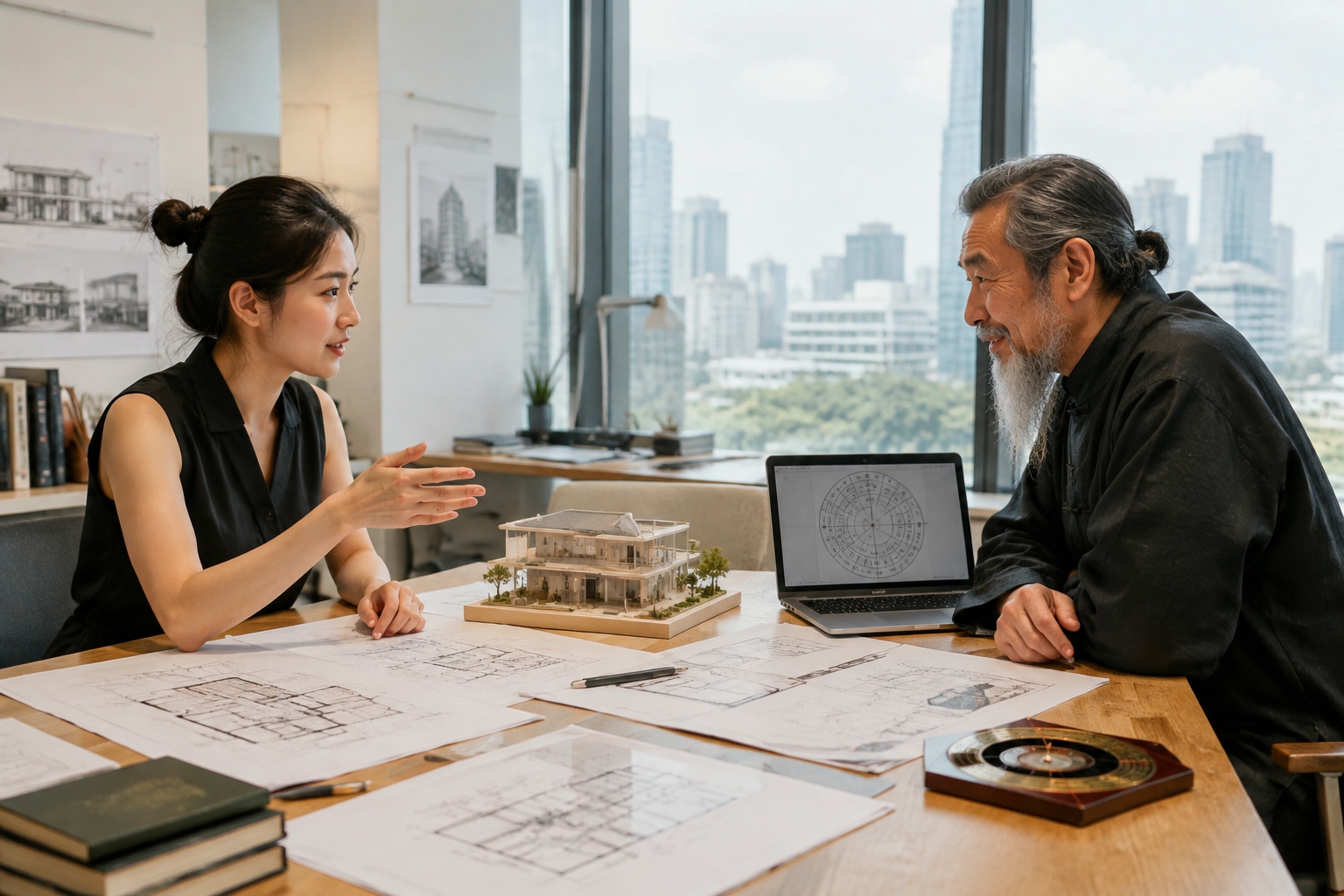
What Does "Lucky" Really Mean?
Lin Yue starts the real discussion. "Master Chen, when a client says they want a ‘lucky’ house, what do they actually want? A winning lottery ticket?"
Master Chen laughs. "Most of the time, they want a home that helps them sleep, recharge, and get along with the people they live with. They have a good job, but they feel anxious at home. They argue with family members, or they cannot focus. They call that ‘unlucky.’ If changing a few doors and windows makes them feel secure and calm, that is not magic, that is design."
He points to the model. "For example, in your kitchen, you put the stove against a wall shared with the living room. In traditional feng shui, that would be considered a fire clash. But your reason is practical: the stove exhaust can then connect directly to the outer wall. Fine. I would agree with you. But if your only goal was to minimize fumes, you could move the stove one more meter to the east, put a tall cabinet between it and the living room, and you would get the same ventilation while creating a buffer that reduces noise. That is what I mean by ‘lucky’: small adjustments that produce daily comfort."
Lin Yue nods slowly. "So you are not telling me to rebuild the whole house."
"Of course not. Sometimes small changes are enough."
Windows: The Architecture of Air
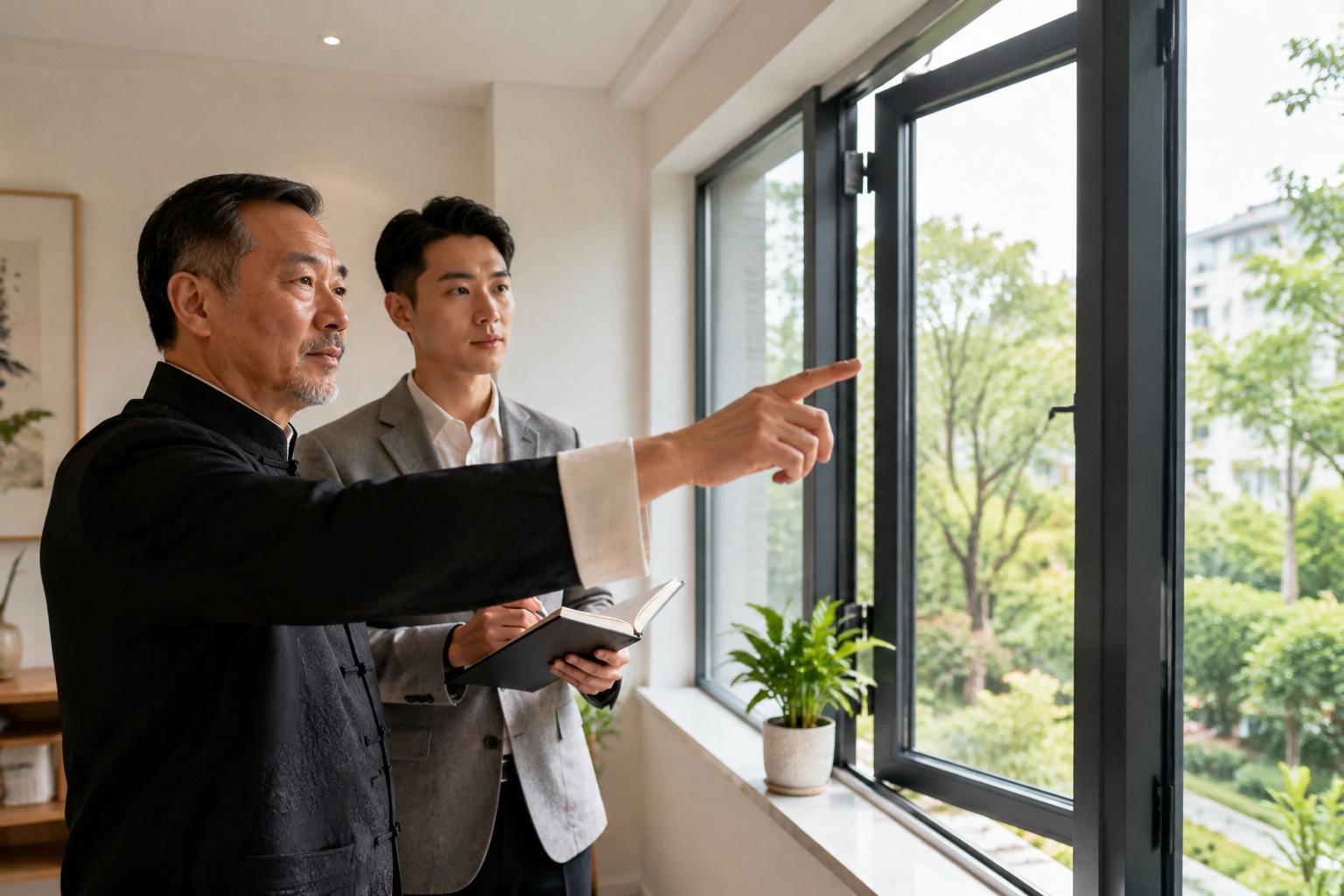
Lin Yue: "Let’s talk about windows. You often talk about ‘cáng fēng jù qì’—’storing wind and gathering qi.’ As an architect, I’m taught to maximize cross-ventilation. In summer, we want cool breezes. In winter, we want to keep the cold out. How is that compatible with your theory?"
Master Chen: "Qi is not a mystical gas. In everyday terms, it is the way air moves through a room and how that movement makes you feel. If you open two windows directly opposite each other, you get a strong draft. Some people love it; others feel uncomfortable. The problem starts when a draft hits your back while you sleep or while you’re sitting at your desk. That is not a climate philosophy, that is common sense. My grandmother knew it without reading a textbook."
He walks to a model window. "You see this sliding window? In modern apartments, the two sliding panels are often placed so that when open, half of the opening is blocked. That means the air takes a diagonal path. From a feng shui perspective, you want the air to sweep gently across the room, not cut straight from door to window. So we might suggest a small change: make the window a casement that opens outward, or add a tiny deflector panel. The result is exactly what you call cross-ventilation, but with a softer curve."
Lin Yue: "Interesting. So you use centuries of spatial intuition to solve problems my ventilation calculations might miss."
Master Chen: "Call it testing a hypothesis. I propose a change; you calculate the result. When the answer is good, we both win."
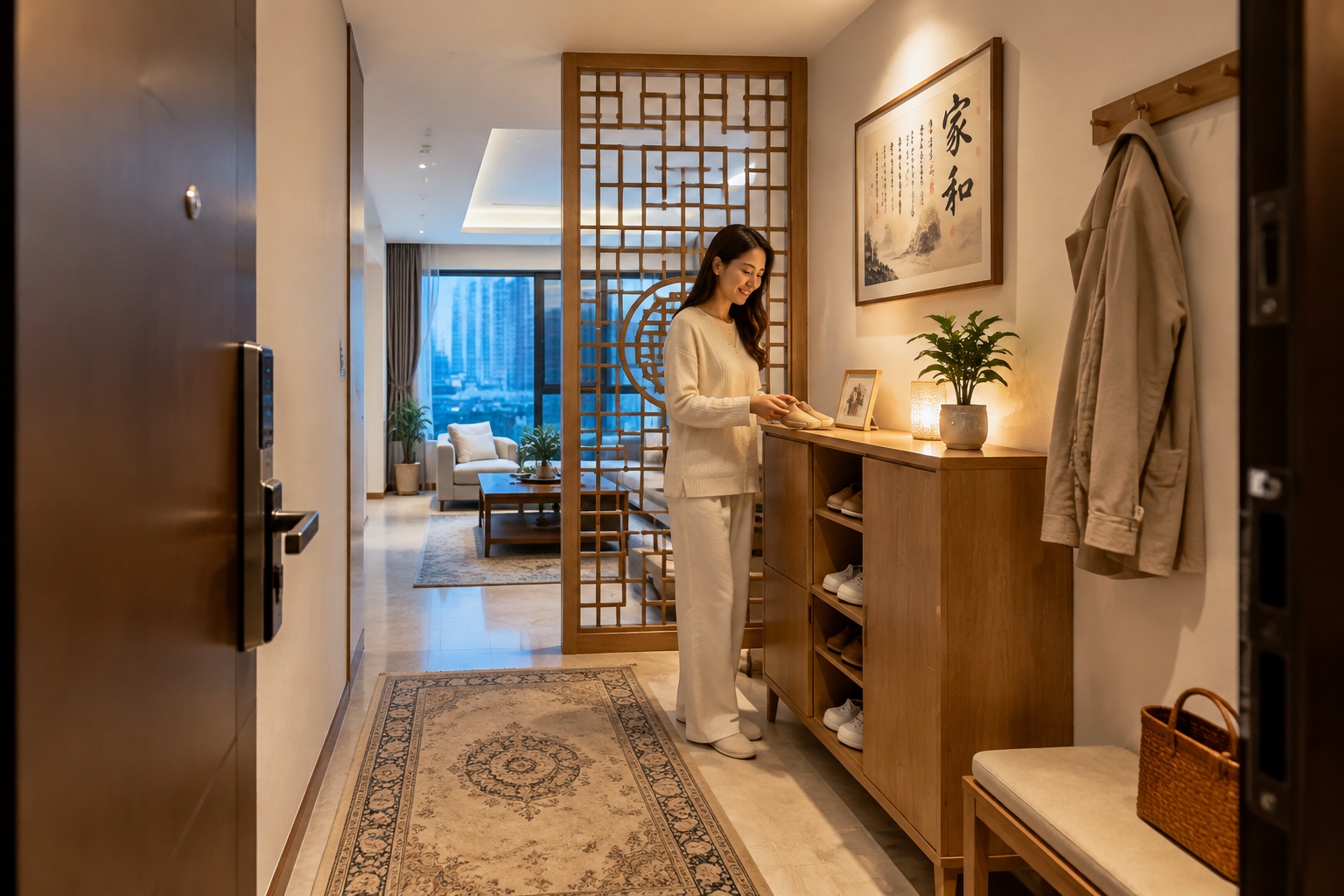
The Front Door: A Threshold Between Chaos and Calm
Lin Yue: "Another classic feng shui rule: never have the front door directly aligned with the back door or a window. As a designer, I often see homes where you can see straight through. I think it looks spacious. Why is it bad in feng shui?"
Master Chen: "Do you know the Chinese phrase ‘yī jiàn chuān xīn’? It literally means ‘a single arrow through the heart.’ That is a straight line from the front door through the entire home. In ancient times, before heating and air conditioning, a direct draft would blow out candles and make the home cold. It also meant that when someone opened the front door, anyone inside could see everything instantly. There was no privacy, no transition. Modern feng shui says the same thing: you want a buffer. A small entrance hall, a screen, a shoe cabinet, even an angled wall. Not only does this block the draft, it also gives you a moment to enter your home, leave the street behind, and change your mental state."
Lin Yue: "So the ‘lucky’ part is really about psychological transition."
Master Chen: "Exactly. Did you know that many people feel exhausted the moment they come home from work? It is not about the house, it is about the abrupt shift. A good threshold softens the boundary. That is why people put a pair of shoes there, a coat hook, a small rug. They are not decorations; they are the ritual of arrival."
The Bedroom: Where Energy Rests
Lin Yue: "Let’s move upstairs. In the bedroom, there are many taboos: do not put a mirror facing the bed, don’t have your feet pointing at the door, don’t place the bed under a beam. Is any of this logically sound?"
Master Chen: "Yes, but each rule needs context. A mirror facing the bed reflects your image at night. When you wake up in the dark or in a haze, you might see a blurry shape and get startled. Ancient people did not have dimmers, so they felt vulnerable. Today you can simply place the mirror inside a wardrobe door. A bed in line with the door means someone entering sees you directly. That’s not only a privacy issue, it can make you tense even when asleep. The best position is the same one that adults intuitively choose in a hotel room: bed against a solid wall, with a glimpse of the door but not directly aligned. It gives you a sense of security."
Lin Yue: "So you don’t have to follow a compass direction?"
"No. Some masters will tell you to point your pillow east because of a mountain in your astral chart, but that is an old method when houses were rural and the sun was your main clock. In a modern apartment, the orientation of the bed should respect the windows and the light. I once advised a client to rotate her bed 90 degrees, not because south was ‘lucky,’ but because the morning sun was hitting her face. After that, she stopped waking up with headaches."
A Case Study: The Narrow Plot
Lin Yue: "Let me show you a project in the old part of Suzhou. A family wants to rebuild their townhouse on a narrow lot, only 4 meters wide. The front faces a street that runs southwest. The back has a small courtyard. In your tradition, what is the biggest challenge?"
Master Chen: "First, the slope of the rain gutter. In old townhouses like this, water should flow from the direction of the main gate to the rear, but that is connected to drainage and also avoids pooling at the entrance. Second, you have no choice but to have one long corridor. We need to design the rooms so that walking through the house feels like walking through different seasons, not a corridor with doors. We can create the sense of a new opening with changing levels or a small light well in the middle. That is where high ceilings and a transparent roof can help."
Lin Yue: "So you want to create a rhythm."
"Yes. And for a narrow lot, the biggest enemy is the feeling of being boxed in. If you install a skylight above the stairwell, the energy rises. This is not magical; it is because daylight reduces stress, and a vertical view opens the mind."
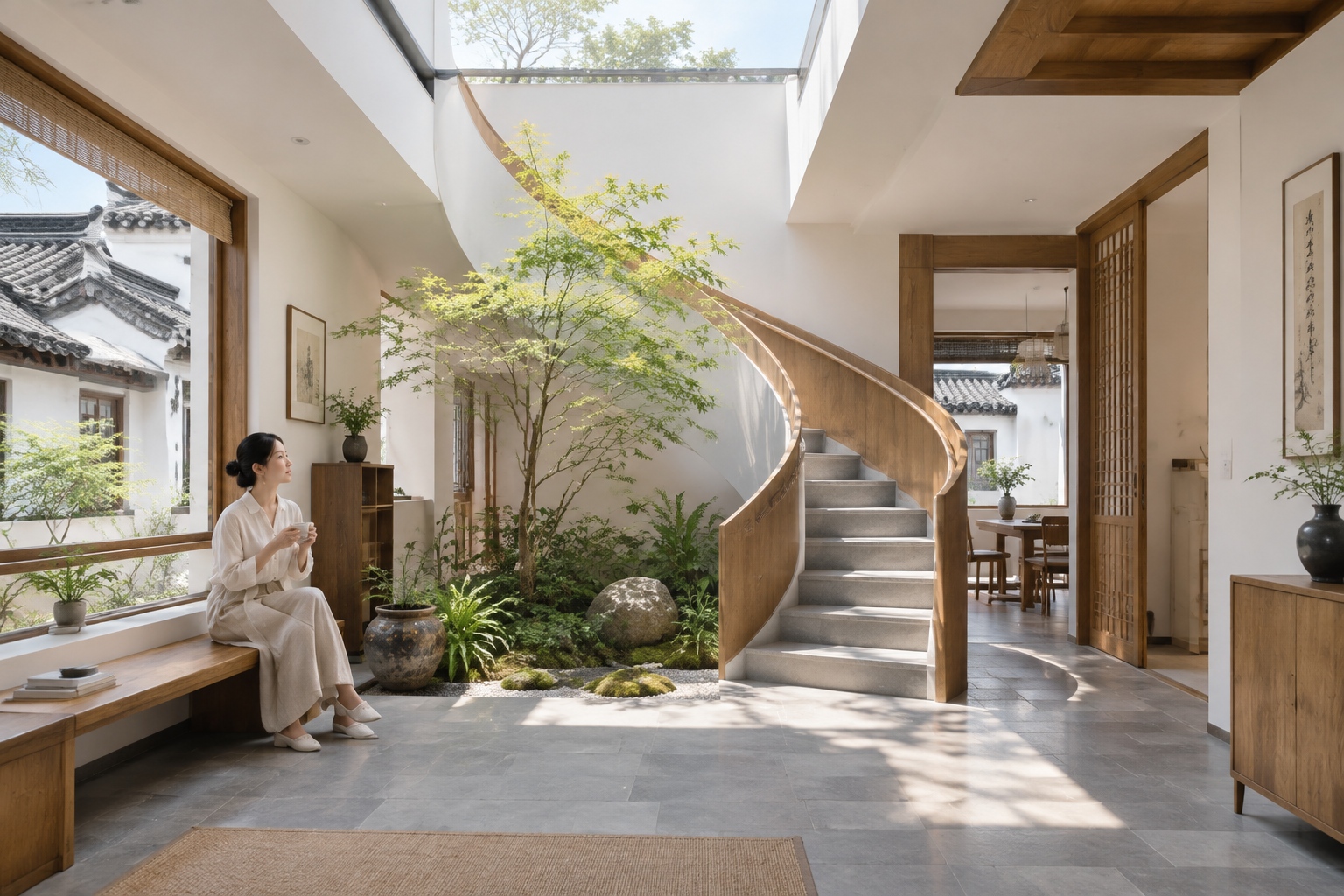
They ended up designing a half-spiral stair with a small skylight above. The corridor became a gallery with three tiny courtyards that bring sunlight and shadow into the center of the home. The family later told Lin Yue that their new house felt bigger than its actual size. "That’s a lucky house," Master Chen said.
From Superstition to Neighborly Wisdom
Lin Yue: "Master Chen, do you think feng shui is dying out in China? My generation is pretty secular."
Master Chen: "Look around you. On WeChat, there are thousands of articles about home layout. When people buy a home, they ask for the floor plan first, not to check the measurements, but to trace the ‘shape.’ They may not call it feng shui; they call it ‘feeling comfortable.’ The demand has not disappeared, it has just changed its vocabulary. Many young architects, like you, are discovering that traditional feng shui forms are often practical. For example, the idea that a home should not be too narrow or too long is now called an efficient layout. So feng shui is not dying; it is being translated into a modern language."
Lin Yue nods. "I guess I never thought of it that way."
In many Chinese cities, this translation happens in quiet ways. A developer might hire a feng shui master to advise on exit placements, though the brochure will only mention "landscape design." An interior designer might use a compass to locate the main switch panel, but the client will call it "ergonomics." The tradition lives on, not as magic, but as a layer of user-experience research—one that has collected centuries of data.
The Verdict
Lin Yue: "So master, after a long afternoon, I have to admit that your suggestions don’t seem as threatening as I expected. They are actually quite reasonable."
Master Chen: "And you, young architect, you have good reasons for every square meter. I just add another layer. In the end, we both want the same thing: a house where people feel safe, free, and able to love the people around them. If that is ‘lucky,’ then let’s call it lucky."
Lin Yue: "I think I’d call it good design. But I’m willing to let you have the word."
Start the discussion at forum.chinacomes.com