

Introduction: An Ancient Script Meets the Smartphone
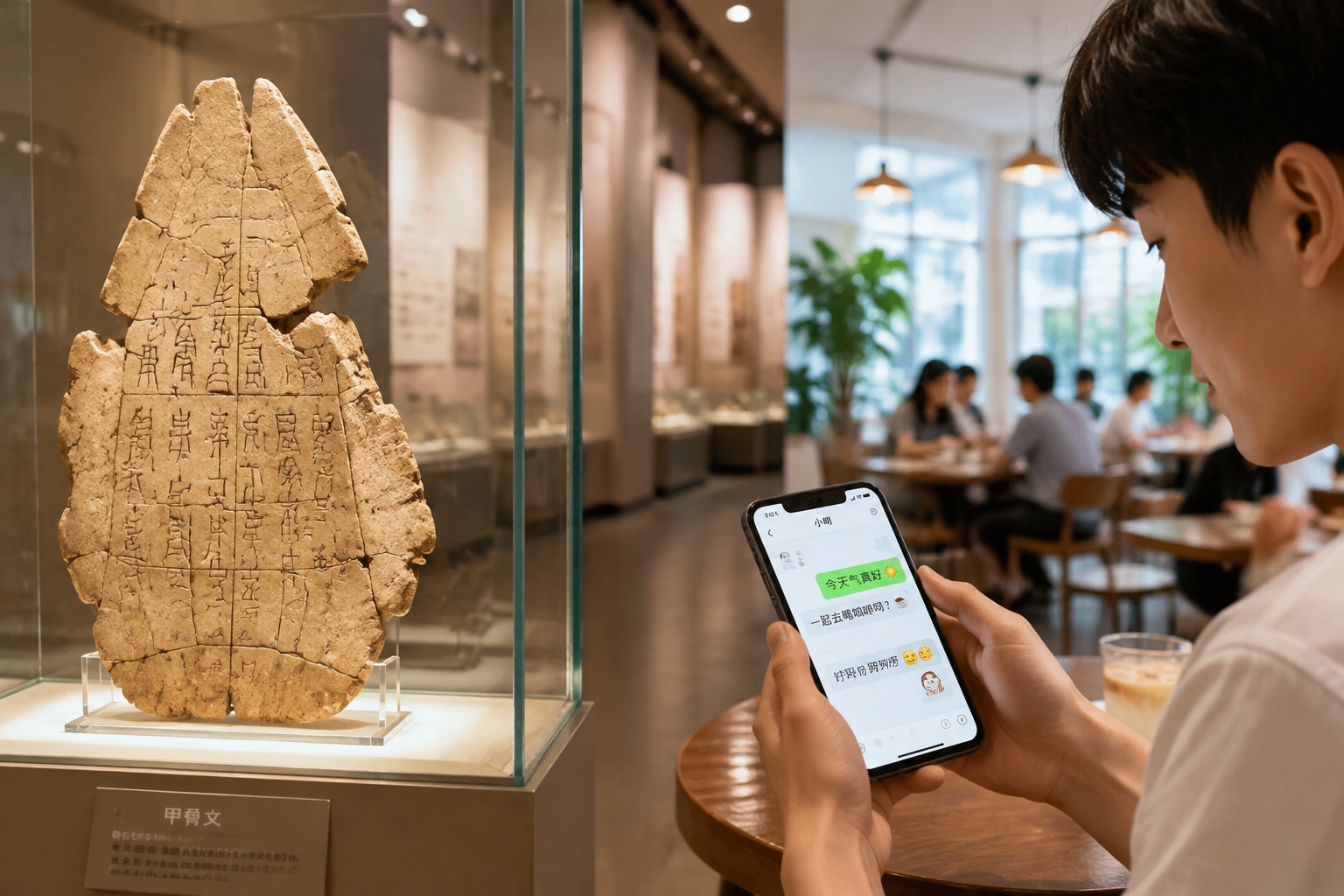
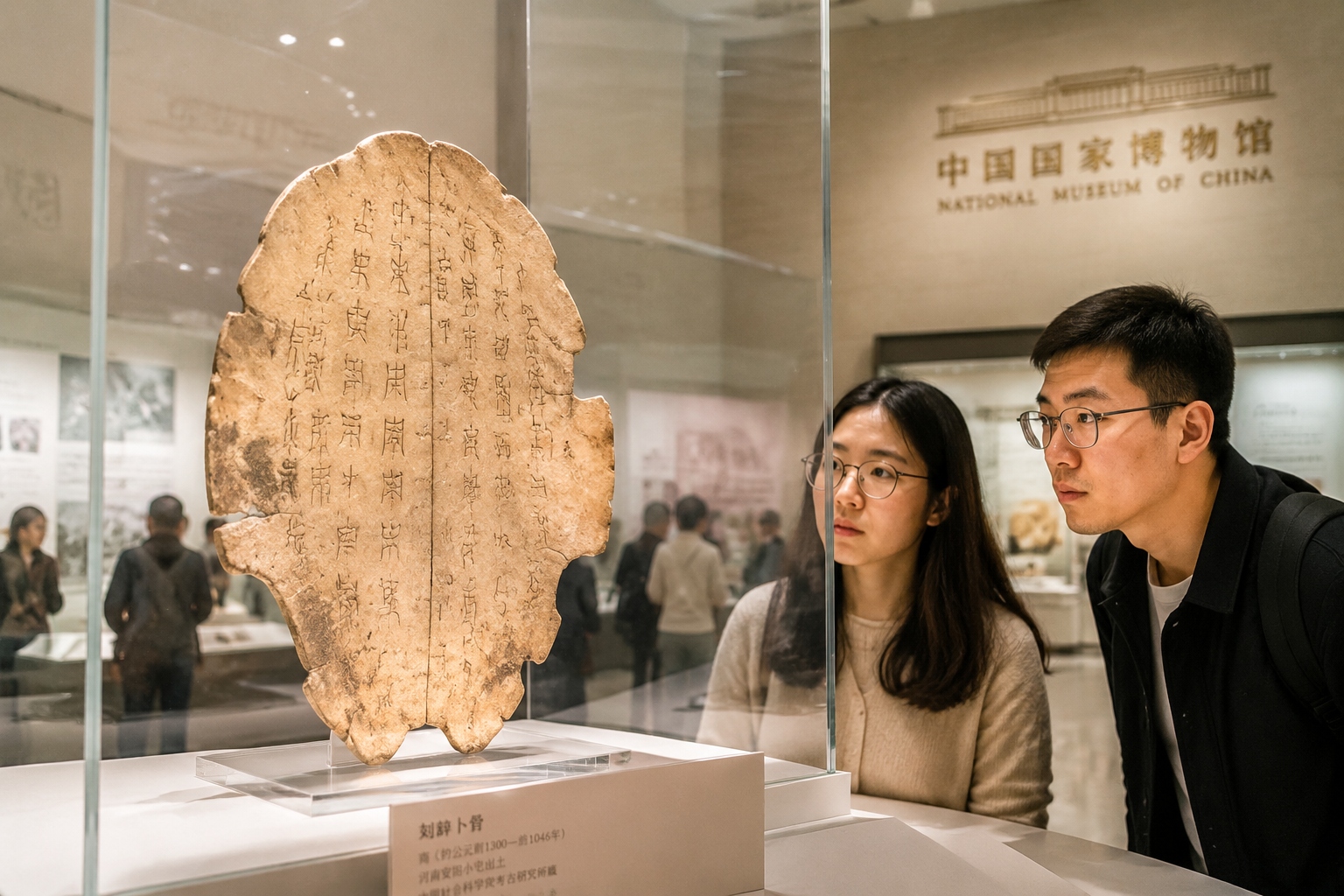
Walking through the National Museum in Beijing, you might stop in front of a glass case holding a piece of bone. It looks unremarkable, but inked on its surface are a few mysterious grooves. That piece of bone is over 3,000 years old, and the grooves are the earliest known form of Chinese writing — oracle bone script.
Now, fast-forward to a Beijing coffee shop. A young woman is tapping on her phone. She types “xie xie” with pinyin, a few Chinese characters appear, and she sends them with a smiley emoji. In just a few seconds, she has used a writing system that has evolved over three millennia.
For anyone outside China, Chinese characters often look exotic and complex. But behind the intricate strokes lies a surprisingly visual logic that has adapted from carved bones to smartphone screens. This article takes you through that visual evolution — from oracle bones to emoji — and shows how Chinese writing remains a living, breathing part of daily life in China.
What Is Oracle Bone Script?
Oracle bone script (甲骨文, jiǎgǔwén) is the earliest known form of Chinese writing, dating back to the Shang Dynasty (about 1200 BCE). It was discovered by accident in 1899 in Anyang, Henan Province, when a scholar noticed marks on “dragon bones” being sold as medicine. Those bones turned out to be turtle shells and animal scapulae used for divination.
The script is highly pictographic. The character for “sun” looks like a circle with a dot inside — a picture of the sun with its rays. “Moon” is a crescent. “Mountain” is three peaks. These images aren’t arbitrary; they reflect the physical world the Shang people lived in.
But oracle bone script also included abstract symbols for concepts like “above” and “below”. That combination of pictures and signs shows that even 3,000 years ago, Chinese writing had a flexible visual system. It wasn’t just drawing cats and dogs; it was a structured way to record language.
For a modern Chinese reader, some oracle bone characters are still recognizable. Take “鱼” (fish), which today still resembles a fish with a head, body, and tail. That continuity is part of what makes Chinese characters so remarkable: a sense of visual heritage that spans centuries.
How Characters Evolved Through Dynasties
After the Shang, Chinese characters went through several major transformations. The Zhou Dynasty introduced bronze inscriptions, called “jinwen” (金文), cast on ritual vessels. These scripts were more polished but still retained a pictorial quality.
The biggest leap came in 221 BCE, when Emperor Qin Shi Huang unified China. He standardized the script known as “xiaozhuan” (small seal script), which gave every region the same writing system. That was a political move as much as a linguistic one — a shared script made it easier to govern a vast territory.
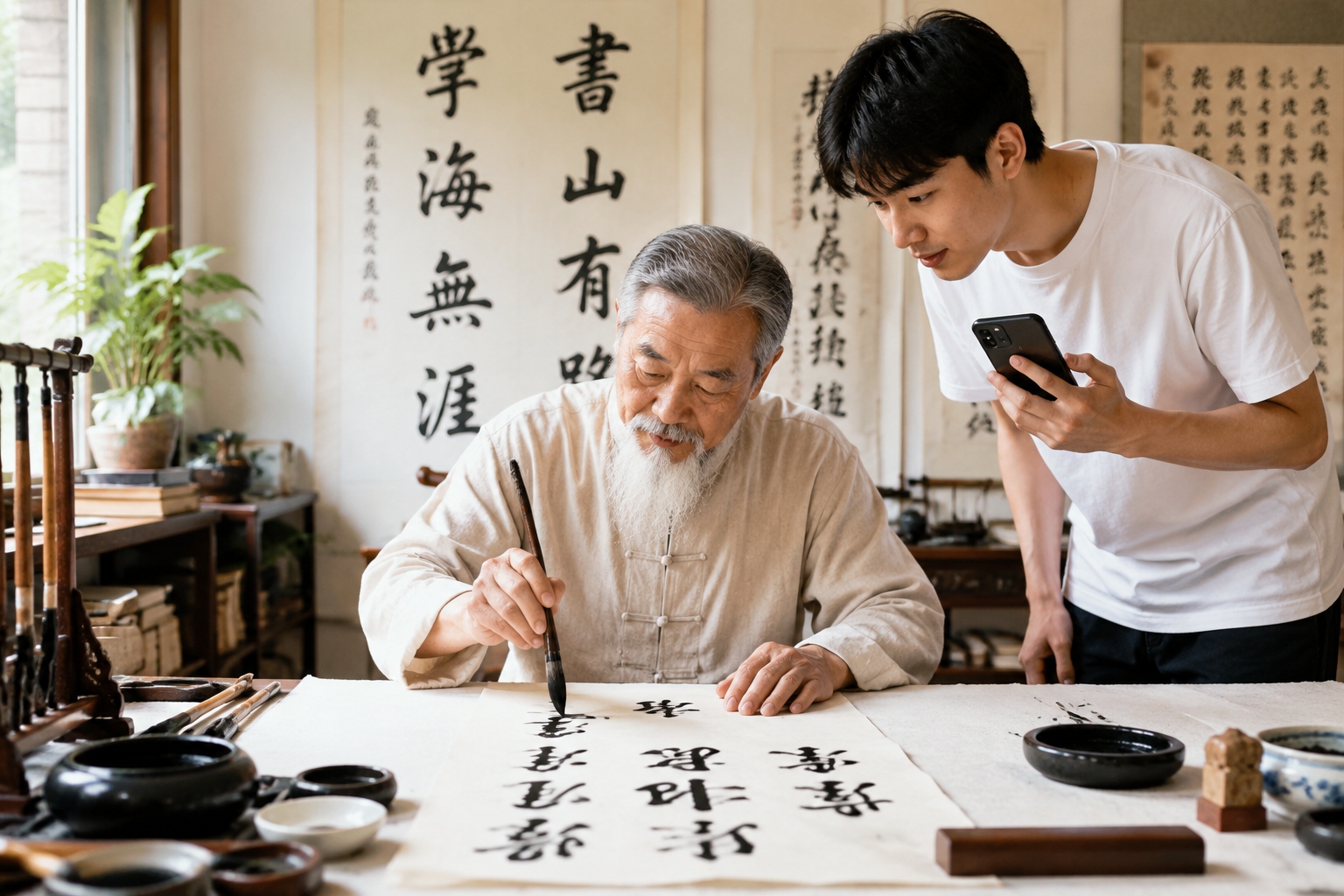
Over time, the characters became more angular and easier to write. Clerical script (lìshū) emerged in the Han Dynasty and is still used for calligraphic art. Then came regular script (kǎishū), the standard for printing and handwriting today. By the Tang Dynasty, the fundamental forms of modern Chinese characters were largely in place.
The most recent major change was simplification. In the 1950s and 1960s, the Chinese government simplified many characters to make them easier to learn and write. For example, “書” became “书”, and “馬” became “马”. Mainland China uses simplified characters, while Taiwan and Hong Kong continue to use traditional ones. That split is a reminder that writing systems aren’t static; they evolve to meet social needs.
Even with simplified forms, the visual logic often remains. “马” still retains a sense of a galloping creature if you look closely. Of course, the link is less obvious than in oracle bones, but that’s the nature of evolution: things become simpler, faster, and more abstract.
The Digital Challenge: Typing Thousands of Characters
When computers arrived in the 20th century, Chinese writing faced a serious problem. Western languages had typewriters with a few dozen keys, but Chinese has tens of thousands of characters. How could you type all of them?
Early solutions were clunky. Some typewriters had huge trays of characters, which weren’t practical for personal use.
The breakthrough came with keyboard input methods, especially pinyin-based input. Pinyin is the system for spelling Chinese pronunciation with Latin letters. Today, you just type “zhongguo” and then choose “中国” from a list. It’s fast and intuitive, so even children can type Chinese fluently after learning pinyin in school.
Another method is wubi (五笔), which assigns strokes and radical patterns to keys. It’s faster for professional typists but requires more training. For most people, pinyin input is the go-to.
This revolution means that Chinese has fully embraced the digital age. On smartphones, you can also use handwriting recognition and voice input. While teenagers in other countries might be glued to their screens texting in English, Chinese users are doing the same in characters — just with a more complex input method that takes a bit of extra brainpower.

Emoji: The New Visual Language?
Now, here’s an interesting twist: Chinese characters are famous for being visual, but today’s digital communication is full of another visual language — emoji. Are emoji stealing the show? Not really.
Actually, Chinese characters and emoji have a lot in common. Both rely on visual symbols to convey meaning. A face with tears of joy (😂) can express laughter without words, just as the character “笑” carries the idea of a smile. The big difference is that characters are a complete writing system, while emoji are optional additions.
In China, emoji are wildly popular. But Chinese users also have a home-grown visual language: Chinese-style emoji and stickers. Apps like WeChat are full of custom stickers featuring cute animals or movie characters. Younger users often combine Chinese characters with emoji, like using “666” (pronounced like “liù liù liù”, which means “awesome”) alongside a thumbs-up.
There’s also a tradition of using Chinese characters as emoji-like symbols. For instance, the character “囧” (jiǒng) looks like an embarrassed face with a frown and eyebrows. It has been used online for years as a visual symbol for awkwardness. That’s a perfect example of how ancient visual thinking has found fresh life in digital culture.
Conclusion: A Living Script
From oracle bones to emoji, Chinese characters have undergone a remarkable visual evolution. What began as pictograms on turtle shells became the world’s oldest continuously used writing system. It has adapted to bronze, silk, paper, and now to pixels and touchscreens.
The visual DNA of Chinese characters remains strong. When you see a character like “雨” (rain), you can almost see the falling drops under a sky. Even simplified characters carry echoes of their past.
For the outside world, understanding a bit about Chinese characters opens a door to understanding Chinese culture and thought. They are not just a means of communication; they are works of art, records of history, and a bridge between ancient and modern. Next time you see a Chinese character, look closely — it might have a story thousands of years long.
Start the discussion at forum.chinacomes.com