
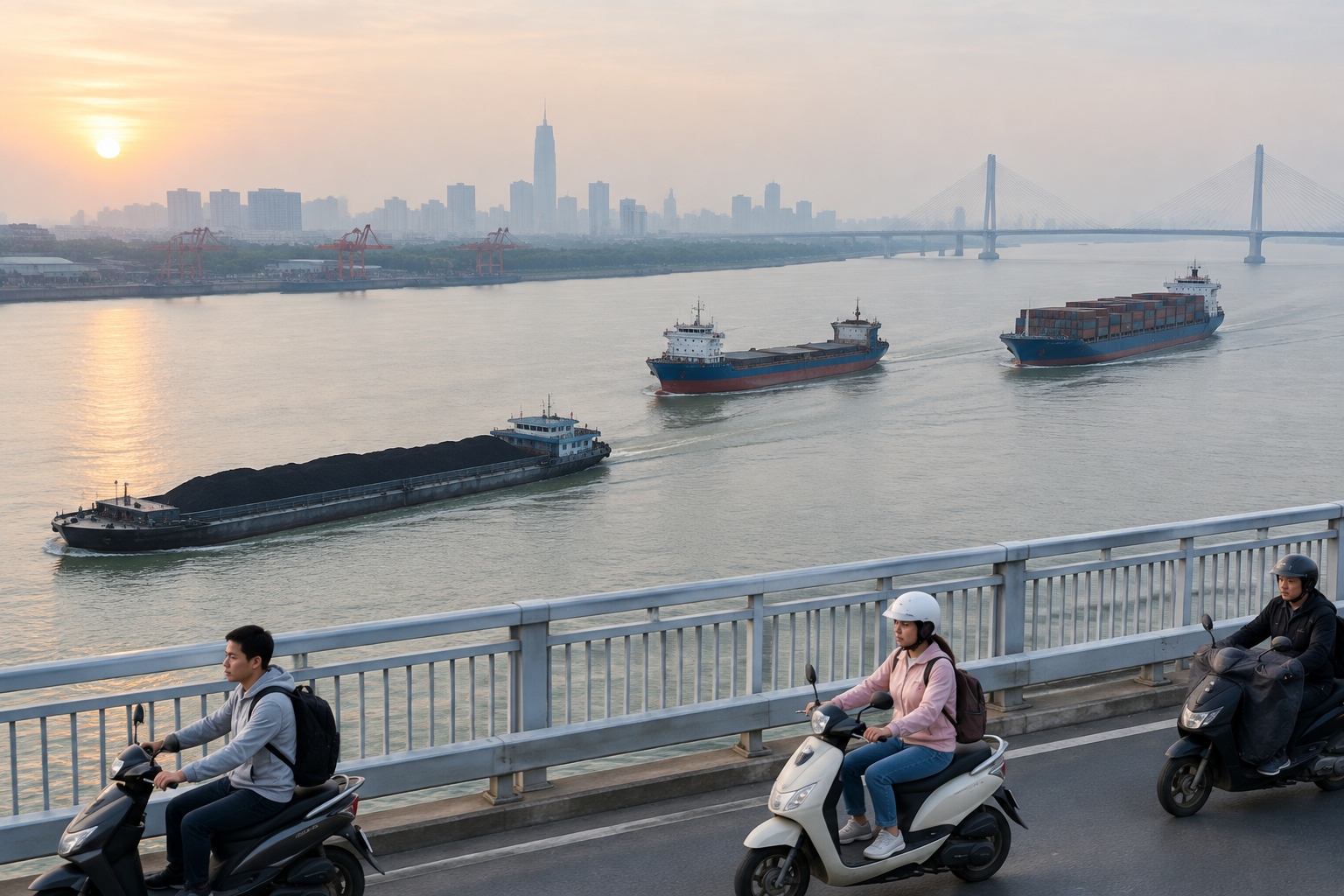

5:40 a.m. at a coal dock
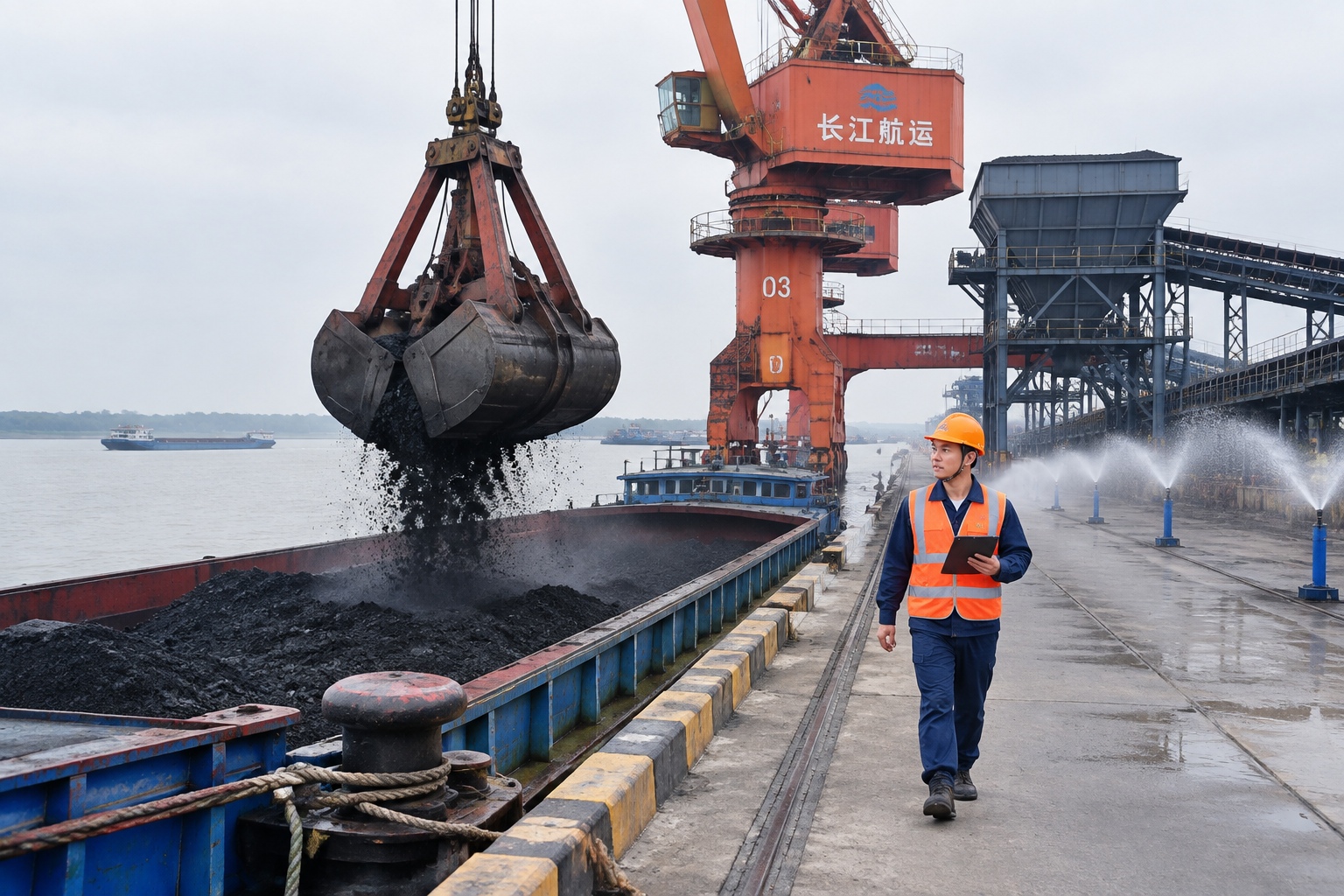
A clamshell grab the size of a small car drops into the open hold of a barge tied up at a bulk terminal on the north bank of the Yangtze, about 40 kilometers downstream of Wuhan. It comes up with roughly eight tons of coal. The arm swings, the jaws open, and the load disappears into a hopper. Dust lifts; sprinklers along the quay switch on automatically. With every pass, the barge sits a little lower in the water.
By breakfast it will be empty. By evening it will be heading back upstream for another load.
The river is usually called China’s “golden waterway,” a phrase so worn out it barely registers anymore. The tonnage is not a slogan, though. Ports on the Yangtze’s main line move more than 3 billion tons of cargo a year — a figure Chinese officials like to compare with the Mississippi, the Rhine and the Volga combined. The river runs nearly 6,300 kilometers, and about 2,800 of them, from Yibin in Sichuan to the East China Sea, are open to commercial shipping.
So what is actually on the water? The list is less exotic than outsiders expect, and more revealing.
Coal is still the heaviest thing afloat
Coal remains the single largest commodity by weight. China still gets roughly 55 to 60 percent of its primary energy from coal, and a dense line of power plants sits along the river, from Jiangsu through Anhui and Hubei and further upstream.
Most of that coal does not start on the Yangtze. It comes out of Shanxi, Shaanxi and Inner Mongolia, rides south on dedicated rail lines, and is reloaded onto barges at river ports — a system known in Chinese as “moving northern coal south.” The Haoji Railway, an 1,800-kilometer line that opened in 2019, took some of that traffic off the water. It did not take much. Coal volumes on the river rose again in 2022, when a severe drought cut hydropower output in the southwest and utilities leaned harder on coal-fired plants.
Solar and wind are growing quickly, and coal’s share of electricity is slowly falling. Slowly is the operative word. On any given morning, the coal dock is still the busiest place on the river.
Iron ore: an import story told in transshipments
China imports more than a billion tons of iron ore a year, and almost none of it arrives by river. The big oceangoing bulkers — 300,000 tons and up — dock at deepwater ports such as Ningbo-Zhoushan, Shanghai and Nantong. From there, the ore is lightered up the Yangtze in 10,000-ton vessels to steel mills at Ma’anshan, Wuhan, Ezhou, and as far upstream as Chongqing.
What the ore becomes has changed. For two decades, the answer was mostly buildings. Since the property downturn, construction steel has weakened while manufacturing steel — cars, home appliances, shipbuilding, machinery — has held up. Port workers describe handling the same tonnage with a different destination. That is the kind of shift that shows up on the river before it shows up in the statistics.
Containers: the part that keeps growing
Shanghai is the busiest container port in the world, and in 2024 it became the first port anywhere to handle more than 50 million TEU — twenty-foot equivalent units — in a single year. The more interesting container traffic, though, is upstream.
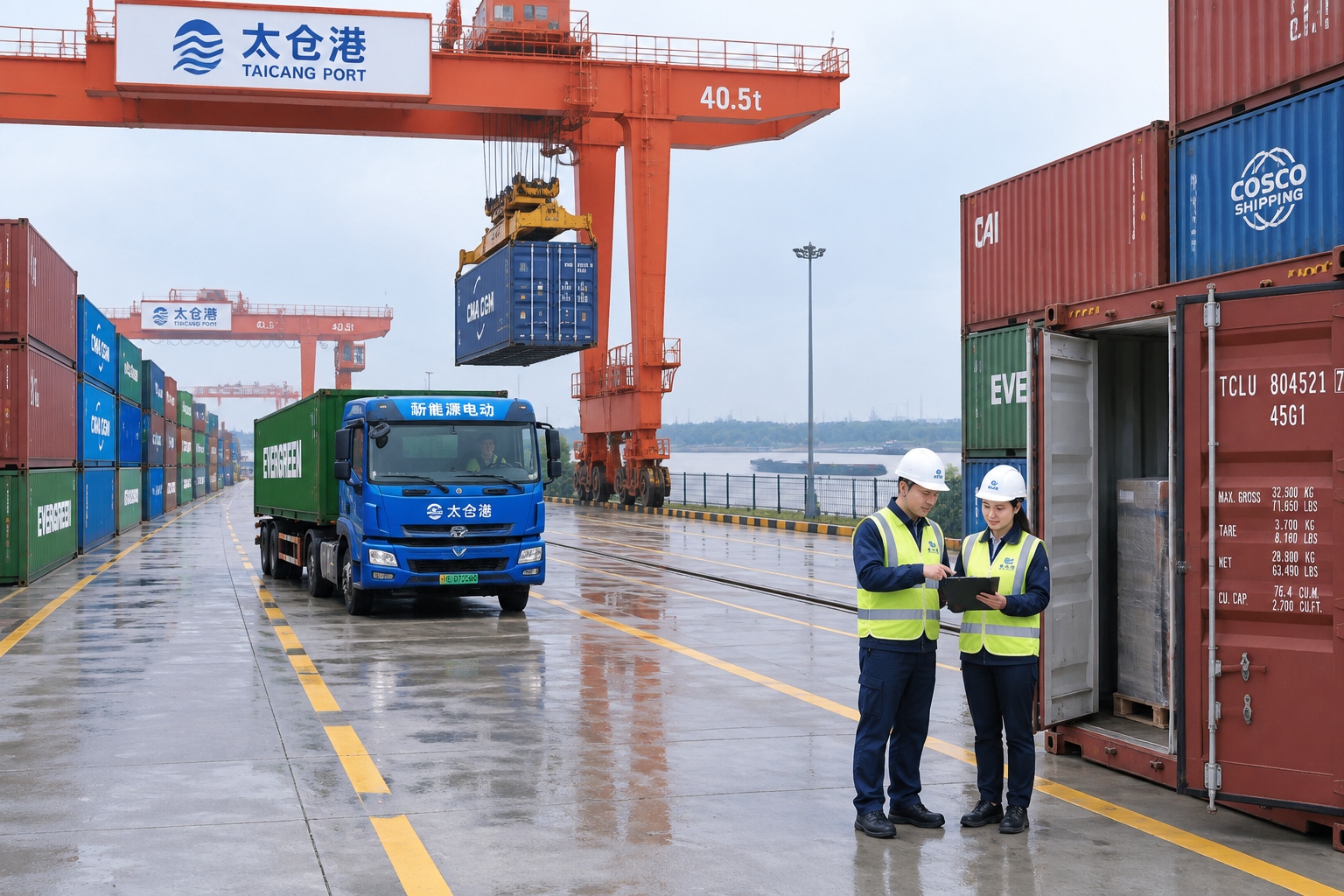
Taicang, Nantong, Nanjing, Wuhan and Chongqing all run regular container services. Chongqing’s Guoyuan port links the river to the China-Europe Railway Express: boxes come up from the coast or down from factories in the southwest, and some of them continue to Europe by rail.
What is inside the boxes has shifted. Furniture, textiles and home appliances remain staples. But a growing share is solar panels, lithium batteries and electric vehicles — the “new three” export categories that Chinese planners have been pushing hard. Walk through a container yard in Taicang and you will see the occasional EV strapped into a steel frame, waiting to go downriver and onto a ship bound for Europe or Southeast Asia.
There is a domestic story in the same boxes. A significant share of Yangtze container traffic never leaves China at all. It moves goods from coastal factories to inland consumers, or parts upstream to assembly plants and finished products back down. Container shipping on the river is not just an export conveyor belt; it is also how the interior gets stocked.
The bottleneck at the Three Gorges
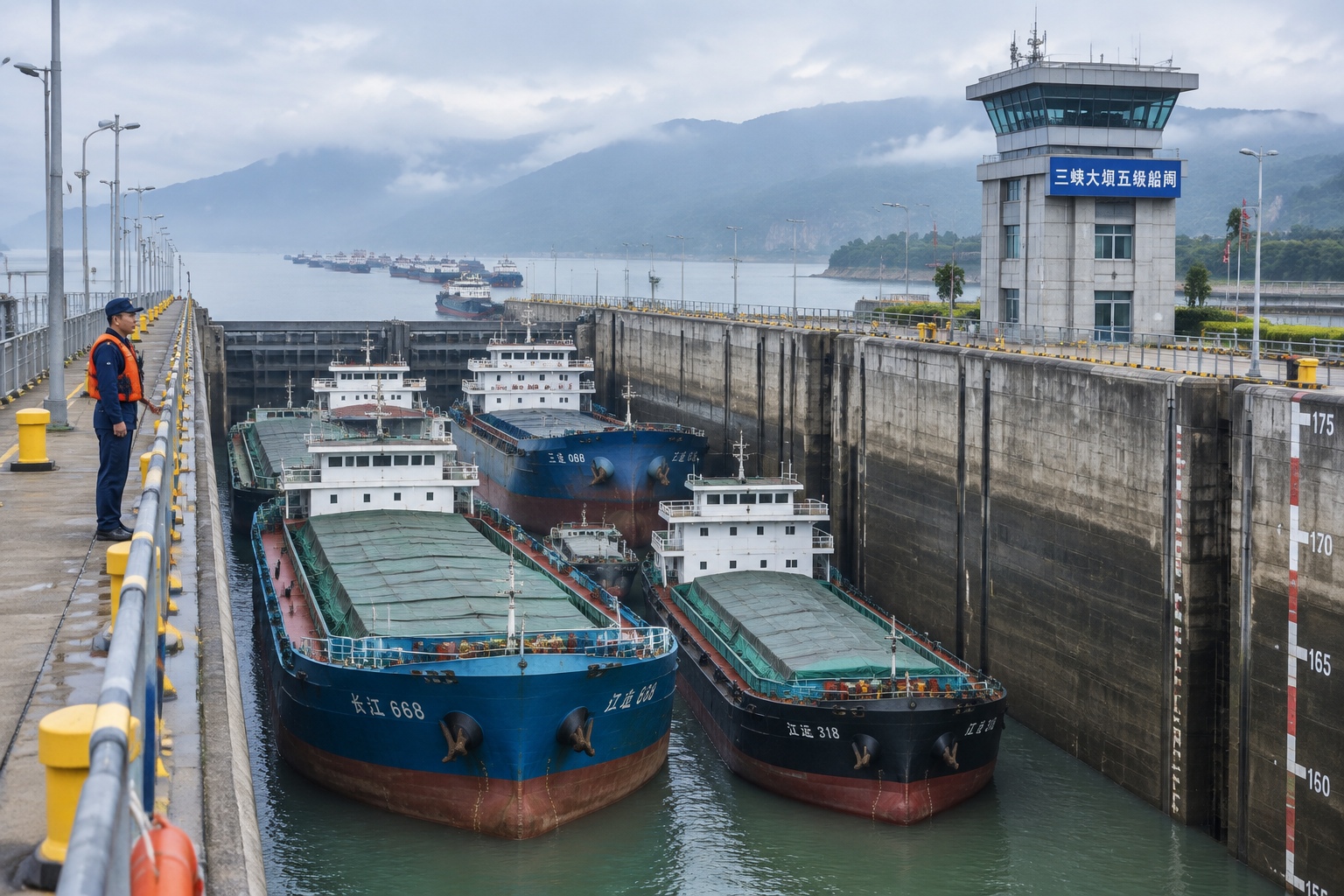
Everything heading upstream from Yichang has to get past the Three Gorges Dam. The five-stage lock system lifts vessels 113 meters. A ship elevator, opened in 2016, moves smaller boats through faster. Together, the two facilities handle somewhere around 150 to 170 million tons a year — and they have been effectively full for years.
Queues are a routine part of planning for shipping companies. In peak season, a vessel can wait days for a slot. A second set of locks has been discussed for more than a decade. The engineering is complicated and expensive, and the river there is a reservoir, a power source and an ecosystem at the same time, not simply a road.
Downstream, some limits are being pushed back with dredging. The channel between Wuhan and Anqing was deepened to six meters, which allows 10,000-ton ships to reach Wuhan year-round. Work continues further upstream, where the depth drops and the ships get smaller.
New ships, aging crews
The ships themselves are changing. In 2024, a 700-TEU battery-powered container vessel began running between Shanghai and Nanjing, described at the time as the largest fully electric container ship in service anywhere. LNG bunkering is now routine at some Yangshan berths, and shore-power connections let crews shut down diesel generators while moored — a small change that matters in a city of 25 million people.
The people are changing more slowly. Crews on river vessels skew older. The work means weeks away from home, and the pay competes poorly with factory jobs or delivery work on land. Maritime schools in Wuhan and Nantong report the same pattern: classrooms are full, but keeping graduates on the water is harder than it used to be.
The river’s ecology runs on its own timeline. A ten-year fishing ban took effect in 2021 and moved more than 100,000 fishermen off the water. In the 2022 national survey, researchers counted 1,249 Yangtze finless porpoises, up from 1,012 five years earlier. In Wuhan, people now stand on bridges over the Han River to watch for them.
What the cargo tells you
Put the loads together and you get something close to a live readout of the Chinese economy.
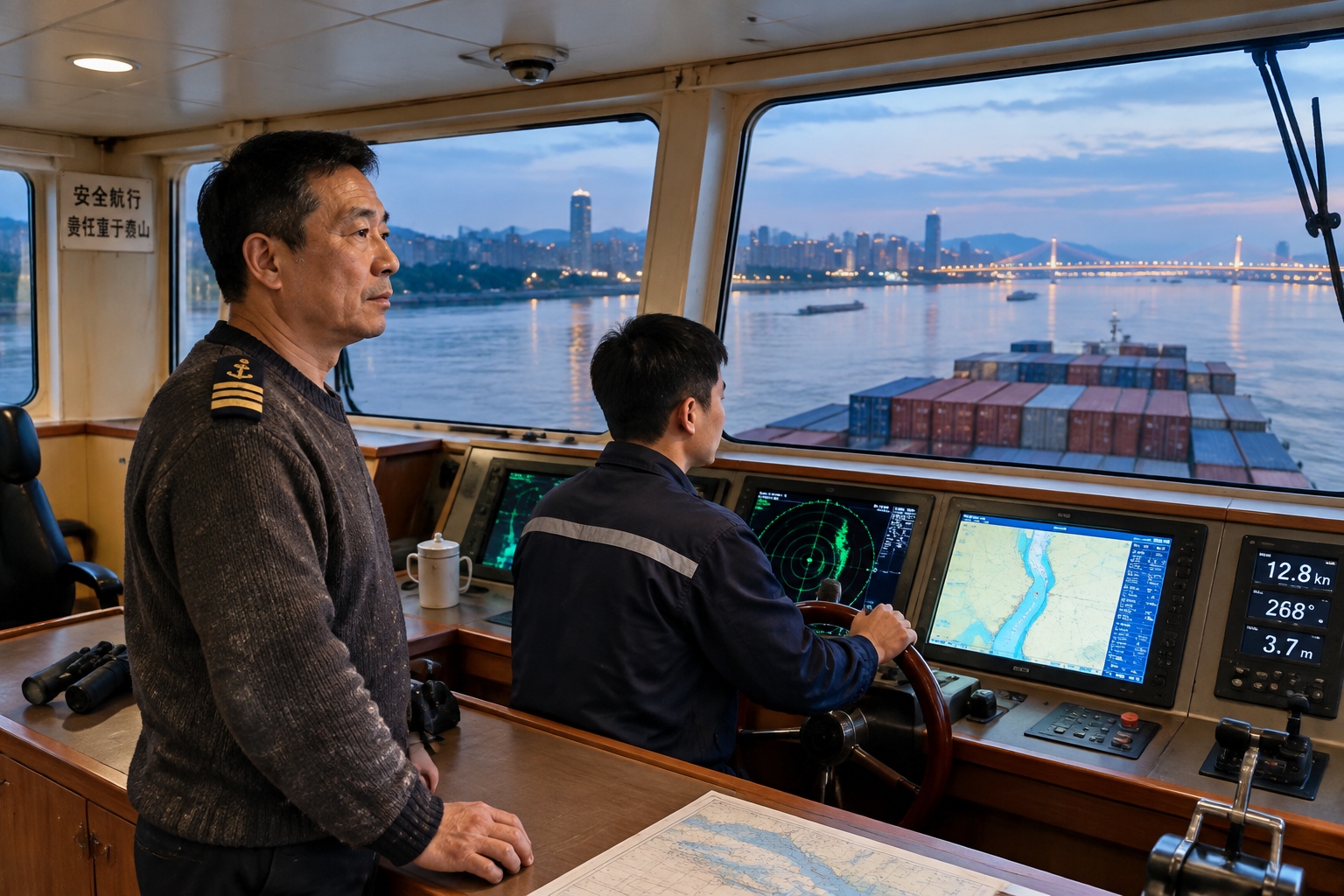
Coal on the water means the grid is still mostly coal-fired, and that the energy transition is real but gradual. Iron ore moving upriver to mills that make car parts rather than rebar means manufacturing has partly taken over from construction. Containers full of batteries and electric vehicles mean exports are moving up the value chain, while the boxes that never leave the country point to an inland consumer market that keeps getting bigger.
And the queues at the Three Gorges mean the river is running close to capacity — a constraint that eventually shows up in freight rates, delivery times and the cost of moving anything from Shanghai to Chongqing.
By early afternoon, the barge near Wuhan is empty and riding high. A tug nudges it out into the channel, and it turns upstream, back toward the coal ports. On the far bank, a container ship passes in the other direction, low in the water and stacked six high, heading for the sea.
Start the discussion at forum.chinacomes.com