

The six-minute ferry that explains the whole river
The ferry from Shanghai’s Minsheng Road pier to Pudong takes about six minutes and costs two yuan. On a weekday morning the deck holds commuters staring at their phones, a delivery rider in a blue jacket, and a man in a fishing vest who never seems to catch anything. Behind them, on the Puxi bank, two grey gantry cranes stand over a lawn where the Shanghai Shipyard used to be. They are lit up at night now. Nobody climbs them. They are what is left of a working river.
That river is the Yangtze. The ferry crosses the Huangpu, the last big tributary before the sea, but the trunk itself runs 6,300 kilometres from the Tibetan Plateau to the East China Sea and drains a basin holding roughly 40 percent of China’s population and GDP, spread across 11 provinces and municipalities. The Chinese call the corridor built around it the Yangtze Economic Belt. In practice it is three economic zones stitched together by water: the Yangtze River Delta around Shanghai in the east, the middle-reach cluster around Wuhan, and the Chengdu-Chongqing region in the west.
Visitors usually meet the Yangtze as scenery — a cruise through the Three Gorges, a photo of the Bund. It is also the world’s busiest inland waterway, moving more than 3 billion tonnes of cargo a year on the main channel alone, more than the Mississippi and the Rhine combined. A car built in Chongqing can be driven onto a ship and delivered to a deep-water port near Shanghai without ever touching a motorway. That is the part of the river that rarely makes it into photographs.
Shanghai: the front door, and the cranes nobody photographs
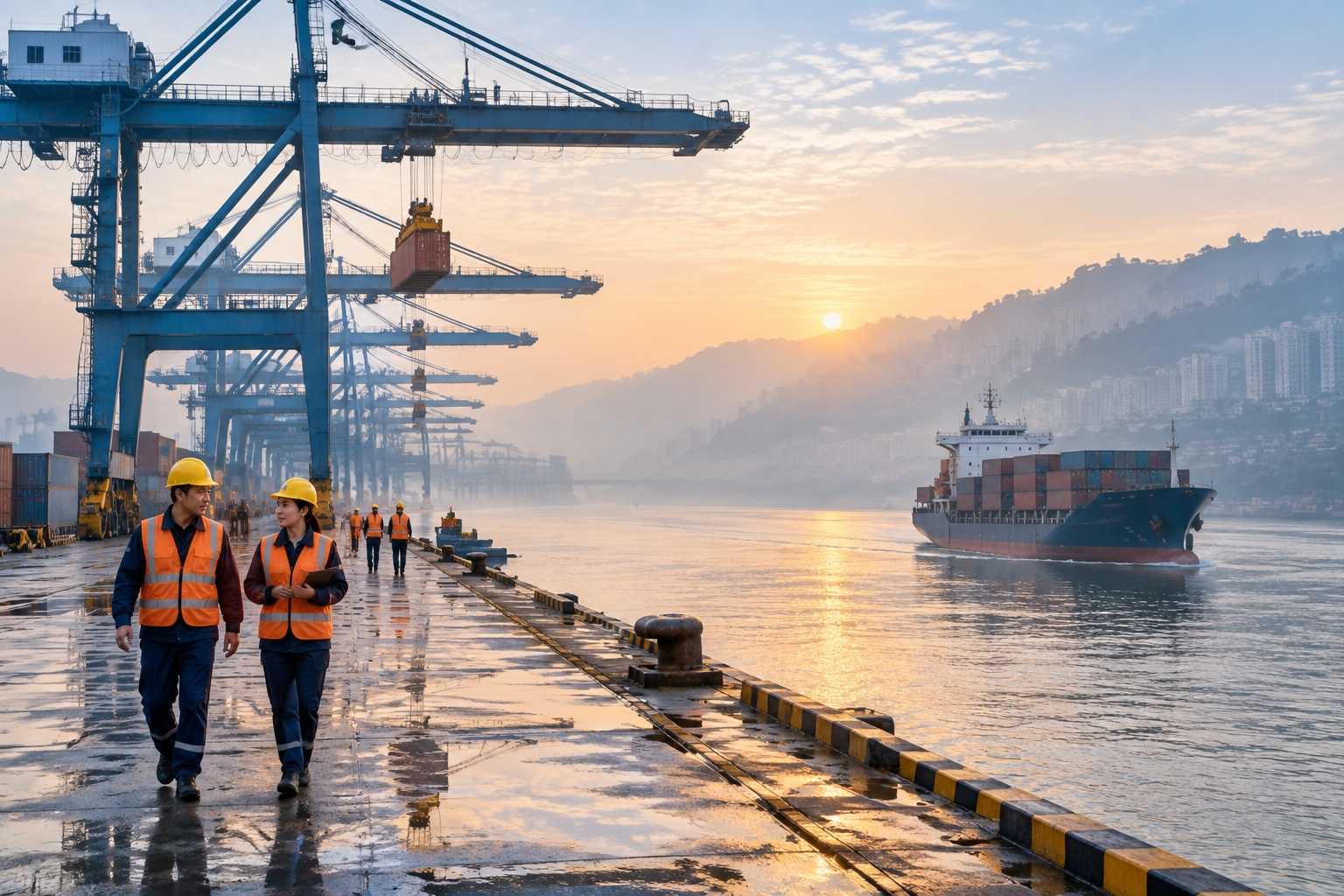
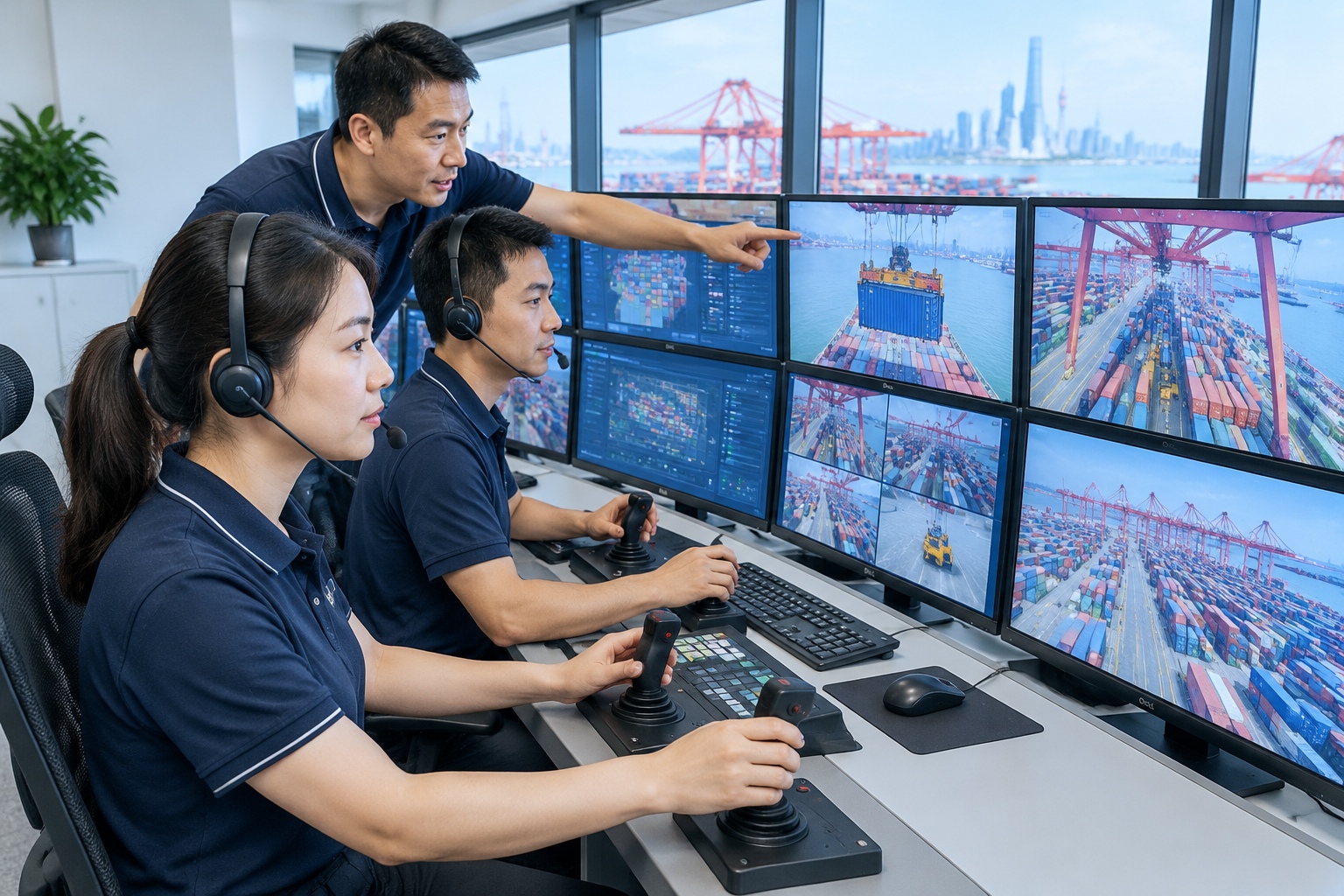
Shanghai’s port moved more than 50 million standard containers in 2024, the most of any port in the world for the fifteenth year running. The deep-water terminal at Yangshan sits about 30 kilometres offshore, joined to the mainland by a 32-kilometre bridge, because the water closer in is too shallow for the biggest ships. At the newest berths most cranes have nobody in the cab. Operators sit in a control building, moving containers with joysticks and a bank of screens, the way a teenager might fly a drone.
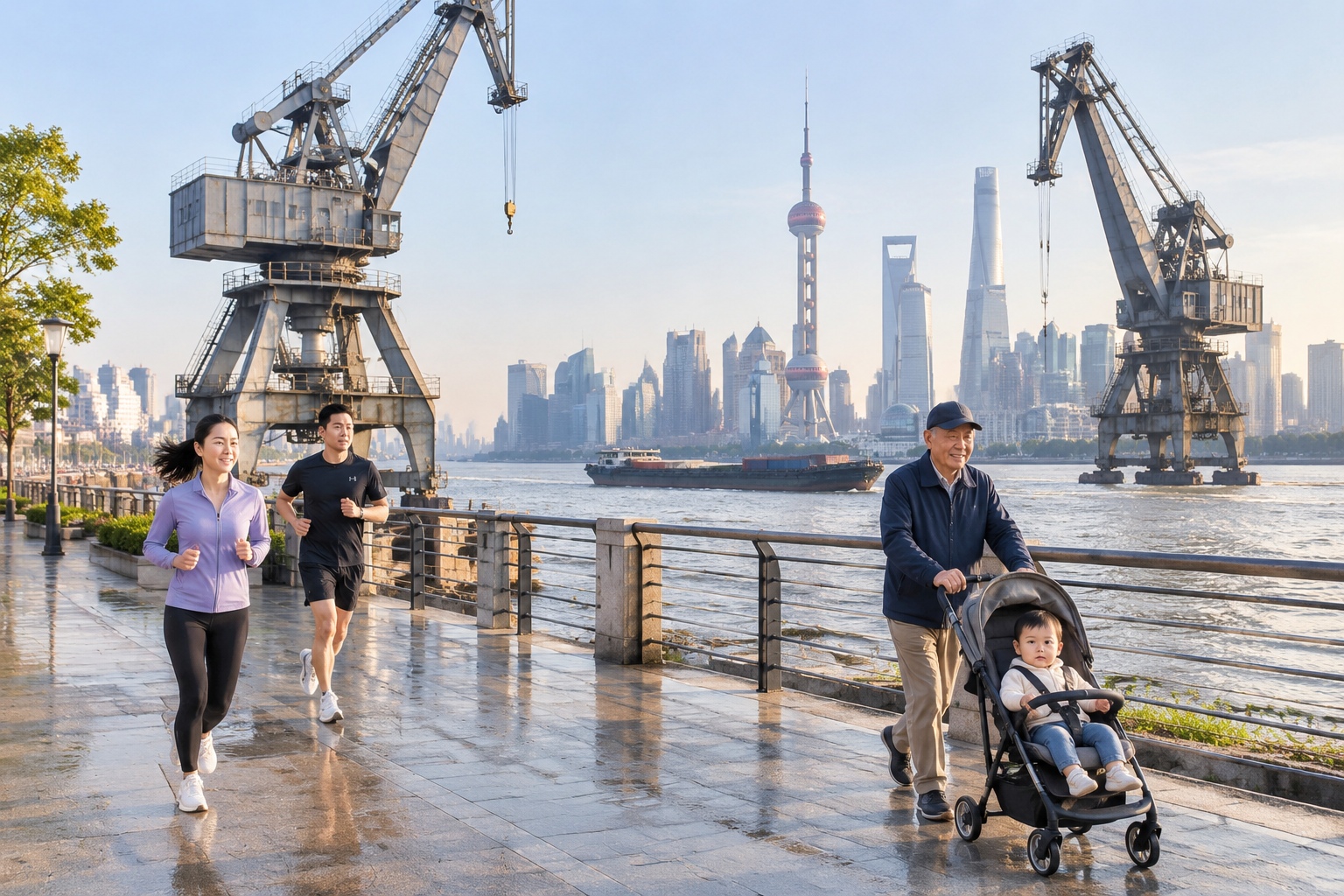
Closer to the city centre, the waterfront has changed jobs. The Huangpu’s banks were shipyards, warehouses and grain silos for a century; from 2016 onward, Shanghai opened roughly 45 kilometres of riverside walkways to the public. The old cranes at Minsheng Wharf were kept as monuments. On a Saturday morning the people using the path are joggers, grandparents with toddlers, and couples photographing the container ships sliding past. The industrial river and the domestic river now share the same bank.
Between Shanghai and Wuhan: the towns the guidebooks skip
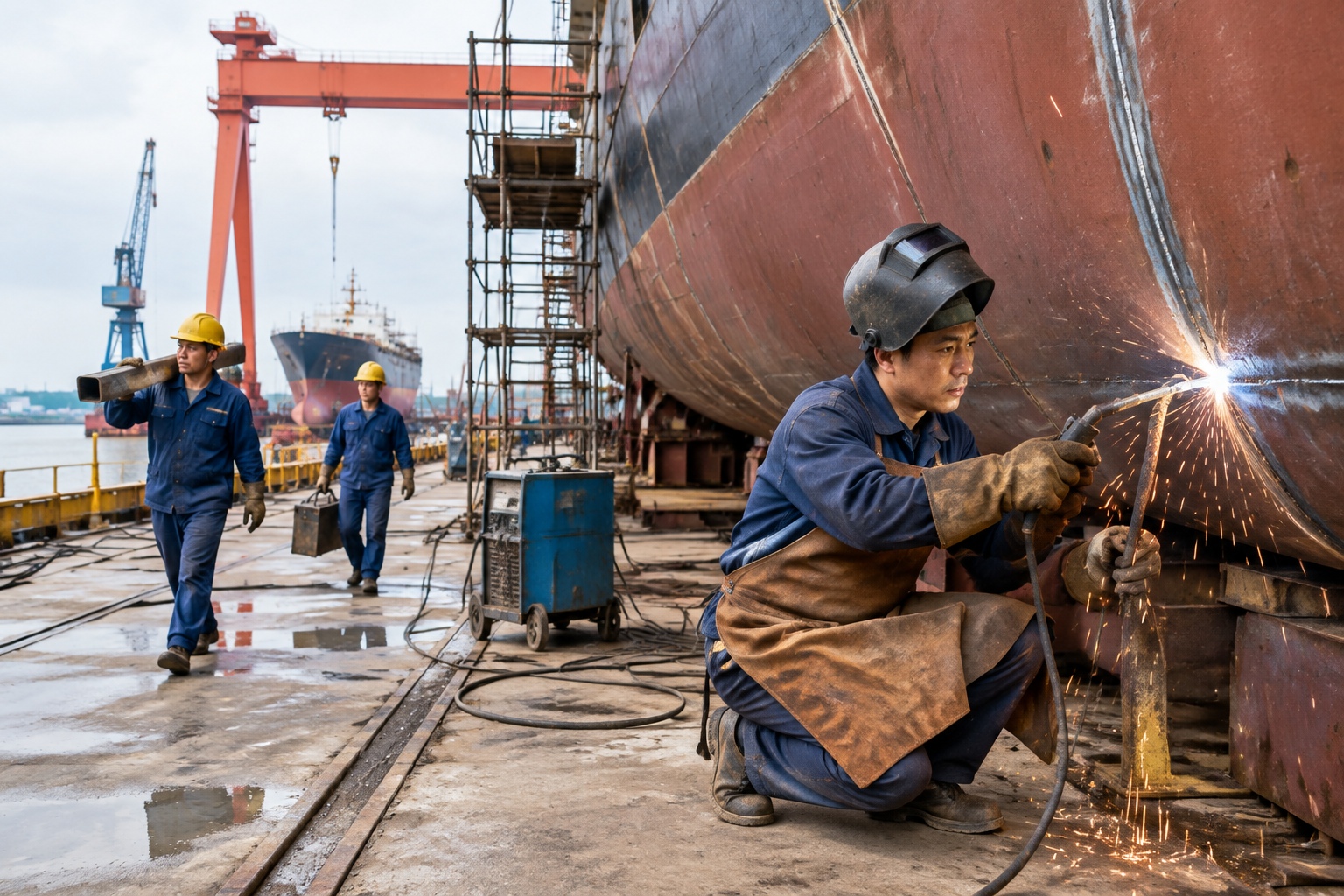
Head upstream from Shanghai and the geography stops being postcard material and starts being payroll. Taicang, a city of a few hundred thousand people on the Jiangsu bank, hosts hundreds of German manufacturers, mostly small and mid-sized firms making machine tools, bearings and auto parts; there is a German bakery and a vocational training centre built to look like the ones back home. Further along the same bank, Nantong and Jingjiang launch ships. China builds roughly half the world’s new vessels by tonnage, and Jiangsu is the country’s biggest shipbuilding province, so the slipways here matter well beyond the river.
This stretch has its own calendar too. In early spring, small restaurants in riverside towns such as Yangzhong and Jingjiang serve pufferfish — farmed now, which is why it is legal and affordable, and cooked by chefs who need a licence for it. A whole pufferfish dinner for four, with soup and rice, runs to a few hundred yuan. Knifefish, a bony, silver, famously expensive fish, appears on menus for a few weeks a year and then vanishes. It is the kind of seasonal eating that no container-terminal price index will ever capture.
Wuhan: noodles standing up, at six in the morning
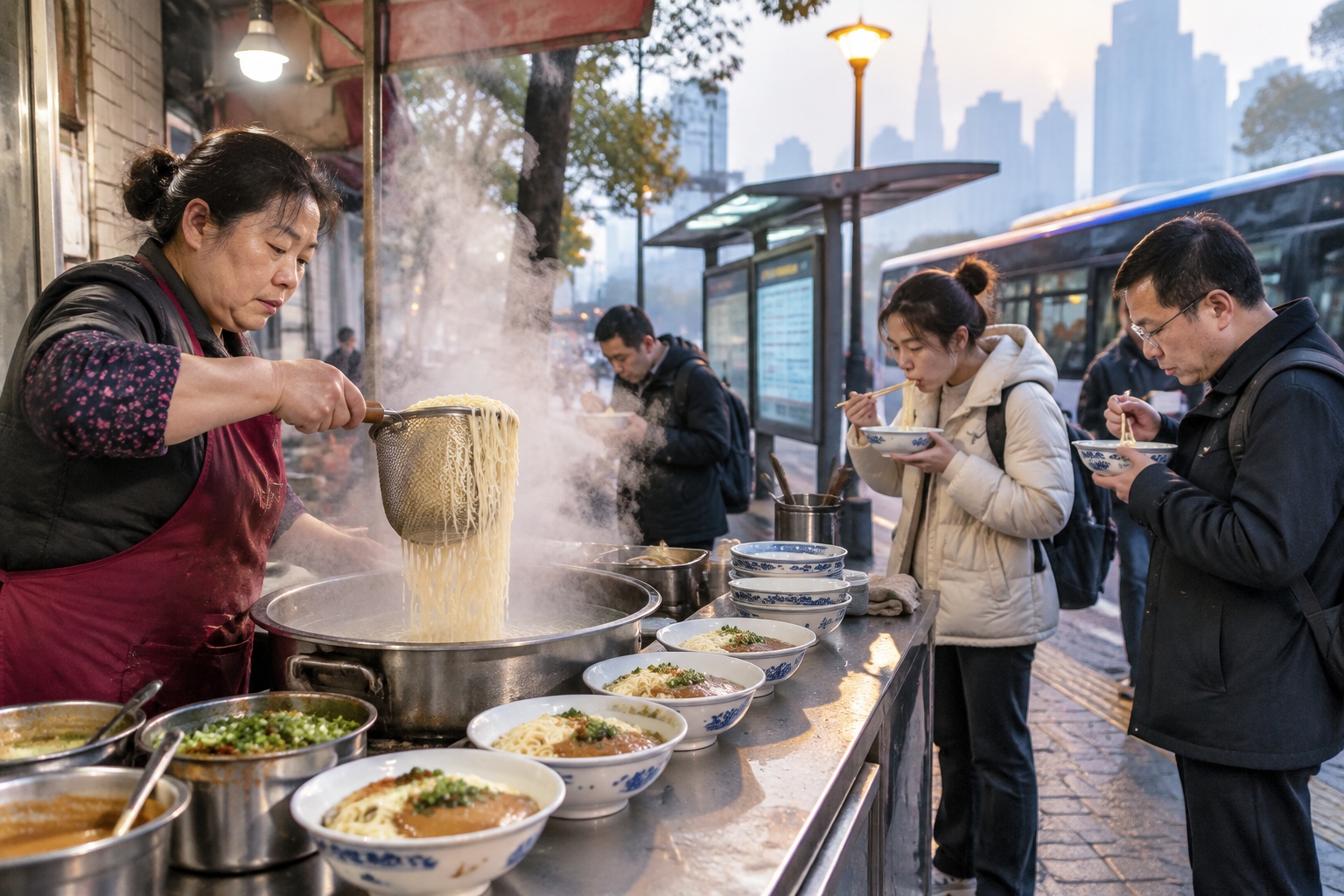
Wuhan is where the middle economic zone becomes visible. Around 6:30 a.m., sidewalk stalls across the city sell hot dry noodles — wheat noodles tossed with sesame paste, soy and chilli oil — for five to eight yuan. Locals call breakfast guo zao, roughly “passing the morning”, and a large number of them eat it standing, bowl in one hand, chopsticks in the other, on the way to a bus stop. It is a five-minute ritual performed several million times a day.
The working version of Wuhan is upriver at Yangluo, where container terminals link the river to rail. Wuhan is close to the inland limit for large oceangoing vessels; the dredged channel is deep enough for ships of around 10,000 tonnes to reach the city, and everything beyond transfers to smaller hulls or to trains. Wuhan also runs its own Europe-bound freight services, and it is a serious technology town: the East Lake high-tech zone is a global centre for optical fibre and cable, and one of China’s biggest memory-chip factories sits just outside the city. With well over a million university students, Wuhan has spent two decades turning graduates into engineers.
One piece of history is worth keeping. Until 1957, no bridge crossed the Yangtze at Wuhan; trains were ferried across the water in pieces. The double-deck road-and-rail bridge completed that year, with Soviet help, was treated as a national achievement, and it is still in daily use. More than a hundred bridges now cross the river. What felt impossible within living memory has become unremarkable.
Yichang and the elevator for ships
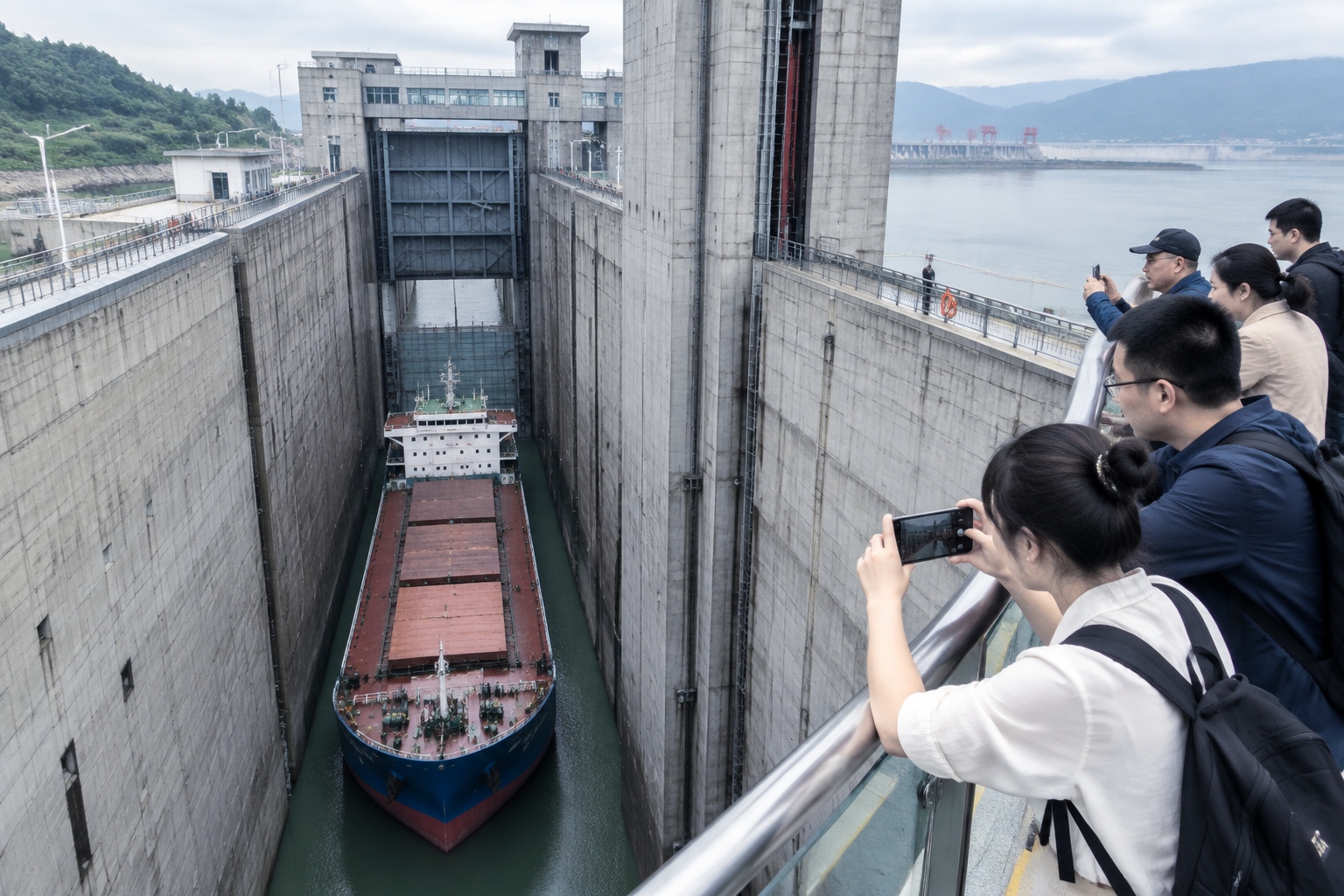
Between Wuhan and Chongqing, the river climbs 113 metres through the Three Gorges Dam, and it does so in two ways. The five-step lock system lifts a cargo ship in about three and a half hours, behind a queue that in busy seasons runs several hours longer. Beside it, since 2016, a ship lift works like a vertical elevator: a vessel of up to 3,000 tonnes floats into a caisson and is raised the full height in around half an hour. From the observation deck at Tanziling you watch a 100-metre ship rise silently out of a concrete trench, which is not a sight most travel writing prepares you for.
The dam also has a cost side that is not hidden in China. About 1.3 million people were resettled for the reservoir, and towns such as old Fengjie and Wushan now sit on hillsides above their submerged originals. Some replacement towns took years to feel inhabited; others, like the new Wushan, became busy again as tourism and river trade returned. Since January 2020, commercial fishing has been banned on the Yangtze main channel and its key tributaries for ten years. Tens of thousands of fishing families handed in their boats and licences, and many were retrained as river rangers, patrolling the same water for illegal nets on a fixed monthly wage.
Chongqing: where the river turns into a mountain
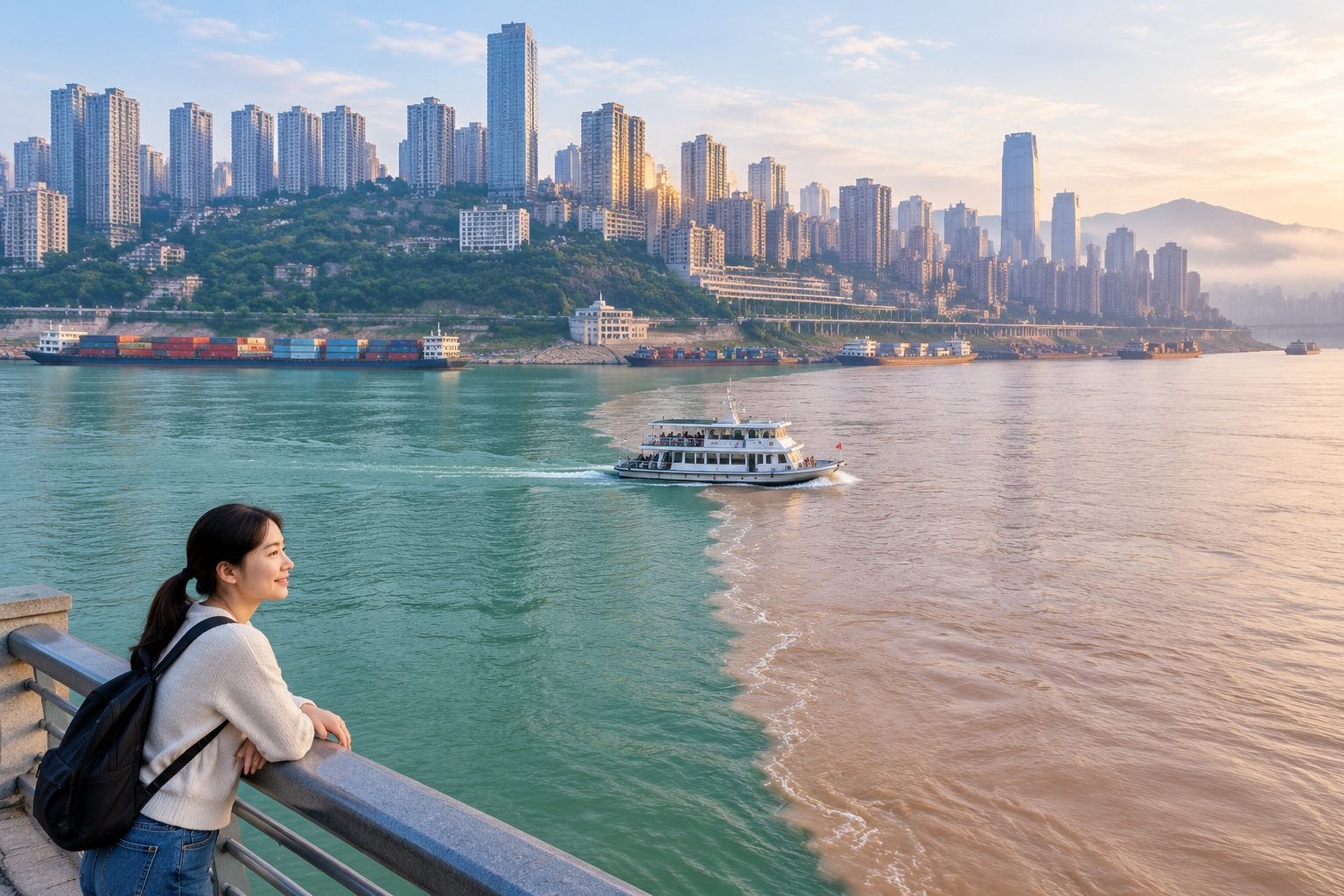
Chongqing is the hinge of the story. At Chaotianmen the Jialing and the Yangtze meet, and for a kilometre or so the water runs in two colours, green beside brown, before it mixes. The municipality of around 32 million people is built on slopes so steep that public escalators and a cable car over the river function as ordinary commuting. Downstream at Guoyuan, the biggest port on the upper Yangtze handles well over a million containers a year and connects to something most outsiders have never heard of: the New International Land-Sea Trade Corridor, a rail-and-sea route that sends goods south to the Gulf of Tonkin and on to Southeast Asia. Chongqing also sent the very first of China’s Europe-bound freight trains, to Duisburg in 2011, and that route now carries laptops, auto parts and machinery westward in about two weeks.
The river’s most obvious cargo from here is vehicles. Chongqing builds more than two million cars and commercial vehicles a year, and a growing share of them leave the country — most ride barges down the Yangtze to Shanghai, or head west by train. At one in the morning near the port gates, hotpot restaurants stay open for drivers and night-shift loaders. A divided pot of chilli broth, a plate of tripe, a bowl of rice: about 60 yuan for two, eaten at a plastic table beside a road that is still moving.
What the river actually delivers
The Yangtze’s economic case is not that it is beautiful. It is that it moves things cheaply. Shipping a container from Chongqing to Shanghai by barge costs a fraction of the equivalent truck trip and produces a fraction of the emissions, which is why the corridor keeps pulling factories inland. The same water carries the consequence: the gap between coast and interior is still wide. Average urban disposable income in Shanghai is roughly twice that in Chongqing. The river narrows the distance; it has not closed it.
People along the route describe the change in practical terms. A former fisherman in his fifties, now a river ranger, talks about the return of fish he had not seen since childhood — and about the fixed salary that replaced unpredictable catches. A freight forwarder in her twenties in Chongqing talks about how many more of her clients now ship to Southeast Asia instead of Europe. A captain who has worked the Chongqing–Shanghai run for two decades says the same thing every time he is asked: the river is faster than it used to be, and more crowded.
If you want to see it yourself
The classic stretch: the Chongqing–Yichang cruise, three nights and four days downstream, is the one section where passenger boats still do what the river does best. Standard cabins on Chinese-language ships start around 1,500 yuan per person; mid-range and foreign-language cruises run 3,000–6,000 yuan and up. Boats stop near the Three Gorges Dam, so you see the locks or the ship lift from land.
Getting there: from Yichang, high-speed trains reach Wuhan in about two hours and Shanghai in roughly seven. Wuhan to Shanghai is about four and a half hours. Flying Shanghai–Chongqing takes about two and a half hours. A full Shanghai–Chongqing high-speed rail trip runs ten to eleven hours and is best broken in Wuhan.
Cheap local river transport: cross-river ferries in Chongqing and Wuhan still cost a couple of yuan, and the Yangtze River Cableway in Chongqing is around 30 yuan. These are commuter services, not attractions, which is exactly why they are worth riding.
When to go: late March to May and September to November. Chongqing in July and August is a 40°C city, and winter fog on the middle reaches can flatten the view for days. Avoid the first week of October and Chinese New Year, when every riverside town is full.
Practical notes: bring your passport — hotels require it. Mobile payment apps linked to an international card work in most places now, but a little cash helps at small ferry piers. Do not plan on finding scheduled passenger boats along the whole river; outside the cruise stretch the Yangtze is a freight channel. The best places to watch it work are the Chaotianmen docks and the cableway in Chongqing, the Hankou riverside in Wuhan, and the old shipyard cranes at Minsheng Wharf in Shanghai.
Nobody markets these places as the soul of the country. They are a river doing its job, at about the speed of a loaded barge.
Start the discussion at forum.chinacomes.com