
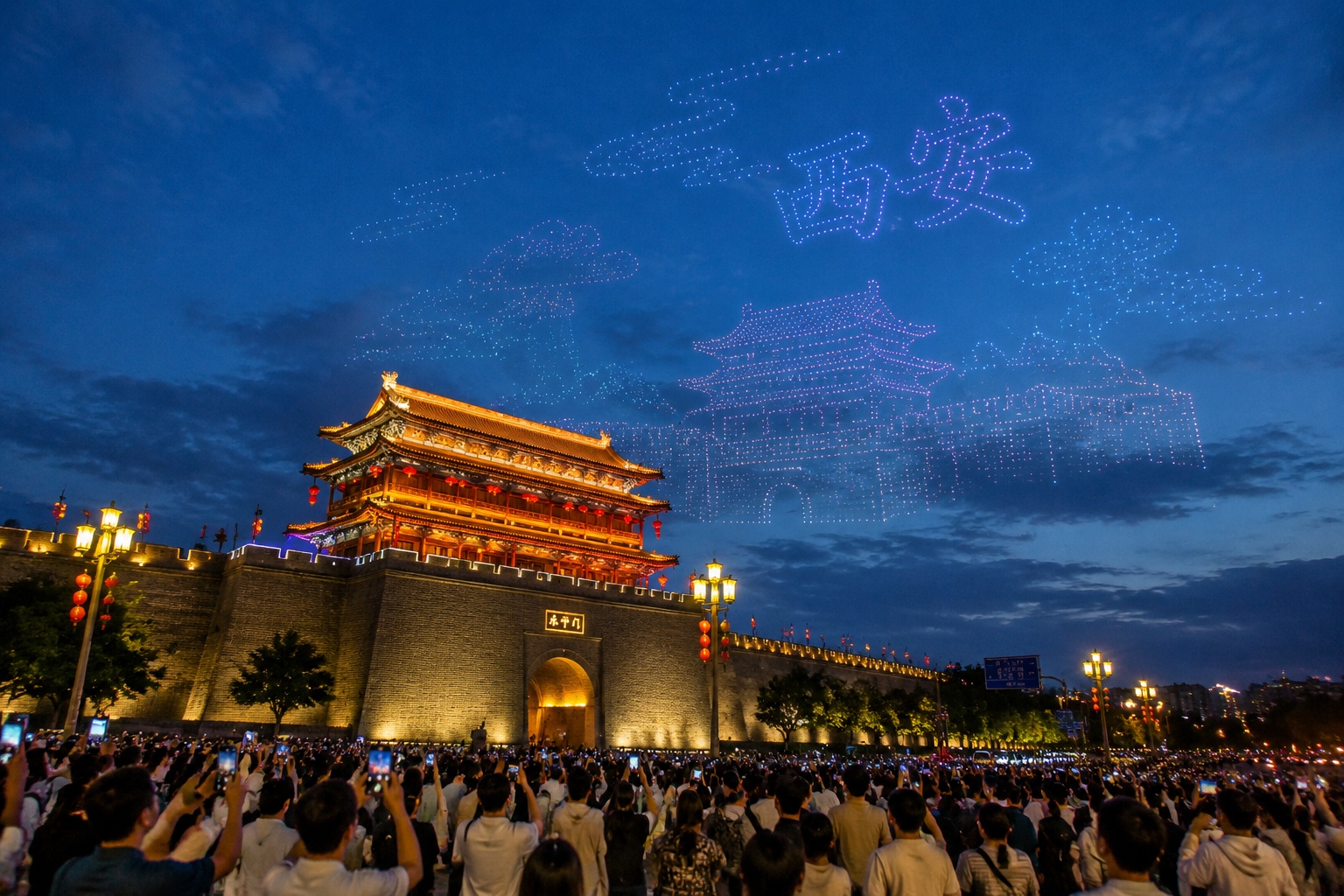

Night over the Ancient Walls
At 8 p.m. on a Saturday in Xi’an, the South Gate – a towering Ming-dynasty fortification – looks like a movie set. Hundreds of spectators line the pedestrian street, phones raised. Above the crenellated walls, a formation of 800 drones slowly rises, flickering into the shape of a running horse, then an astronaut, then a gleaming space station. The crowd lets out a collective “whoa.” A tourist from Spain tells me she flew to Xi’an for the Terracotta Warriors, but didn’t expect to see a sci-fi light show over a 600-year-old wall.
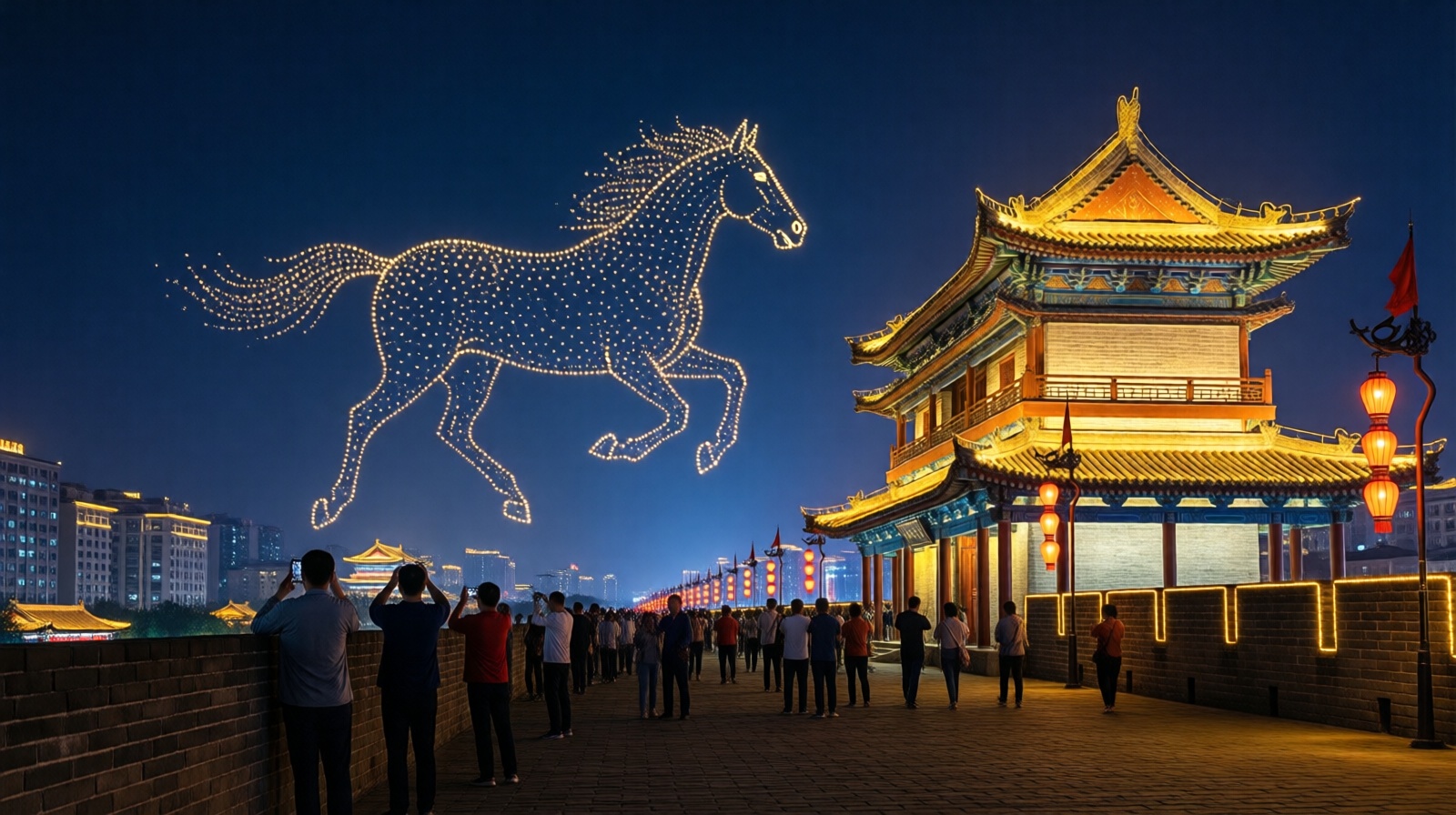
This is not a one-off festival event. In the last three years, drone shows have become a regular attraction in Xi’an, often staged on weekends and holidays. Companies like Shenzhen’s DJI dominate the consumer market, but the choreography software behind large fleets is often developed locally – and many of the engineers who design these light poems over the city skyline previously worked on something far more demanding: China’s space program.
Xi’an’s Invisible Space Legacy
Most outsiders know Xi’an as the ancient capital of 13 dynasties and the home of the Terracotta Army. Far fewer realize that this city, surrounded by history and modern farmland, has been a backbone of China’s aerospace industry for over half a century.
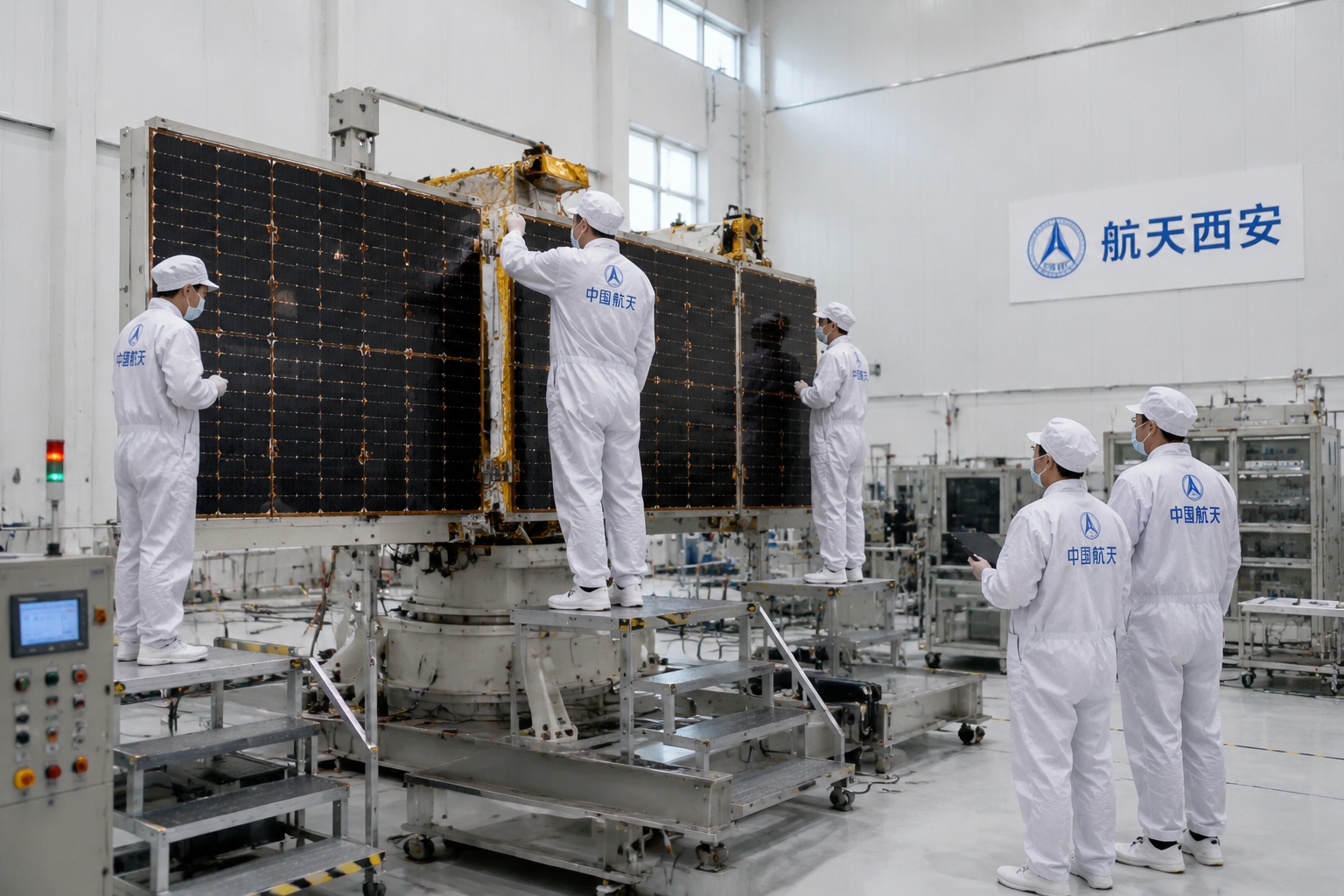
Xi’an is home to the China Academy of Space Technology (Xi’an) – a key institute responsible for satellite electronic systems, tracking and telemetry, and space-borne computers. When China launched the Chang’e lunar probes and the Tianhe space station core module, critical telecommunication equipment and navigation systems were designed and tested here. The Xi’an Satellite Control Center also plays a major role in monitoring spacecraft in orbit. The city’s contribution is largely invisible – there’s no giant rocket on the city square. But if you visit the space campus near East Street, you’ll see a security gate guarded by soldiers, and behind it a cluster of research buildings where mornings often start with an early queue at the cafeteria. Engineers here spend years perfecting a single antenna circuit – the kind of patient, unglamorous work that gets a country to the Moon.
How Space Tech Meets Everyday Life
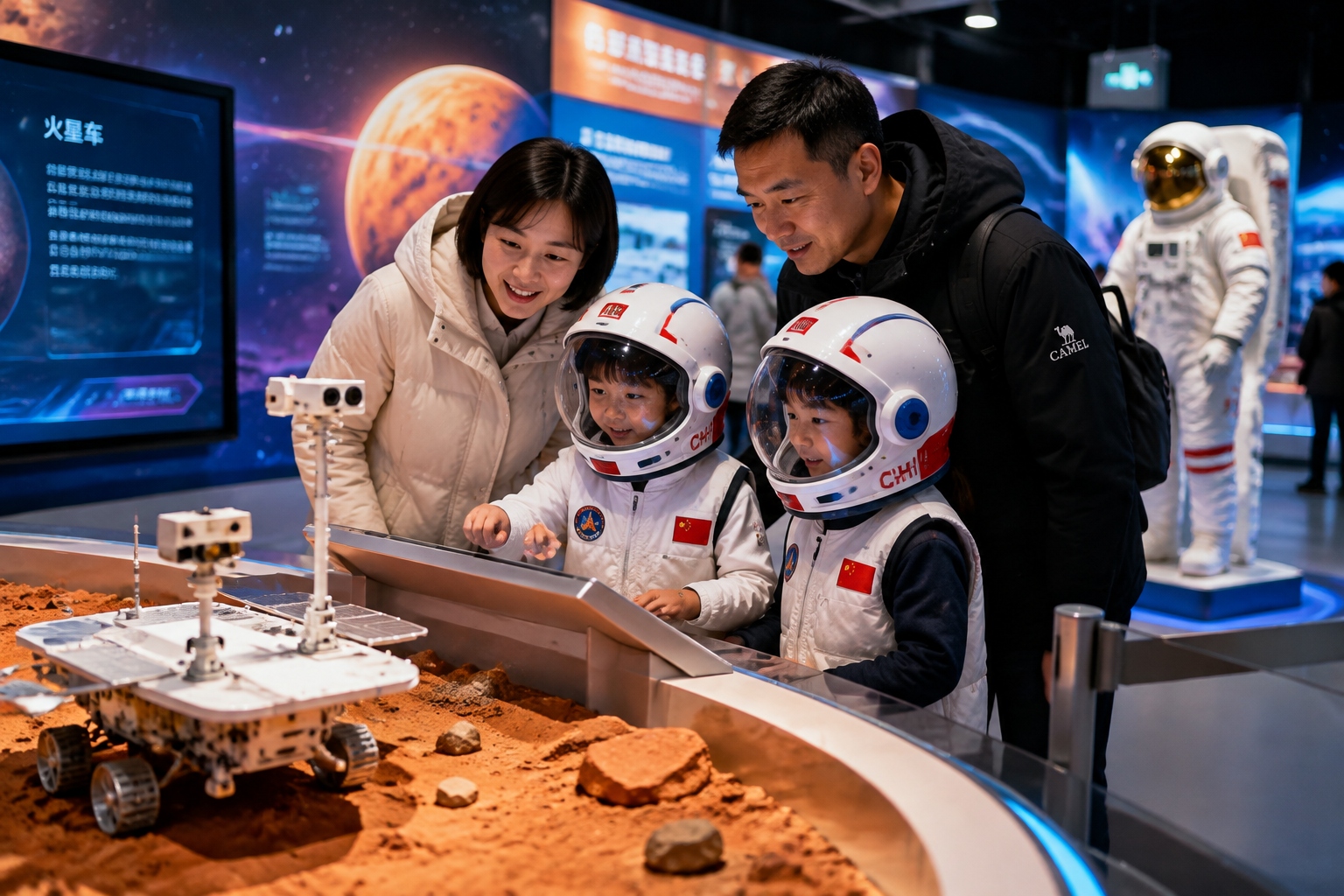
So how does an ordinary person in Xi’an experience this? For one thing, the city has turned its unusual tech heritage into a new kind of tourism. The Hangtian (Aerospace) Industrial Base, located in the city’s southeast, has become a destination where parents take their kids on weekends. There are aerospace science museums, interactive exhibits, and even a “Mars base” simulation camp. Children line up to touch a replica of the Zhurong Mars rover, and a popular café nearby sells coffee with edible silver stars – the waiter jokes that the “astronaut” roast is the best seller.
A more direct encounter happens in the sky. Since 2021, local government-supported drone shows have used the ancient city as a canvas. The drones are not just for fun; the shows themselves test advanced swarm technologies – positioning, obstacle avoidance, and communication in a crowded urban environment. In other words, the same data links that allow satellites to talk to Earth are now helping 600 drones fly in perfect formation over a pagoda.
“I never thought my satellite day job and my weekend drone show hobby were related,” says Wang Lei, a 32-year-old engineer who works at a commercial aerospace company in Xi’an Special Aerospace Industry Park. “But it’s exactly the same math – orbit prediction and drone choreography are both about precision timing and location. We’re solving puzzles in the sky either way.”
Startups and the Next Generation
The growing buzz around drones and space has also pulled in young entrepreneurs. Xi’an now hosts several commercial aerospace startups that are part of China’s wider private sector push into space. One company, whose office is tucked between a noodle shop and a bicycle repair store, designs small liquid-fuel rocket engines. The founder, a former engineer from a state institute, tells me that the city’s advantage is its talent pool – every year, top universities send fresh graduates to Xi’an because of the state aerospace centers. “We have more than enough engineers, but we need more risk-takers,” he says with a laugh, pointing to a whiteboard covered in engine schematics.
Local universities, especially Northwestern Polytechnical University, are feeding that pipeline. The campus is famous for aerospace engineering, and on many evenings you’ll see students in dorm rooms running simulation software for rocket trajectories, right next to textbooks on Tang dynasty poetry. One student, a 21-year-old named Deng Min, has already interned at a drone-light design studio. She helps program flight patterns for the city’s upcoming New Year show. “My friends think I’m just making pretty lights,” she says, “but I’m actually learning swarming algorithms that could one day be used to deliver medicine to remote villages.”
Old City, New Ambitions
All this technology sits uneasily – but productively – beside Xi’an’s ancient character. For every high-tech complex there is a 600-year-old mosque or a restored Tang-era courtyard. The drone shows have even adapted their content to the city’s culture: some sequences depict the Silk Road caravans, and the futuristic astronaut floating above the Bell Tower feels like a dialogue between centuries.
Not everything is flawless. Critics point out that the performance drones create noise and light pollution over residential areas, and some shows have been interrupted by weather. There’s also a discussion about whether the tech industry is widening the gap between old and new neighborhoods – the shiny Aerospace Base is far from the old Muslim Quarter, where residents make a living selling souvenirs and mutton soup. The city government is trying to connect these worlds through subway lines and tech-inclusive tourism packages, but the integration is still a work in progress.
“For us, the drone show is not the point,” says a 45-year-old shopkeeper named Liu, who sells antique replicas near the Drum Tower. “It brings crowds, sure, but the real change is that my daughter now studies computer science in college. She wants to work for a satellite company. When I was young, we thought the future was all about history. Now the future is also about space.”
More Than Just History
Xi’an is a city where you can stand on a Ming-dynasty wall and watch a swarm of drones recreate a Tang dynasty flying horse in the sky. That image – ancient stone meeting algorithmic light – is a perfect metaphor for modern China. The city’s deepest identity is no longer just about the past; it is now also about the people who quietly design the circuitry for a Mars rover, and the young engineers programming dots of light to tell stories above bells and pagodas.
So yes, come for the Terracotta Warriors. Stay for the night sky.
Start the discussion at forum.chinacomes.com