
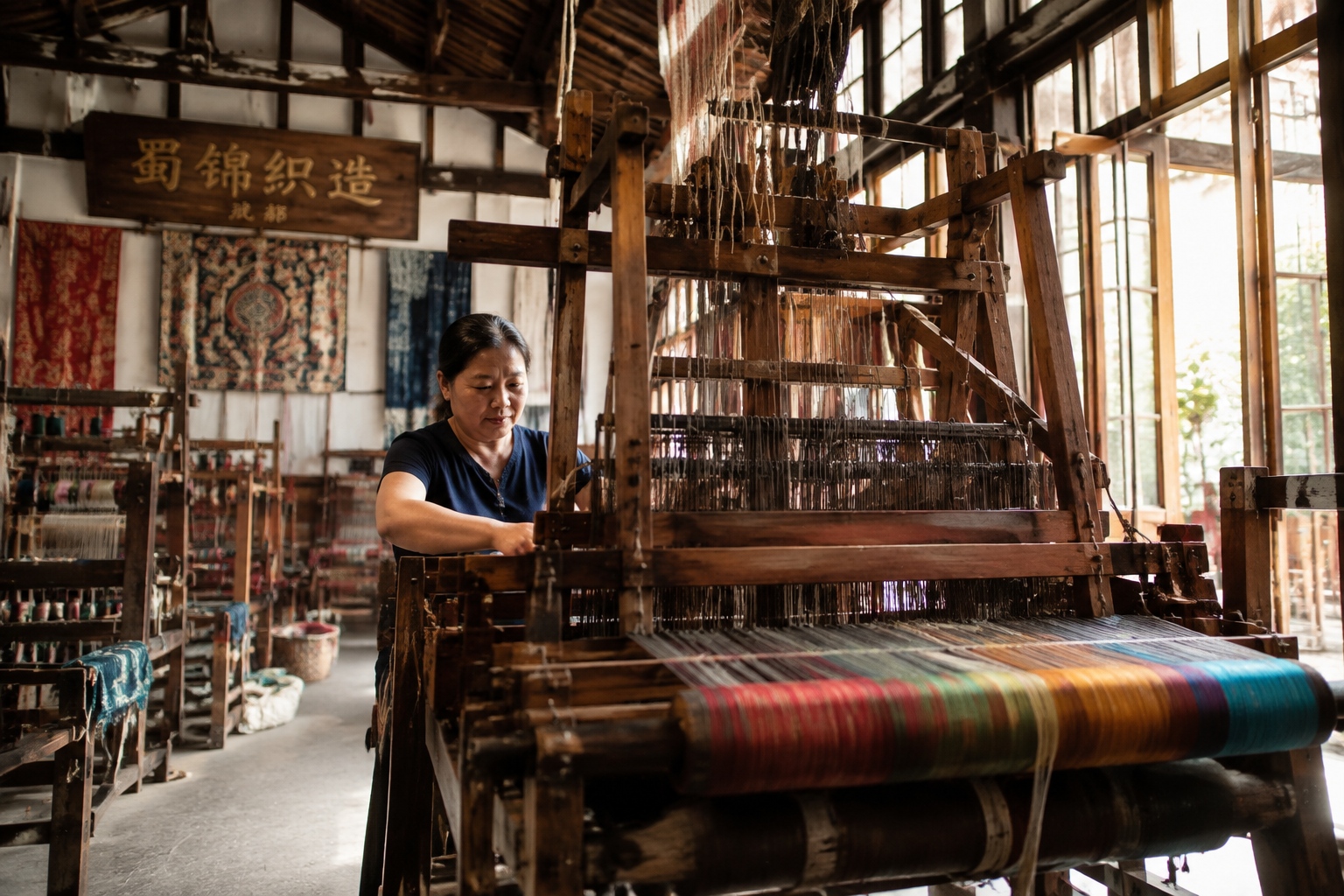

On a Tuesday morning in Chengdu, the capital of Sichuan province, the rhythmic clack of a wooden loom echoes through a high-ceilinged workshop that feels more like a scientific laboratory than an artist’s studio. A middle-aged woman in a blue work apron sits at the machine, her hands moving with dizzying speed across hundreds of silk threads. She is weaving a length of jacquard fabric with a pattern of peonies and clouds, a design that has been replicated for over a thousand years. But unlike the mass-produced textiles you might find in a European home-decor store, this piece takes weeks to complete, and the weaver follows a technique passed down through generations.
This is Shu brocade, or shu jin in Chinese, one of the four most famous brocades in China. Alongside it, a few blocks away, another craft is practiced with equal intensity: Shu embroidery, or shu xiu, where needle and thread are used to paint images on silk. These two arts have been central to Sichuan’s cultural identity for centuries, and today, they are experiencing an unexpected revival among young Chinese who are finding new meaning in handmade things.
What Exactly Are Shu Brocade and Shu Embroidery?
Both crafts are named after the ancient Kingdom of Shu, which ruled present-day Sichuan from around 400 BCE. The region has always been known for its silk, thanks to a mild climate and mulberry trees that feed silkworms. By the Han dynasty (206 BCE–220 CE), Shu brocade was already a luxury product traded along the Southern Silk Road, as far as India and Rome.
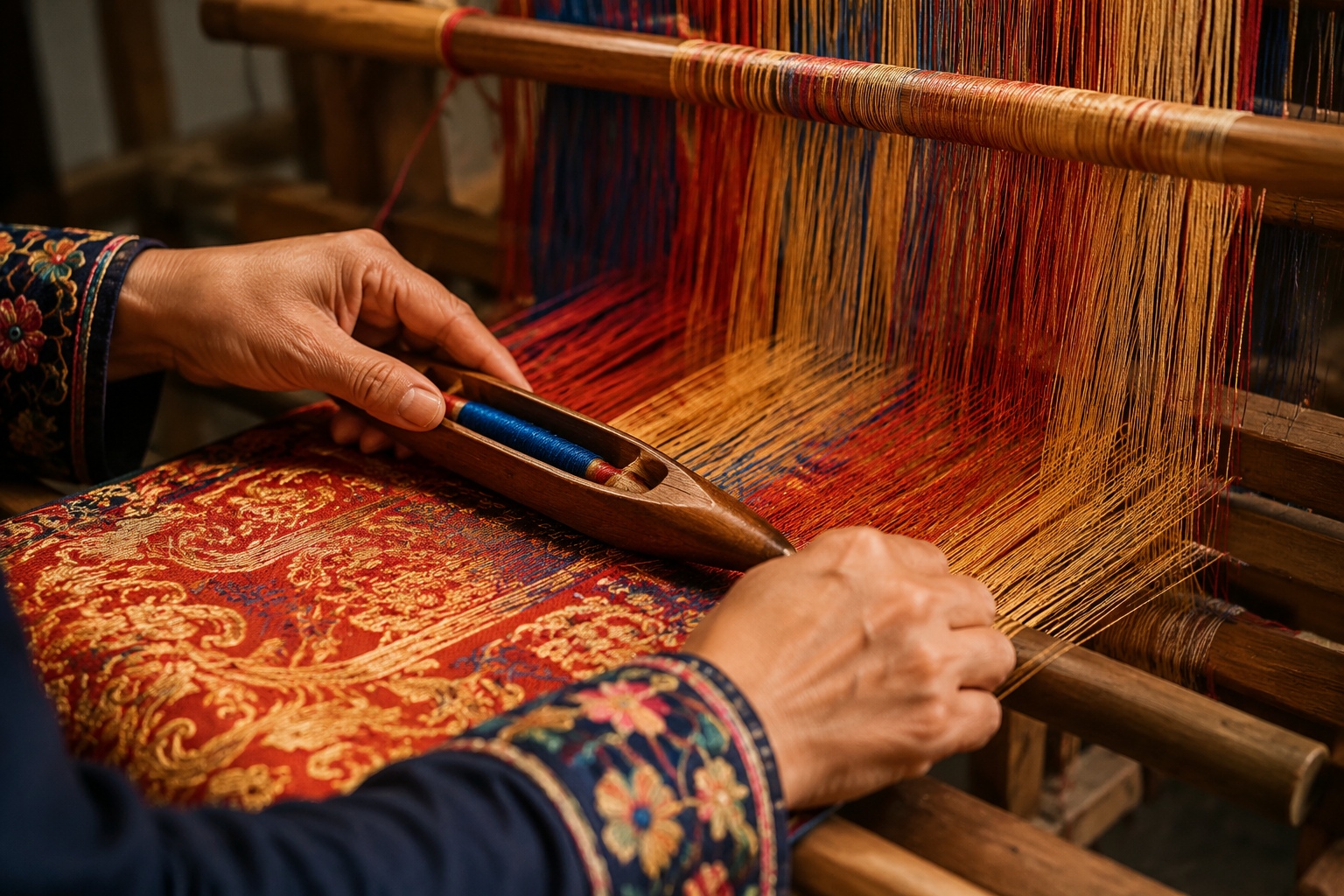
Shu brocade is a woven textile, created on a loom by interlacing colored silk threads to form patterns. The technique involves a “flower-drawing” process where a master designs the pattern, then a weaver manually selects and manipulates the warp threads while a second person assists in throwing the shuttle. The result is a dense, richly textured fabric with vivid geometric or natural motifs, often featuring phoenixes, tigers, and cloud symbols.
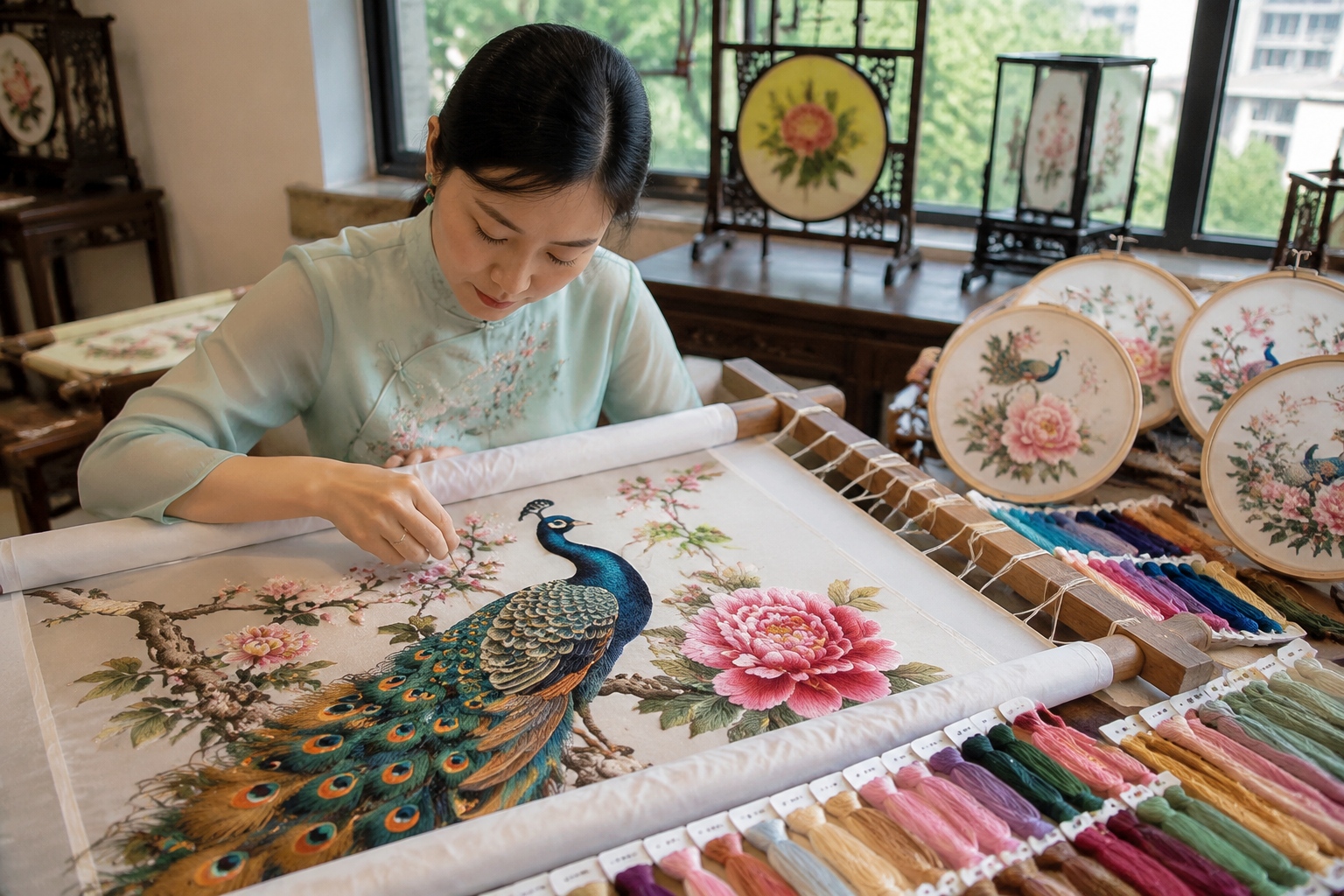
Shu embroidery, on the other hand, is a needlework technique, not a fabric. It is used to decorate silk and is distinguished by its smooth, even stitches and delicate shading. The majority of embroidery images are animals, flowers, and landscape scenes, executed with a variety of stitches that mimic brushstrokes. Historically, nearly every woman in polite Chengdu society learned some form of embroidery, and it served as a mark of refinement.
Two Techniques, One Spirit
While a casual observer might confuse the two, the difference is fundamental: brocade is woven, embroidery is stitched. In brocade, the pattern is created during the weaving process; in embroidery, the pattern is added onto the finished fabric. Think of it as the difference between a striped fabric and a fabric that has stripes sewn onto it afterward. Both require incredible patience. A hand-woven Shu brocade of a meter in length might take two skilled workers up to a month to produce. A single Shu embroidery piece with a detailed image can take three times longer.
How Does It Compare with European Silk Traditions?
If you come from Europe, you might already know the silk-weaving center of Lyons, France, which became famous in the 17th century for its intricate brocades. Both Chengdu and Lyons share a history of state patronage and global trade. But their paths diverged significantly.
In Lyons, silk weaving became deeply tied to the Industrial Revolution. In the late 18th century, the Jacquard loom (named after its French inventor) automated pattern weaving using punched cards. Since then, Chinese factories also use Jacquard-derived machinery, but what is striking about Chengdu’s heritage workshops is the persistence of hand-operated looms. Many master weavers still use traditional equipment, adapted with only minor tweaks. The reason is not a lack of modernization, but rather the very nature of the craft: Chinese scholars believe that the micro-variations in hand tension give Shu brocade a liveliness that a mechanical loom cannot replicate.
Similarly, in Europe, embroidery became a commercial enterprise with elaborate embroidery shops and eventually machine embroidery. Today, most items you buy are machine-made. But in Sichuan, embroidery is still treated as an art form, and many of the top practitioners are honored with the title “Master of Chinese Arts and Crafts.” Their works are exhibited in museums and sold as cultural treasures, not just decorative textiles.
This is not to say that China and Europe are opposites. Rather, both regions have preserved and industrialized different aspects of their textile history. Europe may have industrialized the production, but China has kept the artisanal tradition closer to its original form, partly because of cultural reverence for handcraft and partly because the market for luxury embroidery remains strong.
The Modern Revival: How the Crafts Are Surviving and Thriving
Walk into the Chengdu Shu Brocade & Embroidery Studio (one of the few state-designated workshops), and you’ll see a mix of age groups. Older masters are teaching apprentices in their twenties. Some of these apprentices are art-school graduates; others are self-taught enthusiasts who found the craft on social media. They all learn the same traditional techniques but are encouraged to create contemporary designs. A recent project involved designing fashion tees with embroidered pandas, a nod to the city’s most famous resident.
The central government’s “intangible cultural heritage” program has been crucial. Since 2009, both Shu brocade and Shu embroidery have been listed on China’s national list of intangible cultural heritage, and later inscribed on UNESCO’s list. This status provides subsidies for training, exhibition, and marketing. For example, inheritors can receive a government stipend to take on apprentices, and studios are exempt from certain taxes.
But institutional support alone didn’t revive the craft. It took a cultural shift. In China, there’s been a growing interest in “national style” (guochao), driven by young consumers who see traditional aesthetics as a way to express identity. The same trend that brings hanfu dressing to university campuses is also driving demand for handmade accessories.
From Museum Piece to Everyday Object
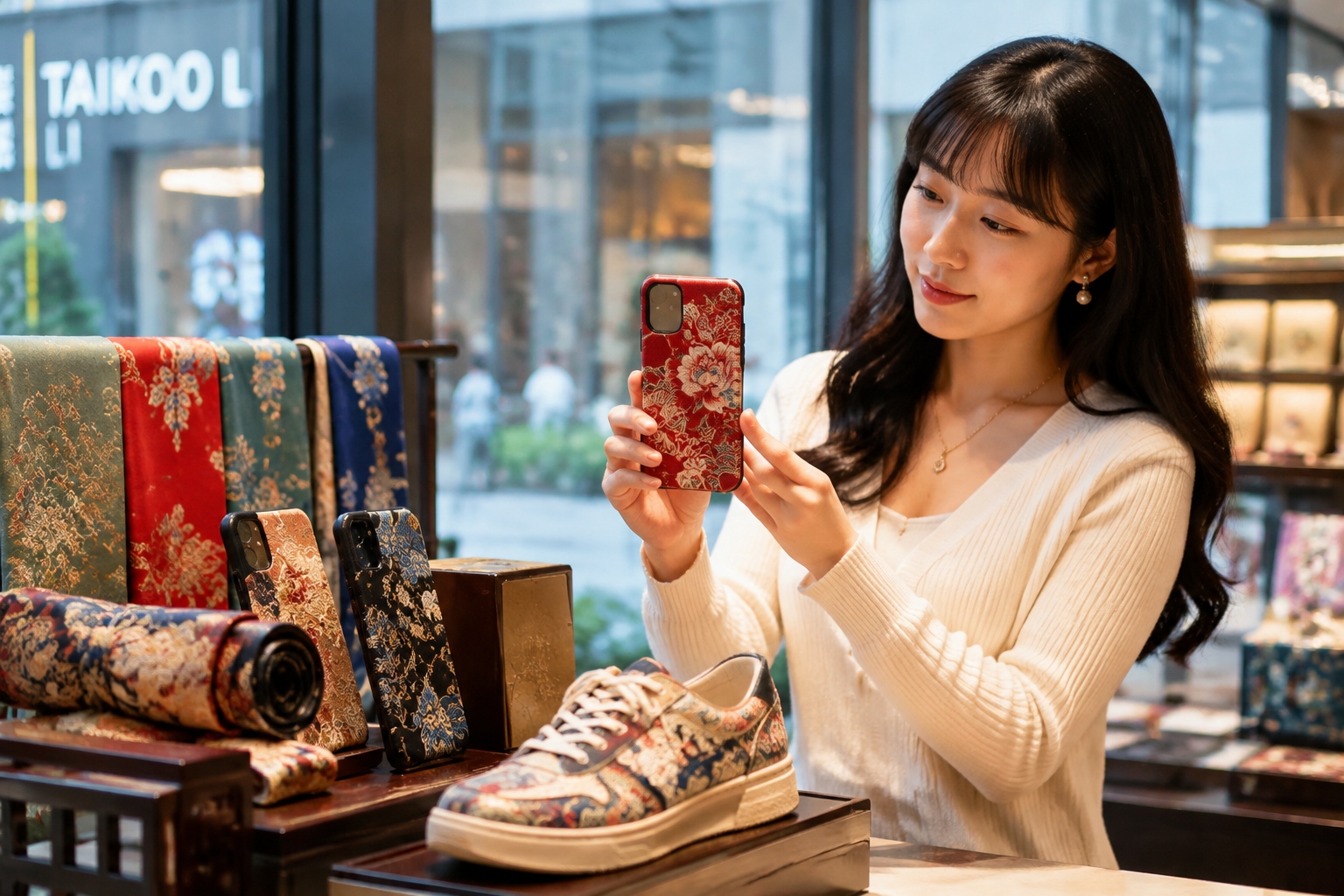
Shopping for Shu silk today is not like visiting a dusty museum gift shop. In Chengdu’s trendy Taikoo Li area, a boutique sells silk scarves embroidered with modern abstract designs, shoes adorned with brocade panels, and phone cases covered in delicate stitching. Prices range from a few dollars for a small keychain to thousands for a custom-made cheongsam.
The tourism industry has also transformed the crafts. The “Shu Brocade, Longquan” experience center, a popular heritage attraction, lets visitors try weaving on a mini loom or take a one-hour embroidery class. On weekends, the classes are often fully booked, especially with families who want to introduce their kids to traditional culture.
Another surprising market is the tech ecosystem. In 2021, a Sichuan-based tech company launched a line of gaming mice wrapped in Shu brocade, combining a high-tech gadget with a centuries-old textile. The product was a hit, raising eyebrows but also sparking conversations about how traditional crafts can find new life.
The Digital Edge: Selling Tradition Online
If you search for “Shu embroidery” on Chinese social-media platforms like Douyin (the Chinese version of TikTok), you’ll find livestreams of artisans embroidering in real-time. Viewers can see every stitch and place orders directly through the stream. Some master embroiderers have amassed millions of followers, not just for their craft but for their commentary on life and art.
This digital visibility is a double-edged sword. It brings income and recognition, but also pressure to produce “quick” pieces that suit cameras, potentially diluting quality. Yet many artists argue that the benefits outweigh the risks. One embroidery artist, in an interview with a local newspaper, said, “Even if people buy a cheap cushion with our design, they’re starting to understand the skill behind it. And some will come back to buy a real masterpiece.”
Challenges Ahead
None of this is easy. The industry faces a steep decline in skilled artisans. The average age of a top-tier Shu weaver is over fifty, and the hours are long—a complex weaving can take months, and the workspace, filled with fine silk dust, can trigger allergies. Embroidery, which requires perfect eyesight and fine motor control, is equally demanding. Young people often quit after a few years because they cannot match the income of a tech job or even a barista.
There is also the issue of authenticity. With the market expanding, low-quality, machine-embroidered items are sometimes passed off as authentic hand-made Shu embroidery. Regulators have tried to set certification standards, but it’s hard to enforce.
And while the guochao trend helps, it is still a niche market. Most Chinese consumers prefer international luxury brands when spending big money. Only a small segment of the population is willing to pay $500 for a hand-embroidered scarf, no matter how beautiful.
Conclusion: Weaving the Past into the Future
Standing in that workshop in Chengdu, watching the weaver’s fingers coordinate with the pedal and the shuttle, you sense something profound. This is not simply a craft preservation project. It’s a living dialogue between generations and cultures. The same silk that traveled to Rome two millennia ago is now being sold online to a teenager in Buenos Aires. The patterns have changed, but the commitment to quality endures.
For outsiders, the allure of Shu brocade and embroidery lies in their unfamiliarity. They don’t look like the textiles you see in Western museums; they have their own rhythm, their own vocabulary. And that’s precisely why they are worth discovering. Whether you buy a modern piece or simply attend a weaving demonstration, you’re witnessing a tradition that has not surrendered to the convenience of the machine—and that, perhaps, is its greatest modern significance.
Start the discussion at forum.chinacomes.com