
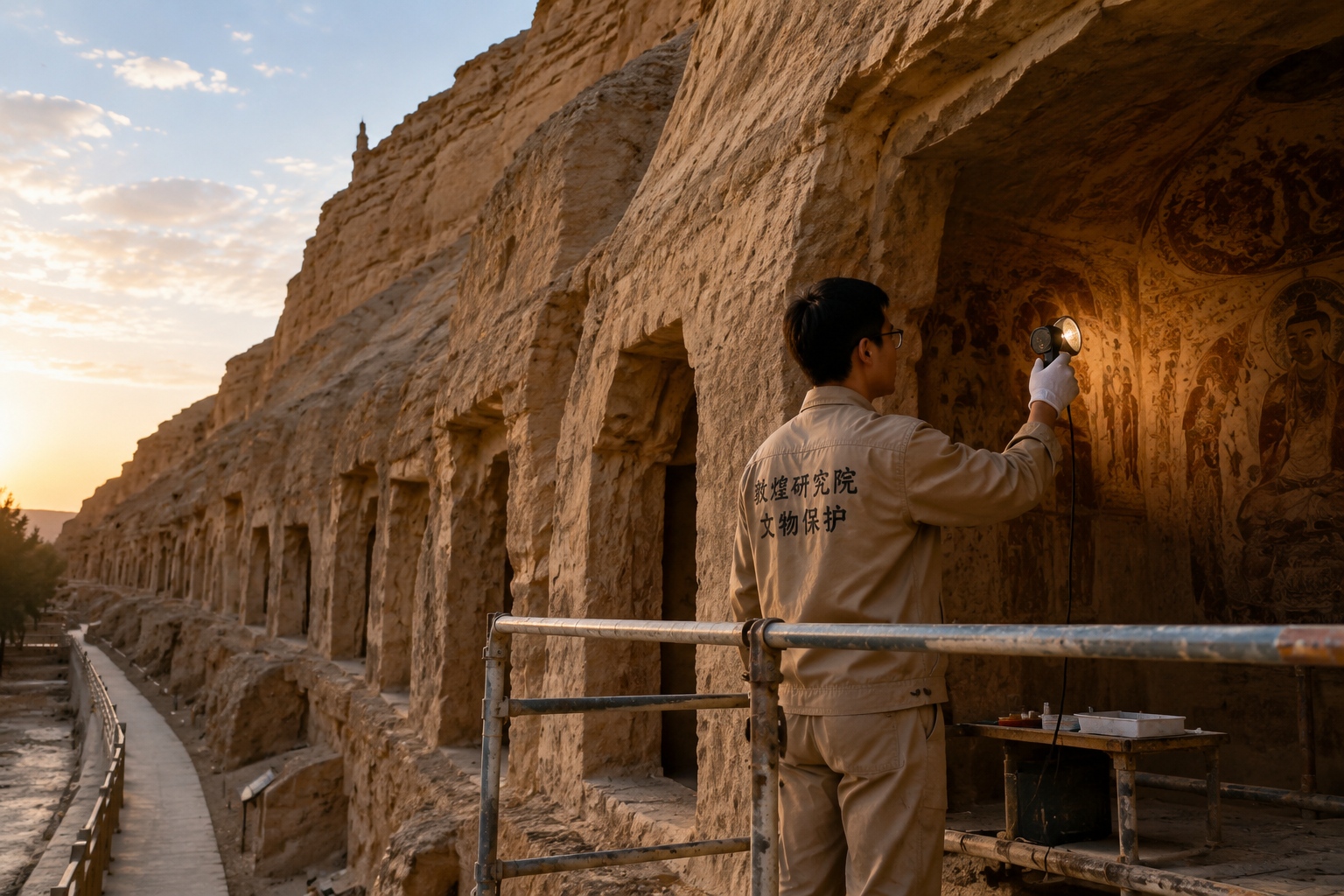

Morning in Cave 285
At 8:30 a.m., the desert sun is already heating the sandstone cliffs of the Mogao Caves. Inside Cave 285, 28-year-old restorer Chen Wei climbs onto a narrow wooden scaffold. She holds a syringe – not one for drawing ink, but for a far more delicate operation. Her mission: to tape down a tiny piece of a 1,400-year-old mural. A small patch of paint is lifting off the wall like curling birch bark.
One drop of adhesive. Wait. Another. With a palette knife and a fine brush, she presses the lifted pigment back into place. The work is so precise that she must hold her breath between movements. In the dim light, dust motes drift across her safety goggles. The silence inside the cave is broken only by the soft hum of a portable fan and the shuffle of her coat.
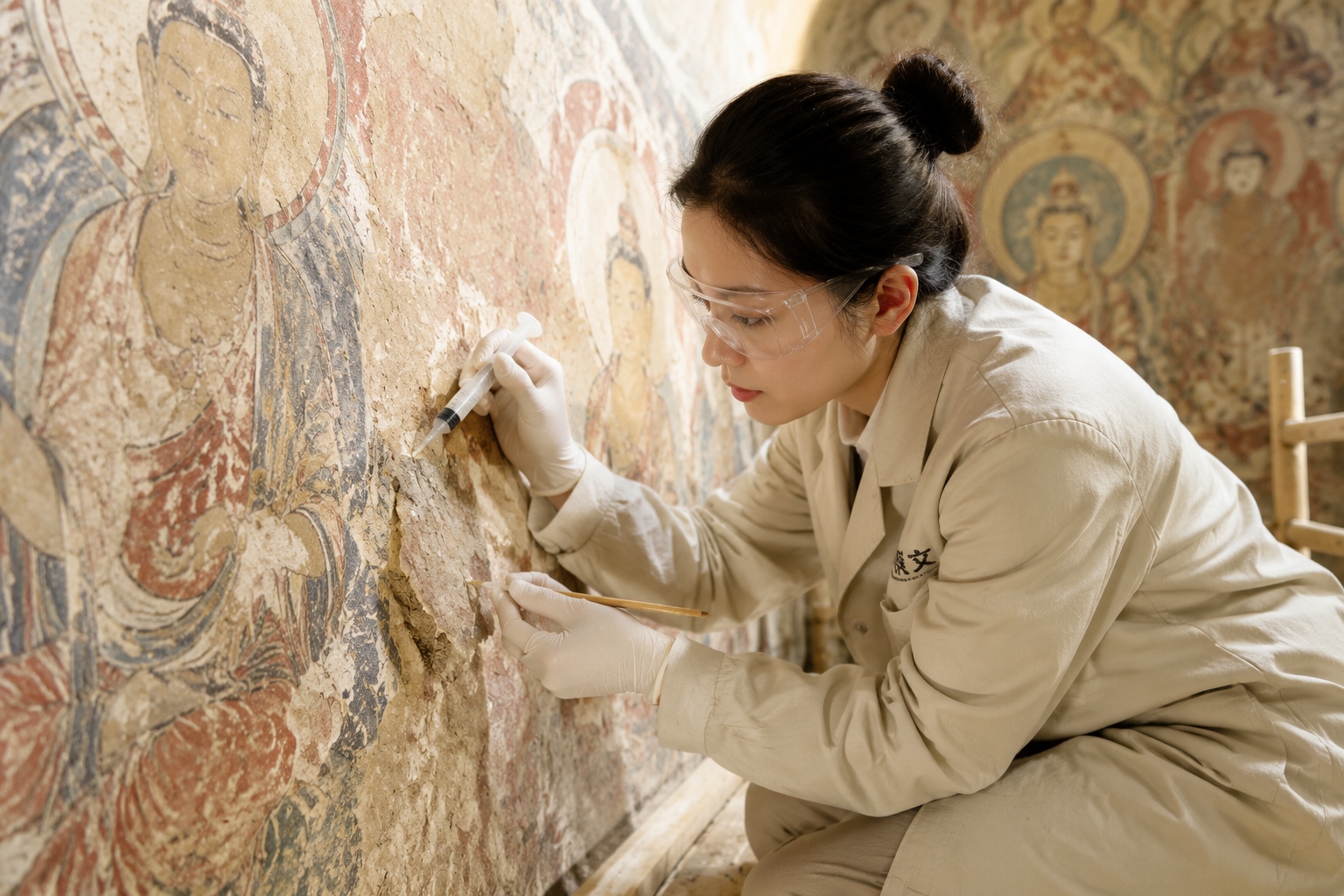
This scene repeats every weekday in dozens of caves along this cliff at the edge of the Gobi Desert. The people doing this work are no longer a handful of elderly monks or scholars from the 1940s – they are increasingly young men and women from China’s cosmopolitan cities, who have chosen a life of painstaking slowness in one of the country’s most remote corners.
The Caves That Hold a Millennium
The Mogao Grottoes, a UNESCO World Heritage Site since 1987, are 735 hand-carved caves a little outside the oasis town of Dunhuang in Gansu Province, northwestern China. For ten centuries, Buddhist pilgrims, merchants, and local rulers commissioned murals and sculptures inside these cave temples. The works cover more than 45,000 square meters of wall and 2,000 painted sculptures, preserving a universe of Buddhas, heavenly musicians, and everyday scenes from Tang, Sui, and Yuan dynasty life.
“We say the murals are reborn every year,” says Liu Ming, a senior restorer at the Dunhuang Academy, who has been working on the caves since 2007. “But they are also dying a little every year. Fluctuations in heat and cold, occasional rain, and – most importantly – salts carried by groundwater and condensation push outward and destroy the bond between paint and plaster.”
This is not new. The bodies of the murals have been degrading since the day they were painted. Early pilgrims lit fires inside the caves, leaving black soot. Twentieth-century visitors caused further harm, and only a long conservation campaign has slowed the damage. Since the 1990s, the Chinese government has poured tens of millions of dollars into scientific conservation at Mogao, with the goal of keeping the site open to both scholars and the public.
The Young Hands Behind the Conservation
According to the Dunhuang Academy, about 200 people are directly employed in mural and sculpture conservation. Nearly half are under 35. They hold degrees in chemistry, geology, engineering, art history, and Chinese painting. In recent years, the academy has recruited graduates from Peking University, Zhejiang University, Beijing Film Academy, and other institutions, as well as students from vocational colleges. For many positions, more than 300 applicants compete for a single post.
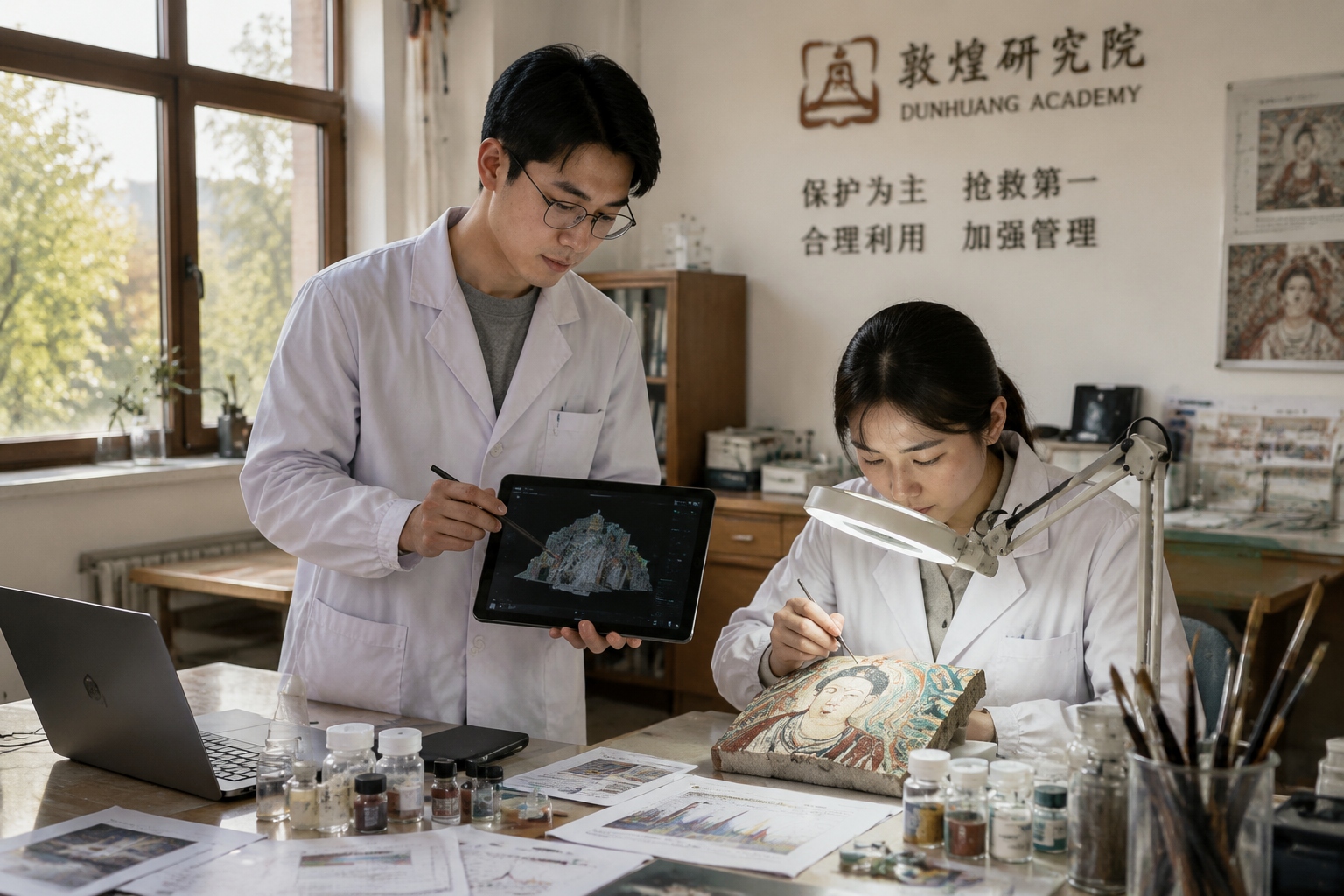
“I expected the application process to be like a national exam,” says Zhang Lin, a 30-year-old from Chengdu. “It felt that way.” She studied material chemistry and now spends most of her days in a laboratory two kilometers from the caves, testing adhesives, consolidants, and cleaning solvents on mockups that replicate the ancient painting layer. “We need to make sure that the products we use today don’t create hidden problems fifty years from now. That’s the most stressful part.”
Newcomers spend at least one year as interns, learning from older restorers through a formal mentorship system. In the first six months, they are not allowed to touch anything original. Instead, they watch, take notes, and practice on plasterboards painted in the traditional way – animal glue, mineral pigments, and a lime-and-clay plaster base. Many say this apprenticeship is the most humbling period of their lives.
Old Hands, New Tools
The discipline has become far more scientific in the past decade. Until the 1990s, restoration was largely based on the intuition of early pioneers such as Chang Shuhong, who began systematically protecting the caves in 1943, and the artist-restorer Li Qixiong, who developed many early techniques for reattaching flaking pigment. Today, each step is preceded by laboratory analysis.
Non-destructive instruments – including thermal imaging and ultrasonic scanners – can reveal detached zones or hidden cracks underneath a mural without scraping it. High-resolution multispectral images show invisible pencil lines and pigment layers. Restorers use 3D-printed copies of damaged areas to rehearse their surgical gestures. And drones equipped with sensors monitor wind and sand accumulation around the cliff face.
A good example is the conservation of Cave 285, which contains some of the most famous murals in the site, a blend of Indian and Chinese motifs. In 2015, the conservation team discovered that a tiny area of one wall had started to blister. Before any physical intervention, they spent eight months studying the blister’s composition and the exact behavior of the salts beneath it. They tried seven different adhesives on mockups. Only then did they begin to treat the real thing.
“Machines make us smarter,” Liu Ming comments. “But patience is still a human skill.”
Life in a Town That Time Forgot
The conservation staff live in Mogao, a small residential area next to the caves. There is a canteen, a basketball court, a row of tamarisk trees, and not much else. Salaries start around 4,000 yuan (about $550 per month) plus housing and meal subsidies, which is far less than what an engineering graduate might earn in Shanghai or Shenzhen. Weekend trips to nearby Dunhuang for shopping and socializing are common, but many workers return Sunday evening to avoid Monday morning traffic.
“The first three months were a shock,” says Chen Wei, who grew up in Xi’an, a city of 13 million people. “I like bright lights and restaurants. Here, the streetlights turn off at midnight, and the market has one vegetable seller. I called my mother every night.” She admits she almost quit. “What kept me was a moment inside Cave 285. I saw a small, faded line across a bodhisattva’s face. It looked like a human line in the paint, like the painter had hesitated. I realized I was touching something that was made by a person like me, 1,400 years ago. That sealed it.”
Despite the isolation, there is a strong sense of community. Colleagues celebrate birthdays together in the canteen, play table tennis, and organize photography clubs. During the summer tourism rush, they also give guided tours to visitors, sharing stories that are not in the official brochures. In winter, when the crowds vanish, the caves feel like a private museum – a time machine with no speed limit.
The Sand Breathes, the Paint Falls
No one is more aware of the enemy than the restorers themselves. The most damaging phenomenon is called qijia – “lifting armor.” It occurs when salt crystals inside the rock expand and contract with changes in humidity and temperature, pushing the thin plaster and pigment layer away from the wall. In severe cases, the paint slowly curls into small tubes, exposing the white plaster beneath. The effect is exactly like bark peeling off a dried branch.
“In the rainy season, we have to open the doors in a controlled manner,” says Zhang Lin. “But rain is not the only problem. In the last decade, we have had more intense sandstorms. They are so fine that they enter the cave despite the doors. Then the sand grains scrape the surfaces like a blowtorch in slow motion.”
Climate change has made historical patterns less predictable. Records at the Dunhuang Academy show that average winter temperatures have risen by over two degrees Celsius since the 1980s, and short but violent rainstorms are more common. Each new weather event forces restorers to rethink their approach. “You cannot rely on the same recipe forever,” Chen Wei says. “That is why we are constantly testing.”
Why Not Just Digitize Everything?
The Academy’s digital project, initiated in the early 1990s, has already scanned more than 250 caves. Visitors today can freely explore high-resolution three-dimensional models of many grottoes on the website, e-dunhuang.com, a resource used by scholars from up to 60 countries every month. This is a safety net against the chance of a catastrophic loss, whether from a large earthquake or a rapid climate shift.
Still, for the restorers, a digital copy is not a replacement. “A scan is a faithful record, but it does not carry the physical presence of paint on rock,” Liu Ming explains. “We are not only preserving images; we are preserving materials that can be experienced with your eyes, your nose, and your own slow attention.”
The ultimate goal is to stabilize the caves for another hundred years. To do that, the young restorers continue to train, measure, and repair – sometimes without knowing exactly whether they will succeed. It is an unusual career path: using the most advanced chemistry to do the most ancient gesture of care, by hand.
Finding the Light in a Desert
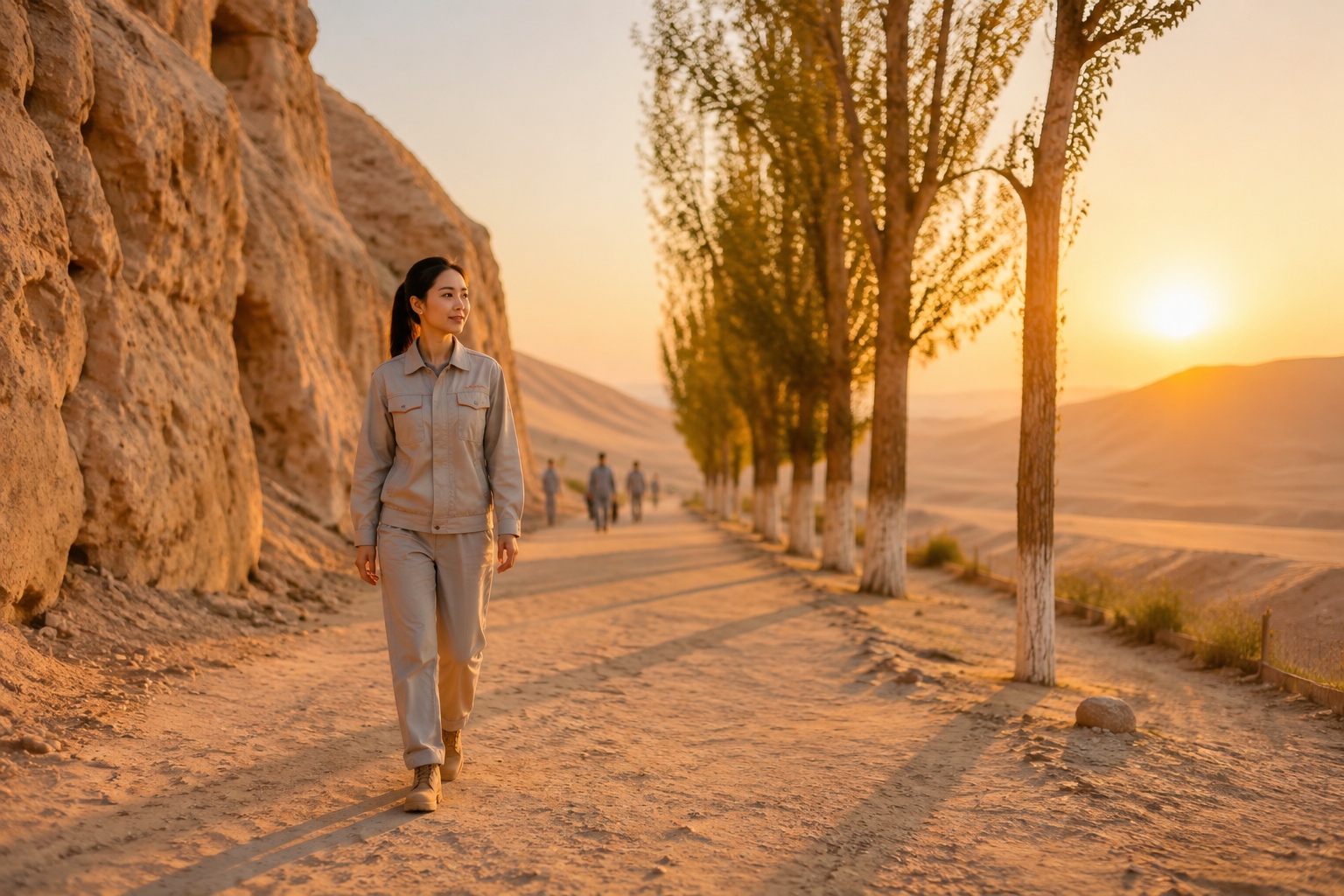
At 5 p.m., Chen Wei climbs down the scaffold for the last time today. She pulls off her mask, squints in the sudden sunlight, and looks down the valley: rows of dark cave entrances against the warm brown cliff. Tourists have mostly left. A few workers sweep the paths. On the distant dunes, a line of camels carries a last tourist back to the parking lot.
She brushes dust from her hair. “People often ask me if the desert is lonely. I tell them that the silence inside the cave is not empty. It’s full of paint dust and the traces of people who passed this way eleven centuries ago.” She pauses. “We are just the latest people passing by. But we try to leave things a little more solid than we found them.”
Start the discussion at forum.chinacomes.com