

Behind the Price Tag
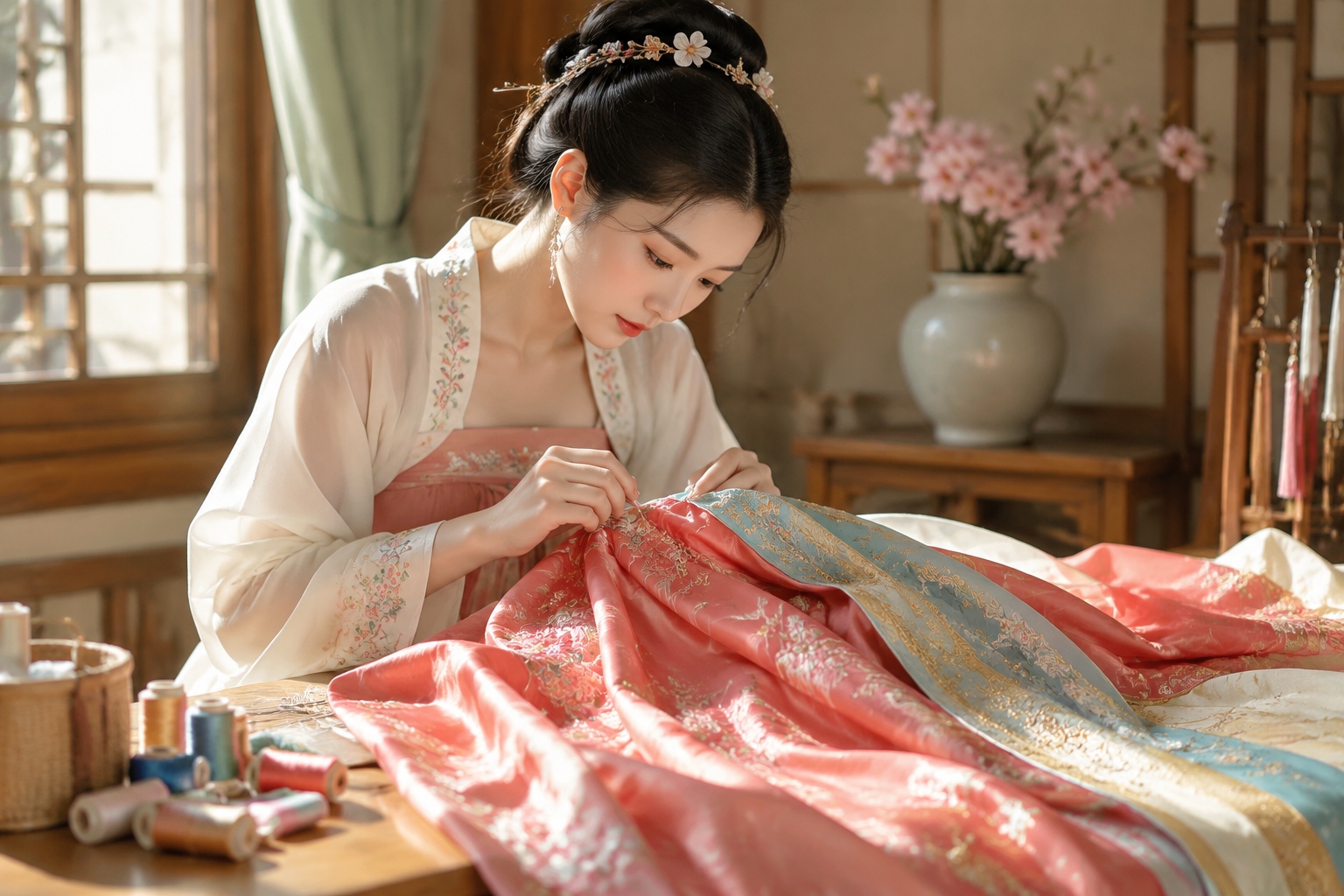
On a busy Saturday in a Hanfu boutique in Hangzhou, a young woman pulls a mamianqun (horse-face skirt) off the rack. It costs ¥899. Beside it hangs a nearly identical skirt, priced ¥300 less. She asks the shop assistant: “Why the difference?” The answer traces a supply chain that reaches silk mills, embroidery workshops, and sewing factories across at least three Chinese provinces.
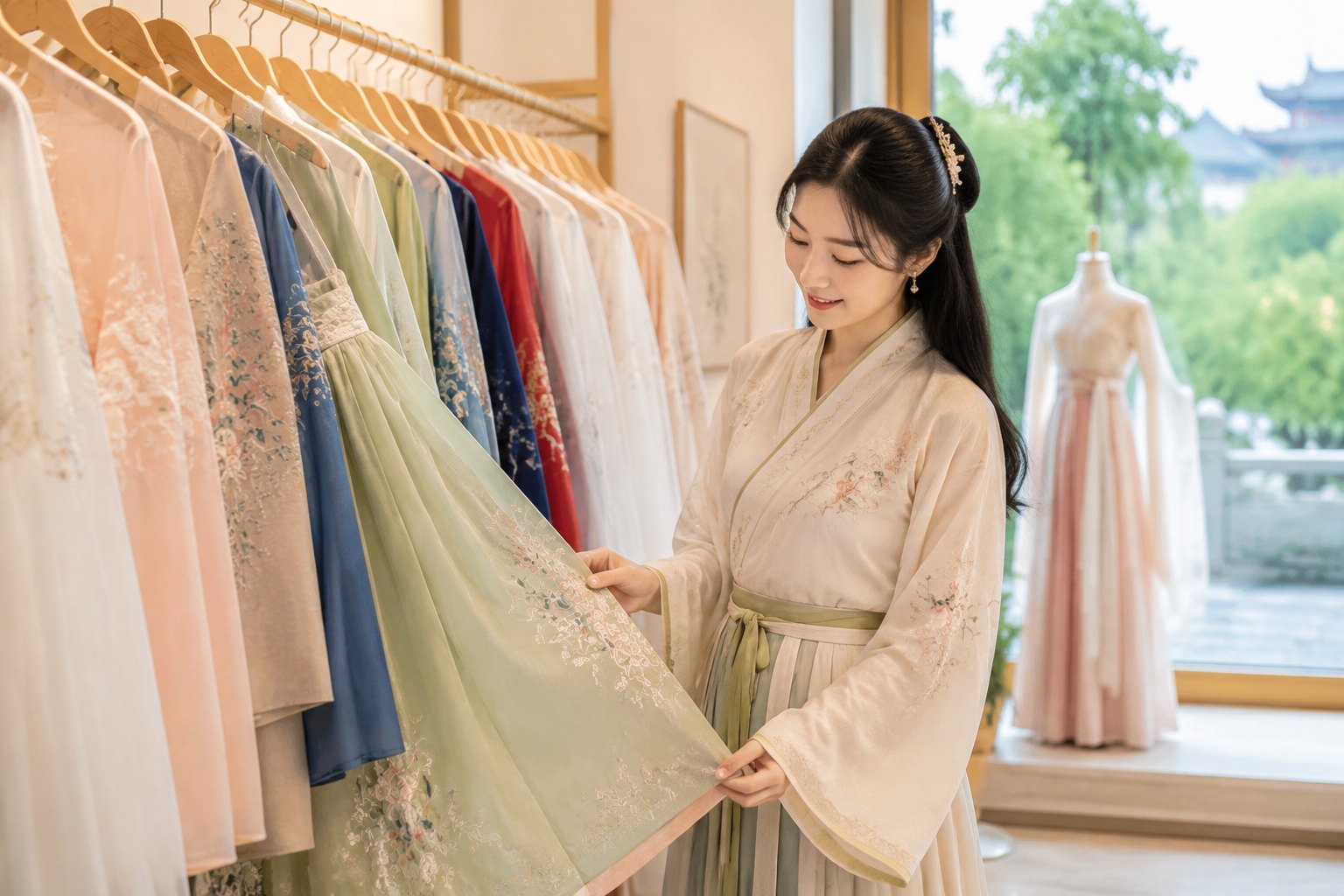
Hanfu, the loose-robed traditional clothing that has become a street style staple for young Chinese, is not one product but a spectrum. A mass-produced skirt made from polyester can cost under ¥300 retail. A hand-embroidered silk gown from a respected workshop may sell for ¥5,000 or more. Between those extremes lies a modern manufacturing system that has adapted an ancient garment category to fast-fashion logic.
The Fabric: Where Hanfu Textiles Come From
For premium Hanfu, the starting point is often a silk mill. Suzhou and Hangzhou, two historic silk capitals, still supply the mulberry silk used by high-end brands. A bolt of 100% mulberry silk for dresses can cost ¥80–¥200 per meter, depending on grade and weight. That raw cost alone can exceed the entire manufacturing cost of a budget garment.
For the bulk market, the workhorse is polyester, increasingly in the form of sharkskin or crepe-back satin that mimics silk drape but is sold for ¥15–¥40 per meter. It doesn’t breathe like real silk and may not last a decade, but it moves. Thousands of fabric stalls in Keqiao, outside Shaoxing in Zhejiang province, supply these textiles in every color imaginable, often in single rolls, to small Hanfu studios that only need 20 meters.
Between the two is a growing middle: blends of cotton and viscose, or xiangyunsha (a hand-dyed alternative). This range of textile choices explains why the raw material cost of a Hanfu can be anywhere from ¥40 to ¥800, before anything is cut or sewn.
Embroidery: The Hand vs. Machine Price Gap
Embroidery is where the visible price difference often appears. Machine embroidery, produced by computer-controlled looms, costs little. A typical sleeve pattern on a runway-style skirt might cost ¥15–¥50 in machine work, depending on stitch count and thread type. The same design executed by hand could take two to four days of skilled labor, priced at ¥300–¥1,200, or more if the work is commissioned from a famous Suzhou studio.
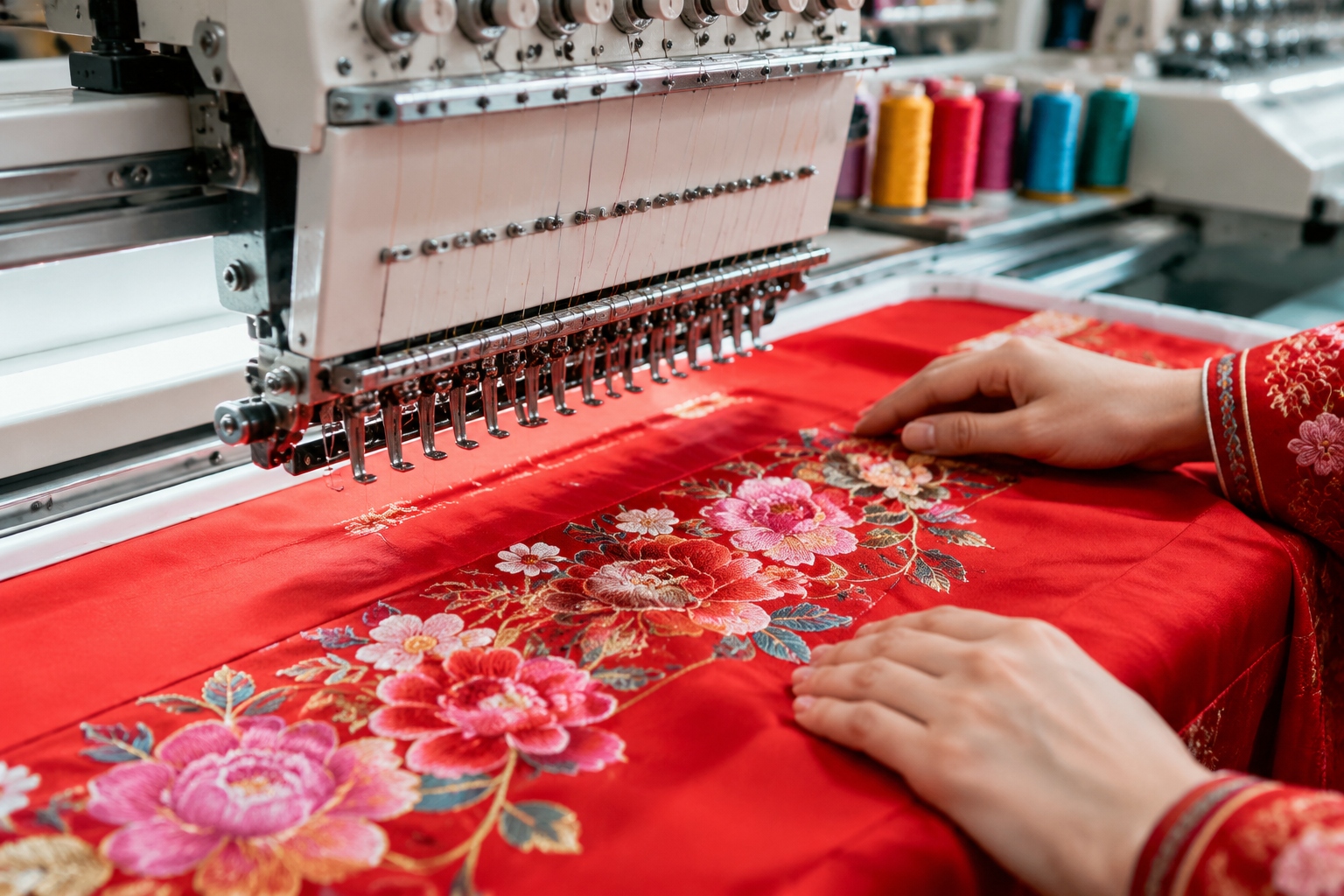
Hand embroidery is not just a decorative upgrade; it changes the drape. Machine stitches are tighter and more uniform, making the fabric stiffer. Handwork uses longer, looser threads that allow silk to flow. For a purist, the difference is obvious. For a casual buyer, a good machine-embroidered piece can be beautiful and more practical for washing.
A less obvious cost is the design for embroidery. Original pattern design and digitizing for machine work costs a few hundred renminbi per design, while a hand-embroidery pattern by an artist can be priced in the thousands. That one-time design cost is spread over a small batch of 20–100 pieces, adding to each unit.
Cutting and Sewing: Workshops and Factories
After the fabric is placed and embroidered, the pieces move to cut-and-sew workshops. Those are clustered in the Hanfu hubs of Hangzhou, Guangzhou, Chengdu, and most importantly, Cao County in Shandong province. Cao County, once known for cheaper garments and stage costumes, has become the largest production base for affordable Hanfu. Several thousand factories and workshops there operate on a “small order, quick response” model. A brand may order an initial batch of just 30 pieces, with a lead time of 10–15 days, and reorder in small batches as sell-through data comes in.
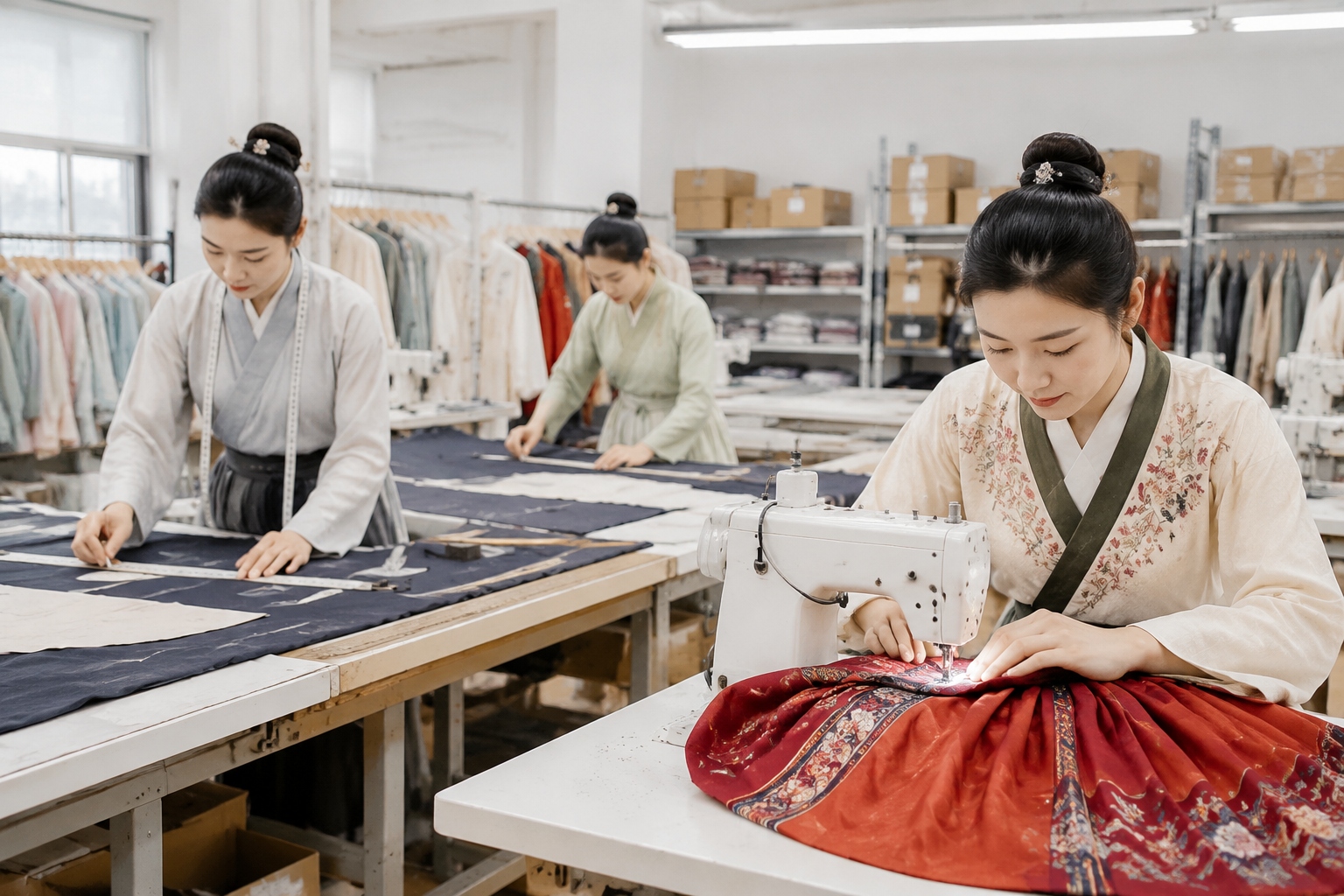
Each Hanfu piece involves more seams and hand-finishing steps than a t-shirt. A typical mamianqun requires an inverted pleat structure with multiple panels; a full-set Hanfu (jacket, skirt, belt) may require several different sewing skills. Workshop labor rates are modest compared to the West: a skilled sewer in a well-run factory might earn ¥6,000–¥8,000 per month, working on pieces that each carry ¥30–¥60 of direct sewing cost, depending on complexity.
Quality control is labor-intensive. Small workshops rely on supervisors who check every piece. Bigger factories use final inspections and sometimes hand-press each seam. This adds cost but also explains why Hanfu produced in China is not simply “sweatshop cheap.”
The Hidden Costs: Design, Marketing, and Inventory
Fabric, embroidery, and sewing cover perhaps 50–70% of the retail price. The rest goes to design, marketing, logistics, and the risk of unsold inventory.
Hanfu is a design-heavy category. Reproduction of historical shapes, like the “horse-face skirt from the Ming dynasty,” requires research into archived patterns. Original collections involve cutting a new pattern for every size. A small brand might spend ¥20,000–¥50,000 per season on design and sample making, before seeing a single sale.
Marketing is equally steep. In China, most Hanfu sales start on e-commerce and social video platforms. Creating short videos, styling, and trying on garments is often more costly than the garment itself. Some studios also participate in offline markets and cultural events, which add to brand cost but create the community feel that buyers pay for.
Inventory risk is real. A style that does not sell often ends up discounted at ¥99 in batch sales. That loss is factored into the price of everything that does sell.
A Buyer’s Guide: What You’re Actually Paying For
For a foreign shopper, the Hanfu supply chain can be opaque. Here are five questions to judge whether a price is fair.
What is the fiber content?
Check the care label. A ¥400 “silk” Hanfu is unlikely to contain true silk. Polyester is fine for casual use, but if you buy real silk, expect to pay ¥600 or more for a skirt and ¥1,500 for a coordinated set.
How is the embroidery made?
Machine embroidery has visible uniform stitches on the backside. Handwork in good quality has slightly irregular stitches and often uses paired tones. If you see “hand-embroidered” on a product under ¥800, verify the claim.
Who makes it?
Brands that work with Cao County factories are not necessarily lower quality; they are usually volume-oriented. Newer studios in Hangzhou and Suzhou focus on small runs and more meticulous finishing. Ask if the factory is disclosed; more transparency means more accountability.
What does shipping and sizing cost?
International shipping from China can almost double a cheap order. Sizes also run differently; Hanfu is often based on Song and Ming body types, with more allowance and slack. Always check the size chart in centimeters.
Can you get custom sizing?
Many Chinese Hanfu brands offer made-to-measure for a small upcharge of ¥100–¥300. This bypasses the biggest complaint about ready-to-wear traditional clothing.
The Bottom Line: A Price That Reflects an Entire Chain
The ¤899 Hanfu is not simply “expensive” or “cheap.” It is the sum of decisions made by fabric weavers in Keqiao, embroiderers in Suzhou, sewers in Cao County, and a designer in Hangzhou who wanted to pay rent and somehow bring a piece of history into the present. That chain is why Hanfu prices range from ¥99 to ¥9,000, and why a well-made piece, whatever the price, is the result of thousands of hours of accumulated skill.
For the international shopper, the takeaway is practical. Understand what you are buying, ask the right questions, and you can navigate this chain with confidence. And the next time you see a low price, remember that the cost of making a garment is rarely the main story; the story is the economics of keeping a craft alive at scale.
Start the discussion at forum.chinacomes.com