
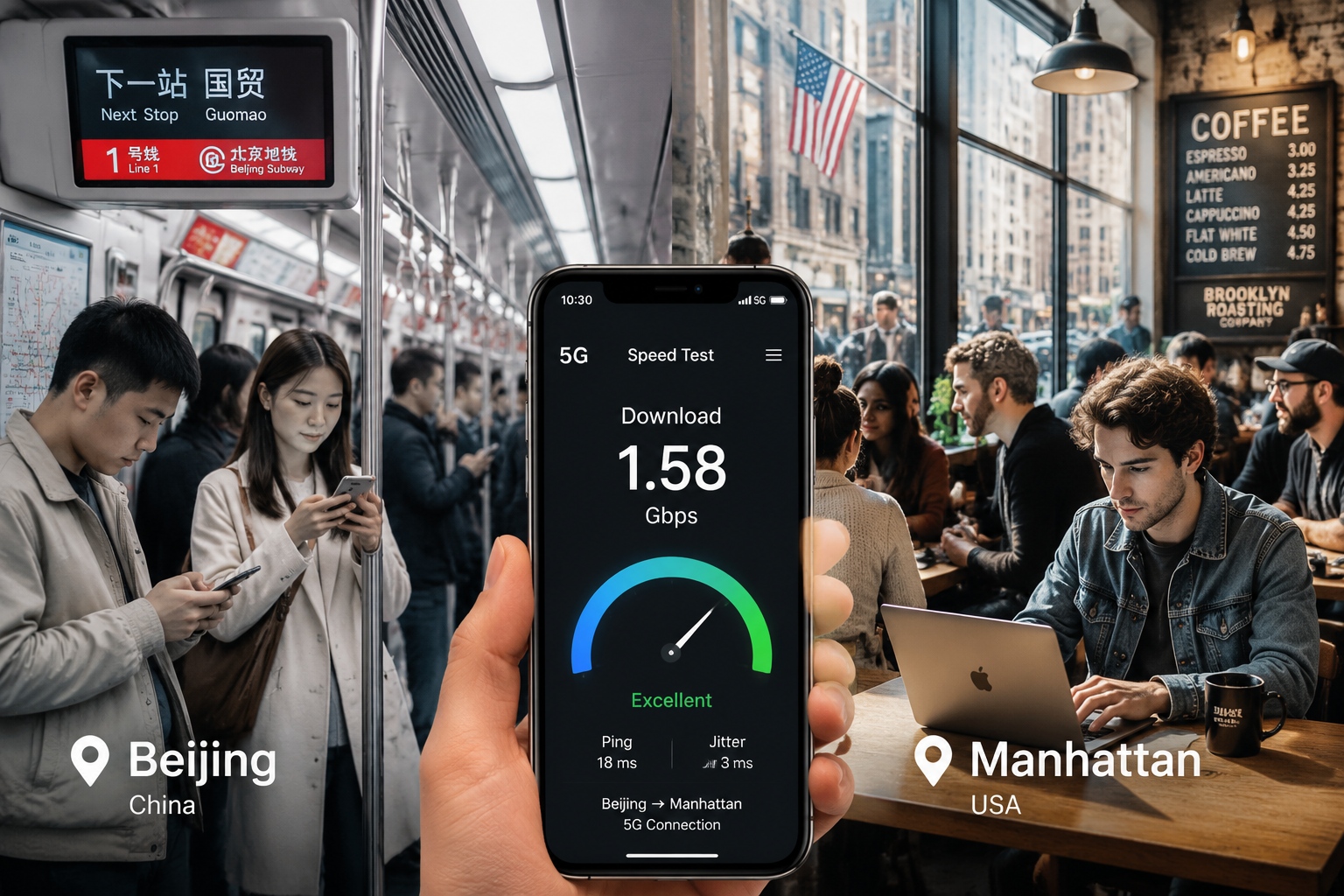

The Daily Commute as a Digital Stress Test
It was 8:15 AM on a Tuesday in late October. I sat on Line 5 of the Beijing subway, packed shoulder-to-shoulder with commuters heading to business districts in Haidian and Chaoyang. My phone displayed “5G” in bright blue at the top corner. In my other hand, I held a second smartphone connected to the free Wi-Fi of a bustling coffee shop on Broadway in Manhattan, New York. The goal was simple: measure how digital life actually feels when you are moving fast underground versus sitting still in a crowded room.
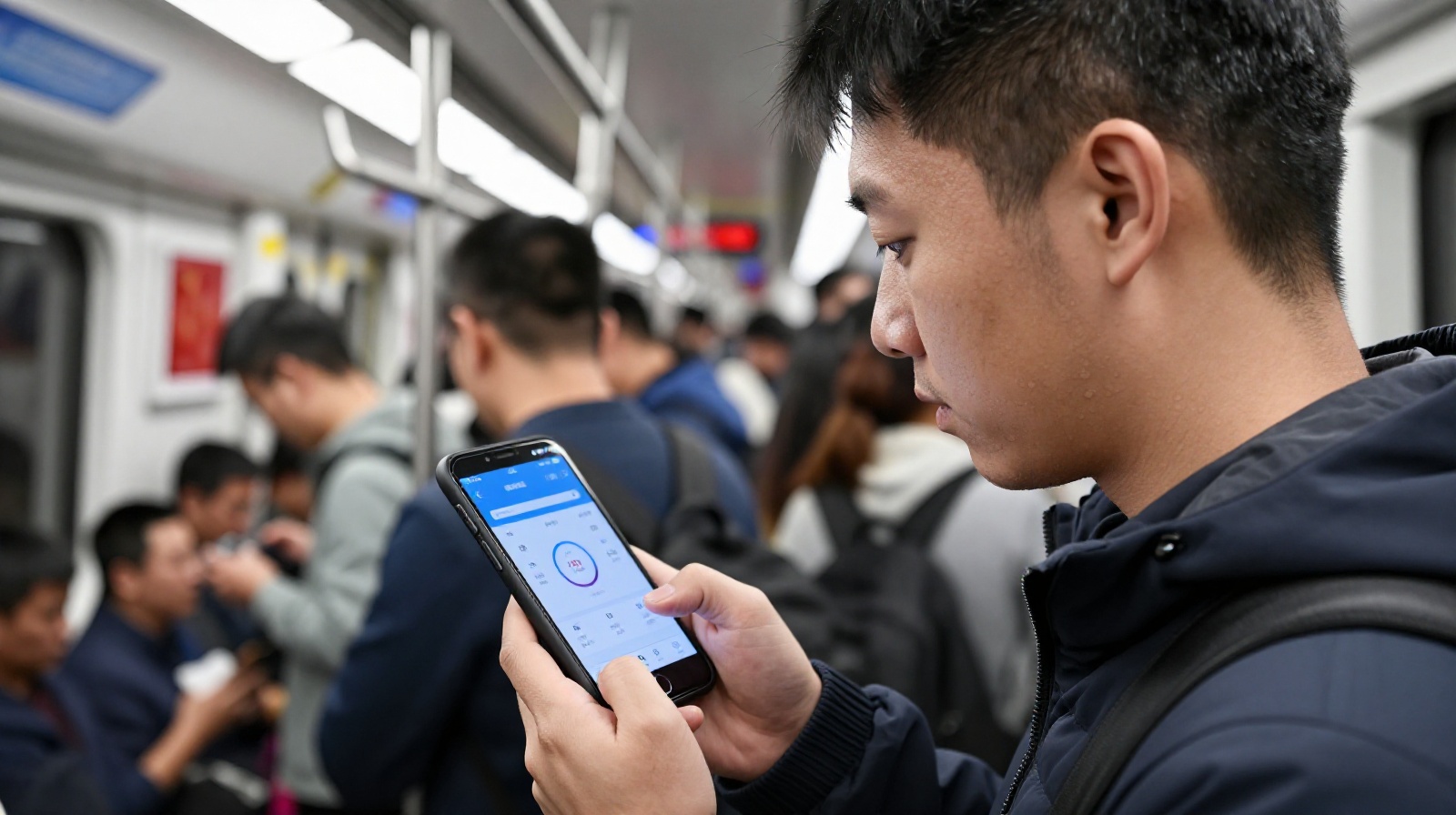
Commute stress test: A commuter checks their phone screen showing 5G signal bars inside a busy Beijing subway train during rush hour.
The Environment: Underground Highways vs. Urban Coffee Shops
Choosing these two locations wasn’t random. The Beijing subway system is one of the world’s largest, carrying over 13 million passengers daily. It is a concrete tunnel maze where signals often die out or drop to 4G. However, China invested heavily in 5G infrastructure years ago specifically for high-density transit. Meanwhile, the Manhattan coffee shop represents a classic Western urban scenario: a public hotspot shared by dozens of people, each streaming video, checking emails, and using cloud services simultaneously.
In Beijing’s subway car, the air is thick with heat and movement, but the digital environment is surprisingly calm. The 5G base stations installed along the tunnel walls are designed to hand off signals seamlessly as the train speeds through at 60 kilometers per hour. In contrast, the New York coffee shop was a cacophony of conversations, espresso machines clattering, and laptops buzzing with data requests. The Wi-Fi router in the corner was visibly overloaded.
The Numbers: Raw Speed and Latency
Using a standardized speed test app on both devices, I ran three rounds at each location. The results were stark.
Beijing Subway 5G:
Download speeds averaged around 450 Mbps, with upload speeds holding steady at 85 Mbps. The latency (ping) hovered between 15ms and 25ms, even as the train accelerated. Video calls on WeChat or Zoom were crystal clear, with no buffering during a video download.
Manhattan Coffee Shop Wi-Fi:
The download speed fluctuated wildly, ranging from 12 Mbps to 45 Mbps, averaging out to roughly 28 Mbps. Upload speeds were significantly lower, often dropping below 3 Mbps. The ping was unstable, spiking between 60ms and 150ms whenever the espresso machine kicked in or someone opened a heavy file. Watching a 4K video required constant pausing to buffer.
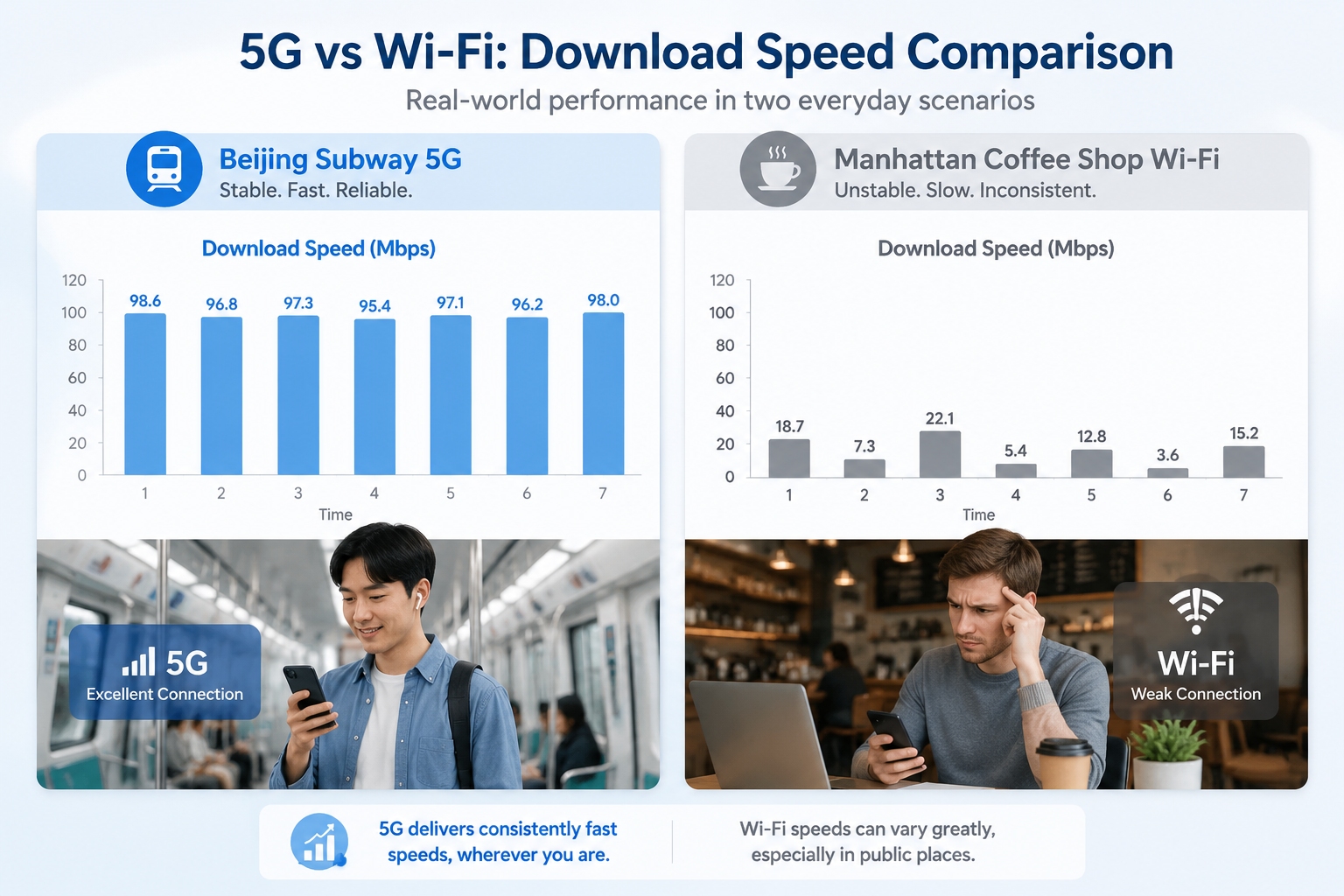
Data visualization: A split-screen graphic comparing download speed graphs of a Beijing subway train versus a Manhattan coffee shop, highlighting the stability difference.
Why the Gap? Infrastructure Strategy vs. Shared Bottlenecks
The disparity isn’t just about technology; it’s about design philosophy. China’s 5G rollout prioritized coverage in high-traffic public transport corridors. The network treats the subway as a “tunnel highway,” using small cells and distributed antenna systems to ensure every passenger gets consistent bandwidth regardless of crowd density.
In many Western cities, including New York, public Wi-Fi is often an add-on service provided by third-party vendors or cafes themselves. These networks are not engineered for high-speed throughput; they are built to offer basic connectivity as a perk. When 30 people try to stream HD video on the same access point, the bandwidth gets sliced so thinly that even simple tasks feel sluggish.
Who Should Use What? A Practical Guide
So, which network wins for daily life? It depends entirely on your task and location.
If you are a commuter like me, Beijing’s 5G is the only viable option for productivity. You can edit documents, join meetings, or download large files without breaking a sweat. The stability allows for seamless transitions between apps.
In New York, the coffee shop Wi-Fi might be fine for checking emails or reading articles, but it fails under pressure. For heavy lifting—like uploading videos to social media or hosting a webinar—you would need to step outside and find a dedicated 5G signal (which is available) rather than relying on the cafe’s router.
The Bigger Picture: Infrastructure as a Utility
This test highlights a fundamental difference in how digital infrastructure is viewed. In China, high-speed mobile networks are treated as essential public utilities, similar to water or electricity, requiring consistent performance even in the most challenging environments like underground tunnels.
In contrast, many Western nations treat connectivity more as a consumer convenience variable by location and provider. The result is a patchwork of experiences: excellent in some areas, frustratingly inconsistent in others.

Urban reality: A close-up shot of a smartphone displaying high-speed 5G download speeds while sitting inside a moving subway train, symbolizing modern connectivity.
The takeaway isn’t that one city is “better” than the other in every way. It’s that the underlying technology serves different priorities. Beijing’s network ensures you don’t lose your connection when life gets fast and crowded. New York’s cafes offer a social space, but the digital plumbing often struggles to keep up with modern demand.
Start the discussion at forum.chinacomes.com