

At 4,600 meters, the water boils before it gets hot
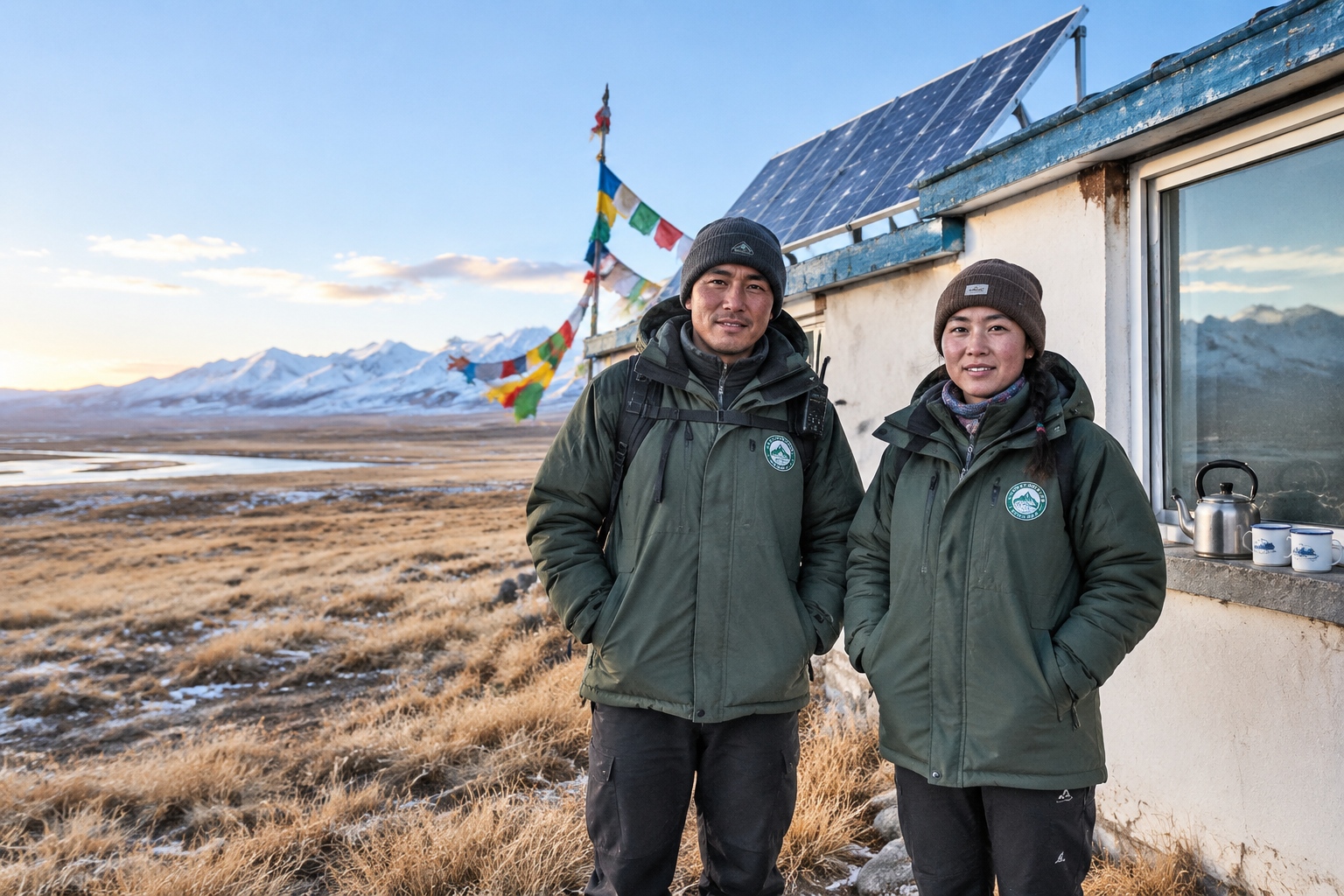
Drive south from Golmud on the G109, the highway that runs to Lhasa, and the land gets emptier and higher at the same time. Kunlun Pass sits at 4,768 meters. Past it the road flattens into a treeless plain of brown grass and blue lakes, and eventually a low cluster of buildings appears on the right: single-story rooms, solar panels angled into the wind, prayer flags, a yellow sign.
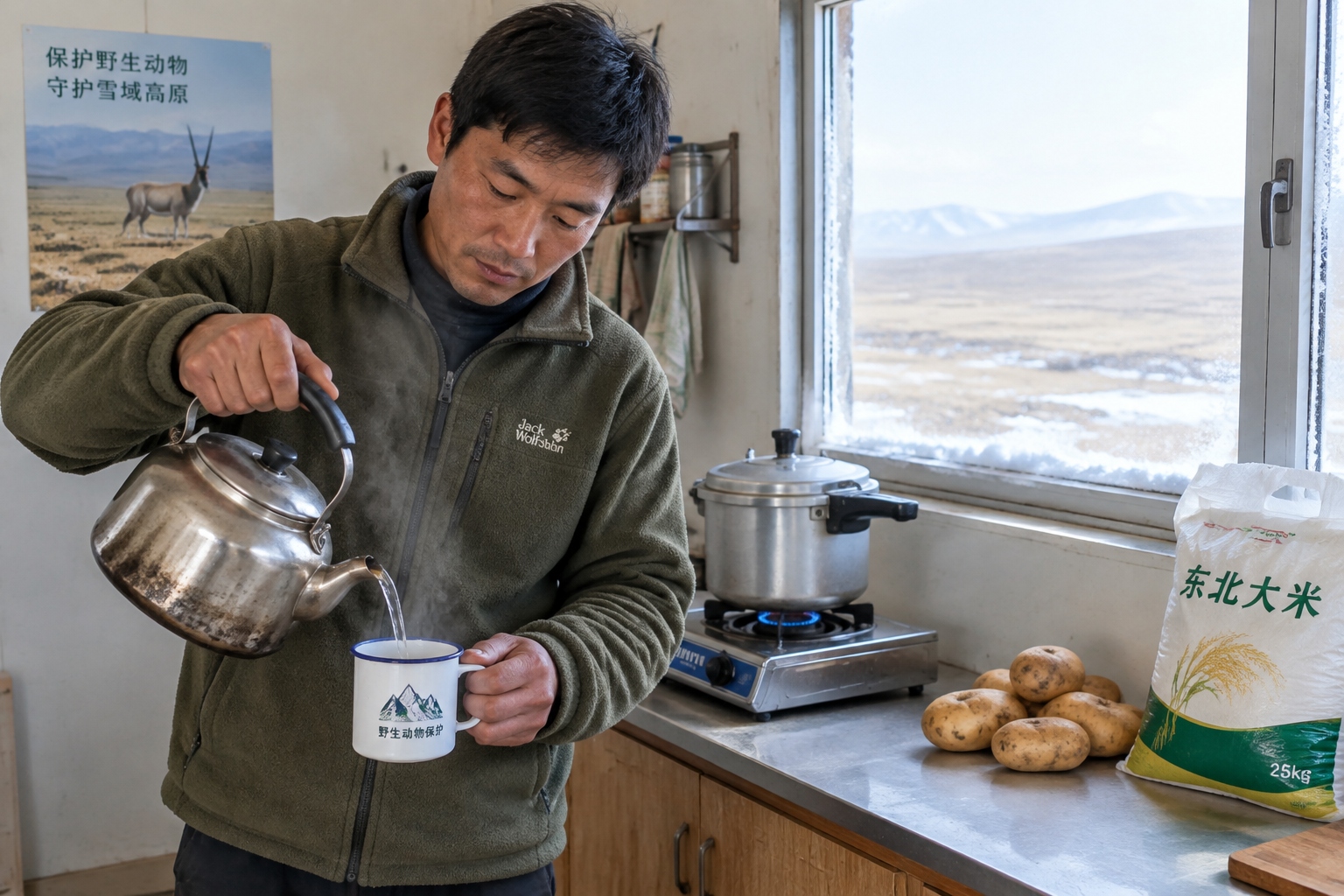
This is the Sonam Dargye Protection Station, one of four in Hoh Xil. The plateau it patrols averages around 4,600 meters. The first strange thing here isn’t the view — it’s the tea. Air pressure at this altitude is roughly 60 percent of sea level, so water boils at about 85°C. The kettle whistles, and the tea comes out warm rather than scalding. Rice and noodles only cook in a pressure cooker.
People who work here will hand a visitor a bowl of noodles and mention, almost apologetically, that everything takes longer up here: cooking, walking, thinking, sleeping. It’s a kitchen detail that happens to describe the whole job.
Who actually protects the Tibetan antelope?
If you’ve heard of Kekexili, or Hoh Xil, it’s probably because of the chiru — the Tibetan antelope — and the shahtoosh trade that nearly erased it. In the 1980s and 1990s, poachers crossed into this roadless corner of the Tibetan Plateau to shoot antelopes for their underwool, smuggled to Kashmir and woven into shawls sold in Delhi and Europe. One shawl took the wool of three to five animals. The population fell from roughly a million at the start of the 20th century to fewer than 75,000 by the 1990s.
The man who organized the resistance was Sonam Dargye, a Tibetan official from Zhiduo County who led patrols with a handful of men and never enough fuel. In January 1994, after a shootout with a poaching gang, he was found frozen in a kneeling position, still holding his rifle. He was 40. A protection station built in 1997 with public donations carries his name.
Today Hoh Xil is part of Sanjiangyuan National Park and a UNESCO World Heritage site, listed in 2017 for the antelope migration. The people watching over it aren’t the movie version of lone heroes. Most are herders from nearby Tibetan villages, hired as ecological rangers under a policy called “one post per household”; across Sanjiangyuan more than 17,000 residents hold such posts, earning a monthly subsidy of around 1,800 yuan — about 250 US dollars — alongside grazing income. A smaller, salaried group runs the stations, and some arrive with degrees in wildlife or grassland science. Rotations are usually about 20 days on, ten off.
What does a normal day look like?
Closer to running a badly located outpost than to a nature documentary. Mornings start with the systems that keep people alive — the solar array and battery bank, the generator, the water tank, the stove. Drinking water arrives by truck or comes from melting ice. Then someone walks up a ridge with binoculars and counts animals for the day’s log. Camera traps scattered across the reserve need their cards and batteries swapped, which can mean a long drive and a longer walk. And there is garbage duty: the G109 carries thousands of trucks and a trickle of travelers, and the roadside collects bottles, bags and packaging that the wind spreads into the grassland.
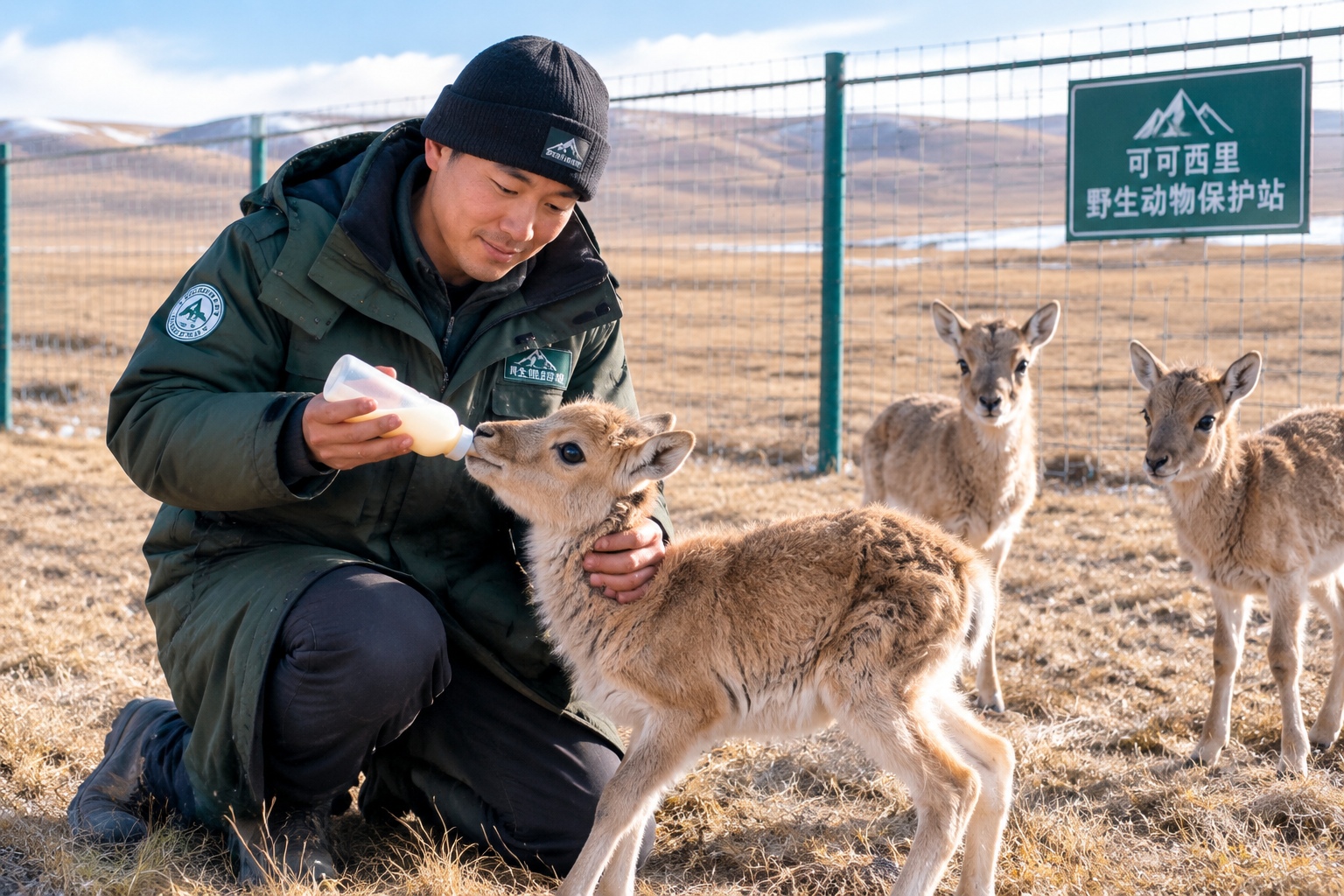
In summer, the rescue pen fills up. Newborn calves get separated from their mothers during river crossings and storms, and patrollers bring the orphans back. They’re fed milk from bottles several times a day, then moved into a pen where they can run before release. The bottles, the bleating and the smell of milk powder are the closest thing here to a nursery.
What is a patrol actually like?
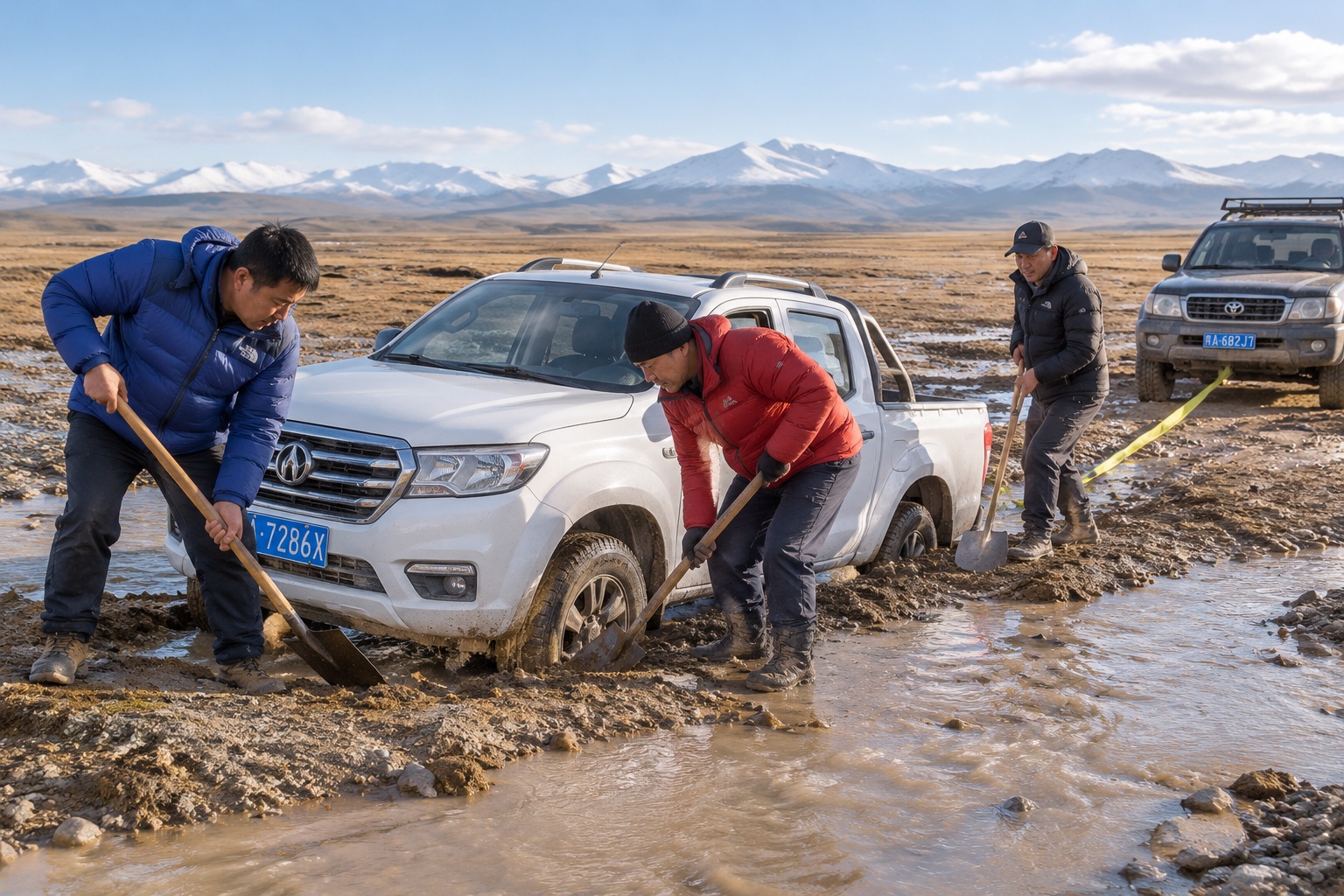
Patrollers spend weeks in the field each year, sometimes in convoys of two or three vehicles, following river valleys and dry lakebeds with no road under the tires. Trucks get stuck in mud, sand, or shallow water hiding a deep channel, and freeing one at 4,600 meters is its own kind of punishment: a winch, a shovel, and men who have to stop every few minutes to catch their breath. Nights are tents at minus 20 or colder. Nobody showers. Food is whatever boils.
The most important destination is Zhuonai Lake, the main calving ground, where tens of thousands of female antelopes gather in June and July, some having walked hundreds of kilometers. Patrollers stay far back, count, and keep people and poachers away. Their kit now includes drones, GPS collars, camera networks and phone apps for recording herd size and calf survival. The clipboard hasn’t disappeared; it just has a screen next to it.
Has it worked?
On the antelope, unusually, yes. Estimates now put the Tibetan antelope at roughly 300,000 across the plateau, up from fewer than 75,000 in the 1990s, and in 2016 the species was reclassified from Endangered to Near Threatened. Large-scale poaching in Hoh Xil has stopped. What’s left is more ordinary and harder to fight.
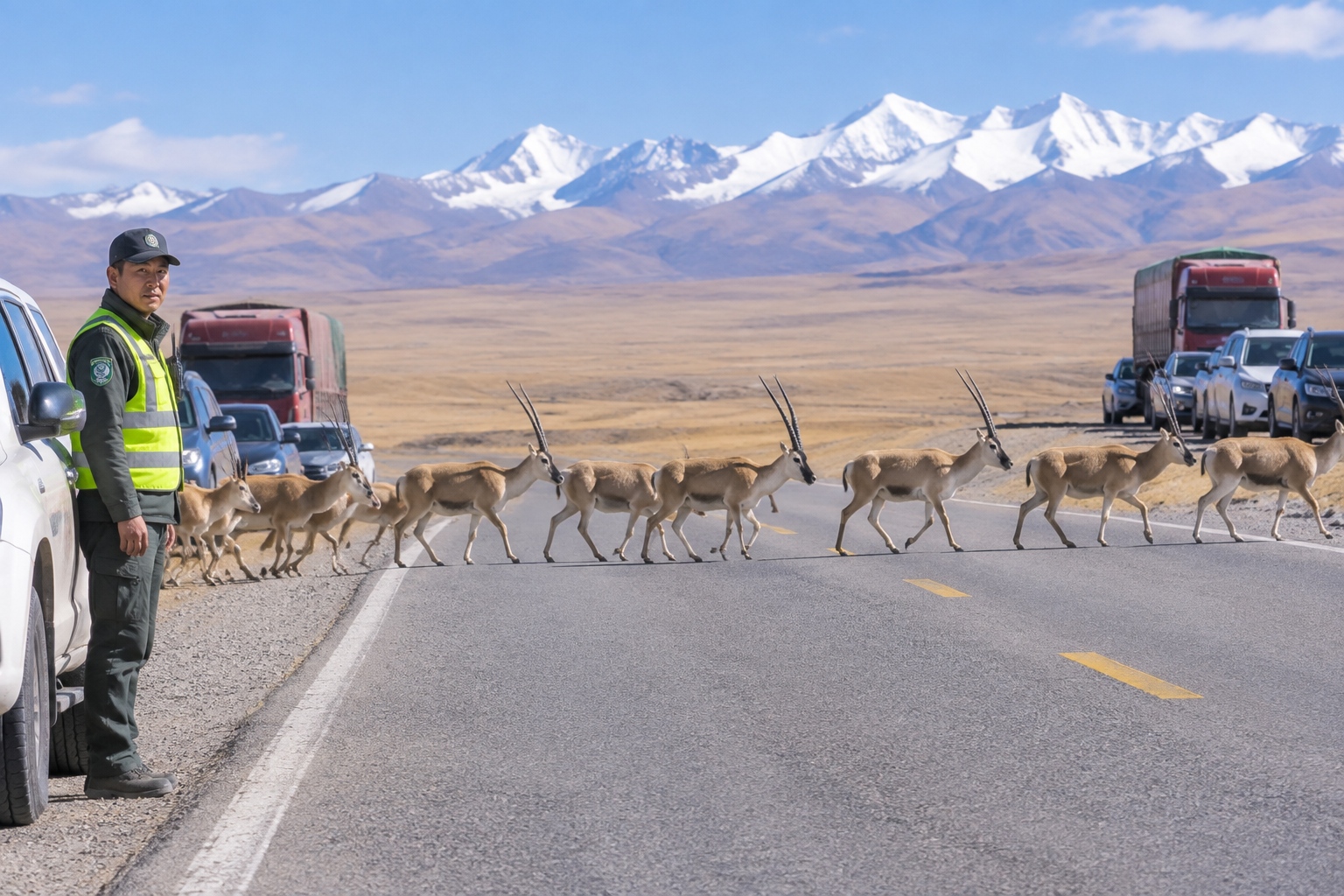
Traffic, for one. The Qinghai-Tibet Highway and the railway opened in 2006 cut through the migration routes. The railway was built with dozens of wildlife underpasses so animals can cross, and trains slow down in the Hoh Xil section. On the highway it comes down to drivers: when a herd steps onto the asphalt, everyone stops — sometimes for 40 minutes — while hundreds of animals flow past parked trucks.
Climate is another. Grassland is shifting, lakes have expanded, and Zhuonai Lake has redrawn its own shoreline as water levels rose. Garbage keeps arriving from the road. The reserve itself stays closed to tourists: you can drive the highway through it, but leaving the road, camping, or entering the core zone without a permit is illegal, and rangers do stop people who try.
Food, sleep, family — the everyday part
Food is simple and repetitive: yak meat, potatoes, cabbage, tsampa, instant noodles, frozen vegetables that arrive on a weekly run. In winter a delivery can be delayed by wind and snow, and the menu narrows.
Sleep is harder. The body doesn’t rest well at this altitude; people wake in the night gasping, with headaches and a pulse that won’t slow. Long stays leave them thin and short-tempered, which is why rotation matters: 20 days up, then down to Golmud at 2,780 meters, where the air feels as thick as soup and sleep returns in a night or two.
Family life happens on a screen. There’s mobile signal along much of the highway now, so evenings at the station look like evenings anywhere: a video call with a child, an argument about homework, a grandparent shown the snow outside. The difference is that everyone on the call knows the other person is a six-hour drive away, on a road that closes in bad weather.
So why stay? The answers aren’t poetic. It’s steady work in a place where jobs are scarce. For herders whose families have used this land for generations, it’s also close to home. And there’s one thing few jobs offer: a herd that is bigger than it was when you started, in a landscape many people had written off.
If you drive the G109
Altitude first. You’re above 4,500 meters for hours; drink water, don’t hurry, don’t sleep at the pass, and turn around if a headache becomes vomiting or confusion. Stay on the road — the plateau looks flat and isn’t. Keep drones away from animals and never feed them. Pack out your garbage, including the small stuff. And when the antelopes cross, put the car in park and wait. They have the right of way.
The quiet answer
Protecting an animal at 4,600 meters is mostly undramatic: a logbook, a battery, a kettle that won’t boil properly, a truck that needs digging out again. Then, once in a while at dawn, a few hundred antelopes walk across the highway in front of you, and the rangers count them out loud as they pass — because somebody has to, and because the number keeps going up.
Start the discussion at forum.chinacomes.com