

An Experiment, Not a Miracle
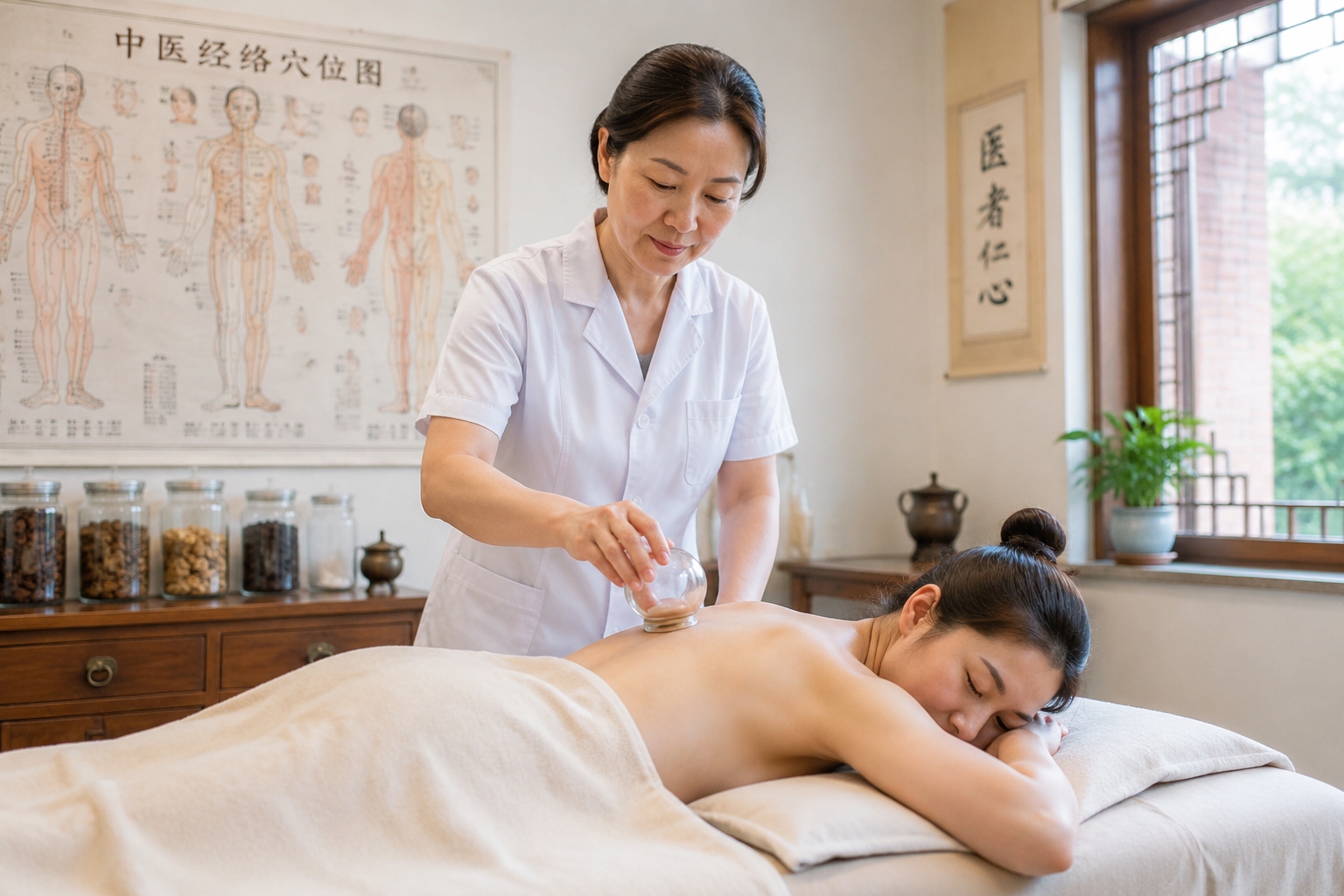
It was a Thursday morning in a narrow yard tucked behind a busy Beijing street. The clinic smelled like dried herbs and warm smoke. At 8:30, three people were already waiting — an office manager with a stiff neck, a retired teacher with knee pain, and me, a journalist wanting to test whether “中医理疗” was more than wellness theater.
The practitioner, a woman in her fifties named Zhang, didn’t ask me to describe my symptoms first. She brought out a box of glass cups and a bottle of 75% alcohol. “Your upper back is tense,” she said, pressing her thumb along my spine. “The blood and qi are not moving smoothly here. We call it ‘stagnation.’”
I had spent the past two years hunched over a laptop, with occasional gym sessions that never seemed to undo the damage. I was skeptical but willing. Zhang told me to lie on my stomach, and the first cup came down with a soft thump. The skin under it rose into a purple dome, and I felt a clean, direct pressure — not painful, but impossible to ignore.
The Sensation of Being Reset
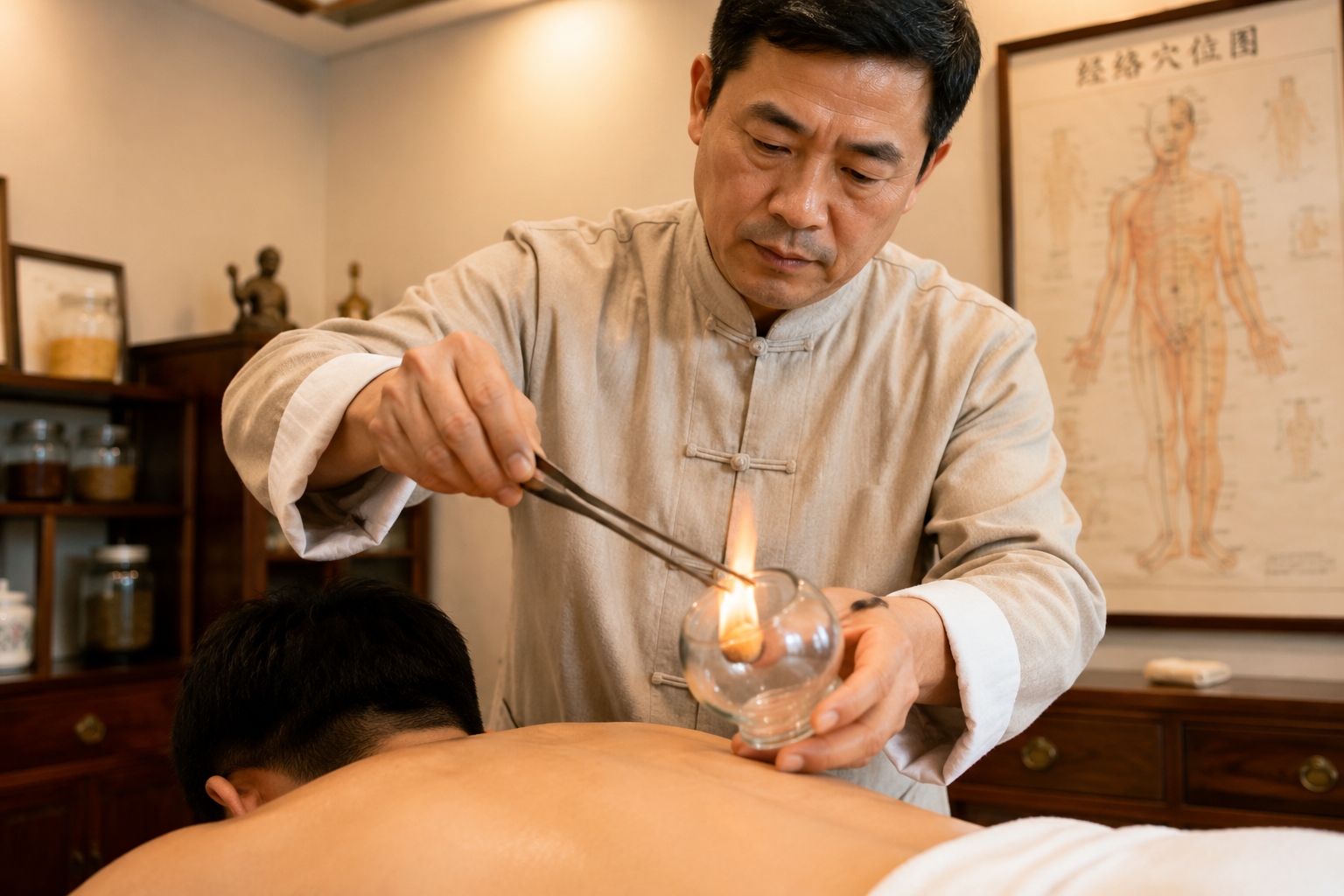
Over the next few minutes, she placed ten more cups along my back and shoulders. The room filled with a crackling sound as she lit the cotton balls. My skin felt warm, then tight, as if each cup was a small vacuum pulling old tension to the surface. Zhang asked me to breathe slowly. “When we open the pathways, the body starts to clean itself,” she said.
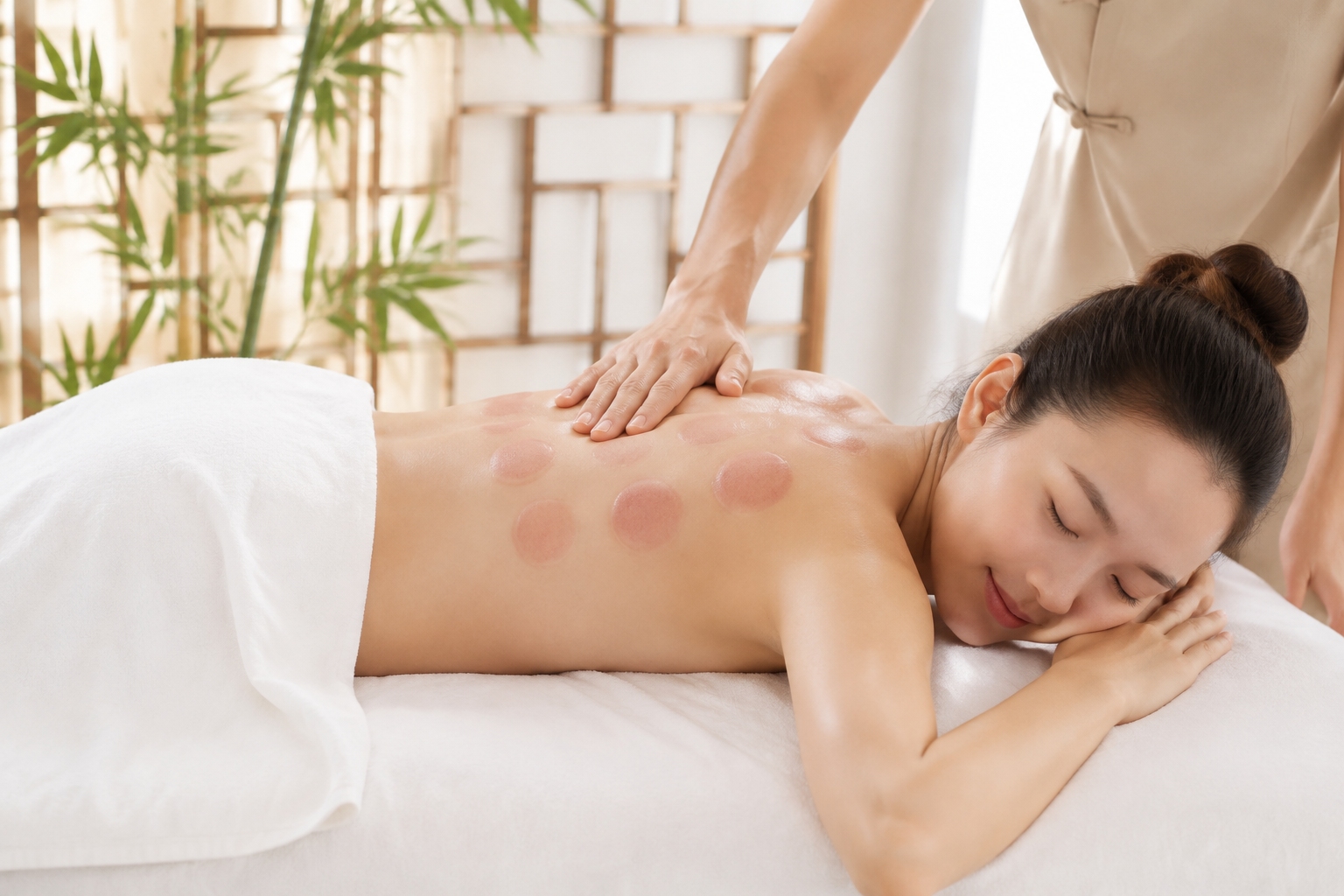
After fifteen minutes, she removed them one by one. The marks looked like a series of dark red moons. She then switched to gua sha — scraping a smooth jade tool across my neck. It moved in long, firm strokes that felt oddly satisfying, like someone finally pressing the knots out of a tangled rope. When she finished, she told me to sit up slowly. My shoulders felt lighter, my head cleaner. I couldn’t tell if it was physiology or expectation, but the weight was gone.
“Your body now has new instructions,” Zhang said, pointing at the marks. “These are not bruises. They are reminders to your flesh that blood and qi can flow again.”
Ancient Terms, Modern Translation
Traditional Chinese medicine (TCM) often confuses outsiders because its core metaphors — qi, blood, meridians — don’t map neatly onto anatomy textbooks. A modern way to think about it: the body is a self-healing system with its own communication networks. Nerves, hormones, immune signals are like high-speed data lines. When we sit too long or stress too hard, these lines get blocked or noisy. Acupuncture and cupping, in this view, are like sending tiny reset signals to the system, asking it to reroute and restore flow.
This isn’t a New Age fantasy. In China, TCM is fully integrated into the public health system, taught in universities, and used in hospitals alongside Western medicine. At the same time, researchers are studying whether acupuncture changes blood flow, releases natural painkillers, or modulates brain scans. The mechanisms are still debated, but the clinical evidence for certain uses (like pain and nausea) has been recognized by the World Health Organization.
One of the most mind-opening moments for me was when Zhang traced a line from my wrist to my elbow. “This is the lung meridian,” she said. “It starts outside the thumb and runs along the forearm. If your lungs are tired, your breathing is shallow, and your skin feels dry.” I had no idea that a western-trained doctor would consider such a connection. But as a writer, I found it poetic. It forced me to think of the body not as a collection of organs, but as a living map.
Two Ways of Treating Pain
Western medicine excels at identifying the enemy — a virus, a tumor, a torn ligament — and deploying targeted weapons against it. Ibuprofen blocks the enzymes that cause inflammation. Surgery removes damaged tissue. It’s efficient, measurable, and often life-saving.
TCM takes a different route. It asks: Why did this area become vulnerable? What in the body’s environment allowed the problem to grow? The treatment is less like killing a bug and more like adjusting the operating system. A needle inserted at a point in the wrist might be far from the disease site, but the practitioner says it’s connected by a meridian. To a Western mind, this sounds implausible. Yet clinical trials have shown that real acupuncture outperforms sham acupuncture for chronic pain — not always, but consistently enough that many hospitals now offer it.
In my case, the cupping didn’t heal any specific diagnosis. But it changed how I perceived my own pain. Before the session, I thought of a stiff neck as a mechanical problem: bones and muscles misfiring. Afterward, I started to notice how fatigue, stress, and even weather mapped onto my body. That shift in awareness is something Western medicine rarely provides.
Who Chooses TCM Now?
In China’s big cities, TCM has become a lifestyle marker for the over-stressed, over-caffeinated modern worker. On the social app Xiaohongshu, “中医理疗” has hundreds of thousands of posts. Young employees share photos of their cupping marks like war trophies. Appointments through platforms like Dianping can be booked for around 100–300 RMB (roughly $15–$40) for a session — cheaper than a private physiotherapy session in Shanghai.
But the appeal goes beyond price. During my hour in the clinic, nobody checked a phone or clock. The entire treatment was structured around attention: my pain, my posture, my breathing. That kind of focused care is rare in a world of 10-minute doctor visits and AI-driven health chatbots. For many, the experience is not just about fixing the body — it’s about feeling seen.
One of the waiting patients, a 31-year-old software engineer named Li, told me he comes every two weeks. His job involves twelve-hour shifts and constant screen time. “Western clinics give me painkillers. Here, they ask about my dreams, my digestion, my mood. It feels more human.” He admitted that the effect might be partly placebo, but “placebo is still an effect. It helps me survive the week.”
The Limits of Magic
I don’t want to romanticize this. Cupping marks fade in a week, and the relief can be temporary. TCM is not a replacement for vaccines, antibiotics, or surgery. It has its own blind spots and occasional quackery. In China, there are calls to strengthen regulation and evidence-based practice within TCM spaces. A good practitioner will tell you when to see a Western specialist.
Zhang was such a practitioner. When she noticed one of my molars was chipped, she didn’t offer herbs. “Go see a dentist. This is not my field.” That honesty, I think, is what makes TCM credible — it knows its boundaries while still offering something valuable.
Your Body Is a Codebase
Maybe the metaphor “code rewrite” is not so far off. Our health is shaped by repeated daily operations — sitting, staring, worrying — all running in the background. Western medicine is great at fixing a crashed program. TCM, at its best, gently refactors the code: removing deadlocks, reopening communication, and reminding the system to listen to its own signals.
I left the clinic with a set of purple circles and a new question: What if the body isn’t a machine to be repaired, but a system to be maintained?
Start the discussion at forum.chinacomes.com