

A morning in the mist
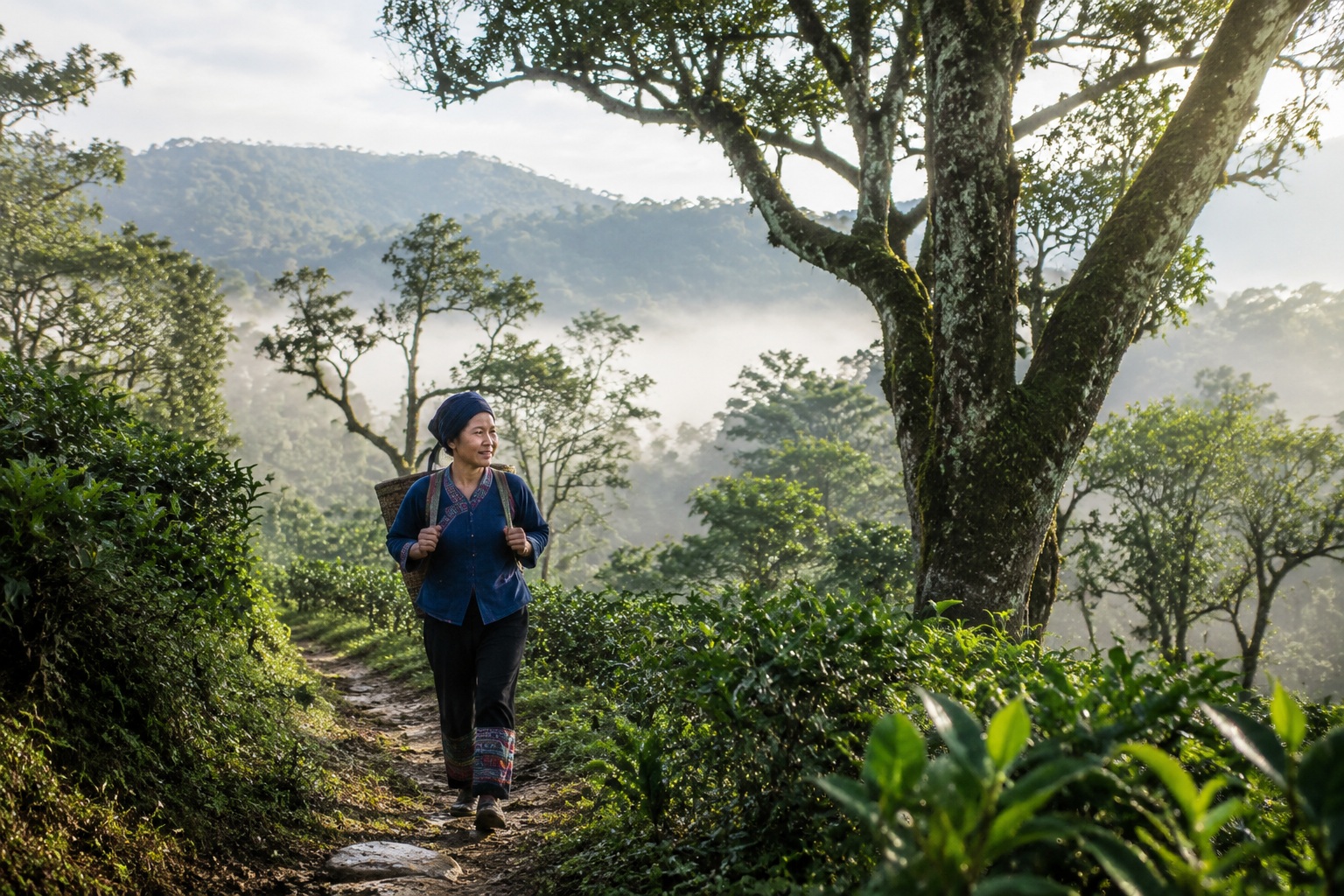
At 5:30 a.m., the fog still hugs the ridgelines of Jingmai Mountain in Yunnan Province, southwestern China. On a narrow earthen path, a Bulang woman in a blue homespun jacket and indigo headwrap picks her way through wet leaves. The only sounds are the rustle of leaves, a distant rooster, and the soft squish of her rubber boots in the mud. The dew has soaked the ground, and every leaf shines as if polished. She breathes in the smell of damp earth, sweet rotten fruit, and the faintest hint of tea.
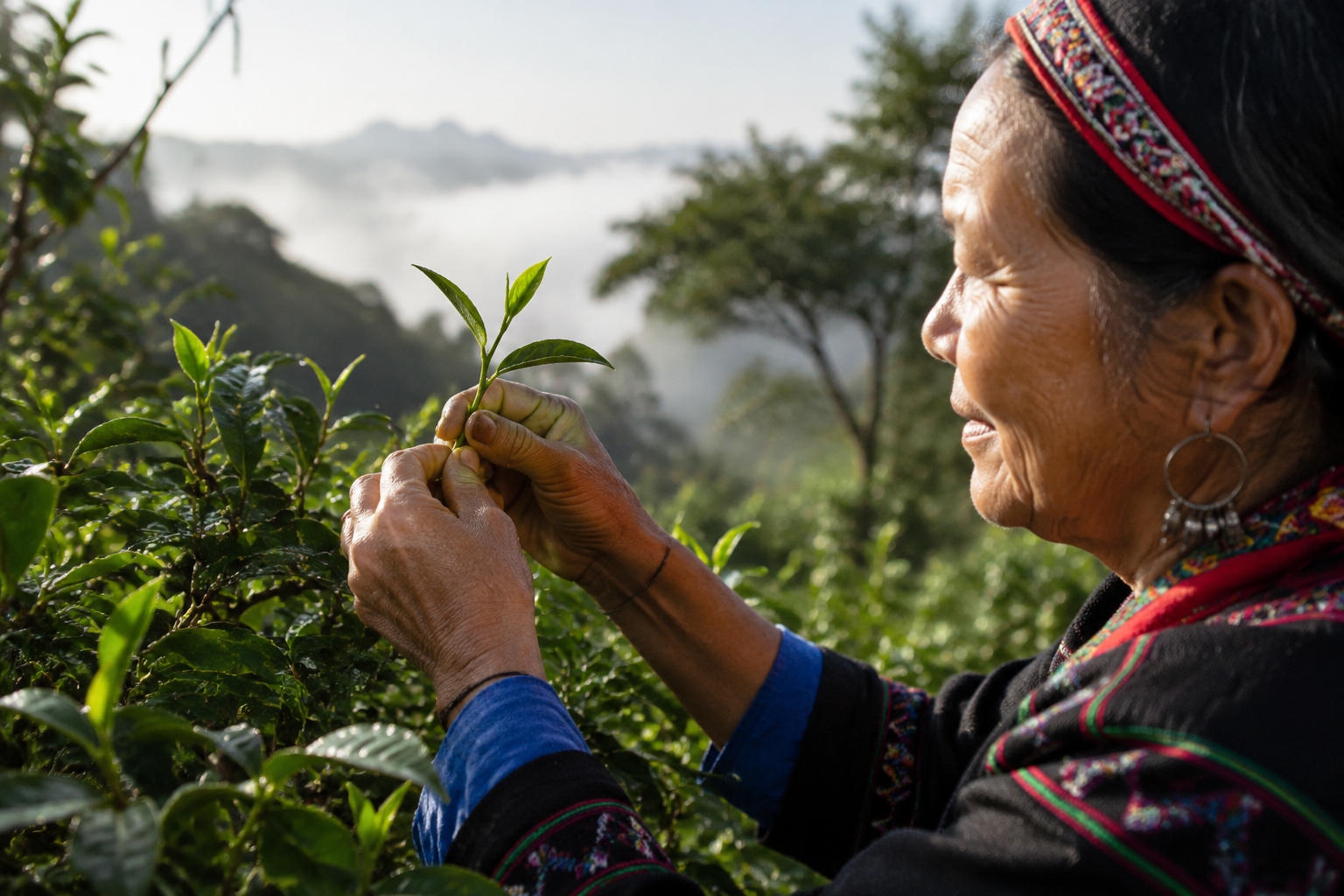
Her woven bamboo basket thumps rhythmically against her back as she climbs. The air is cold enough to bite the ears, but she doesn’t quicken her step. She stops at a tall tea tree—one of more than a million here—and gently twists off a sprig with two tender leaves and a bud. Her hand moves quickly, but carefully. Her name is Ai Wen. She has made this climb almost every day for fifty years.
What makes Jingmai different
Jingmai Mountain rises to about 1,500 meters above sea level in Lancang Lahu Autonomous County, Pu’er City. It holds what researchers say is the world’s most extensive ancient cultivated tea forest: more than 16,000 mu (about 2,700 acres) of tea trees scattered among dense tropical forest, some of them over 1,000 years old. In 2023, UNESCO inscribed this landscape on the World Heritage List—the first tea-themed cultural landscape to receive that honor.
Unlike modern plantations with endless neat rows, the tea “forest” of Jingmai is a layered community. Giant oaks, camphor trees, and wild fruit trees tower above the tea bushes, while ferns, orchids, and mosses crowd the ground. Nothing is sprayed, and nothing is pruned into straight lines. The forest itself does much of the work.
This stewardship isn’t just about tea. The Bulang and their neighbors—the Dai and Lahu peoples—manage the whole forest as a single living system. They leave scattered trees for nesting birds, preserve springs, and let fallen fruit rot into the soil. The result is a mosaic of tea groves, fields, and primary woodland that supports dozens of rare species, including the white-cheeked gibbon and the great hornbill.
The Bulang and their tea ancestors
The Bulang are one of China’s smallest ethnic groups, numbering about 130,000, most living in the mountains of western Yunnan. For them, tea is not merely a crop; it is identity, memory, and spirit. According to oral tradition, their ancestor Pa Aileng was the first to domesticate the wild tea trees here in the seventh century, and his parting words became a kind of constitution for the people: “Keep the tea forests for your children and grandchildren. Protect them as you would protect your own eyes.”
That instruction has been passed down for sixty generations. “Our grandmothers taught us which leaves to pick, which branches to leave alone,” says Ai Wen, pausing to touch a low-hanging branch. “We do exactly what they did.”
Walking the forest with a guardian
This morning, Ai Wen is joined by her older brother, Ai Meng, a wiry man of 70 whose face is creased like the bark of the trees he tends. He doesn’t use a watch to time the harvest. “We look at the sky and the wildflowers,” he says with a laugh. “When the dew is heavy and the white flowers on the old trees open, the tea is ready.”
We walk deeper into the forest. Ai Meng points to the tall shade trees overhead. “Too much sun makes the tea bitter,” he explains. Here, insects are kept in check by birds, and undergrowth is browsed by cattle and goats. Fallen leaves decay to rich humus. He stops at a trunk covered with thick green moss. “This is the mark of a healthy forest,” he says. “If the forest dies, the tea dies with it.” He pulls a leaf from a neighboring tree and crushes it between his fingers. The smell is sharply camphor-like. “Usually you pick tea, but you also have to know all your neighbors.”
From bud to puer tea
The leaves picked by Ai Wen and her family are not immediately brewed. They are carried in bamboo baskets to a drying shed, then tossed in large woks over a fire to “kill” the enzymes—a step that stops fermentation. Tea makers then knead the leaves, roll them into strips, and sun-dry them on bamboo mats.
This is raw puer tea, known as ”maocha”. It can be stored for years, slowly maturing. Some Jingmai trees’ leaves are pressed into round cakes called ”bingcha” and sold to collectors at astonishing prices. But most families keep some for themselves, storing it in bamboo tubes or clay jars. Ai Wen says that a good cup of tea is the simplest daily pleasure. “You drink it with rice, you drink it when you talk, you drink it when you sit alone. Tea is the water of life.”
Living forest, living tea
The ecological logic of the ancient tea forest is now backed by modern science. Shade trees slow evaporation, protect leaves from scorching, and their roots keep soil porous. The diversity of plants helps keep pests and diseases from exploding into webs. In return, tea bushes grow slowly, concentrating flavor compounds.
Scientists from the Chinese Academy of Sciences have counted more than 200 plant species in a single 100-square-meter plot inside the ancient tea forest. This is not a monoculture; it is a human-engineered ecosystem that has sustained itself for centuries. And it produces some of the most sought-after puer tea in the world—the district’s name has become a defining flavor in the global tea market.
Tea ceremony and shared memory
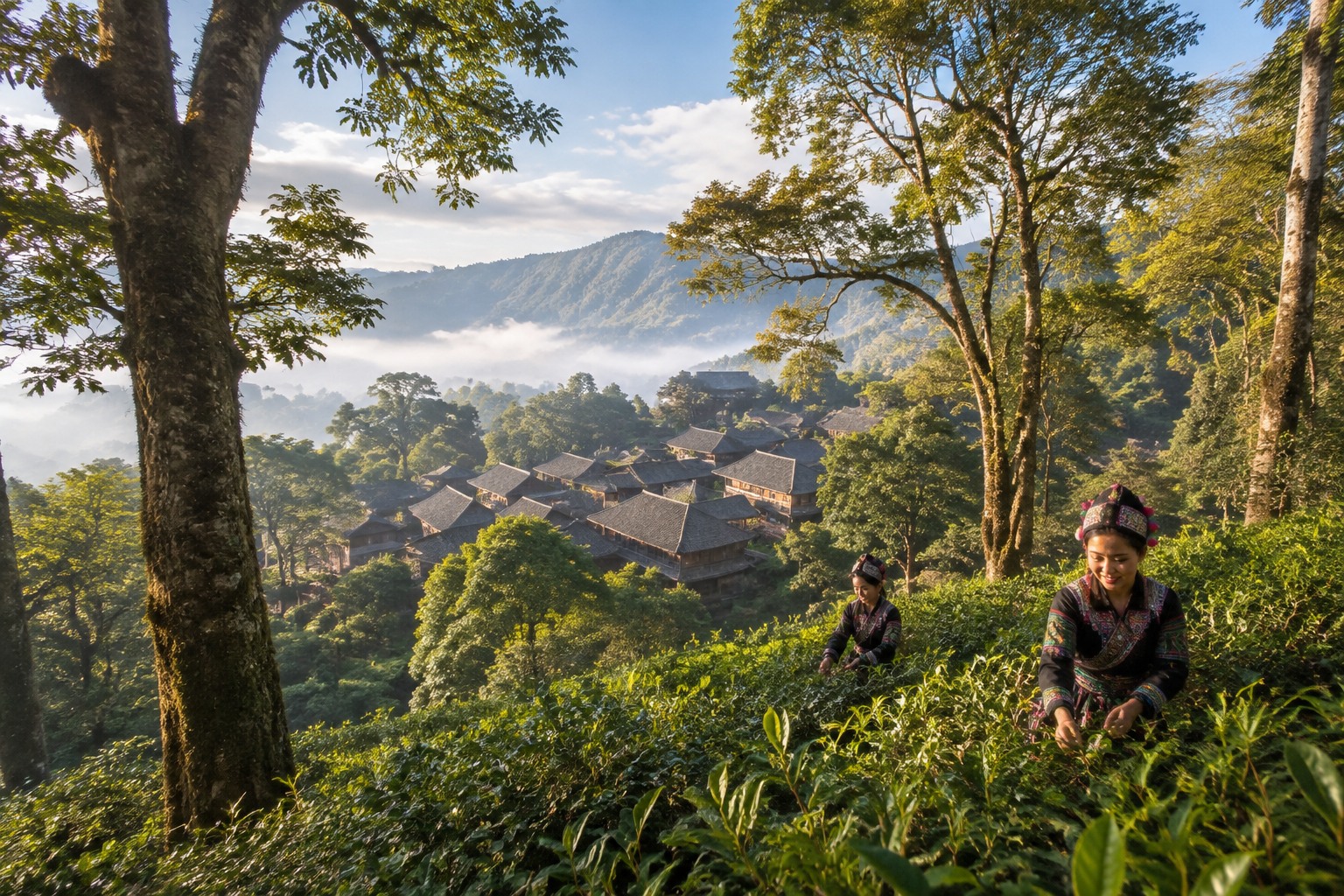
Every spring, before the new harvest, Bulang villagers climb to the forest’s highest point to hold the Tea Ancestor Festival. They carry roasted chicken, sticky rice, and newly dried buds to an altar beneath the oldest trees. The shaman chants the story of Pa Aileng while people kneel, burn incense, and pour tea into the soil. In the evening, the whole village dances around a fire until late.
Since the UNESCO listing, the festival has drawn more curious visitors. A few villagers worry it might become a show, but Ai Meng shrugs: “The tourists change how we sit, but they don’t change why we sit.” For him, the ritual is simply gratitude—a way of saying “thank you” to the forest before asking it for another year of leaves.
New faces, old roots
The global recognition is bringing a new kind of change to the old mountainsides. In the Bulang village of Wengji, with its grey-tiled roofs and wooden stilt houses, some young people who left for jobs in Beijing or Shenzhen are coming back. One of them is 32-year-old Yu Nan, who returned three years ago to open a small teahouse in her grandfather’s house.
“I used to think tea was old-fashioned,” she says, pouring a cup for a visiting couple. “But now I see it’s a way to keep my family close and my culture alive.” She is part of a local cooperative that sets strict harvest days, tests soil quality, and sells tea under an eco-label certified by the local government. The cooperative also patrols the forest to prevent illegal logging and over-picking.
Not all is smooth. The oldest trees offer the most expensive tea, and high prices create pressure to pick every leaf. In 2020, some villagers were caught cutting a large branch in search of a rare type of tea. The village committee publicly penalized them and now runs community patrols every day during the harvest season. A single kilogram of premium Jingmai raw puer can sell for tens of thousands of yuan—the equivalent of several months’ salary for a local worker. But the high price also encourages fraud and overpicking. More and more producers now trust the eco-label, which guarantees that the tea was picked by hand from trees that are at least 300 years old.
Still, Ai Meng sees reason for hope. “Young people are not abandoning the mountain; they are coming back with better phones, better knowledge. They are not replacing the old tea—they are helping us remember how to keep it.”
A cup at dusk
As the sun drops behind the ridge, Ai Wen and Ai Meng return to the village. In the kitchen, Ai Wen crouches beside a fire pit, roasting fresh leaves in a clay pot. She pours hot water over them; the liquid turns amber and fills the room with an earthy, smoky scent. She hands me a small cup. It tastes the way the forest smells—green, damp, layered with mushrooms and sweet grass.
Outside, the last light brushes the crowns of ancient trees. A rooster crows somewhere, and the smoke from cooking fires drifts into the trees. “Tea is alive,” Ai Wen says. “Take care of it, and it will take care of you.” That is not a slogan. It is simply how a people have lived for more than a thousand years.
Start the discussion at forum.chinacomes.com