
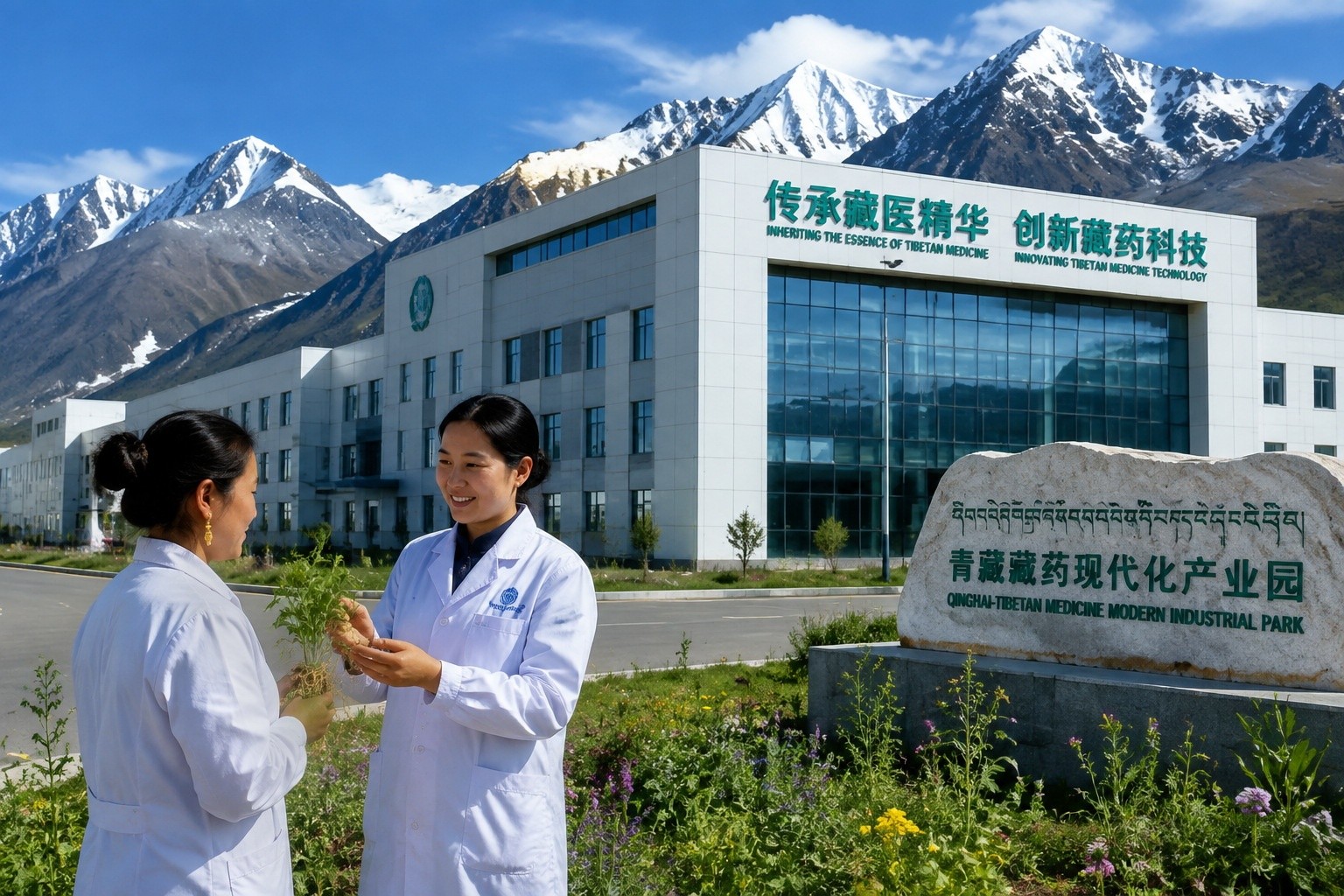

From the Plateau to the Production Line
At dawn on the Qinghai Plateau, a thin layer of frost covers the leaves of Rhodiola rosea at a cultivation base. A few hours later, in a factory at the foot of a mountain, the same plant is being cleaned, dried and processed in a cleanroom that follows international Good Manufacturing Practice (GMP) standards.
For a growing number of Tibetan medicine firms in China, this contrast is not a contradiction. It is the heart of a quiet revolution that has turned a centuries-old healing tradition into a modern industry — with all its benefits and tensions.
An Industry Reinventing Itself
Tibetan medicine has been practised across the Himalayan region for over a thousand years. It is rooted in a highly developed theoretical system that draws on ancient Indian, Chinese and even Greek ideas, adapted to the physical and spiritual realities of high altitude living. Practitioners traditionally gather wild herbs from steep valleys, test taste and smell, then produce simple powders, pills or pastes using hand-made tools.
Until the late 1990s, most Tibetan medicine was made in small tribal workshops. Quality varied from batch to batch, and the supply of wild plants was under growing pressure. Tourist demand and rising incomes, however, pushed the industry to scale. That was when the Chinese government stepped in.
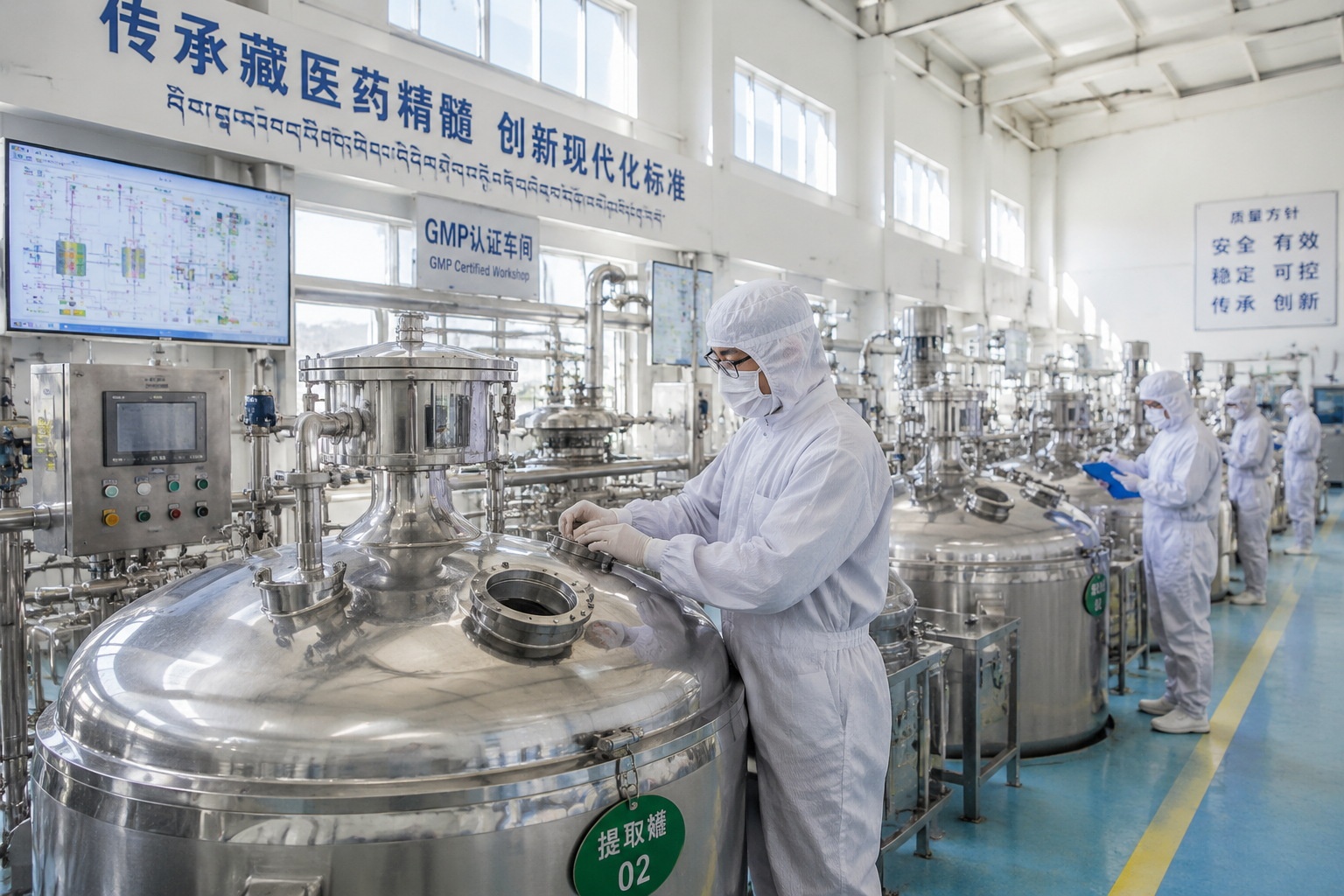
In 2002, China adopted a stricter set of pharmaceutical production standards, aligned broadly with the World Health Organization’s GMP norms. Every drug manufacturer, including makers of ethnic medicines, had to meet the same requirement: clean facilities, validated equipment, constant temperature and humidity control, trained staff, and documented evidence for every step.
At the time, very few Tibetan medicine shops could comply. Today, more than a hundred well-equipped Tibetan medicine companies operate with GMP certificates in Tibet and Qinghai. The industry’s output value for ethnic medicines has grown from under RMB 4 billion in 2005 to more than RMB 30 billion by 2023, according to industry data.
One of the first to embrace the change was the Jinhe Group [金诃藏药], founded in 1994 in Xining, the capital of Qinghai province. Its factory is now a glass-and-steel complex where Tibetan doctors and pharmacists work alongside laboratory technicians.
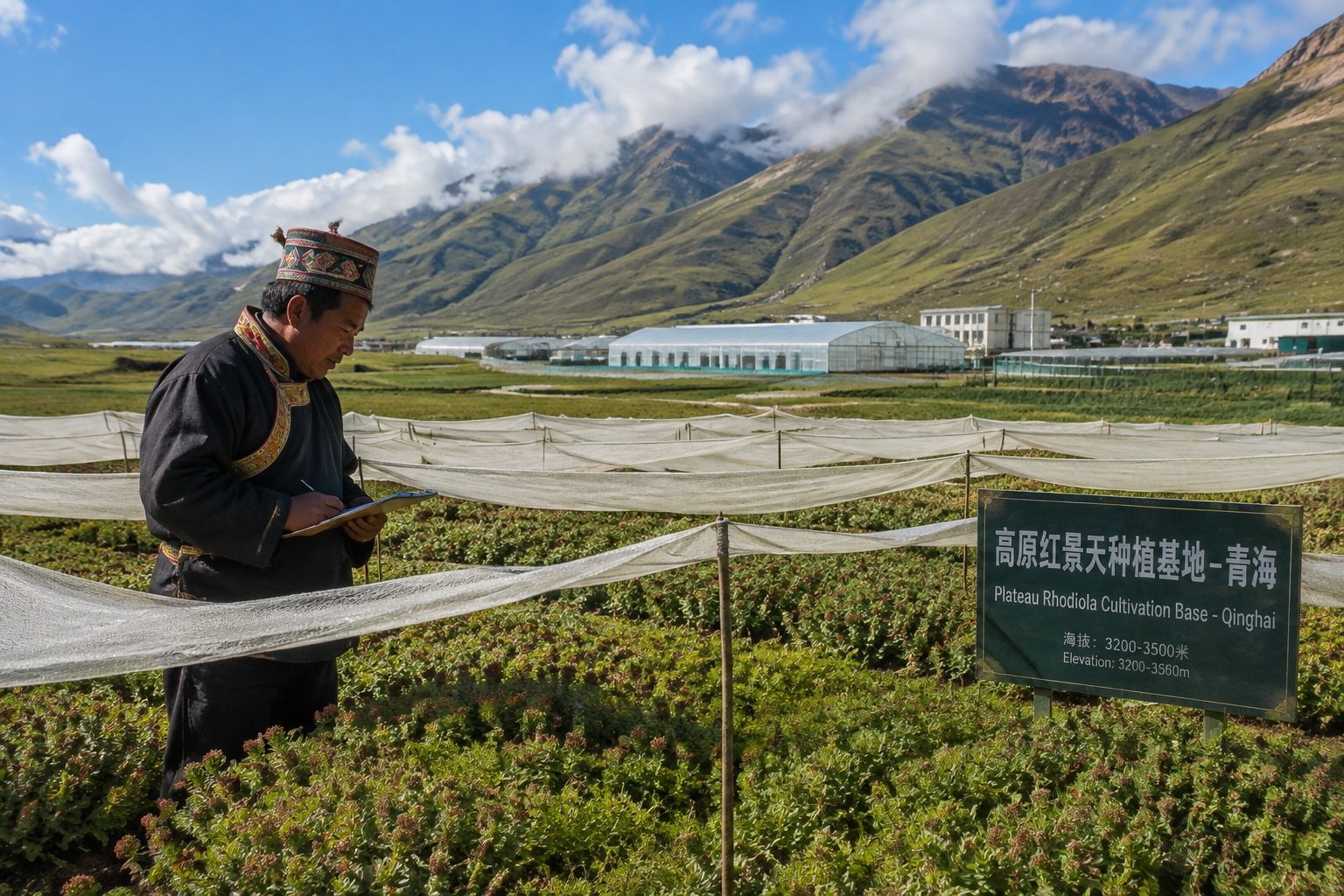
The transformation starts with the raw material. Instead of relying on wild collecting, Jinhe manages 8,000 mu (about 530 hectares) of fenced mountain land where Rhodiola, Saussurea and other high-value herbs are grown under shade nets. After harvest, they are left to dry in a controlled environment before being crushed into powder, extracted with ethanol or water, and concentrated under vacuum.
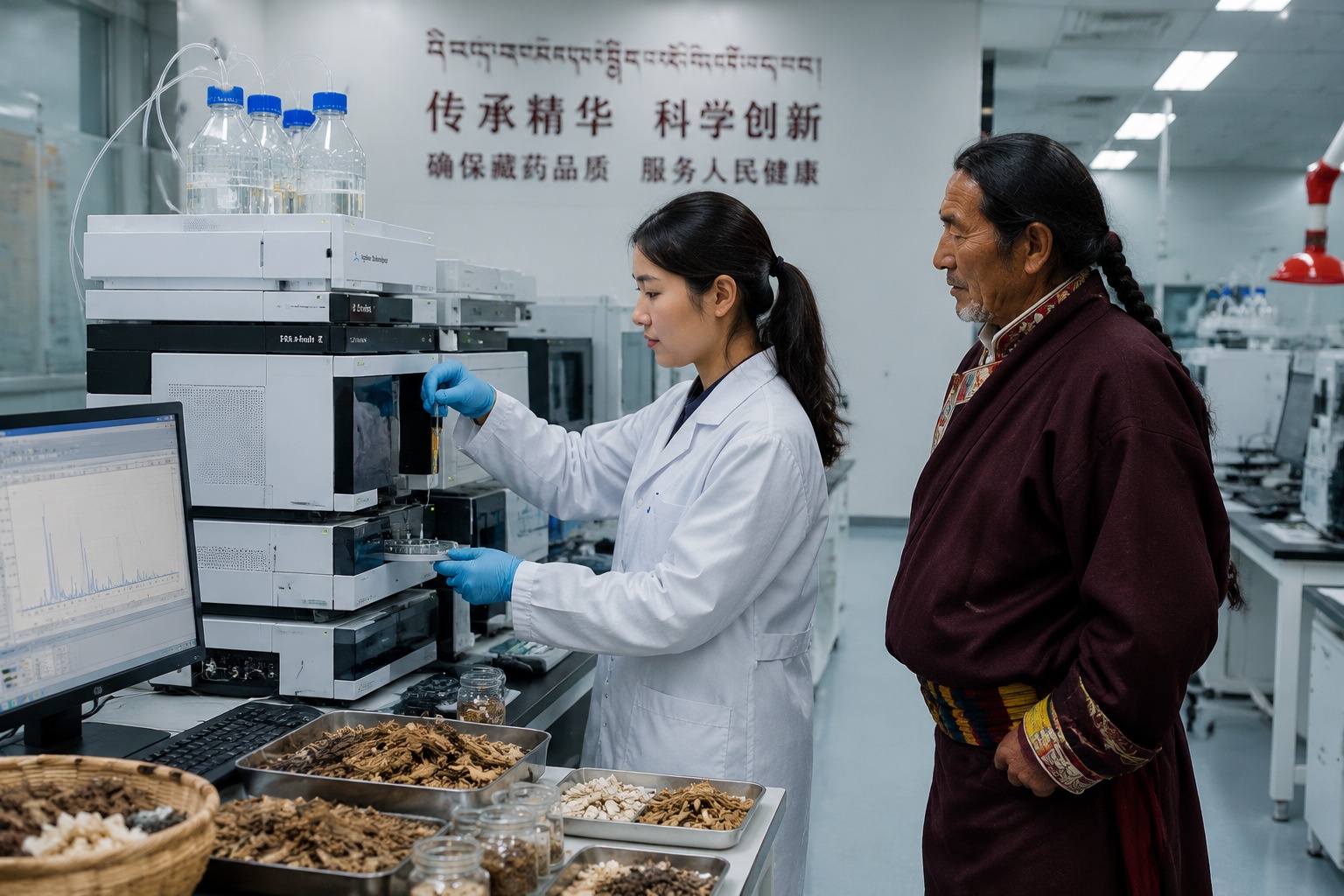
The most unusual part is the quality control lab.“We use high-performance liquid chromatography to measure the concentration of active ingredients,” explains Zhang Mei, a chemist who has worked in Tibetan medicine for 18 years.“Our requirement is to make every batch exactly the same.”
That is a difficult promise for a tradition that values individual diagnosis and recipe variations. But it is precisely what a modern drug approval system expects.
How a Tibetan Herb Makes the Journey to a GMP Workshop
Take Rhodiola rosea, known as hong jing tian in Chinese, as an example. It has long been used by Tibetans to fight fatigue and altitude sickness. Today, it is the core ingredient of several pharmaceutical products exported from China.
In a GMP-certified facility, the herb goes through a fixed sequence: cleaning, breaking, extraction under low pressure, spray drying, and final granulation. Each step is recorded on a batch card. Temperature, air pressure, and alcohol content are monitored continuously. Sensors can alarm the operator the moment a parameter drifts away from the approved range.
Nothing here resembles the storybook image of a monk grinding herbs with a stone bowl. But company managers insist that the essential Tibetan knowledge — which part to use, when to pick it, how to prepare it — remains central. Modern machines simply reproduce the traditional cookery on a larger and more reliable scale.
Marrying Tradition and Technology
The quiet challenge is to prove that Tibetan formulas have a scientific basis without losing their soul.
In partnership with universities such as Peking University and Qinghai University, several companies are now using network pharmacology to map the multiple pathways through which Tibetan mixtures affect the body. Instead of testing one active ingredient at a time, scientists study the whole formula as a complex network. Preliminary results have shown that many Tibetan medicines work by hitting several targets simultaneously, which is one reason they feel different from single-compound Western drugs.
Another innovative step is the use of molecular markers. Qinghai’s provincial institute of Tibetan medicine has gathered an electronic database of plant DNA from the plateau, allowing customs officials and companies to authenticate wild herbs. A lab test can now tell, within minutes, whether a bag of so-called Cordyceps contains the true mushroom species or an injected counterfeit. This is a far cry from the old days of visual inspection.
The People in the Middle
For many young Tibetan professionals, the modernisation of their traditional medicine has created new career paths. Chime, 31, comes from a pastoral family in Yushu. He learned pharmacology at Lanzhou University and, after working for an international drug maker, returned to Qinghai to join the quality assurance team at a Tibetan medicine factory.
“My grandfather was a traditional healer. He carried his own scales and used to inspect plants by biting them. I respect that, but I also want to ensure that the same plant goes safely to people in hospitals all over China,” Chime says.
His mother was initially worried that a factory job meant giving up her culture. After visiting the modern plant and seeing her son explain the process to a visiting Tibetan master, she said, “I thought it was a different industry. But they still listen to the doctors.”
That dialogue is part of the company’s design. Jinhe’s research unit employs several leading Tibetan doctors and asks them to audit production steps and provide clinical explanation for quality complaints.
Challenges on the Road Ahead
No honest portrait of Tibetan medicine’s modernisation would be complete without mentioning the difficulties. The most visible problem is the fate of wild species. Cordyceps, which is sold by weight and has become a luxury health product, is still harvested on a massive illegal scale. A few years of over-harvesting in one valley, or one unexpectedly dry spring, can wipe out a plant population that took decades to establish.
Companies are aware of the risk. Jinhe, for instance, has invested in greenhouse breeding programmes for alpine plants that are notoriously difficult to grow, and it shares seedlings with local communities. But some species, such as the parasitic fungus Ophiocordyceps sinensis, cannot be farmed at all. Their future depends on conservation and sustainable collection plans.
There is also a broader source of tension: the relationship between intellectual property and traditional knowledge. When a GMP factory turns ancient formulas into standardised products, who owns the rights? Many Tibetan doctors argue that the community’s collective knowledge should not end up as private property. In response, some local governments have set up collective trademark and benefit-sharing arrangements, but the legal framework is still evolving.
Finally, the cost of modernisation is high. Small family workshops that lack the funds to upgrade are being pushed out of the market. This consolidates production in the hands of a few large firms, which may be efficient but also reduces diversity.
Conclusion: The Future of Tibetan Medicine
The move from wild harvest to GMP workshop is a profound shift for a tradition that once valued the skill of the healer above all else. It is also, in many ways, a win-win: factories create jobs, quality improves, and more people around the world gain access to a unique healing system.
At the same time, the modernisation process is still a work in progress. The next decade will tell whether Tibetan medicine can maintain its integrity while being transferred from mountain shrines to high-tech production lines. If it succeeds, the lesson will extend far beyond the plateau: it will show how a culture can embrace the future without discarding its past.
Start the discussion at forum.chinacomes.com