
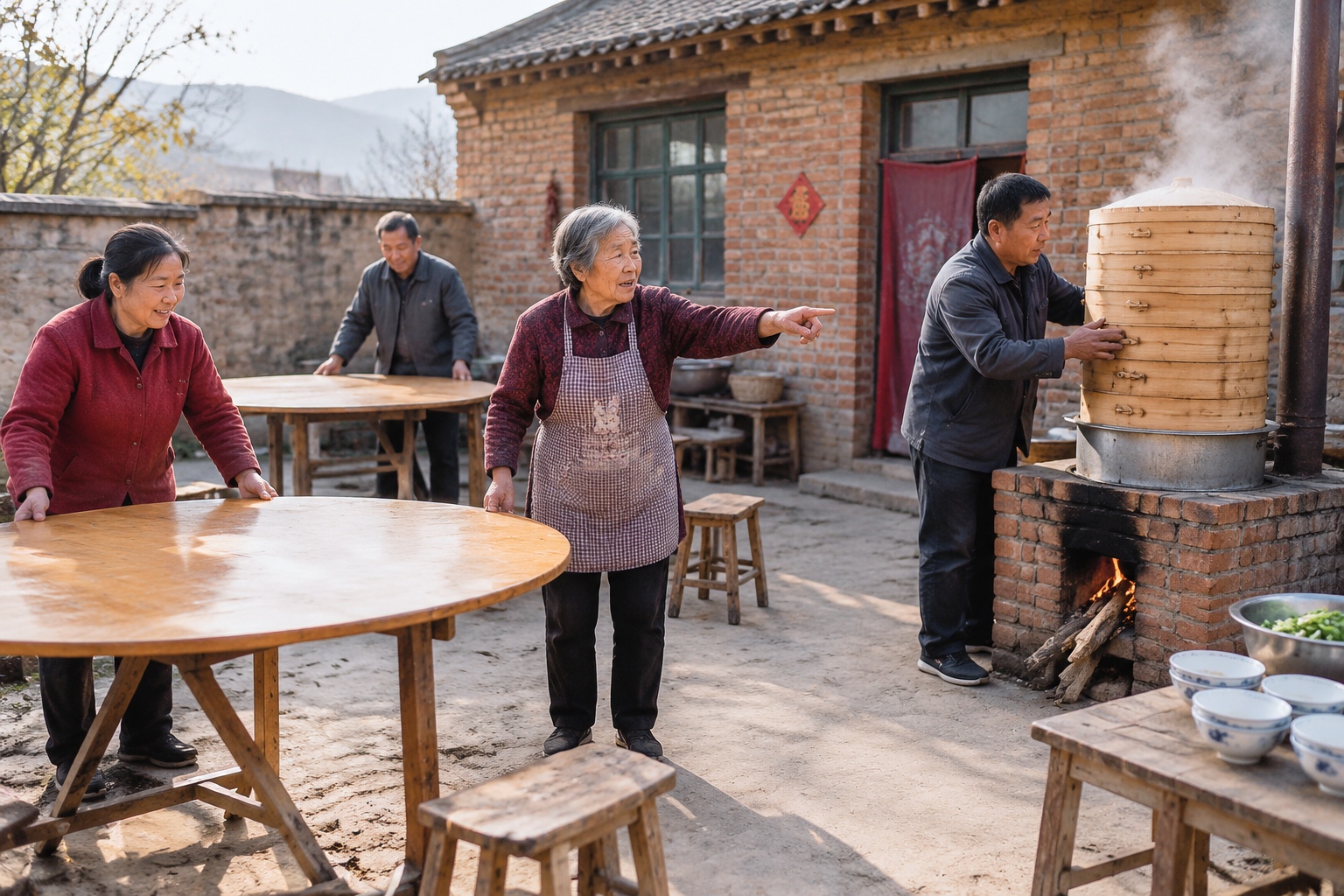

A courtyard kitchen before the guests arrive
The first thing I notice in the courtyard is not the food. It is the tables—round wooden tops borrowed from three neighbors, stacked against the wall like oversized coins. At 7 a.m., a village outside Jinzhong, in Shanxi Province, is still cold. Steam is already rising from a brick stove, and Grandma Guo, 80, is directing two men to lift a bamboo steamer taller than a child.
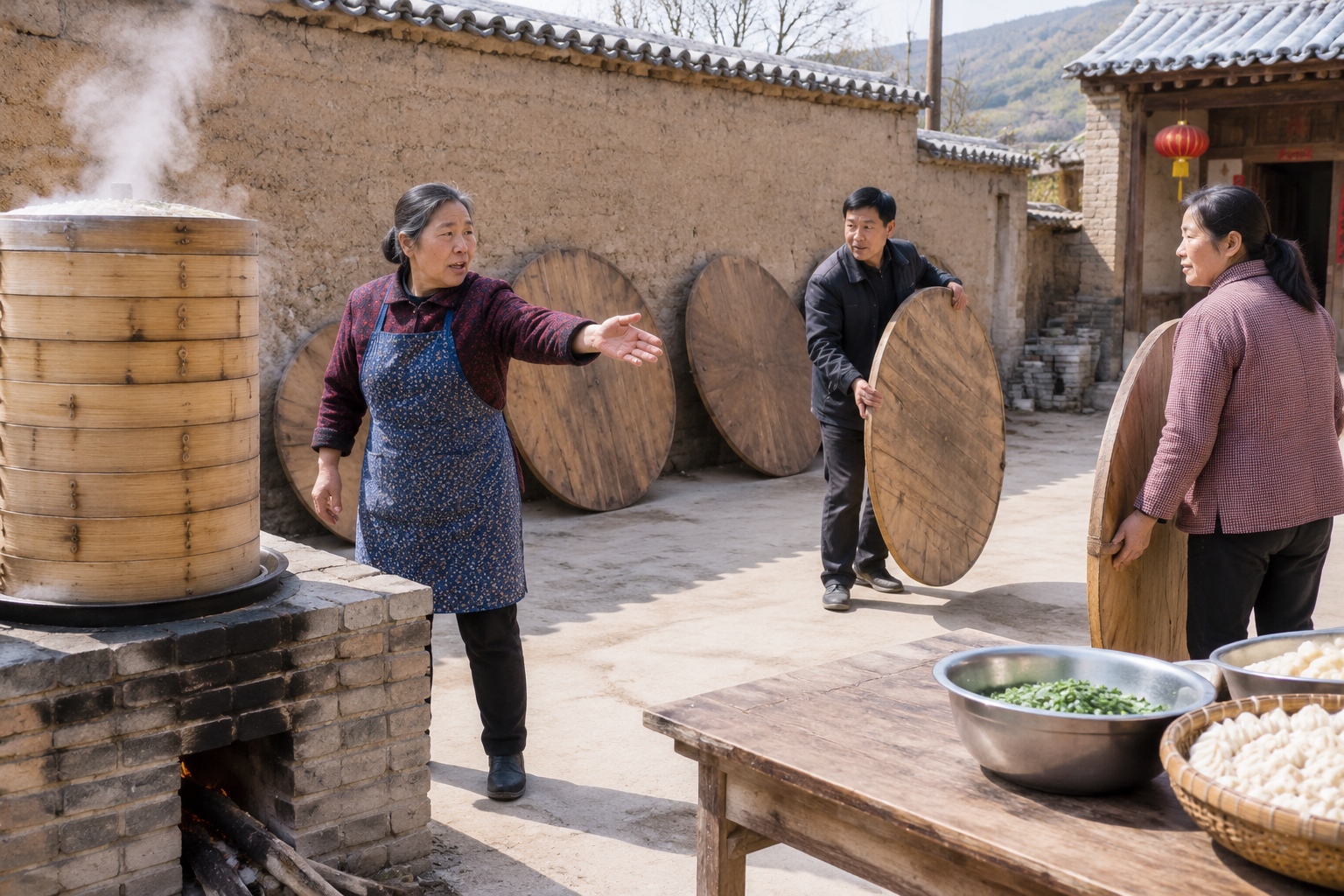
Her 80th birthday is tomorrow. Today is for preparation. A neighbor arrives with a stack of stools. Another brings a box of bowls wrapped in newspaper. Someone’s uncle is chopping pork belly on a long wooden board. The courtyard smells of star anise, wood smoke, and wet cabbage. This is not a restaurant. It is a family turning its home into a banquet hall for one day.
What “Eight Big Bowls” actually means
In Shanxi, “Ba Da Wan” literally means “Eight Big Bowls.” It sounds like a fixed menu. It is not. The term is used across many villages and small towns in the province for the steamed dishes served at big life events: weddings, funerals, full-moon celebrations for babies, birthdays, and Spring Festival gatherings. The number and content change by county, by village, and by family budget.
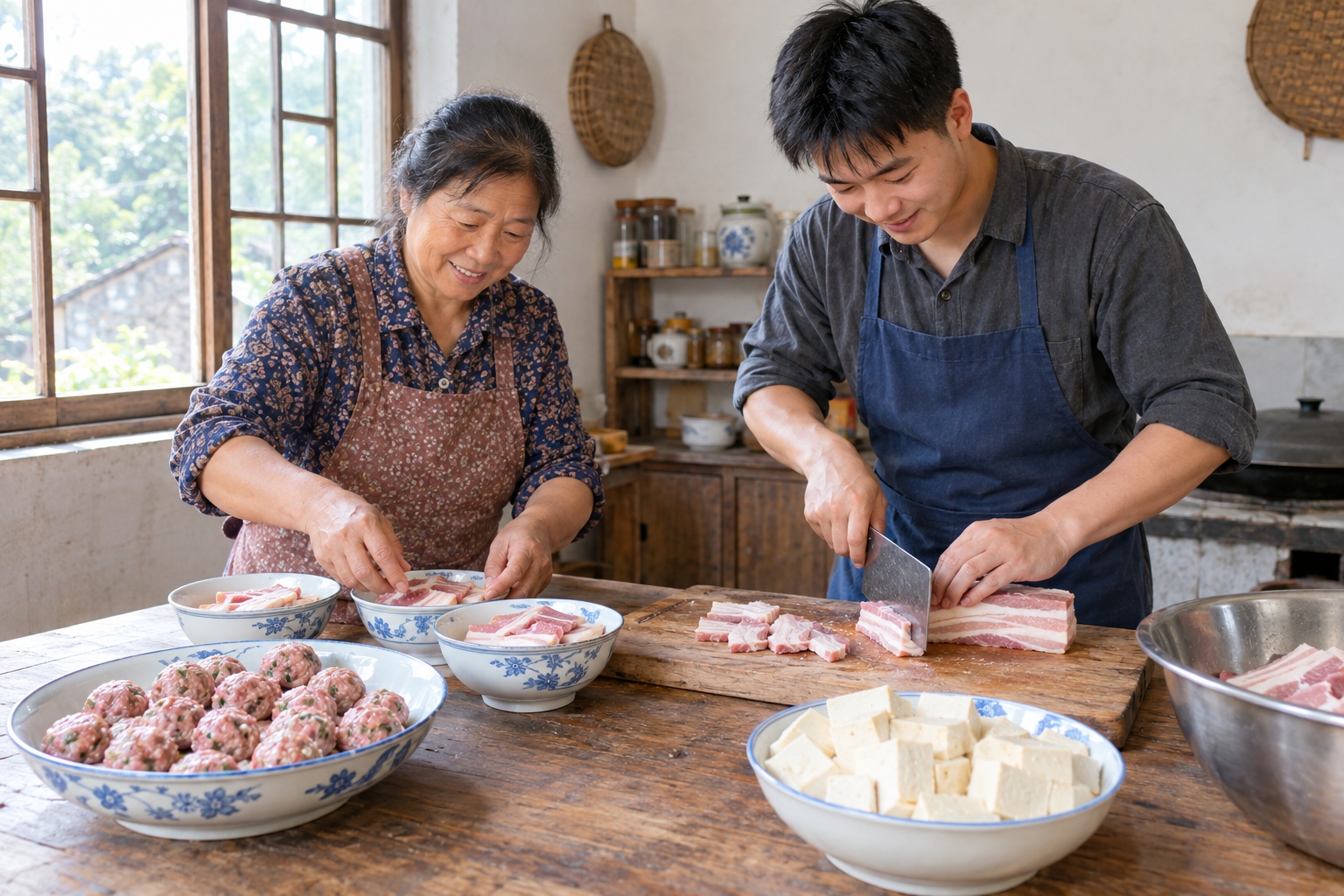
Shanxi is famous for noodles and vinegar. Both are everyday things. Eight Big Bowls belongs to a different kind of day—a day when a family has to feed fifty, eighty, or a hundred people and wants the table to look generous. Common bowls include kou rou, slices of pork belly steamed over pickled vegetables or potatoes; meatballs; fried tofu; glass noodles with cabbage; kelp; dried vegetables; and sometimes chicken or fish. In some places you will see six bowls and four plates. In others, eight bowls plus soup. The point is not a fixed recipe. The point is a recognizable standard: enough meat, enough steam, enough food to send guests home full.
For overseas readers, it helps to know that a rural banquet in northern China is not a restaurant meal with a menu. It is a social event with a seating plan, a gift ledger, and a kitchen built in a courtyard. Food is the visible part. Underneath it is a system of favors and obligations that families keep for decades.
The people behind the table
A village banquet is a small production line. Preparation starts two or three days ahead: buying pork, soaking dried vegetables, frying tofu, rolling meatballs, cleaning borrowed bowls. Neighbors bring tables, stools, chopping boards, and steamers. In many villages, a mobile chef is hired with his own stove and assistants. In others, an uncle or aunt who has cooked for decades takes charge, and younger relatives do what they are told.
Grandma Guo keeps a notebook. It is not a recipe book. It is a gift ledger. When guests arrive, someone sits near the door and writes down who gave how much. A hundred yuan, two hundred, sometimes more, depending on the relationship. The host will later attend that guest’s family events and return the favor. The ledger is not cold accounting. It is a map of who has stood by this family.
The cost is real. A home banquet can run several hundred yuan per table, depending on pork prices and how many dishes are served. Gift money may not cover it. Families still do it because the meal is not only about eating. It is about showing that this family can host, can organize, can remember its people. In a village, that matters.
How the meal unfolds
Guests arrive around noon. Cold dishes come first: cucumber with garlic, seaweed with vinegar, sliced liver, peanuts. Then hot stir-fries. Then the steamed bowls, carried out two at a time on wooden trays. The bowls are still steaming, and the table goes quiet for a second. The host moves between tables, refilling tea, pressing food on people, apologizing that the food is not better. It is a ritual of modesty, but everyone knows the food is the point.
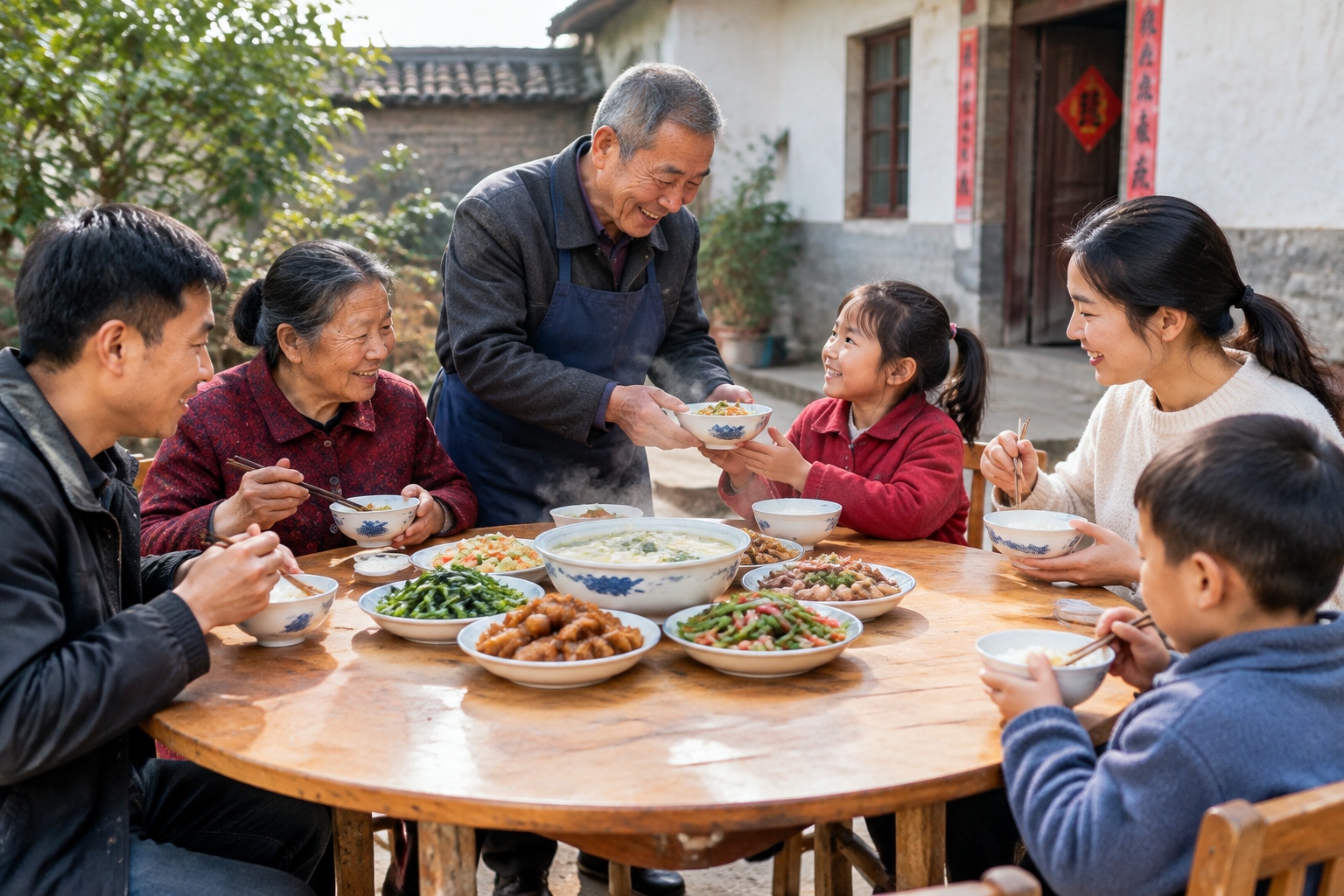
Seating follows age and relationship. The oldest guests sit near the stove or in the inner room. The host does not sit for long. Someone is always getting up to fetch more buns, more porridge, more napkins. Elders are served first. Children are given meatballs. A grandmother may push a second bowl toward a young guest and say, “Eat more, you are too thin.” The language of hospitality is not abstract. It is a sentence repeated at every table.
The meal ends with staples: steamed buns, millet porridge, sometimes oil cakes. People take home leftovers wrapped in plastic bags. That is part of the etiquette too. Refusing would be polite; accepting is warmer. The host wants the food to leave the table, not because it is extra, but because it has done its job.
Flavor as a family archive
The same dishes mark different passages. A wedding, a funeral, a baby’s full moon, a grandmother’s birthday—the table may look similar, but the mood changes. In a red event, there is noise and laughter. In a white event, the same bowls are served with quieter voices. The food is a structure that holds people together when they do not know what to say.
Every family argues about the details. The meatballs need more ginger. The kou rou should be sliced thicker. The tofu was fried too hard. These arguments are a form of memory. A recipe is never just a recipe. It carries the hands of the person who taught it. Wang Lei, 29, Grandma Guo’s grandson, works in Taiyuan, about an hour and a half away by high-speed train. He remembers stealing cold meatballs from the kitchen as a child. He also remembers that his grandmother’s meatballs are softer than his aunt’s, and that his aunt insists hers are more authentic. No one wins. The argument returns every year.
Young people may not know how to steam a bowl of kou rou. Many do not know how long to soak the dried vegetables. But they know the taste. They know that when they come home, the steamer will be on. That knowledge is part of family memory too, even if it is incomplete.
A tradition that keeps moving
Rural Shanxi is changing. Many young people work in cities. Villages have fewer hands for preparation. Mobile chefs now arrive with gas stoves, pre-steamed bowls, and assistants. Some families order a banquet package from a local restaurant and reheat it at home. In cities, families may book a private room and order a scaled-down version of the dishes.
Health concerns have changed the food. Less salt, less oil, smaller portions. A doctor’s warning can travel faster than an old recipe. But the structure holds. The bowls still come out. The ledger still appears. The host still says, “Eat more.” Tradition is not in a museum here. It is in the choices families make when they are tired, busy, and trying to do right by their guests.
The 80th birthday, and a grandson with a phone
On the morning of Grandma Guo’s birthday, Wang Lei stands at the steamer with his phone. He is not trying to make his grandmother famous. His cousins in Guangdong cannot come home, so he films the pork bowls coming out, the steam fogging the camera, his grandmother’s hands testing the meat with a chopstick. He sends the video to the family group chat. Within a minute, an aunt replies with a voice message: “Leave me a bowl.”
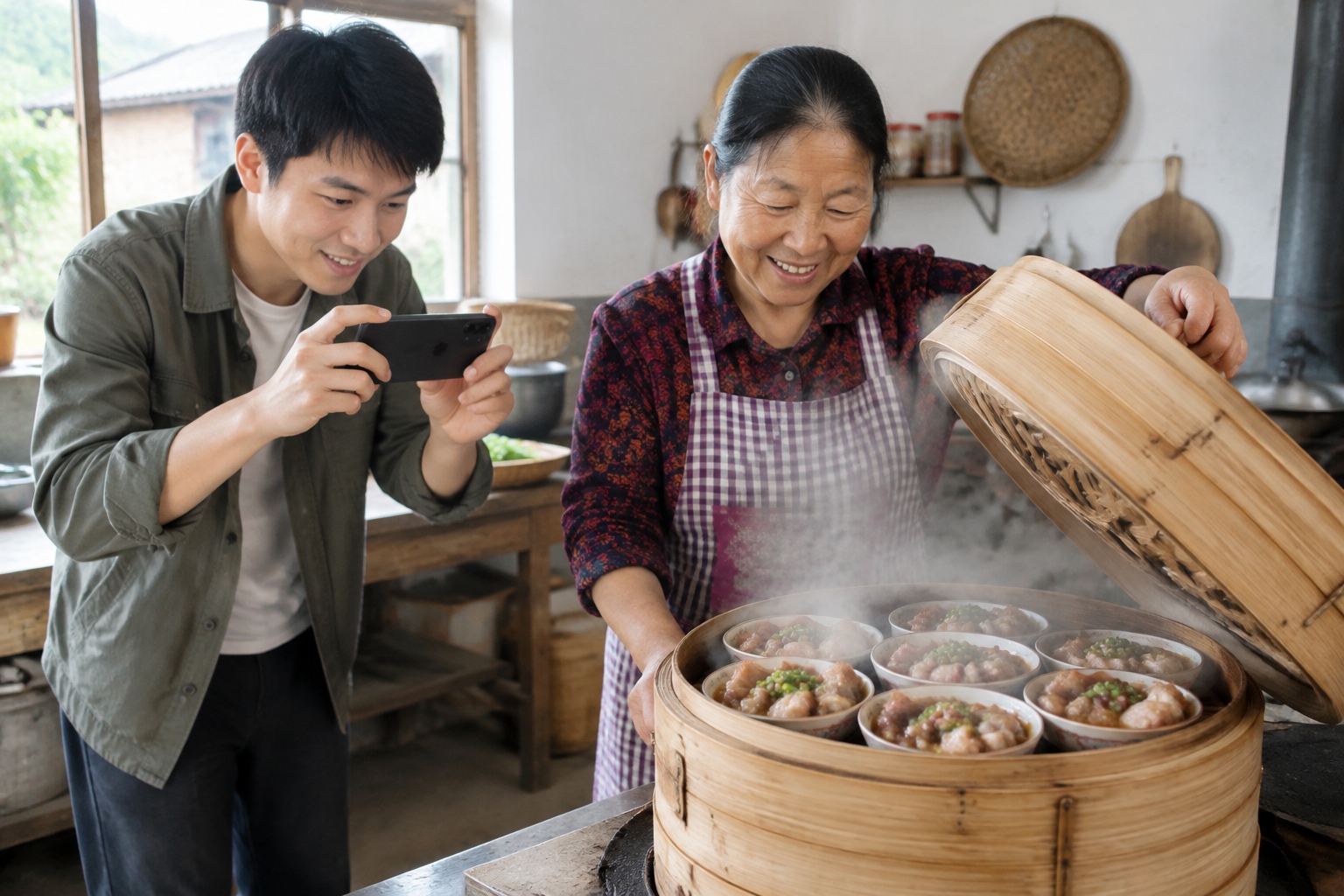
Later, he does the math on his phone. Pork, oil, coal, hired steamers, red envelopes. He laughs. It is not cheap. But his grandmother has attended every neighbor’s wedding and funeral for fifty years. She has sat at their tables, eaten their food, and written her name in their ledgers. This banquet is the return. Wang Lei may not know how to make every dish, but he understands the account.
What stays on the table
Eight Big Bowls is not a performance for tourists. It is not a fixed set of eight dishes, and it is not only about food. It is what ordinary people cook when they need to say: you are welcome here; we remember you; we are still connected. The bowls will change. The cooks will change. The ledgers will fill up with new names. But the table will still be borrowed from a neighbor, and someone will still press a second meatball onto a child’s plate.
So when you think of Chinese food, do not stop at noodles. Ask instead: what does a family cook when it wants to honor someone? In your own family gatherings, which dish says welcome?
Start the discussion at forum.chinacomes.com