


Start With a Pulse, Not a Scan
On a rainy Tuesday in Chengdu, a woman in her early sixties sits in a community health clinic. She is not there for an emergency. She wakes at 3 a.m., feels hot in the afternoon, has a dry mouth, and her shoulders stay tight. The doctor, a woman in her forties with short black hair and a white coat, asks about sleep, appetite, bowels, temperature and stress. Then she rests three fingers on the patient’s wrist and listens to the pulse.
To an outsider, this can look soft, almost literary. No scanner, no blood tube. But the visit is not a rejection of modern medicine. A blood pressure monitor sits on the desk. The clinic is part of China’s public health system. Many patients move between blood tests, ultrasound and herbal prescriptions in the same week. Traditional Chinese medicine, or TCM, is not a separate universe here. It is one room in a busy building.
The words still need translation. What is qi? Is yin-yang a moral scoreboard? Why does a doctor ask about cold hands and bad sleep when the patient came for shoulder pain? The short answer: TCM treats the body less like a car with replaceable parts and more like a small weather system. That is not a scientific claim. It is a way of organizing observations.

Qi Is Closer to Activity Than to a Mysterious Gas
The easiest mistake is to imagine qi as a glowing vapor inside the body. That is not how a good TCM doctor talks about it. In practice, qi is shorthand for activity and function: the body’s ability to move, warm, hold, protect, digest and recover. A city analogy helps. A city has no single substance called city energy, yet you can tell when deliveries stop, lights dim and buses run late. Qi is used a bit like that: not a thing you pour into a cup, but a way to describe whether systems are moving and supporting one another.
This is why a consultation may include phrases like qi deficiency or qi stagnation. They are patterns, not lab results. A person with qi deficiency might feel tired after small tasks, speak softly, sweat easily or lose appetite. A person with qi stagnation might feel a lump in the throat, sigh often or have pain that moves around. These are not Western medical diagnoses. They are a clinical language for grouping symptoms and deciding what to ask next.
The language changes the conversation. If a patient says they are exhausted but tests are normal, a TCM doctor may ask: When does the tiredness come? After eating? After talking? After stress? Is it better with rest or worse with rest? The answer may shape a prescription, a food suggestion, or simply a nudge to sleep earlier. The point is not to name a hidden substance. The point is to notice a pattern.
Yin and Yang Are Not Good and Evil
Yin-yang is often translated as balance, which is true but too flat. The original image is a hillside with one side in shade and one side in sun. The two sides belong to the same hill. They define each other. Day becomes night; night becomes day. Activity needs rest; rest makes activity possible. Yin and yang are not good and evil, and they are not fixed labels. They are relationships that keep shifting.
In a clinic, this shows up as questions about heat and cold, dryness and moisture, tension and looseness. A patient with night sweats, a dry mouth, a red tongue and trouble sleeping may be described as having too little yin, meaning the cooling, moistening, resting side is under strain. A patient who feels cold, has loose stools and low energy may have too little yang, meaning the warming, activating side is weak. Nobody is a better person for being more yang.
The useful part is the dynamic. A person can be tired but wired. A body can be hot on the surface and cold underneath. Symptoms can flip after a fever, a bad month at work or a change of season. Yin-yang gives a doctor a way to ask: What is in excess? What is depleted? What is stuck?
The Body as a Small Universe
The third idea is holism, and it shapes TCM most directly. The body is not a set of isolated rooms. Digestion can affect sleep. Sleep can affect mood. Mood can affect breathing and appetite. A shoulder problem may be linked to desk posture, but also to stress, poor sleep and a recent cold. TCM calls this looking at the whole pattern rather than a single symptom.
There is an outer layer too. People are affected by weather, seasons, food, work schedules and living conditions. A doctor may ask whether symptoms get worse in damp weather, whether the patient skips breakfast, whether they work night shifts, whether they live alone. This is not a claim that the mind can cure everything. It is a practical recognition that bodies do not live in laboratories. They live in apartments, offices, kitchens, buses and parks.
This is where the phrase a small universe comes from. It does not mean the body contains stars. It means the body is understood as a system with internal links and a constant exchange with the world outside. In everyday Chinese life, this idea appears in small ways. Parents tell a child to avoid cold drinks after sweating. Office workers drink chrysanthemum tea after late nights. Someone with a cold avoids heavy, greasy food for a few days. Some of this is habit, some is folk advice, some is marketing. A good doctor separates the useful part from the noise.
What It Looks Like in a Real Week
Consider a 28-year-old marketing worker in Shanghai. She sleeps six hours on a good night and has neck pain from laptop work. She goes to a public hospital for tuina, a kind of Chinese therapeutic massage, and also gets a blood test through her company’s annual check. She does not think of herself as choosing between two medical systems. She uses what is available and affordable. Her doctor may tell her to adjust her desk, take walks and come back if the pain shoots down her arm. The TCM part is not a replacement for an X-ray. It is an added layer of care.
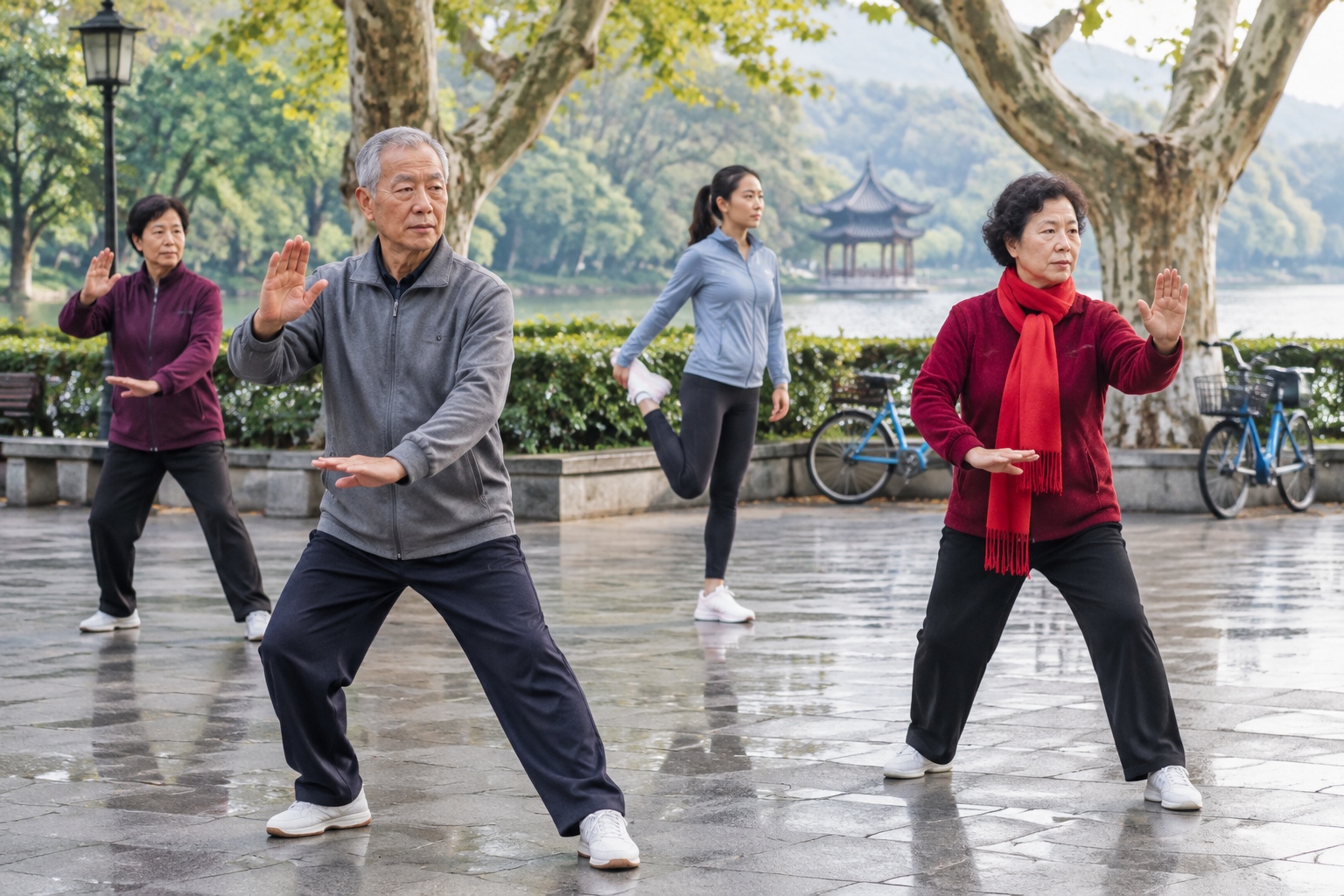
Or take a retired couple in Hangzhou. Every morning they walk to a park near the canal. One does slow arm movements with neighbours; the other walks laps and chats. Their daughter buys them a packet of herbal soup ingredients for winter. They also take blood pressure medicine. In their kitchen, a clay pot and a pill organizer sit on the same shelf. For many Chinese families, traditional medicine is part of the same everyday routine as a thermometer and a box of plasters.
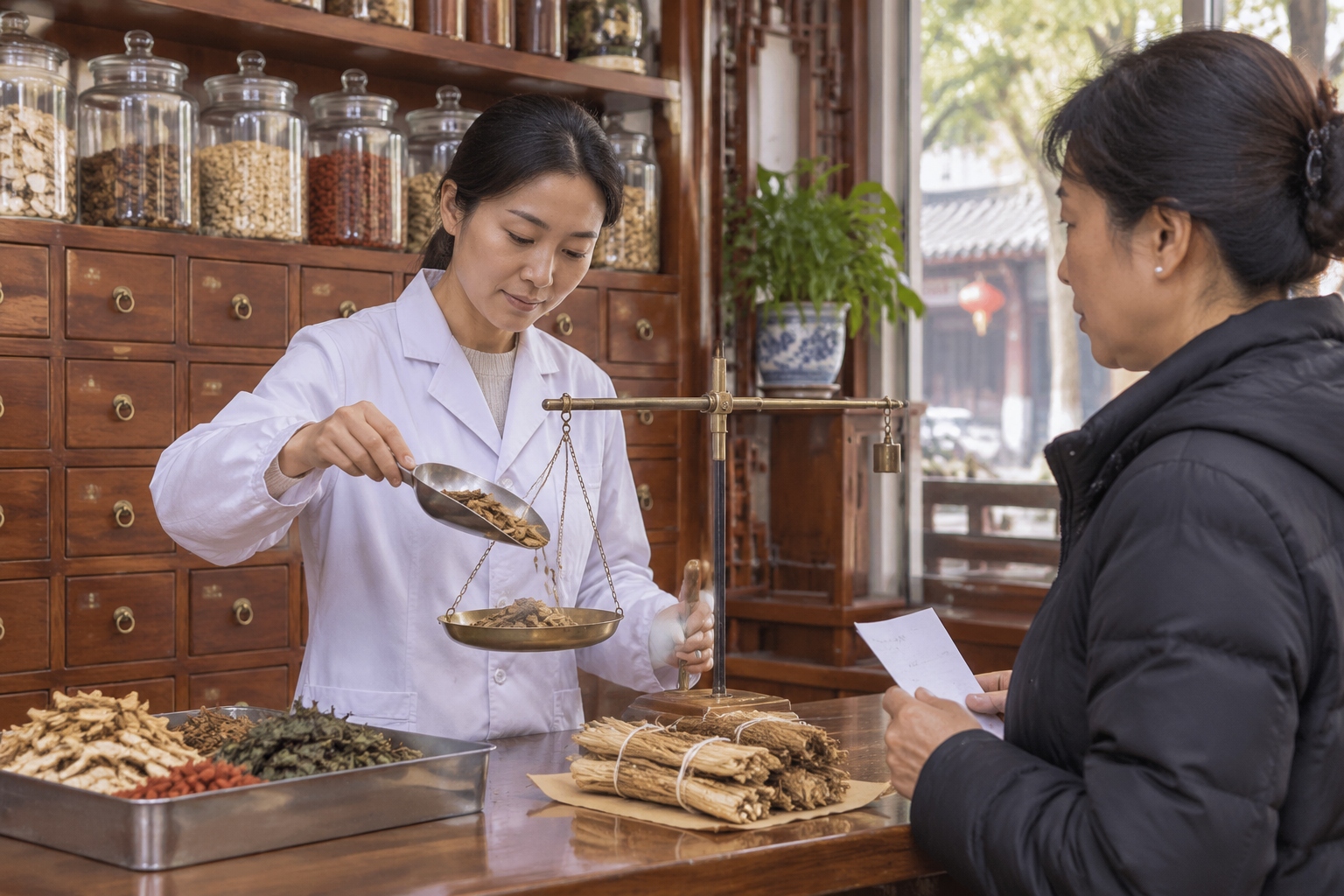
This mixed reality matters for outsiders. TCM in China is not only a philosophy kept alive by enthusiasts. It is taught in universities, practiced in hospitals, regulated by health authorities and sold in ordinary pharmacies. It also has weak claims, overpriced products and vague marketing. Chinese patients argue about it, joke about it and criticize it. The interesting question is not whether every claim is true. It is why this language still helps people describe their bodies.
Why the Language Still Appeals
Part of the appeal is practical. Modern medicine is good at finding disease, but many people live with problems below that line: poor sleep, low energy, digestion that shifts with stress, pain that comes and goes. TCM offers a vocabulary for these fuzzy states. It asks about timing, appetite, temperature and mood. Sometimes the result is a prescription. Sometimes it is a change in routine. Sometimes it is the relief of being asked a fuller set of questions.
Part of the appeal is cultural. The words feel familiar. Grandparents use them. Soup recipes use them. They connect a person to a family kitchen and a shared memory of care. That does not make them scientifically proven. It makes them socially real. When a doctor says your spleen is weak, a patient may not picture an organ. They may picture a pattern of tiredness, bloatedness and loose stools that their mother also described.
There is also a practical caution. TCM is not a free pass to avoid emergency care. Chest pain, sudden weakness, a high fever that will not break or a growing lump needs modern medical assessment. Good TCM doctors in China often say this themselves. They work with hospitals, not against them. They know their limits.
How to Read TCM Without Turning It Into Magic
A useful way to approach these ideas is to treat them as a map, not a molecule. A map is not the territory. It highlights some features and ignores others. Qi highlights function and movement. Yin-yang highlights relationships and change. Holism highlights links between systems and environment. None is a substitute for anatomy or pathology. Together, they give a clinician a different set of questions.
For an outsider, the first step is to drop the either-or frame. China today is not a place where ancient medicine rules and modern medicine waits outside. It is a place where both are woven into ordinary life, sometimes well, sometimes badly. A patient may get an MRI in the morning and a bowl of herbal soup at night. A doctor may read a lab report and still ask about cold hands. That mix can be confusing, but it is not mysterious. It is a practical culture of care, with all the strengths and contradictions that come with it.
The next time you hear someone say the body is a small universe, do not picture stars. Picture a kitchen, a bus, a clinic and a park. Picture a person trying to sleep, work, eat and recover in a changing week. That is the scale TCM is usually talking about.