

A warm box, and a very large building
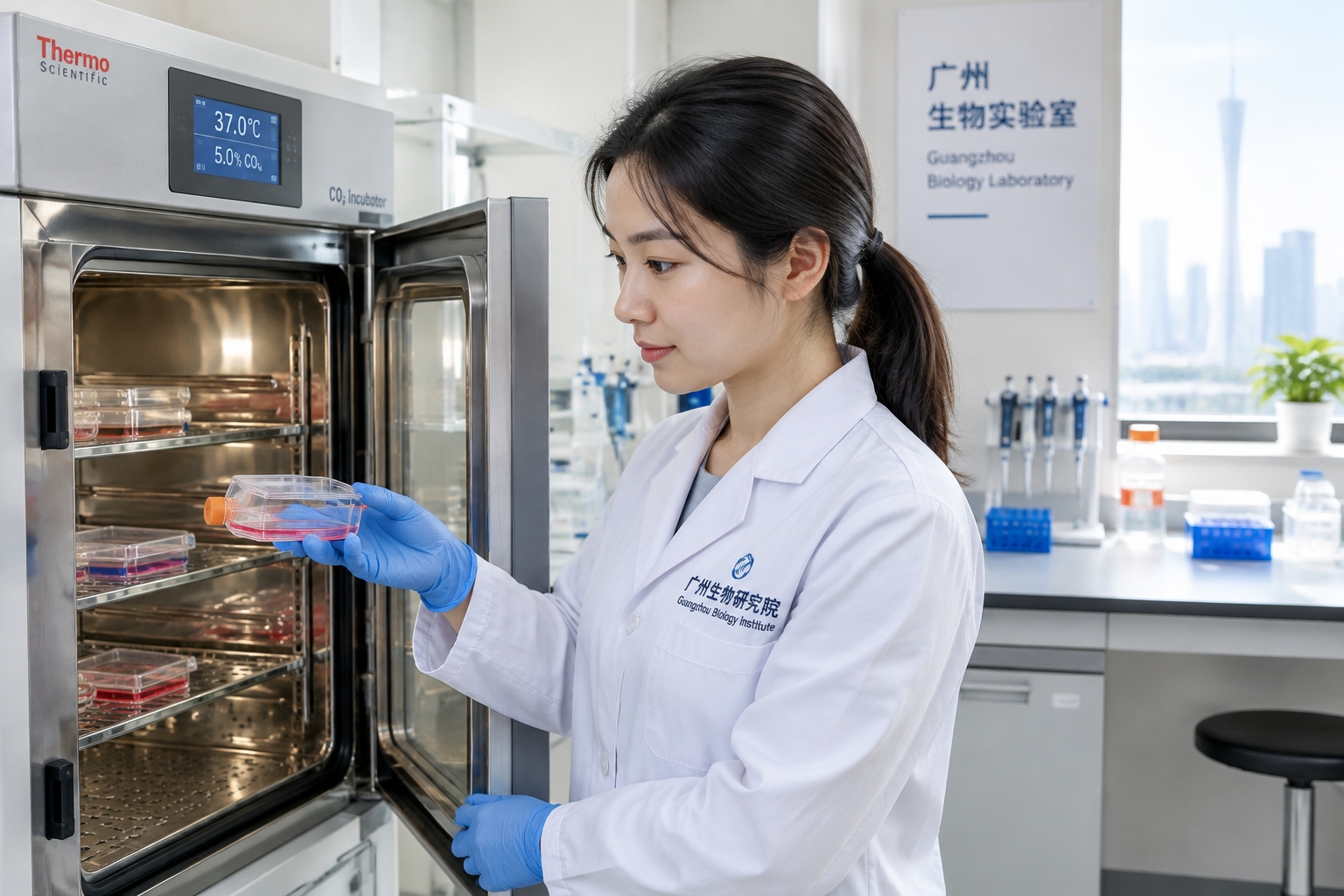
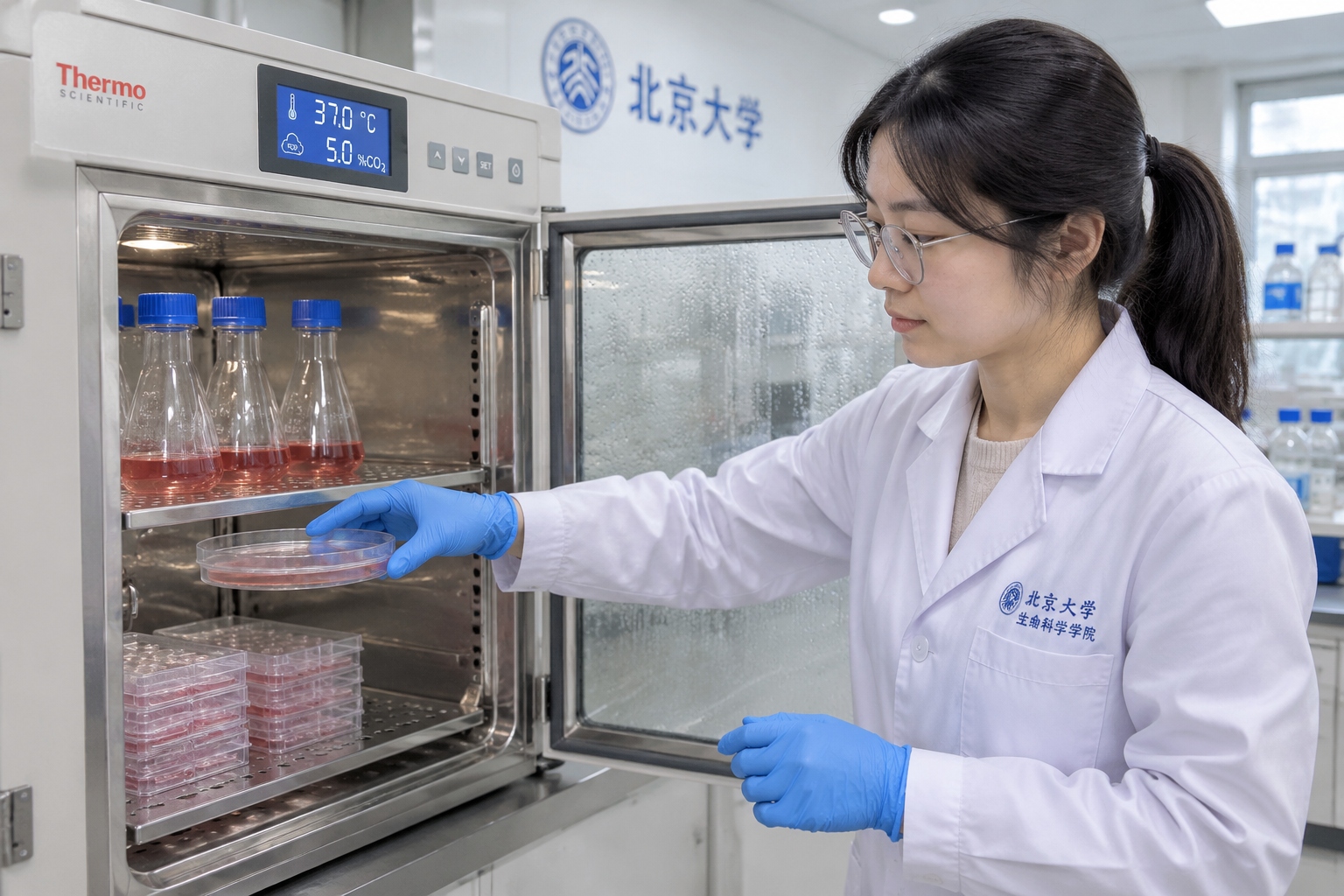
Walk into one of the cell labs in Guangzhou Science City on a weekday morning and the most important machine is not the supercomputer down the corridor. It is a stainless-steel box about the size of a hotel minibar, humming at 37°C with 5% carbon dioxide. A technician in a white coat opens the glass door, slides out a transparent plastic dish and holds it up to the light.
Inside is a thin film of living human cells. They are taking in sugar, burning oxygen, dividing. Nothing about it looks dramatic. But this is what researchers mean when they describe China’s newest biology megaproject as something that “can breathe.”
The project has a long official name: the Human Cell Lineage Big Science Research Facility (人类细胞谱系大科学研究设施). It is being built in Huangpu district, led by the Guangzhou Institutes of Biomedicine and Health under the Chinese Academy of Sciences, with Chinese state media reporting an investment of roughly 3.2 billion yuan, or about US$450 million. The plan is for a campus of automated culture rooms, imaging halls and a data centre, with full operation targeted for the late 2020s.
The easiest way to understand it is to drop the word “facility” for a moment. Think of a library where the books are alive, keep rewriting themselves, and can be dosed with a drug to see what happens.
What “cell lineage” actually means
You started as one cell. That cell divided, and its daughters divided, and after a few trillion rounds of that you became a person with skin, liver, retina, blood and about 200 recognisably different cell types — roughly 37 trillion cells in total, by the standard estimate.
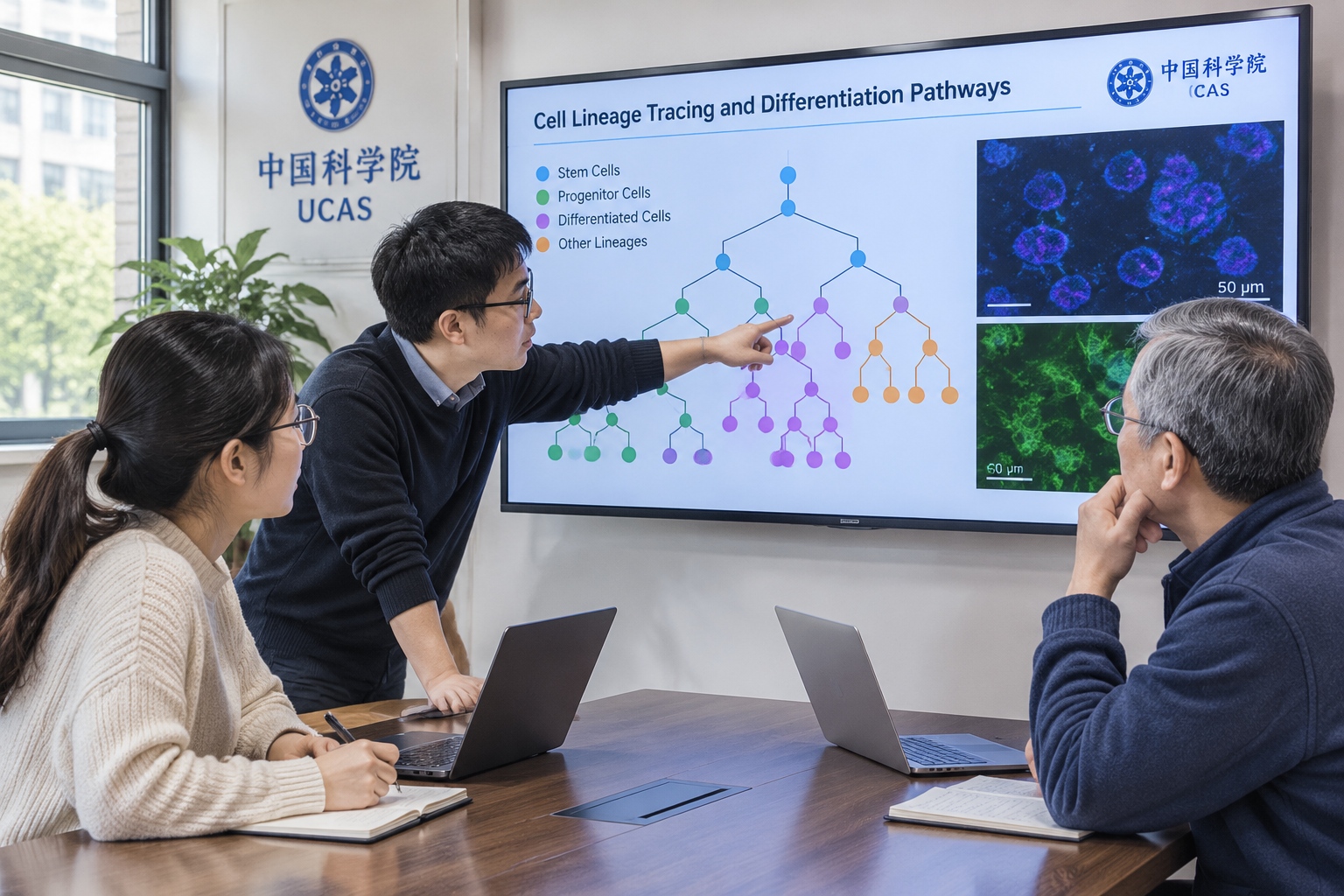
At every fork in that road, a cell made a choice. It read chemical signals, switched certain genes on, switched others off, and committed to a career. A cell lineage is simply the record of those choices: who came from whom, in what order, prompted by what.
Researchers already have partial maps. The international Human Cell Atlas, launched in 2016, has published reference data for dozens of tissues. But most of these are snapshots — a slice of tissue frozen at one moment, ground up and sequenced. Useful, like a photograph of a city. Not the same as traffic data.
The Guangzhou facility is aiming at the moving version. Grow human cells under controlled conditions, watch them differentiate in real time, image them, sequence them, and record the branch points. Do that at scale, with standardised methods, and you get something closer to a timelapse of how a body gets assembled.
Why a mouse is not a small human
Here is the problem that makes this worth billions. Most drugs fail.
Roughly nine out of ten candidate medicines that enter clinical trials never make it to market, and for cancer drugs the failure rate is often put above 95%. A big reason is the gap between the animals we test on and the people we treat. A mouse liver metabolises compounds differently. A mouse immune system is not a scaled-down human one. A drug can cure a mouse and do nothing, or something dangerous, in a person.
That gap is expensive in a very literal way. Developing a single new medicine is commonly estimated at over a decade and somewhere between US$1 billion and US$2.6 billion, depending on how you count the failures. Most of that money is spent discovering, in year eight, what could have been known in year one.
Human cell models change the arithmetic of early testing. Instead of asking “does this compound shrink a tumour in a mouse,” you can ask “which cell type in this dish does it disturb, and at what dose.” Liver cells can flag toxicity. Heart muscle cells grown from stem cells can show an irregular rhythm within hours. Intestinal organoids — tiny self-organised balls of gut tissue — can show whether a drug crosses a barrier or damages it.
That is the “会试药” part of the Chinese phrase: not just a map, but a test bench.
Standardise, photograph, share
The engineering challenge is less glamorous than the biology, and probably harder.
Cell experiments are notoriously fussy. Two labs using the same cell line can get different results because of subtle differences in medium, temperature, handling, or how many times the cells have been passaged. Multiply that by thousands of experiments and the data becomes hard to compare.
So a central piece of the facility is standardisation. A common set of protocols, a common set of cell lines, a common way of recording what was done. The comparison people use in China is the switch from a messy pile of charging cables to a single USB-C port: boring, unglamorous, and the thing that makes everything else possible.
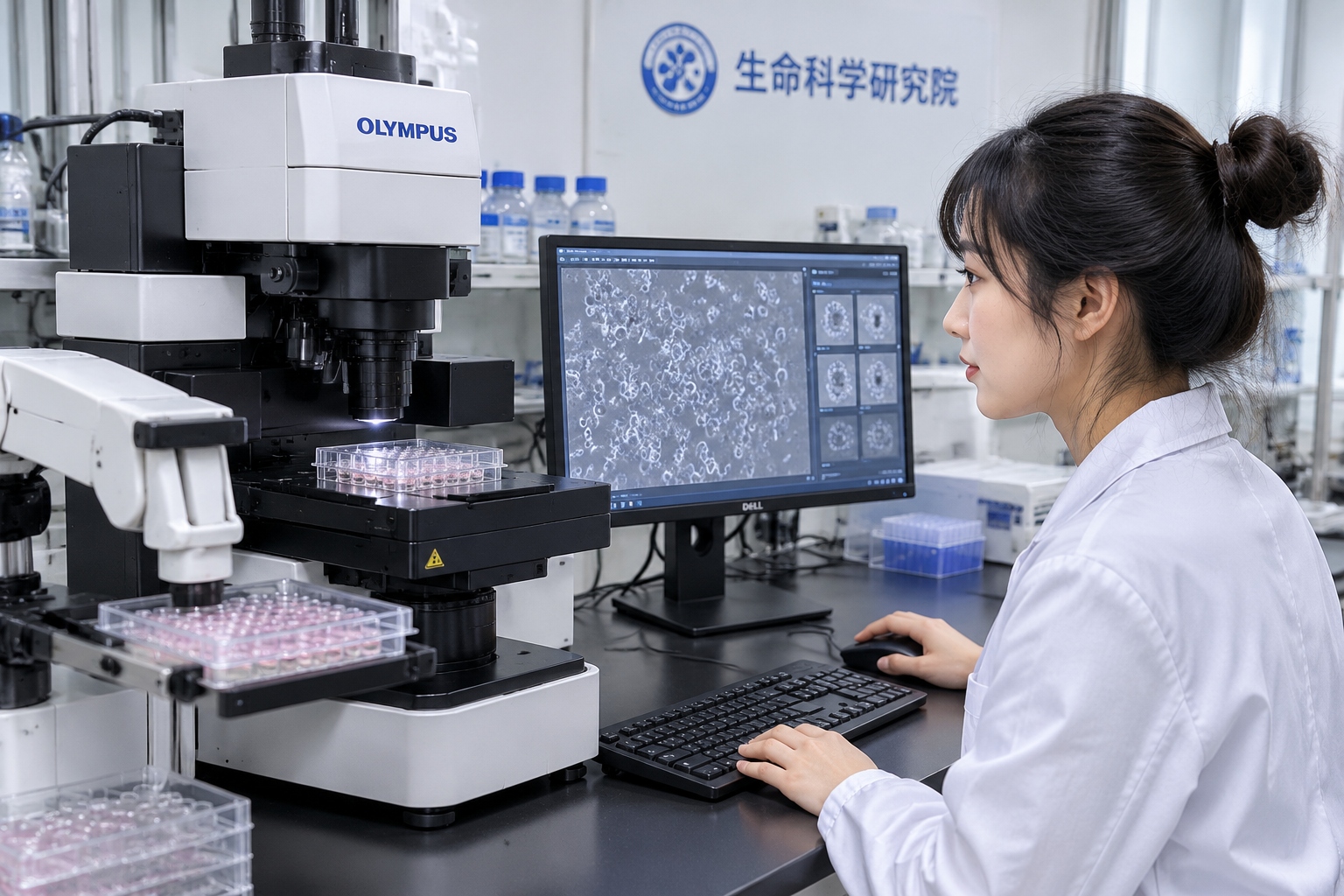
The second piece is imaging. Cells are photographed automatically, plate after plate, tens of thousands of images a day, and machine vision classifies what it sees — a cell that has stopped dividing, a nucleus that has begun to wrinkle, a colony that has drifted off its developmental path. The third piece is the data platform, designed so that a researcher in another city can pull a lineage map rather than rebuild it from scratch.
None of this is uniquely Chinese. Labs in the Netherlands, Japan, the UK and the US are pushing the same ideas. What the Guangzhou project adds is scale and a national commitment to shared infrastructure — the same logic behind China’s other big science facilities, from synchrotron light sources to spallation neutron sources.
What it can’t do
This is where the hype usually gets out of hand, so it is worth being blunt.
A dish of cells is not a body double. It has no immune system patrolling it, no blood flow carrying a metabolite from the gut to the brain, no kidneys clearing it, no thirty years of accumulated damage. An organoid is an approximation with a short lifespan, not a miniature organ.
Which means the facility cannot replace clinical trials. It can only make the queue in front of them shorter and better informed. Anything that comes out of it still has to go through animals, then humans, then regulators — a process measured in years, for good reason.
There are also open questions that come with the science itself. Human cell models sit close to the ethical line around embryonic stem cells and tissue donation, and China, like the US and Europe, regulates that work carefully. Consent, privacy and who gets access to large cell databases are unresolved everywhere, not only here.
What changes for the rest of us
The practical payoff is unglamorous: fewer dead ends.
If a compound is going to poison the liver, it is much cheaper to learn that from a plate of liver cells in month three than from a Phase II trial in year six. Cheaper failure means more shots on goal for rare diseases that drug companies currently skip because the market is too small. It means faster screening when a new virus appears and everyone needs to know which existing drugs might work. And it means a better chance that personalised medicine — matching a drug to a patient’s own cells — moves from conference slides into ordinary hospitals.
For most people in Guangzhou, none of this will feel like a revolution. The facility will sit behind a fence in a science park, next to office towers and a metro stop, and the visible change will be more cranes, more postdocs, more coffee shops.
But the warm box in the lab is the part worth keeping in mind. The future arriving here is not a glowing city of robots. It is a technician lifting a plastic dish to the light, and a slow accumulation of knowledge about how a single cell becomes a person — one that might, eventually, keep a drug from failing in someone you know.