

Morning at Gongchen Bridge
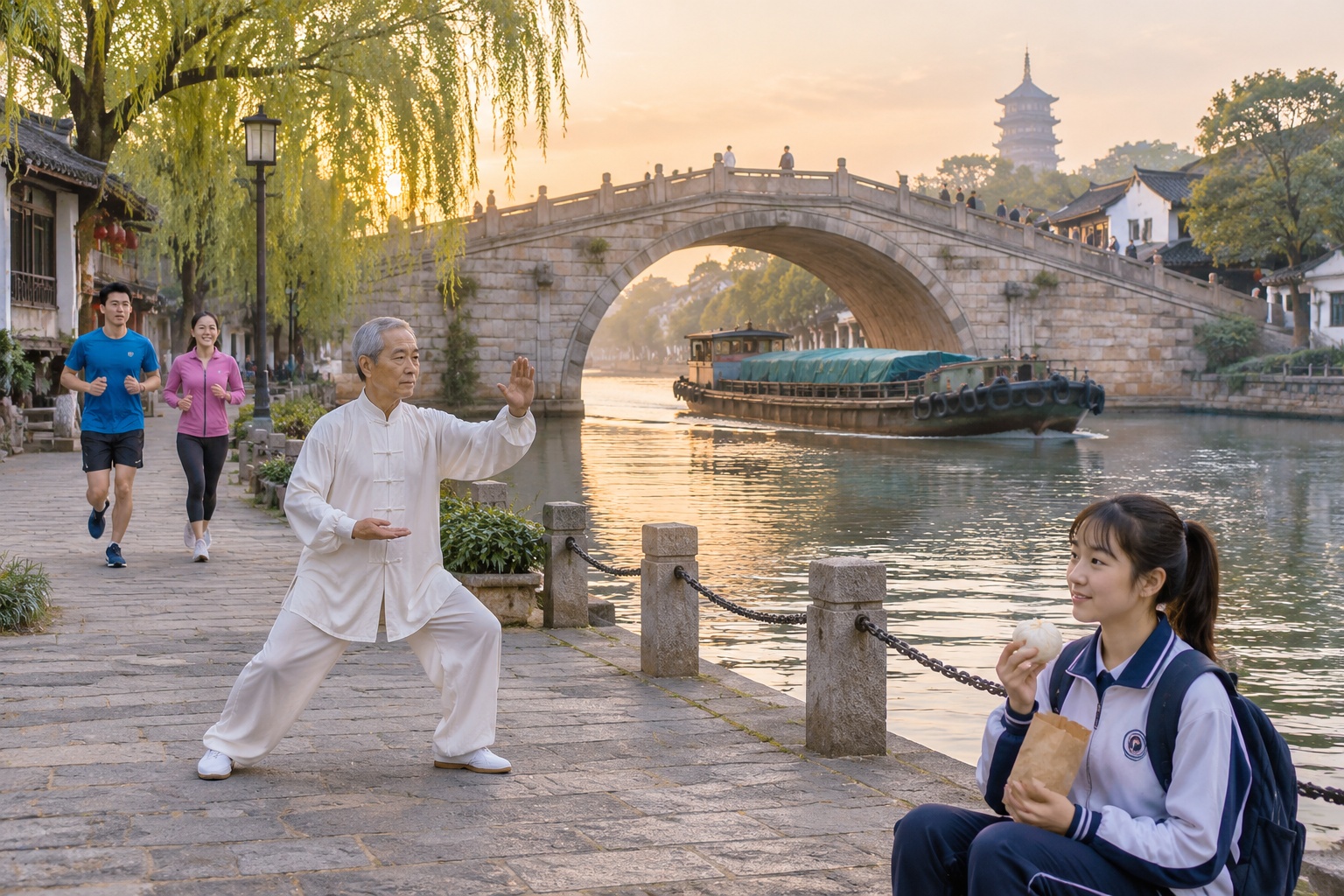
At six in the morning, the stone steps of Gongchen Bridge in Hangzhou are already busy. A student in a school uniform eats a rice ball while a delivery rider checks his phone. An elderly man folds a tai chi sword into a cloth bag. Below them, a cargo boat slides under the arch, its engine a low hum that shakes the morning air. A visitor from Venice, camera in hand, asks me whether this is also a canal. It is. But the Grand Canal is not a single postcard waterway. It is a system, and it has been working for centuries.
Most visitors know China through the Great Wall, the Forbidden City or the skyline of Shanghai. The Grand Canal is less photogenic at first glance. It is a long, flat, often ordinary-looking piece of water that runs through neighborhoods, industrial parks and farmland. That ordinariness is exactly why it is useful for understanding the country. The canal shows how China has moved people, food, goods and ideas across a huge landmass, and how it still does.
The best-known section, the Beijing-Hangzhou Grand Canal, is about 1,794 kilometers long. In 2014, the UNESCO World Heritage listing for the Grand Canal included 27 river sections and 58 heritage sites, with about 1,011 kilometers of heritage waterways. It linked five major river systems: the Hai, Yellow, Huai, Yangtze and Qiantang. For European readers, the closest comparison is not Venice but the Erie or Midi canals, on a much larger scale and over a much longer life. Parts of the Chinese canal still carry freight. Others irrigate fields, drain cities, move water and host parks, bike paths and morning exercise.
A waterway that fed the Silk Road, without being the Silk Road
It is tempting to call the Grand Canal a water Silk Road. A more accurate description is less romantic and more interesting. The Silk Road was a network of overland and maritime routes. The canal was the internal supply line that made those routes work. Grain, salt, silk, porcelain and tea moved along it. The northern capital needed southern rice. Armies needed supplies. Tribute missions and merchant caravans needed goods to trade at ports and border markets.
The Sui dynasty built large canal sections in the 7th century, and the Yuan dynasty later reshaped the route into the Beijing-Hangzhou line. The canal did not replace the Silk Road. It connected the Silk Road to China’s interior. A bolt of silk from the Yangtze Delta could travel by canal to a northern depot, then onward by road or sea. A Persian merchant in Tang-dynasty Yangzhou could buy ceramics and tea in a city made rich by canal trade. Hangzhou, at the southern end, became a major commercial and cultural center; its markets and workshops were tied to the canal network.
This is where the canal’s global story begins. It was not a Chinese curiosity. It was one of the logistical foundations that allowed Chinese goods, technologies and ideas to reach other parts of Asia and beyond. The canal also brought foreign goods and people inward. Envoys, monks, soldiers, merchants and missionaries moved along the same water. Some stayed. Their footprints are still visible.
Mosques, churches and the footprints of traders
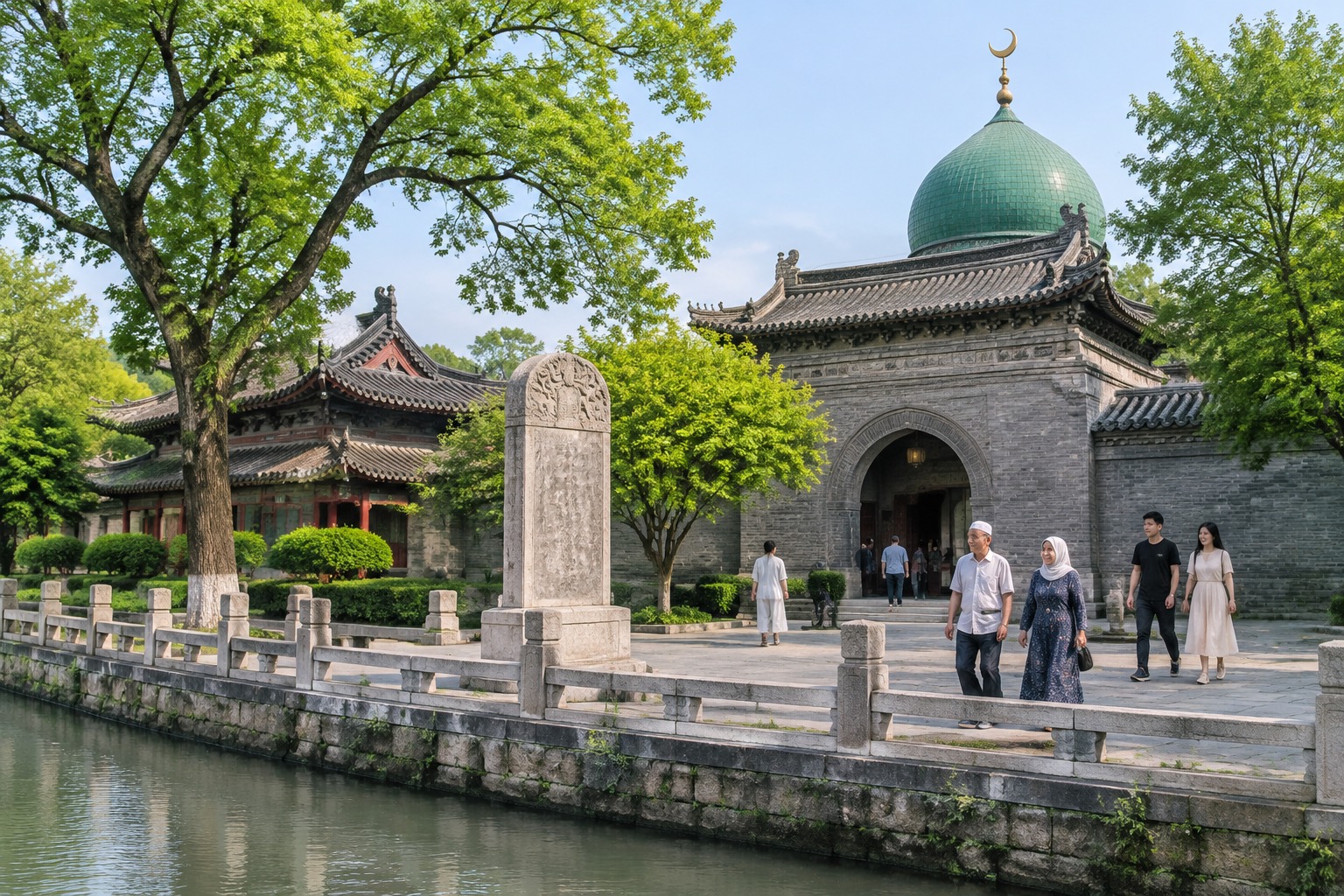
In Yangzhou, a short walk from the old canal, Puhading Garden holds the tomb and mosque associated with Puhading, a Muslim figure from Arabia who died in the city in the 13th century. The site is not a museum reconstruction. It is a quiet, working place of memory and worship, with Chinese garden elements and Islamic inscriptions. For a European reader, it may recall the way port cities in Liverpool, Marseille or Rotterdam accumulated sailors’ churches, synagogues and mosques near the docks. Trade routes create communities, and communities build places to pray.
Hangzhou’s Phoenix Mosque is another example. It stands in the old city, not far from the canal’s southern terminus, and is one of China’s oldest mosques. Its history is usually traced to the Tang dynasty, with major rebuilding in the Yuan. Jining, in Shandong, has the East Great Mosque near the canal. Further north, Tongzhou, at the Beijing end, has a Catholic church that served a canal town long before the modern city grew around it.
These buildings matter because they complicate a simple picture. The canal was not only a Chinese engineering project. It was a corridor where people from Central Asia, the Middle East, Europe and other parts of Asia met, traded and sometimes settled. The architecture is not exotic decoration. It is the ordinary result of people needing a place to worship, bury their dead and raise families.
What a living canal feels like today
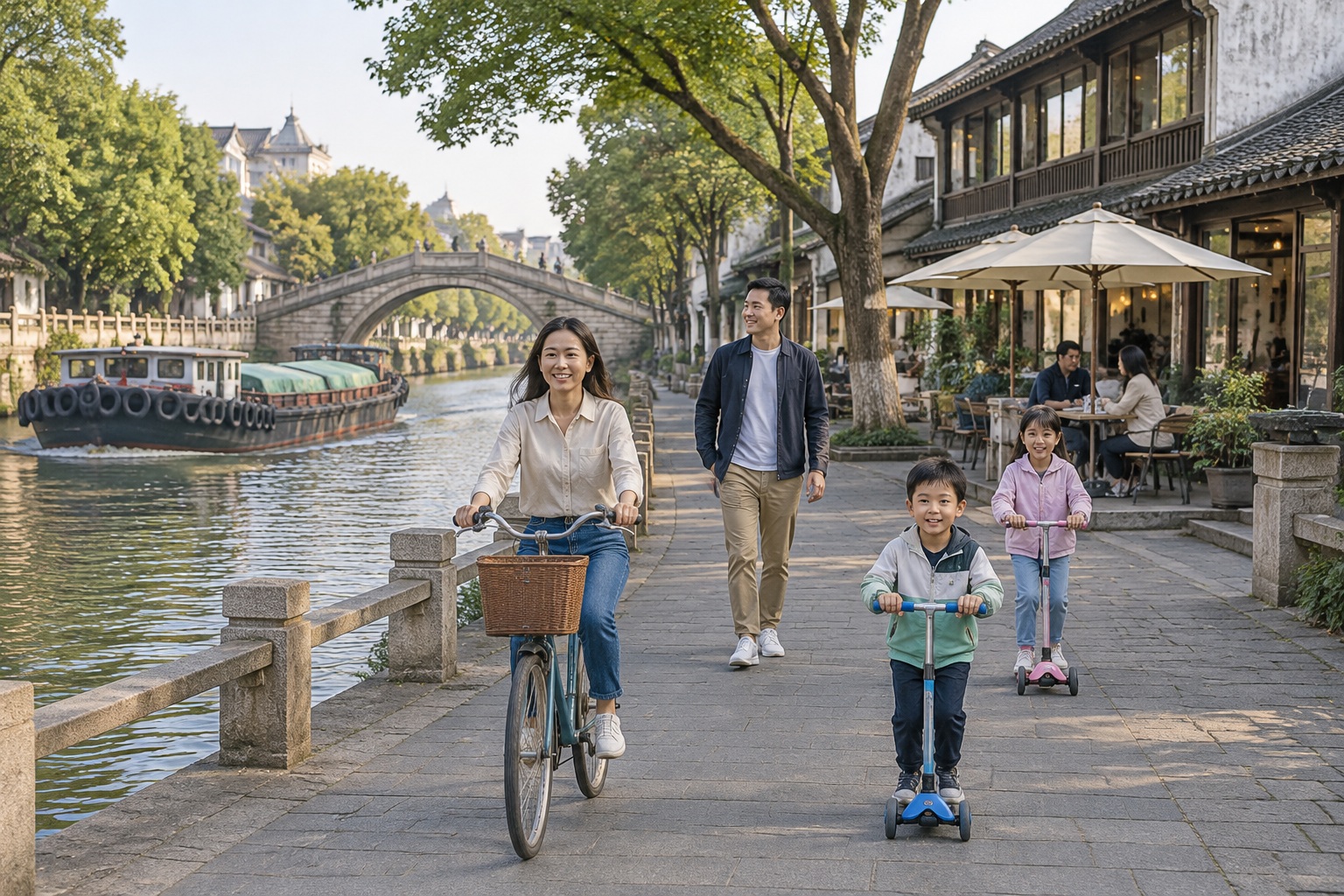
In Hangzhou, the area around Gongchen Bridge is a good place to see the canal’s double life. On one side is the Qiaoxi historic block, with workshops, small museums and old warehouses converted into cafes. On the other side, cargo boats still pass. Residents walk their dogs, children ride scooters, and runners follow the towpath. The canal is not fenced off as a monument. It is part of the neighborhood’s daily circulation.
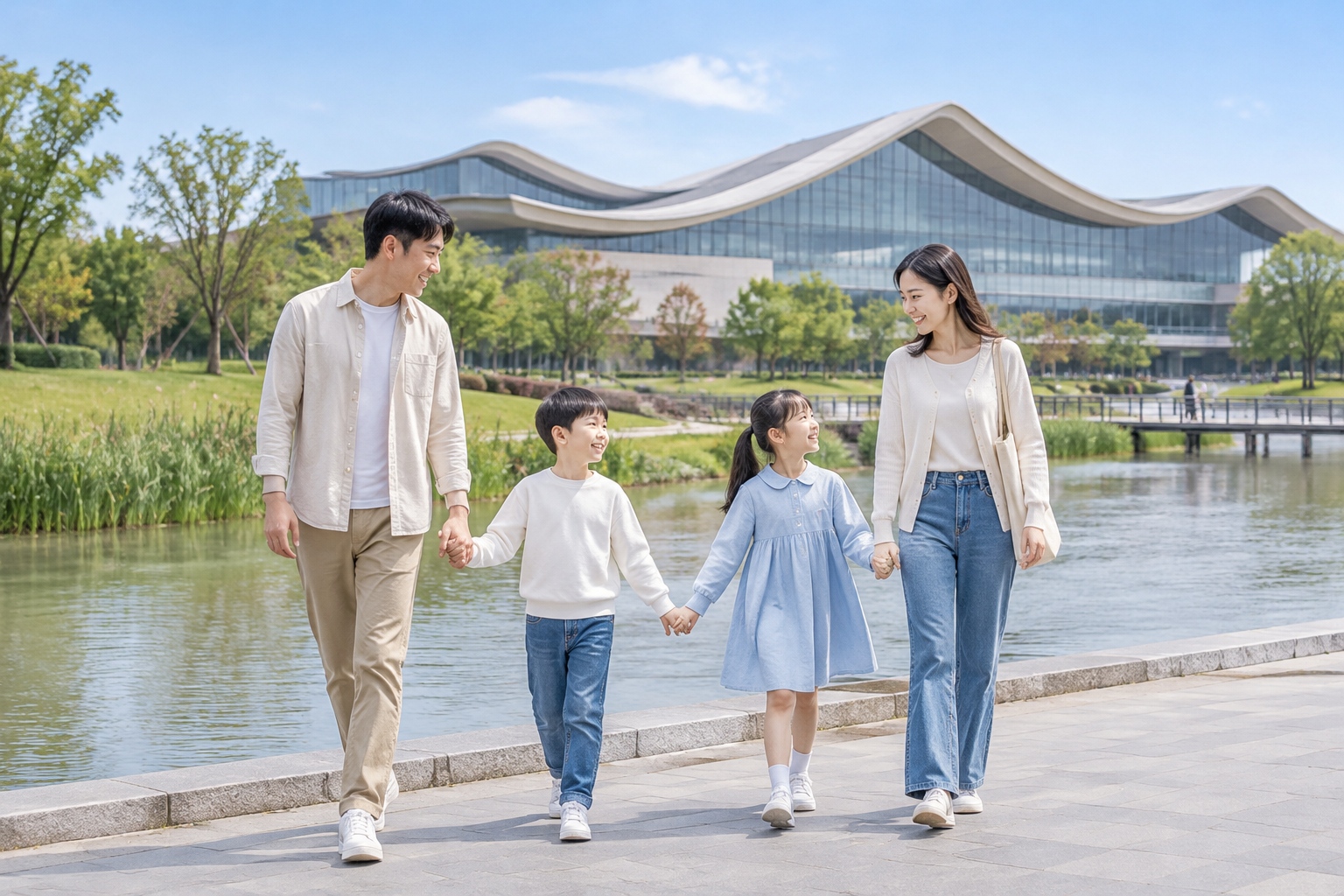
Yangzhou’s Sanwan section tells a different story. It was once an industrial waterfront. In the past decade, the city cleaned up the area and turned it into a large public park. The China Grand Canal Museum opened there in 2021. Families visit on weekends; local people use the paths in the evening. In Beijing’s Tongzhou district, the Grand Canal Forest Park has become a weekend destination for people from the city center. In Jining, the Nanwang water-control complex shows how engineers used locks and dams to manage water levels centuries ago.
If you come from Amsterdam or Venice, you will recognize the pleasure of water in a city. You may be surprised by the scale and by the mix of uses. This is not a canal frozen for tourists. It is infrastructure, public space and heritage at the same time. That mix creates friction. Freight boats and pleasure boats share the water. Old neighborhoods attract visitors and rising rents. Water quality is better than it was, but it is not uniformly clean. The canal is not a perfect postcard. It is a working landscape with compromises.
The future of a global heritage corridor
Since the 2014 UNESCO listing, the Grand Canal has become a national cultural project. China is building a Grand Canal National Cultural Park, a long-term effort to connect heritage sites, green space and local economies across provinces. The South-to-North Water Diversion project uses parts of the canal and related waterways to move water north. That adds a modern engineering role to an ancient route. It also raises hard questions about water quality, ecological flow and the needs of cities along the way.
The global significance is not that the canal is the biggest or oldest. It is that it is a living linear heritage site. Most World Heritage sites are points on a map: a palace, a cathedral, a wall. The Grand Canal is a line across a continent-sized country, managed by different provinces and used by different industries. Its future depends on coordination that no single city can achieve alone.
Other countries with old canals face similar choices. The Erie Canal in New York State is now mostly a recreation corridor, but it still shapes local identity. The Canal du Midi in France struggles with tourism pressure and tree disease. The Chinese canal is larger, but the questions are familiar: How do you keep freight moving without damaging heritage? How do you bring visitors without turning neighborhoods into stage sets? How do you protect water quality while cities grow?
Back at the bridge
By seven, Gongchen Bridge is fully awake. The student has gone to class. The tai chi swords have been packed away. The Venetian visitor is still taking photographs, now of a grandmother pushing a stroller across the stone steps. A cargo boat sounds its horn and disappears under the arch. The canal connects east and west in history books, but it also connects a school run, a delivery route and a morning walk. That is the part I want foreign readers to see. The Grand Canal is not a relic of globalization. It is a daily machine for it.