

Salt Flats That Supply the World’s Batteries
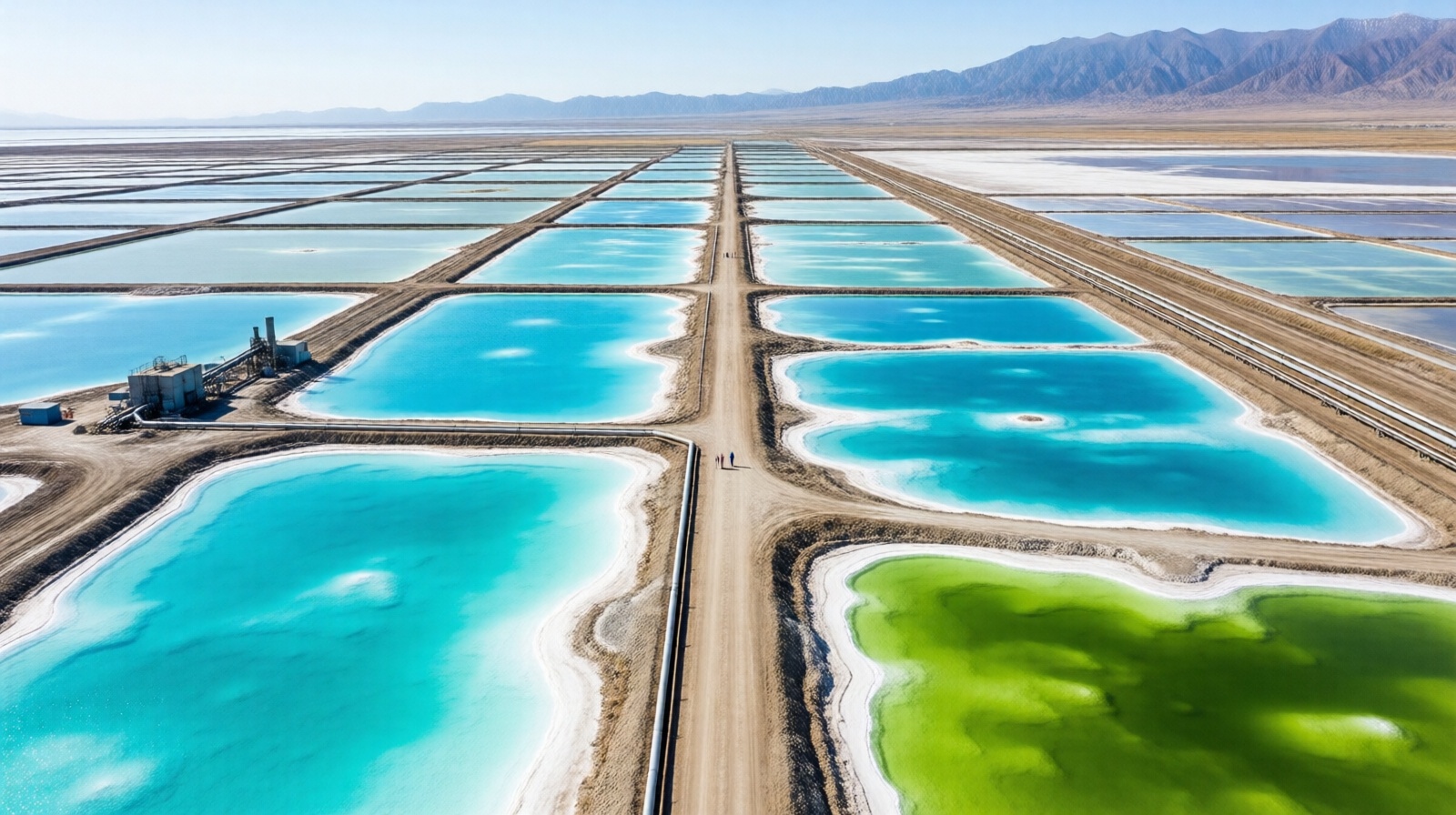
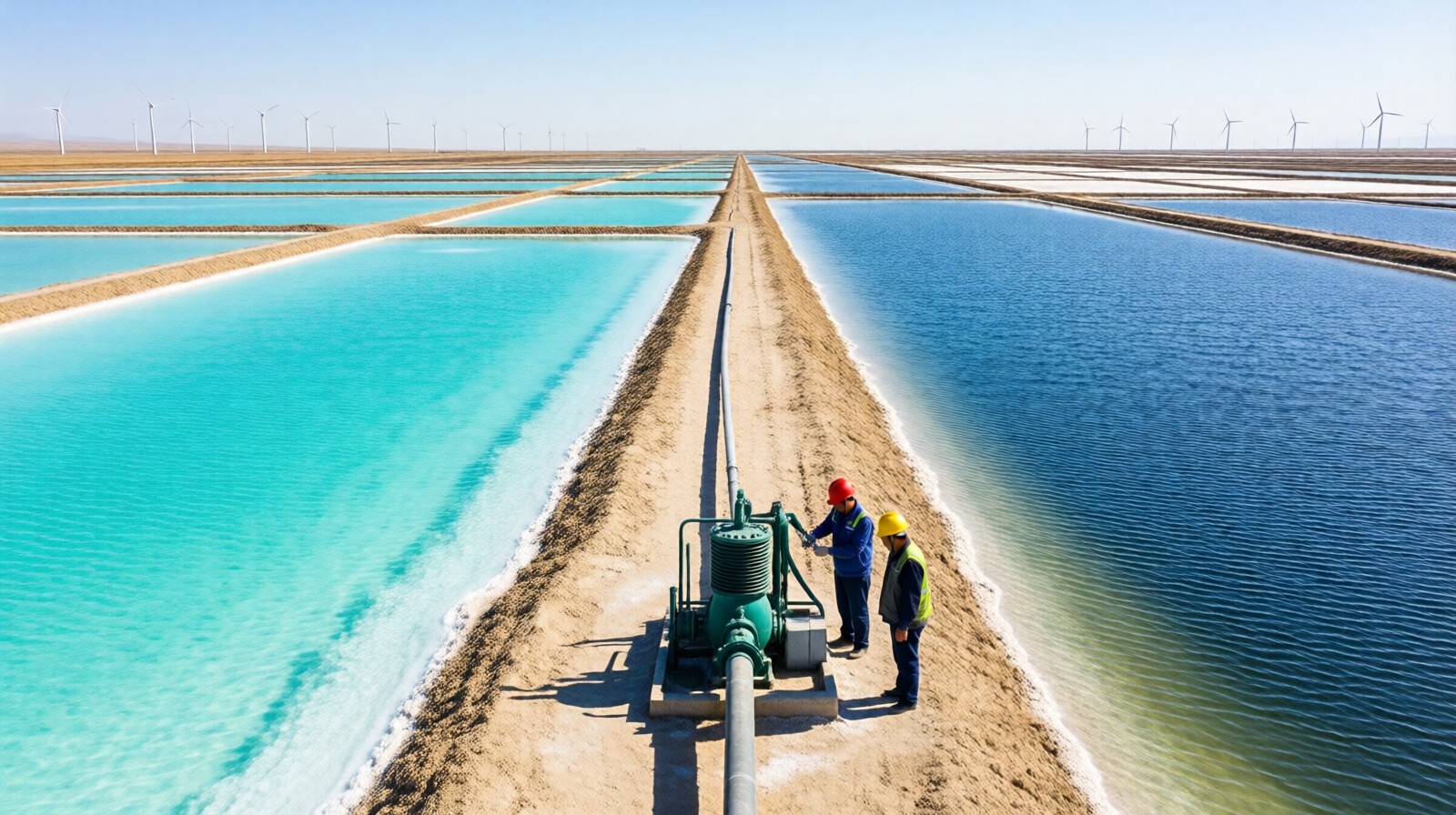
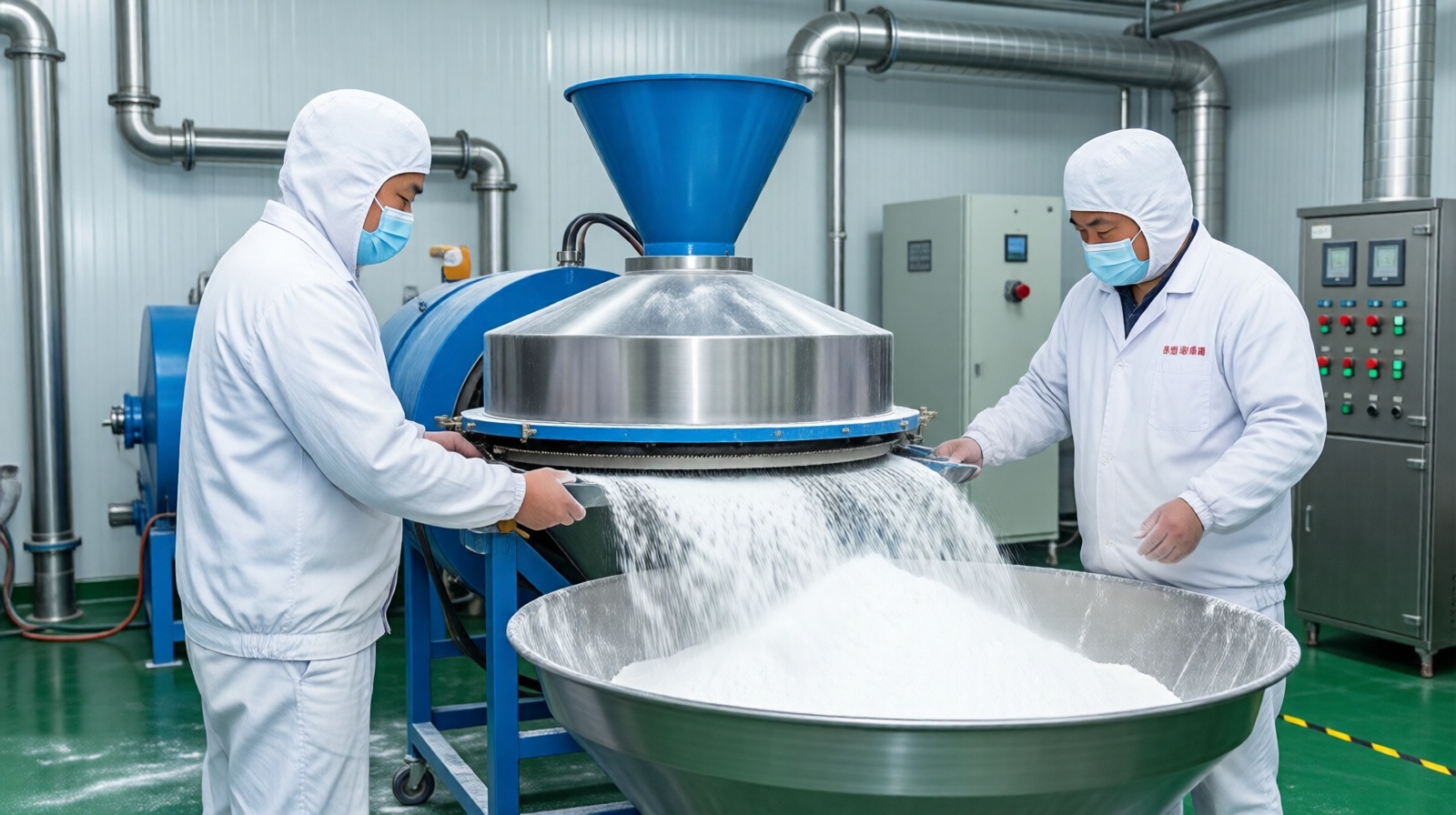
At an altitude of 2,700 meters, the Chaerhan Salt Lake in China’s Qinghai province doesn’t look like a mining site. It appears as an endless patchwork of turquoise ponds separated by narrow embankments, where white crystals crust over the edges. Wind turbines spin on the horizon. Below the surface, a saturated brine containing lithium ions moves through a complex network of pumps and pipes. On dry ground, workers in insulated suits regulate the flow from one pond to another, using evaporation to raise the brine concentration. After a year or more, the enriched brine is fed into processing plants, where chemical reactions produce fine white powder — lithium carbonate.
This is China’s “white petroleum.” In the past decade, lithium has become as critical to the energy transition as oil was to the industrial age. Each electric vehicle battery contains roughly 8 kilograms of lithium carbonate equivalent. The world’s biggest carmakers are fighting for this metal, and a large share of it now comes from a remote, wind-scoured basin thousands of miles from Shanghai’s skyscrapers.
Why Salt Lake Lithium Matters
The neat thing about “salt lake lithium” is that it is extracted from water, not dug from hard rock. Traditional mining in places like Western Australia involves blasting granite and crushing ore, which is expensive and energy-hungry. Salt lake brine, by contrast, is naturally concentrated in lithium, so it tends to be cheaper to process — if the chemistry cooperates. The South American “lithium triangle” (Chile, Argentina, Bolivia) has been the world’s leading source of brine lithium for decades. But China’s province of Qinghai, sitting at the northeastern edge of the Tibetan plateau, has quietly become another heavyweight.
Qinghai’s Qaidam Basin holds about one-fifth of China’s proven lithium reserves and — more importantly — some of the world’s most abundant lithium-rich brines. Official statistics from the Qinghai Geological Survey put the province’s lithium reserves at more than 20 million tonnes (in lithium carbonate equivalent). While this figure includes both proven and probable reserves, it gives a sense of scale: it’s comparable to the resources of the Lithium Triangle combined.
But the basin’s brine composition is different from South America’s. The magnesium-to-lithium ratio in Qinghai can be 50 times higher than in Chile, meaning lithium is mingled with a heavy load of magnesium. Separating them has historically been a nightmare for chemical engineers. For decades, the province’s salt lakes were exploited mainly for potassium minerals, used as fertilizer. Lithium was a headache, not a treasure.
The Technical Leap That Turned a Problem Into an Advantage
So how did a technically hostile brine become a major source of lithium carbonate? The answer is a combination of new extraction methods that Chinese companies developed over the past 15 years.
The breakthrough was “selective adsorption.” As the name suggests, a porous manganese oxide or alumina-based material absorbs lithium ions from the brine, leaving magnesium, sodium, and other impurity ions behind. When the material is washed with dilute acid, it releases a high-purity lithium chloride solution. The second key method is membrane separation, where special filters physically block larger magnesium ions while letting lithium pass through.
In 2018, Qinghai’s first commercial-scale adsorption plant began operating using technology licensed from the local research institute, the Qinghai Institute of Salt Lakes. Today, the facilities run by Salt Lake Industry, in partnership with Ganfeng Lithium, produce around 40,000 tonnes of lithium carbonate annually. Another major producer, CITIC Guoan, uses a calcination–leaching route. Overall, Qinghai’s annual lithium carbonate output now exceeds 100,000 tonnes, roughly 10% of global production.
These are real numbers, but the more striking detail is how fast the technology evolved. In 2010, China extracted less than 5,000 tonnes of lithium from its domestic salt lakes. By 2023, the figure had grown twentyfold. It wasn’t a natural progression — it was an industrial response to China’s electric vehicle push.
From Salt Lake to Battery Pack
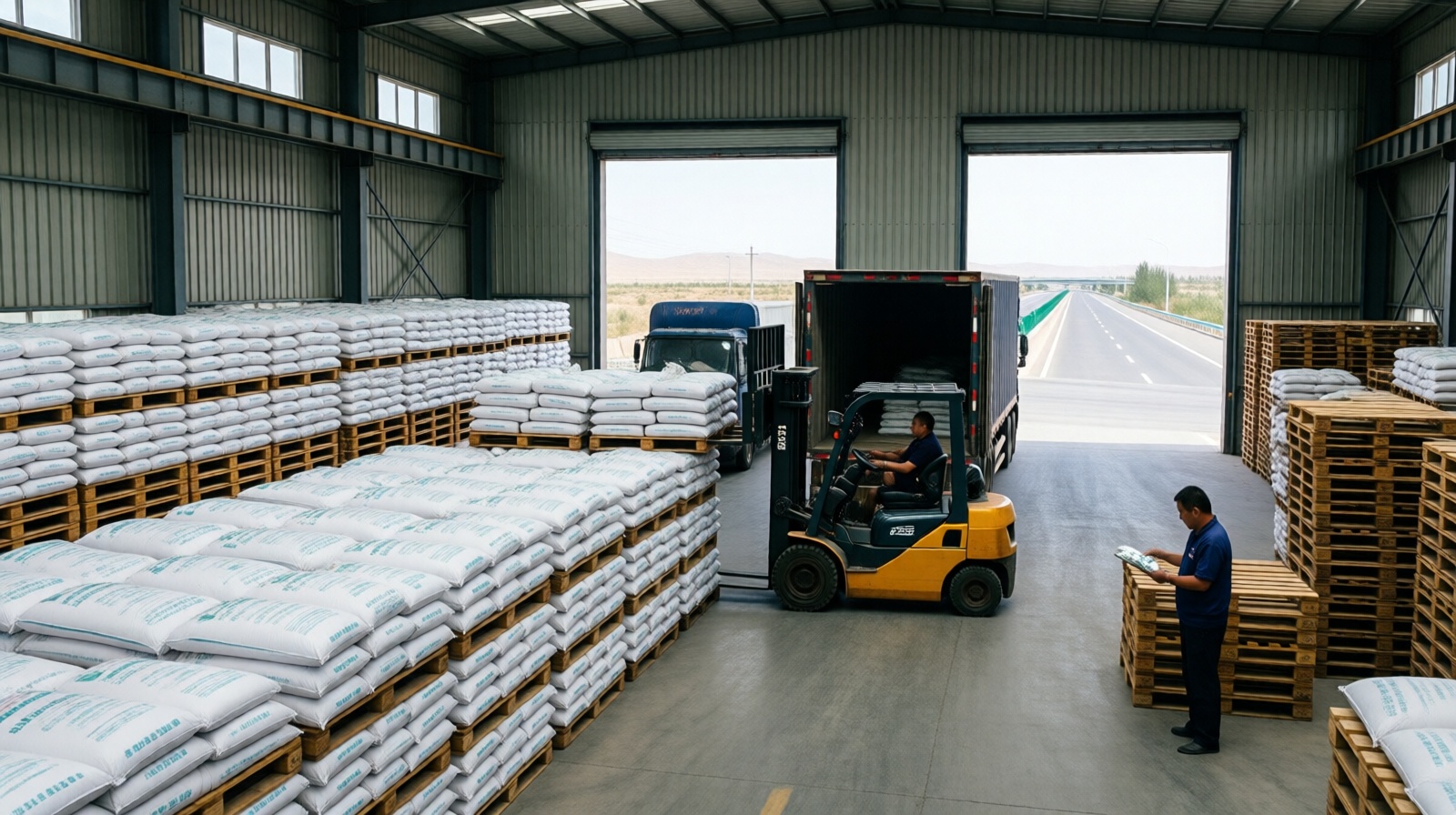
Once produced, Qinghai’s lithium carbonate is a whitish substance similar in appearance to icing sugar. It is packed in 500kg bags and loaded onto trains and trucks heading for Chengdu, Changzhou, and other battery hubs. In those plants, it is refined into lithium hydroxide and blended with nickel, manganese, and cobalt to make cathode powder. The powder then gets coated onto foil, assembled into cells, and sealed into battery packs. Those packs find their way into passenger cars, buses, and stationary grid storage units.
The connections are direct. Major battery makers, including CATL and BYD, are among the buyers of Qinghai-based lithium. China’s demand is huge: over half of the world’s electric vehicles are sold in China. With Chinese automakers exporting EVs to Europe and Southeast Asia, the lithium from Qinghai indirectly powers the Tesla Model Y built in Shanghai, the BYD Atto 3 driven in Norway, and the Volkswagen ID.4 assembled in Anhui.
The Environmental Balance Sheet
No extraction industry is purely green. Qinghai is a high-altitude desert where water is scarce and the ecosystem is fragile. Salt lake evaporation ponds cover hundreds of square kilometres, and the pumps that feed them draw groundwater that has accumulated over thousands of years. Local environmental groups have raised concerns about dropping water levels and damage to wetland habitats along the edges of salt lakes.
The industry is aware of its reputation. China’s Ministry of Ecology and Environment has issued guidelines for salt-lake lithium operations, mandating water recycling, dust reduction, and environmental monitoring. Some large plants now use a closed-loop circulation system that recycles the brine after lithium removal, minimizing waste and reducing water consumption. For example, a new direct lithium extraction (DLE) pilot plant in the Qaidam Basin aims to recover lithium without large evaporation ponds, cutting land use by up to 90%. Still, the concern isn’t fully resolved, and balancing industrial growth with a fragile environment will remain one of Qinghai’s most delicate tasks.
A Global Price Setter?
Does Qinghai have enough weight to shape global lithium prices? Not alone, but it is part of China’s larger dominance in lithium refining. China handles about 60% of global lithium chemical production, even though it mines less than 20% of the raw ore. Qinghai’s output gives Beijing leverage with domestic producers, cushioning the impact of price spikes in Australia or Chile. When global lithium prices soared in 2021–2022, Qinghai ramped up output faster than many analysts expected. When prices dropped in 2023–2024, the salt-lake producers remained profitable because their production costs are typically in the lower half of the global cost curve.
Moreover, Chinese control of lithium refining means transparency can be limited. Industry reports and pricing agencies have noted that the actual state of Chinese salt-lake production isn’t always clear, leading to speculative swings in futures markets. Yet for international buyers, Qinghai’s reliability as a supplier is more important than the price volatility.
What the Future Holds
Looking forward, the world’s appetite for lithium won’t weaken. Electric vehicle deployment is still in its early days, and energy storage is expanding even faster. The International Energy Agency predicts that global lithium demand could rise from 650,000 tonnes in 2022 to 2 million tonnes by 2030. Qinghai’s known reserves and existing production lines put it in a strong position to expand further.
However, emerging technologies might change the game. Direct lithium extraction (DLE) — which allows lithium to be pulled directly from brine in a matter of hours rather than months — could make salt-flat production faster and cheaper. If DLE is perfected, it could unlock challenging sites in the United States, Germany, and elsewhere, reducing the world’s dependence on China’s salt lakes. Qinghai is already testing DLE in pilot projects. If commercialised, it could push its production to above 200,000 tonnes a year. If not, it may still remain competitive due to its scale and experience.
Another wildcard is sodium-ion batteries, which don’t require lithium, but they are unlikely to take over a major share of EV batteries before the 2030s. For the coming decade, lithium remains irreplaceable.
Conclusion: A Desert Province on the Global Energy Map
A decade ago, the brine beneath Chaerhan was treated as a nuisance in potash production. Now, it is a cornerstone of the clean-energy supply chain. The shift didn’t happen naturally; it was driven by Chinese industrial policy, heavy R&D, and huge investments in a place most people have never heard of. The white powder that workers shovel into bags in the middle of a barren desert will power a global fleet of electric vehicles. It’s a story of technological will, environmental trade-offs, and the complicated geography of the energy transition.
If you ever see a map of the world and look at the heart of Asia, you’ll notice a cluster of blue ponds with no city nearby. That’s the place where lithium finds its way out of the earth — and into your phone.
Start the discussion at forum.chinacomes.com