
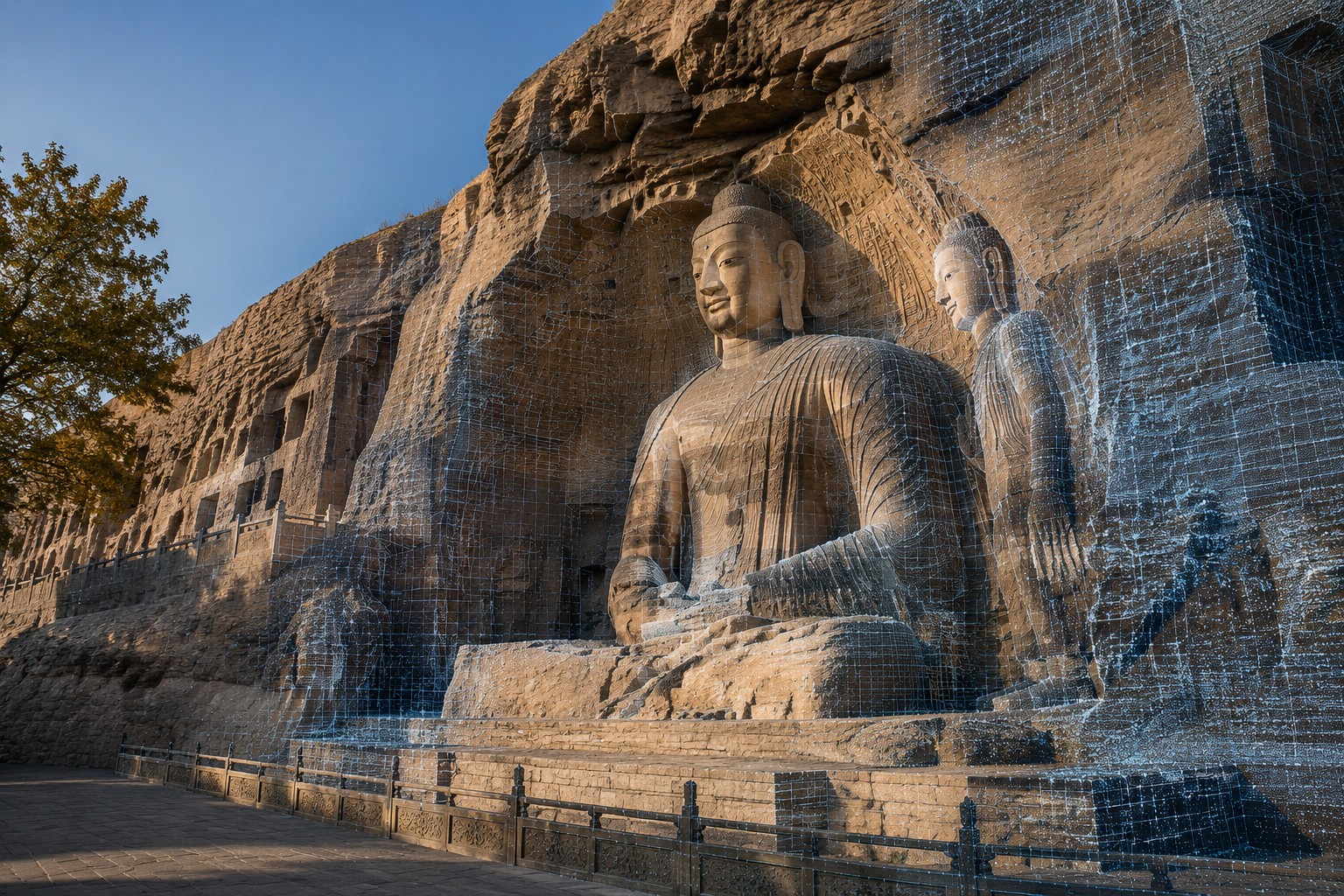

A Conversation with a 1,500-Year-Old Buddha
When you walk into the Yungang Grottoes near the city of Datong in northern China, the first thing that hits you is scale. The giant seated Buddha in Cave 5 is 17 meters tall—a silent figure carved into the sandstone cliff more than 1,500 years ago. But here’s something you didn’t expect: many visitors aren’t just looking at the statues. They’re holding up their phones.
Some are taking photos, sure. But a growing number are using an official AR app that recreates how the grottoes may have looked when freshly painted—vivid blues, reds and golds that have long worn away. On the screen, the weathered Buddha gains color and clarity. The stone seems alive again.
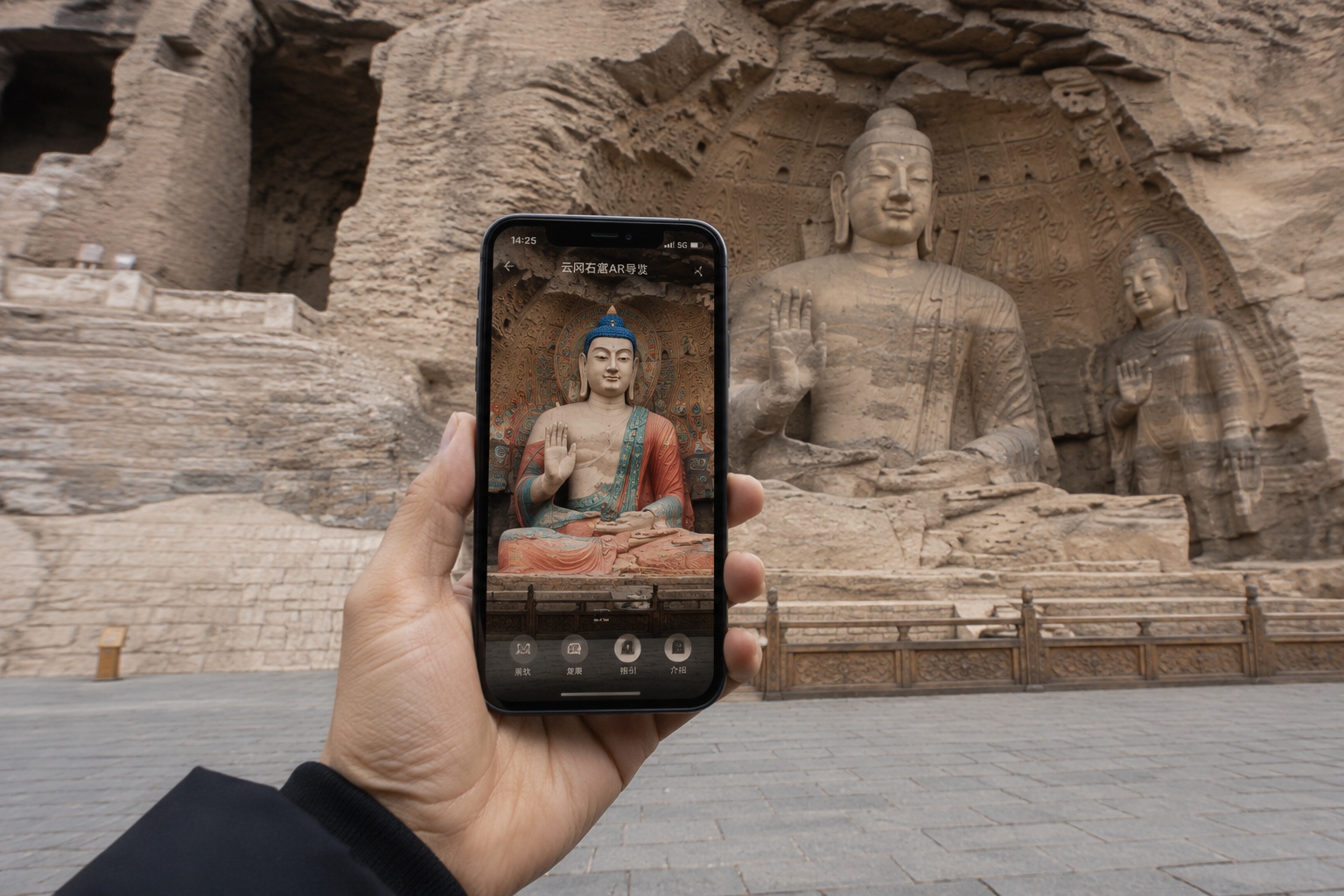
That app is not a gimmick. It’s a window into one of China’s most ambitious efforts to protect culture: digital restoration of the Yungang Grottoes, a UNESCO World Heritage site that has survived wars, earthquakes and the slow, ruthless work of wind and rain.
Yungang Grottoes, More Than Just Ancient Rock
Carved between 460 and 525 AD, Yungang is a treasure of early Buddhist cave art. It holds 51,000 statues, spread across 252 caves and niches, deeply influenced by Indian, Central Asian and Chinese styles. For historians, it’s a visual record of the Northern Wei Dynasty, a period when Buddhism flowed into China along the Silk Road.
But sandstone is fragile. Exposure to air and moisture causes it to crumble. Acid rain worsens the damage. Some statues have lost their faces. Others are so decayed that even a gentle touch could make them fall apart. The traditional approach—physical restoration—is often risky and irreversible. So conservators turned to a different tool: pixels.
Why Digital Restoration? The Battle Against Slow Decay
Think of digital restoration as a high-tech insurance policy. Instead of touching the stone, you record every detail in the most precise way possible, creating a data-rich copy that can outlive the physical original. If a statue collapses, if an earthquake strikes, the digital version still holds a perfect record.
But it’s not only about backup. Digital models help researchers study the grottoes without physical contact. They can simulate structural stability, track changes over time, and even test possible repairs in a virtual environment before ever touching the rock. In short, the technology lets us ask ‘what if’ without risking a single grain of stone.
The Toolkit: 3D Scanning, Photogrammetry, and AI
So how does it actually work? The team at Yungang uses a combination of technologies that have matured only in recent years. Laser scanners emit millions of pulses of light to measure the rock face, building a point cloud that maps the geometry down to a few millimeters. Photogrammetry takes thousands of overlapping photographs, stitching them together to create a realistic texture. Together, these methods create a 3D digital twin—essentially an exact copy on your computer.
Then comes artificial intelligence. For missing or broken parts, AI algorithms learn from the statue’s remaining features and patterns, suggesting reconstructions that human experts then review. In some cases, AI can also recover original colors, using traces of pigment that are invisible to the naked eye. It’s like a detective story, with the algorithms doing the detective work.
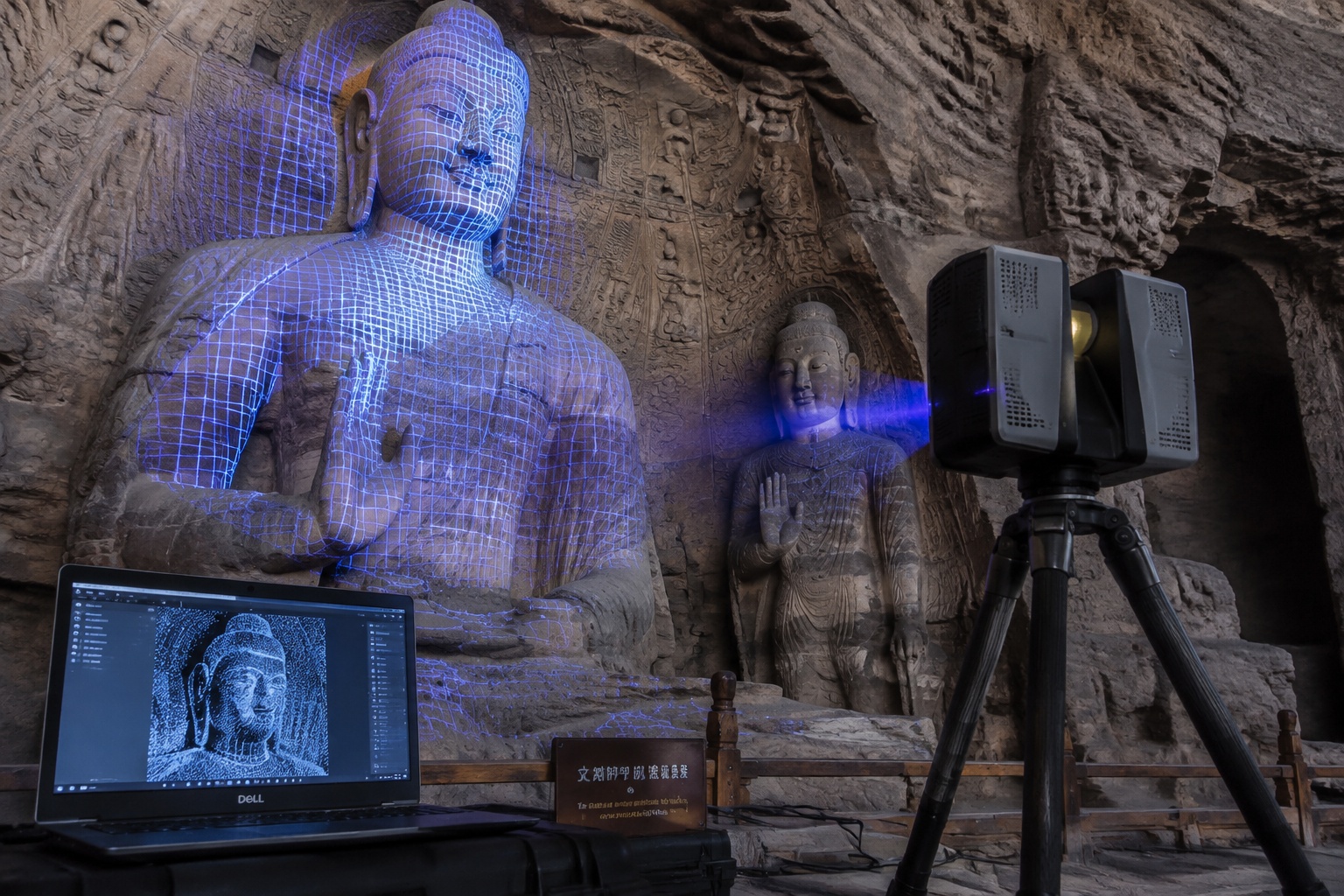
From Scans to Pixels: Building a Digital Twin
Building the digital twin is no small task. The Yungang complex stretches over a kilometer. Each cave needs thousands of scans. The team combines laser data with drone imagery captured from multiple angles to create a seamless model. The result is so precise that you can zoom into a single chisel mark.
It also takes time. A full scan of the most intricate caves can take months. But the payoff is huge: researchers now have a growing database of Yungang’s every nook and cranny, which they can consult on any screen. In 2019, the project launched a 3D digital archive, offering data to researchers worldwide under open licenses.
Giving People a Closer Look: VR and Open-Source Data
This isn’t just for scientists. Walk into the Yungang Digital Center, and you can put on a VR headset and explore cave interiors that are usually closed to the public. You can get nose-to-nose with statues that are normally protected by barriers. The experience is intimate, intense, and almost too real.
Online, visitors can explore virtual tours with annotations in multiple languages. The grottoes have also been ‘replicated’ in full scale in other cities using 3D-printed modules, allowing people who can’t travel to Datong to feel the scale of the site. These efforts blend conservation with democratization: more people than ever can appreciate this art.
A Global Trend with Local Roots
Digital restoration is not unique to Yungang. France’s Lascaux cave paintings have 3D replicas. Italy’s Pompeii uses digital mapping to monitor decay. But Yungang stands out because of its scale and the deep integration of AI. It’s also a model that other Chinese heritage sites, like the Dunhuang Mogao Caves, are following. The experience gained here has practical value not only for China but for anyone preserving ancient wonders.
What Does This Mean for You?
If you visit Yungang today, you might not notice the technology—the cave walls still look ancient and weathered. But the digital twin is working behind the scenes. It allows you to view the grottoes in vibrant AR as you walk, it offers VR experiences for those who can’t make the trip, and it gives conservationists a safer way to study and protect the stones.
Perhaps the most profound change is the shift from ‘preserving a thing’ to ‘preserving knowledge.’ With digital tools, the knowledge embedded in Yungang—its art, its history, its craftsmanship—becomes accessible to everyone, anywhere, forever. That’s a kind of immortality that even the most durable stone cannot achieve.
Conclusion
Technology isn’t replacing the ancient statues. It’s giving them a second life in the digital world, while strengthening their chances of surviving in the physical one. At Yungang, the past and the future meet under a banner of pixels and light. And for anyone curious about how China is tackling the challenge of heritage protection, it’s a great place to start.
Start the discussion at forum.chinacomes.com