

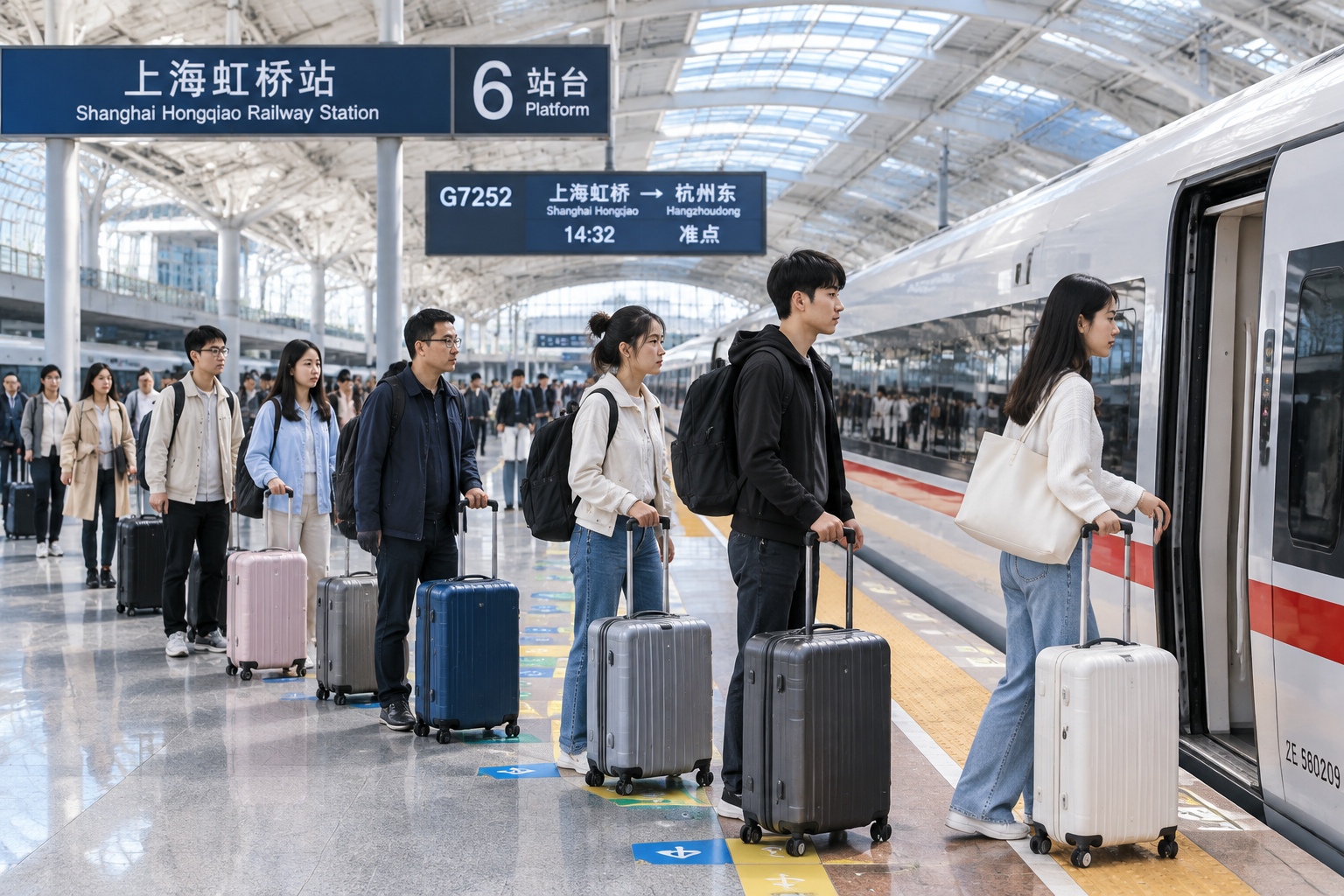
Platform 20, Shanghai Hongqiao, 1:40 p.m.
The departure hall smells like scallion pancakes and floor cleaner. A family is sitting on its suitcases eating instant noodles from paper bowls, chopsticks moving fast. A recorded voice repeats a train number, first in Mandarin, then in English, and then comes the four-note chime you will hear another forty times before tomorrow afternoon.
Your train is the 14:12 to Lanzhou West. On the platform, coloured strips run along the floor like lane markings — yellow, green, purple — and everyone waits in a diagonal huddle beside the number that matches their carriage. A man in a polo shirt has taped a rice cooker to the top of his suitcase. Two students are sharing one pair of earbuds.
Twenty-three hours from now, if the timetable holds, you’ll be in a desert town where it is still light at nine in the evening.
What this trip actually is
China’s high-speed rail network now runs more than 45,000 kilometres. Very little of it, though, crosses the country in a single westbound line the way this route does.
The plan is simple. Shanghai Hongqiao to Lanzhou West: about 1,900 km, nine and a half hours. Sleep near the station. Then Lanzhou West to Dunhuang: another 1,100 km, six hours and forty-five minutes. Elapsed time door to door, roughly 23 hours. Distance covered, about 3,000 km. Time actually spent sitting on a train, sixteen and a half hours.
Trains reach 350 km/h on the eastern lines and settle around 250 km/h once you are west of Lanzhou. You cross two of China’s great rivers, one mountain range that swallows the railway in tunnels, and a 1,000-km strip of green that separates a snow range from the Gobi.
Leg one: the delta flattens into the North China Plain
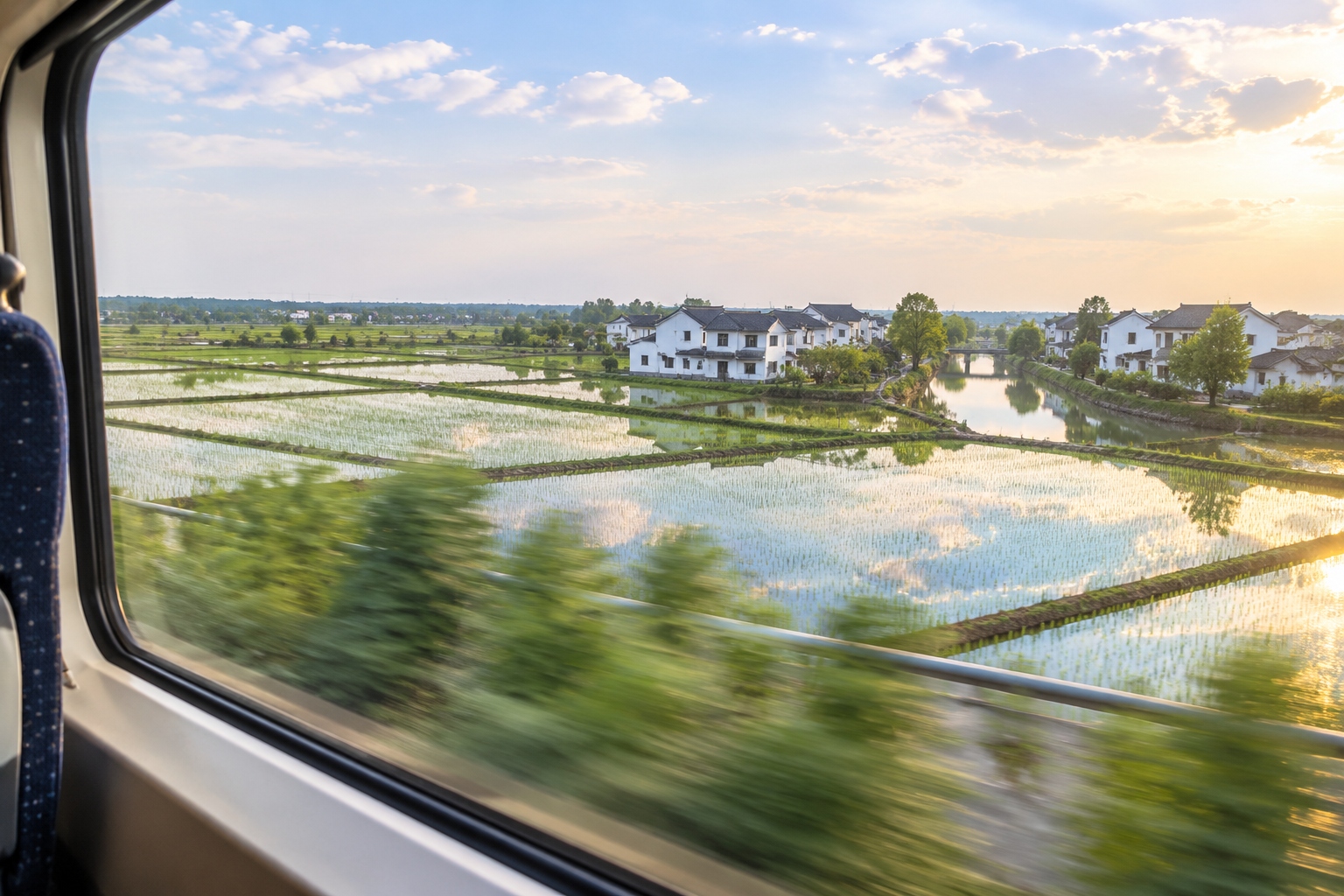
For the first forty minutes you don’t really see countryside. You see the backs of apartment towers, container yards, the flat roofs of electronics plants outside Kunshan. Then the paddies begin — flooded rectangles reflecting sky, herons standing in them. This is the Yangtze delta, the most densely built landscape in the country, and the railway crosses it on viaducts so the villages underneath keep their lanes and their fish ponds.
The screen at the end of the carriage ticks up: 348 km/h.
Past Nanjing the water disappears and the fields change colour. Rice gives way to wheat and corn, farmhouses to brick. Around Xuzhou the land turns serious and brown. Near Zhengzhou the train crosses the Yellow River on a long bridge — look for it, because the river is wide, flat and the colour of milky tea.
A few things worth knowing while you sit here. Every carriage has a hot-water dispenser at one end, and people make tea and instant noodles all day. There is a power socket under each seat. The toilets at the far end are usually one squat and one Western. A cart comes through with snacks and, oddly, single-serve yogurt. Onboard Wi-Fi exists but is unreliable; mobile data is fast almost everywhere except inside tunnels.
The Qinling tunnels, then Lanzhou at midnight
West of Xi’an North, the train does something dramatic: it buries itself in the Qinling Mountains. For long stretches the windows go black and your ears pop. In the brief gaps between tunnels you catch terraced hillsides, cave dwellings cut into loess, walnut trees.
Then the hills open onto the Yellow River valley and you are in Lanzhou, a city of four million strung along a narrow river gorge, arriving just before midnight.
Take a hotel within walking distance of Lanzhou West station — expect ¥200–400 for somewhere clean — and set an alarm. Trains to Dunhuang leave early.
Six a.m. in Lanzhou: noodles, then the desert train
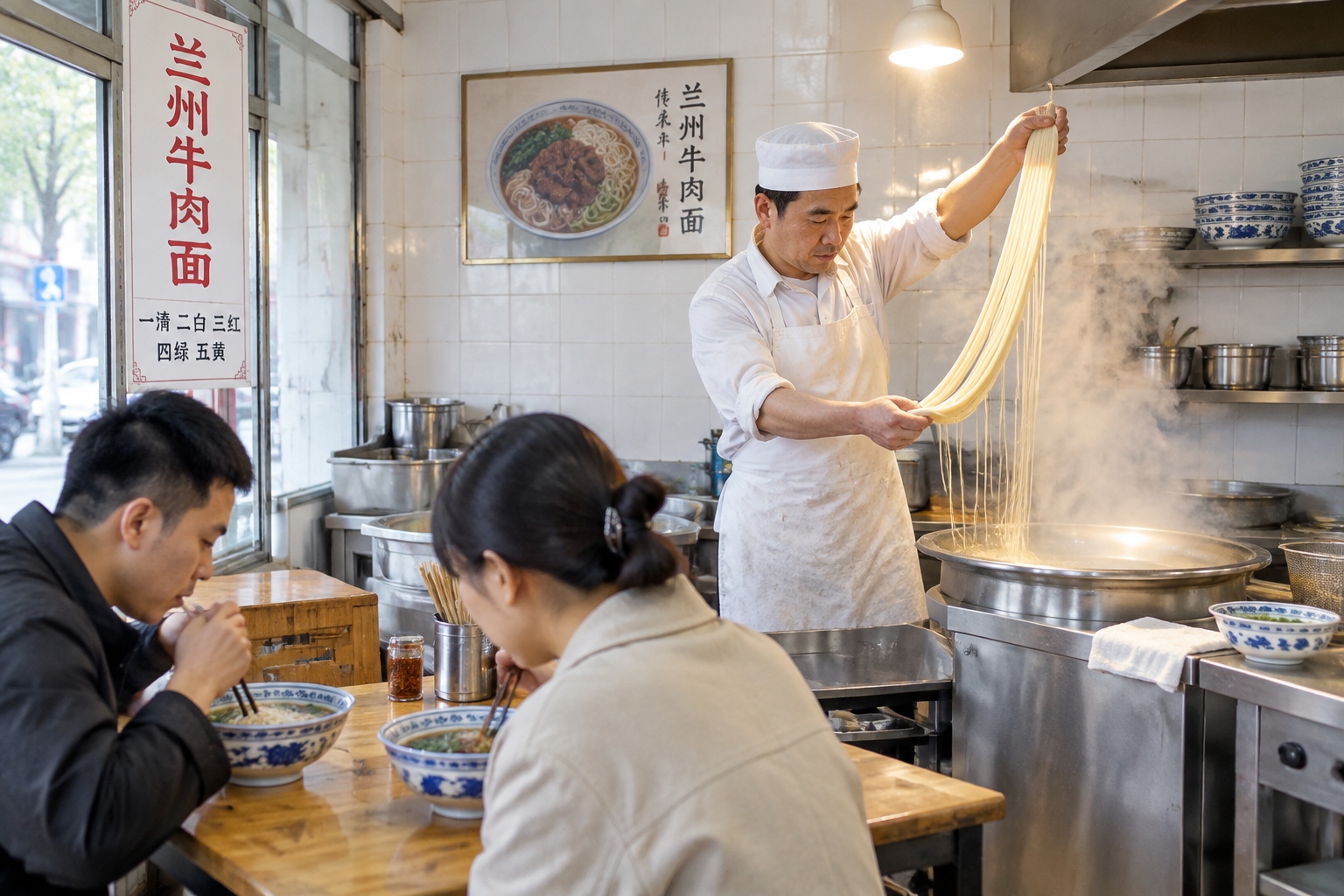
Lanzhou is the home of Chinese beef noodles. Shops with the name exist all over the country, but here the broth is genuinely made from scratch each morning. Find one that is open at six. A bowl costs ¥10–20. Watch the man behind the counter pull a fist of dough into threads in about eight seconds and drop it into boiling water.
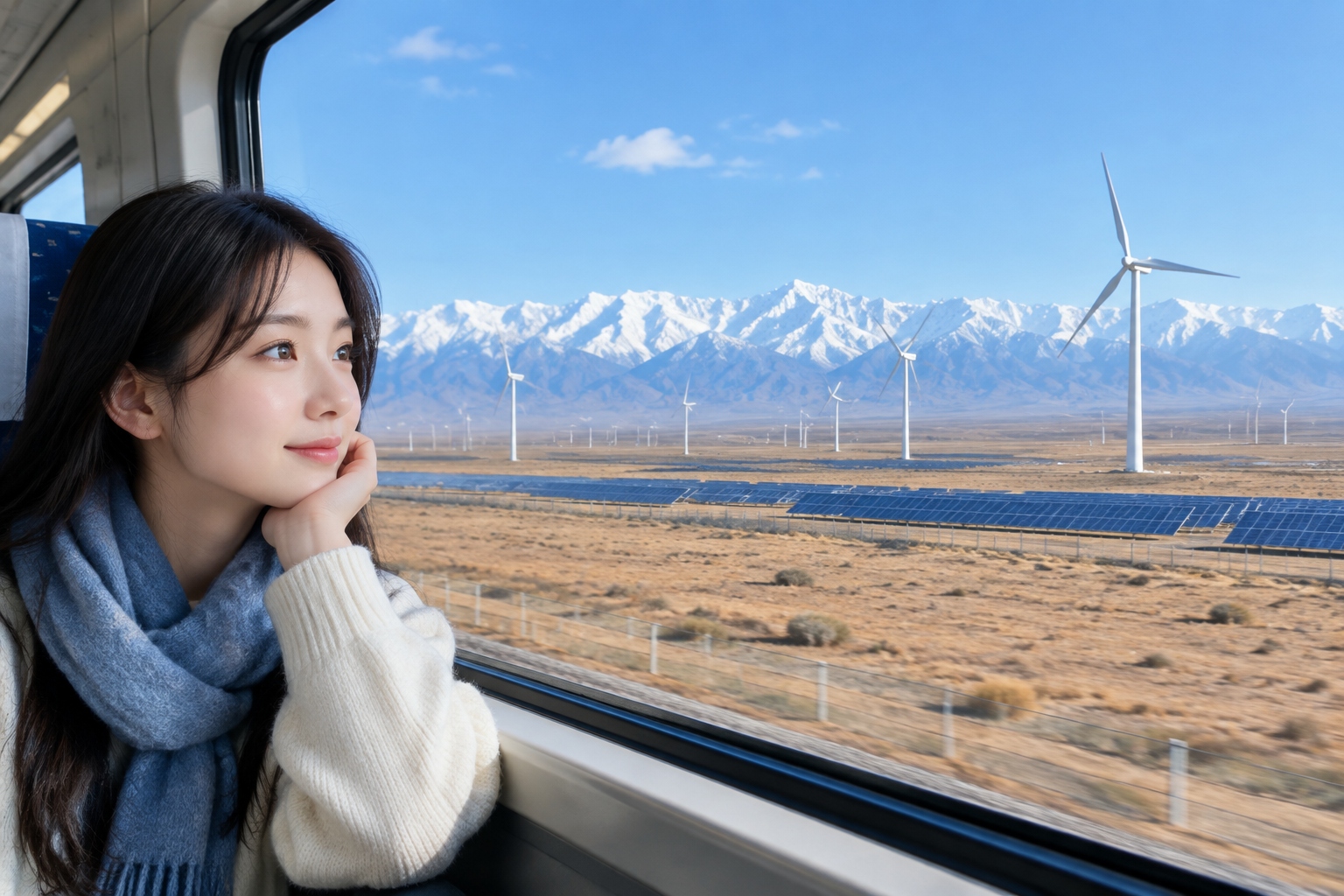
By 06:33 you’re on the morning train heading northwest, and the landscape changes for good. The Qilian Mountains rise on your left, snow on the peaks even in June — an 800-km wall of rock and ice. To the right, the Gobi. Between them runs the Hexi Corridor, a strip of irrigated green sometimes only 40 km wide that has carried Silk Road traffic for two thousand years. It is the reason this railway exists at all: there is no water for a hundred kilometres north or south of it.
Wind farms, a Great Wall fort, and oil country
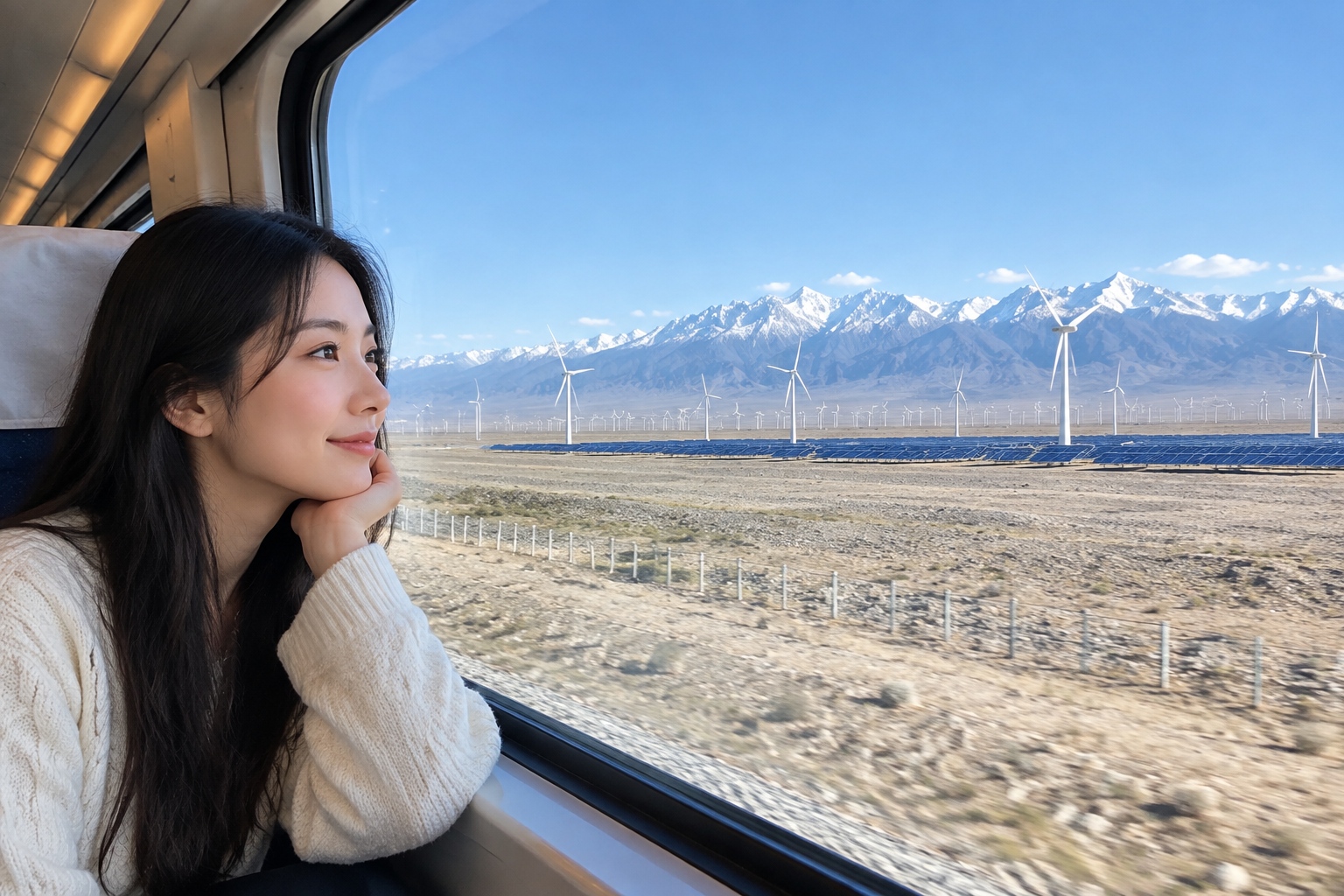
The window show becomes hypnotic. Around Wuwei and Jinchang, rows of wind turbines stand in the flats like a crop nobody harvests. Gansu has over 20 gigawatts of wind capacity, part of a long push to move China’s power generation west. In places you’ll also see the dark blue rectangles of solar arrays stretching to the horizon.
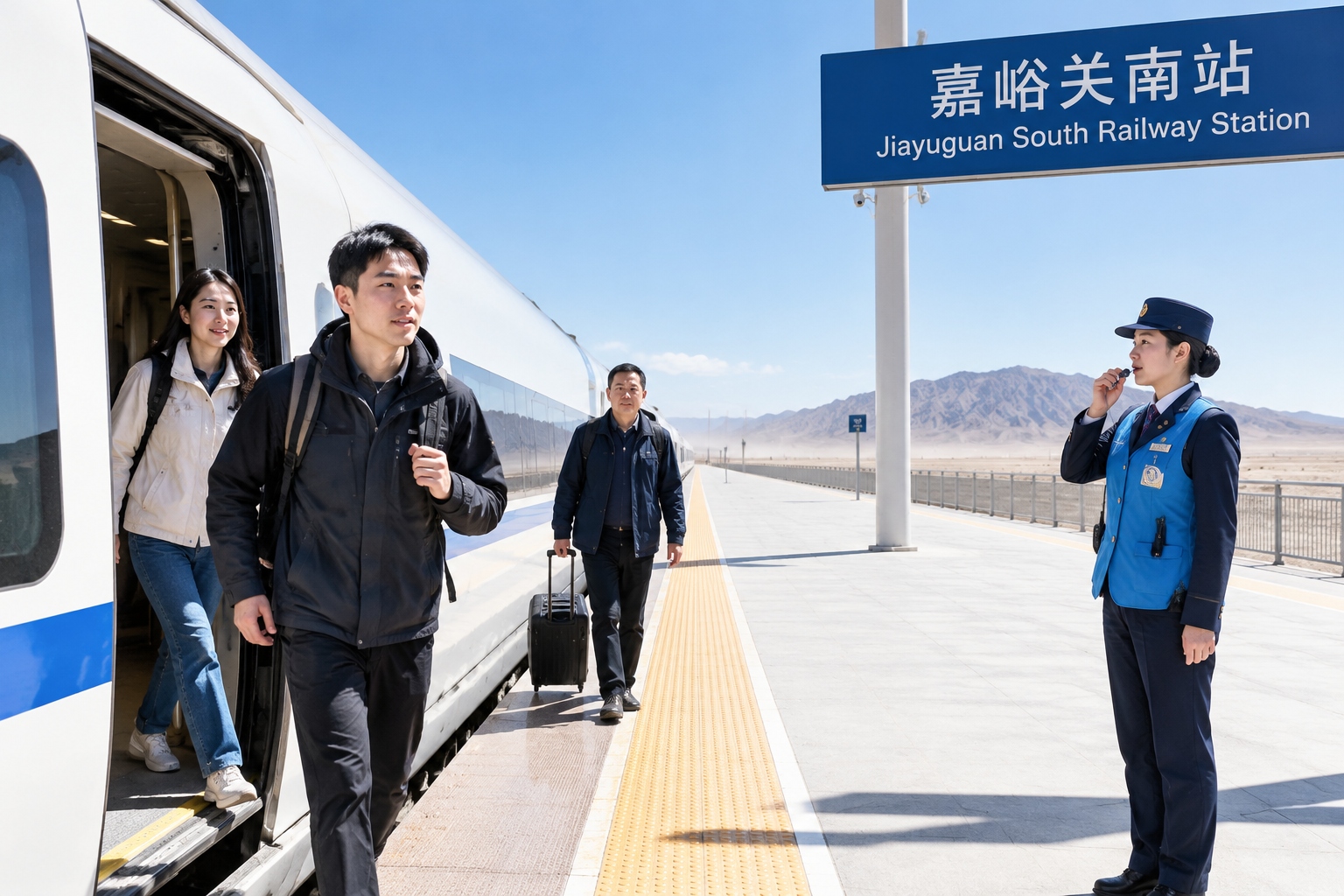
Zhangye West is the stop for the rainbow-striped Danxia landforms, if you want to break the trip in half. Jiayuguan South is a four-minute stop at the western end of the Ming Great Wall; the fort itself is a short taxi ride from the platform, and the wind on the platform is a decent preview of what the frontier felt like.
Then Yumen, where nodding pumpjacks work the flats and the old oil town stands half-empty beside the new one.
Somewhere in this stretch the carriage empties out. The business travellers who boarded in Lanzhou get off at Jiayuguan. It goes quiet. Two rows up, a woman is doing her son’s homework with him, both of them whispering.
One note on time: all of China runs on Beijing time, so in Dunhuang in July the sun sets around 21:10. Locals eat dinner at nine.
The last hour, and the sand
After Yumen the green thins, then stops. The final hour is pure Gobi — gravel plain the colour of a biscuit, low ridges, a pipeline running parallel to the tracks. Then, just before the station, the first dunes.
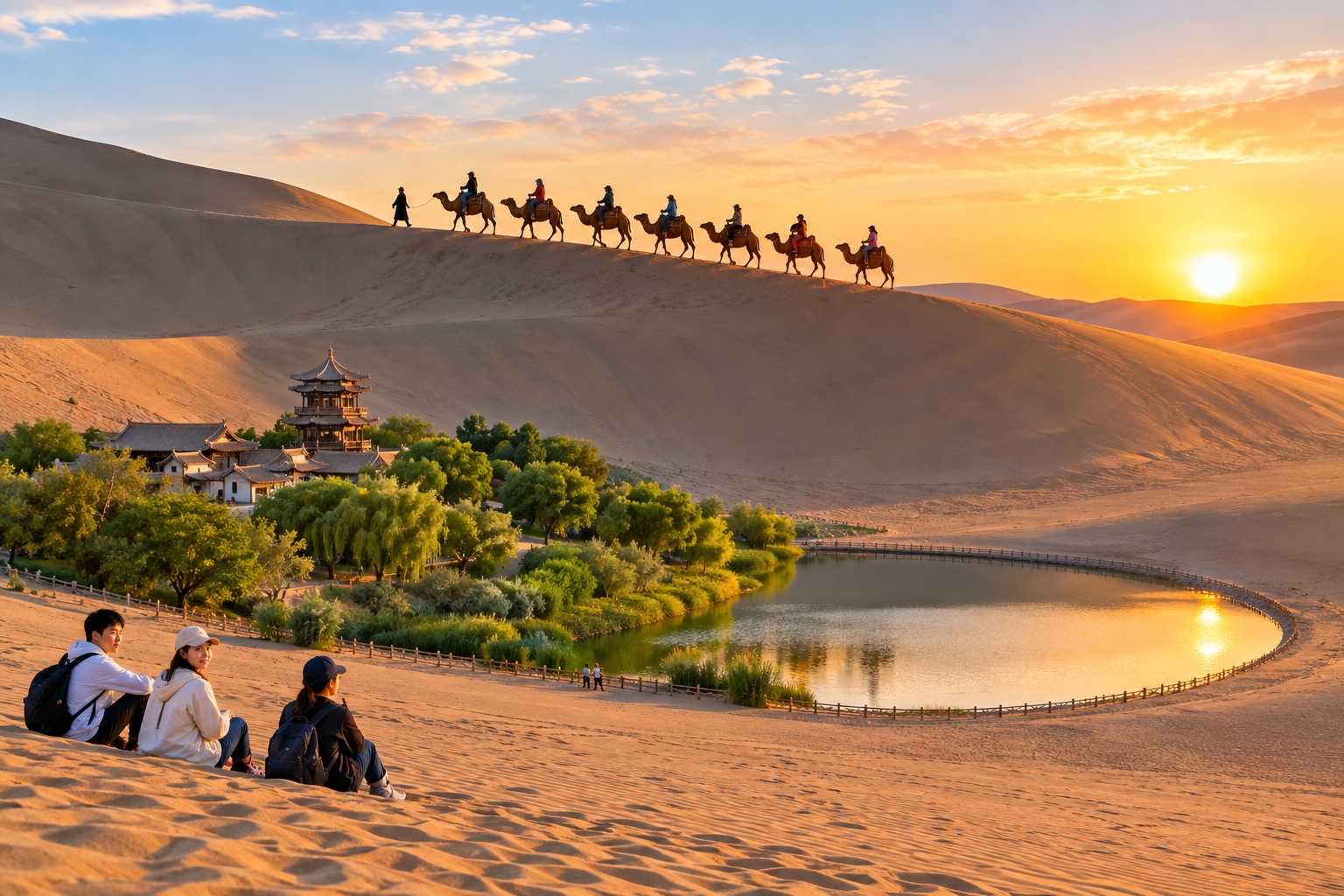
Dunhuang station sits about 12 km outside town; a taxi is ¥30–40. Check in, drop your bag, and go straight to Mingsha Shan, the dune field at the edge of the city. Entry is around ¥110. It is exactly as strange as it sounds: a wall of sand 200 metres high inside a town of 200,000 people, with a small crescent-shaped lake at its foot that has somehow not dried up in two thousand years. Camel trains go out at dusk. So do a lot of people in sneakers and rented orange shoe covers.
Then the night market: lamb skewers, cold apricot juice, a bed.
The practical part
Booking
Use the official 12306 app, which now has an English interface, or a booking site like Trip.com. Register with your passport number and complete identity verification a few days ahead — it can take up to 24 hours to clear.
No paper ticket is needed. Your passport is your ticket; scan it at the gate. If the machine refuses, use the staffed lane on the right.
Book 5–14 days out. Avoid the Lunar New Year period and the first week of October, when the entire country is travelling.
Costs, roughly
Shanghai Hongqiao to Lanzhou West, second class: ¥800–900. First class: ¥1,300–1,400. Lanzhou West to Dunhuang, second class: ¥350–450. A clean budget hotel near the station: ¥200–400. All in, about ¥1,200 (US$165) in second class.
Second class is 3+2 seating and perfectly comfortable for nine hours. First class is 2+2. Business class is a different price universe and rarely worth it on this route.
Best time to go
Late May, June, September and early October. Dunhuang summer days clear 35°C; winter drops to -10°C with snow on the dunes, which is quieter and, arguably, better. Mogao Caves tickets sell out — book on the official site three to four weeks ahead; about ¥240 for the full ticket with films and eight caves.
Small things that matter
Bring a small thermos or cup; hot water is free and everywhere. Bring tissues, because station and train bathrooms often have none. Smoking and vaping are banned everywhere on board, including the vestibules. Cash is close to useless now — set up Alipay or WeChat Pay and link a foreign card before you arrive. Announcements are mostly in Chinese, so watch the scrolling screen above the door for the next station. And if you stay in a hotel, the front desk will register you with the local police; that is normal, and it is why some small guesthouses say they cannot accept foreign passports.
Why it’s worth the day
You could fly Shanghai to Dunhuang in four hours. You would see clouds. On the train, you get the actual shape of the country: the wet, crowded east, the dry, empty west, and the thin green line in between that people have been walking for two thousand years. By the time the dunes appear outside your window, the geography stops being a map and becomes something you sat through.
Start the discussion at forum.chinacomes.com