
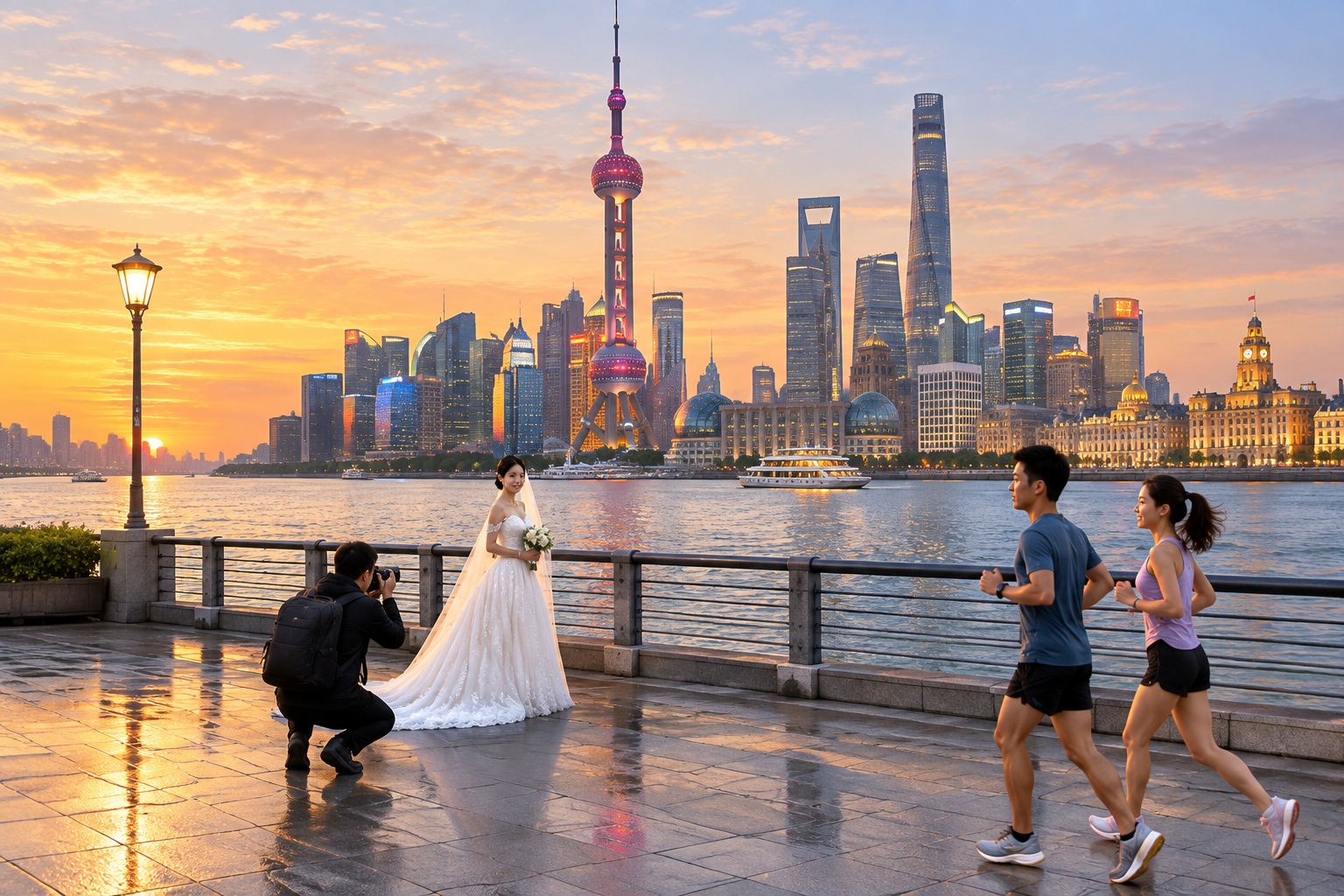

The 8:10 Ferry from Jinling Road
Diesel, wet rope, and the flat mineral smell of the Huangpu River. The ferry from Jinling Road to Dongchang Road costs two yuan, takes about ten minutes, and leaves every few minutes from before dawn until after dark. On a Tuesday morning in March, most of the passengers are heading to work in Lujiazui: a woman balancing a thermos, two men sharing one pair of earbuds, a delivery rider who has wheeled his scooter on board and stands with one hand on the seat.
Stay on the open deck. Behind you, the stone bank buildings of the Bund shrink. Ahead, the towers of Pudong rise out of the mist. The one your eye lands on first is not the tallest. It is the one with the spheres — a big ball low down, a smaller one above, a concrete shaft running up to a spike of antenna.
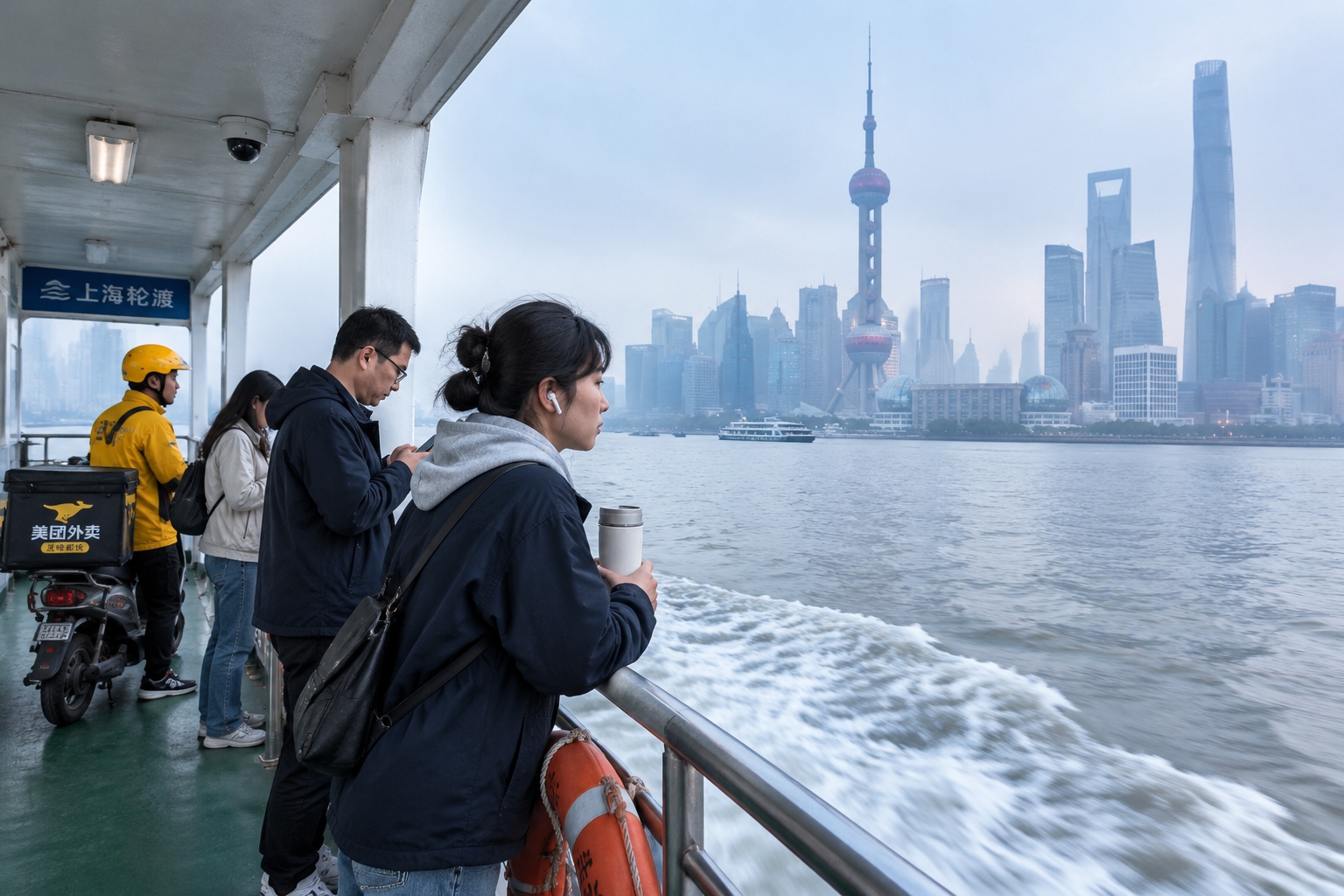
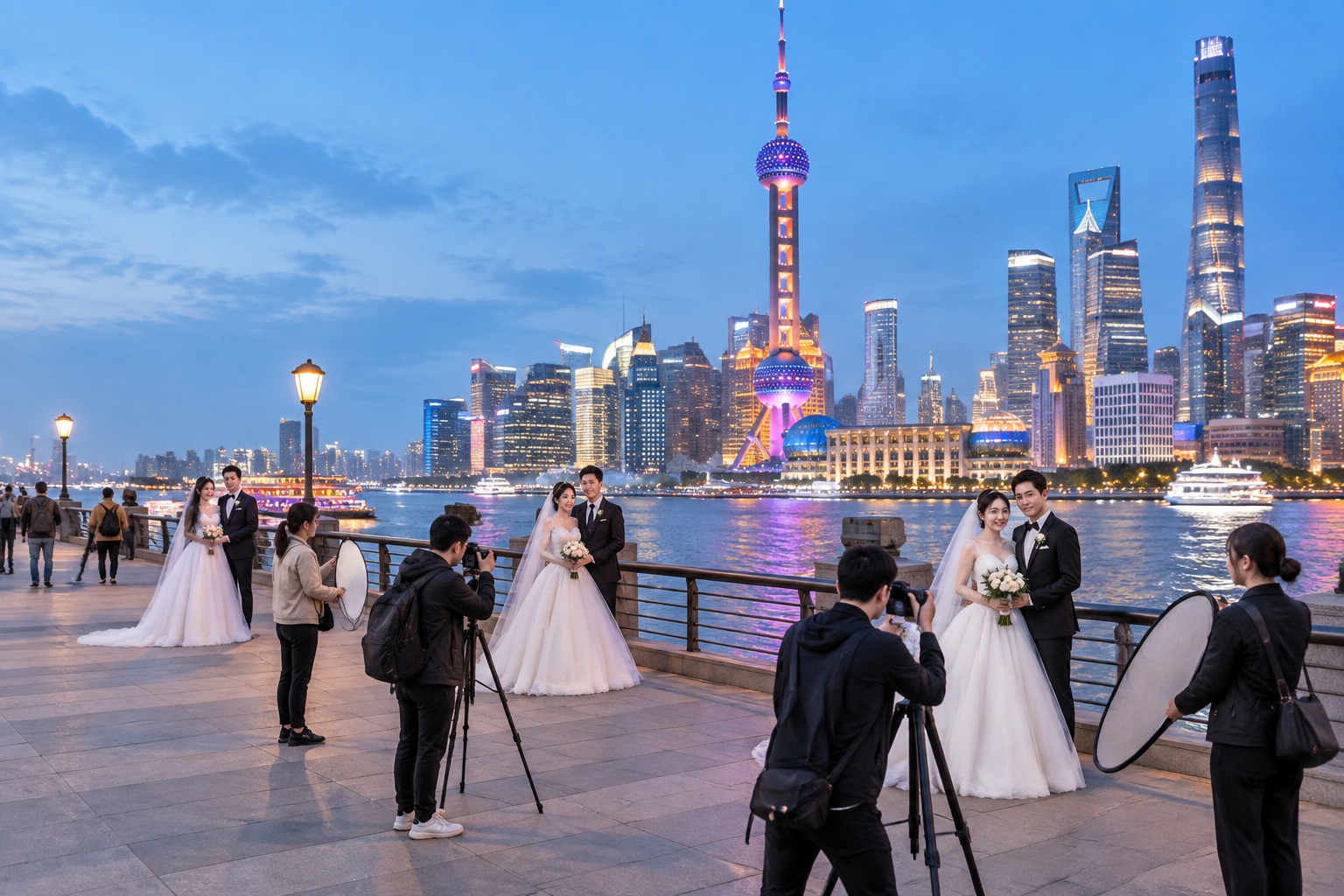
Ten minutes later you step off at Dongchang Road and walk north along the riverside promenade. Joggers, a man doing tai chi slightly wrong, three brides in white being photographed against the water. The tower is ten minutes away on foot, and it keeps changing shape as you approach: from postcard, to engineering, to a very large building with a queue in front of it.
A Tower Built While Pudong Was Still Warehouses
Ground was broken on the Oriental Pearl Radio and TV Tower on 30 July 1991. The site, on the tip of the Lujiazui peninsula where the Huangpu bends, was then a mix of warehouses, low houses and vegetable plots. The joke in Shanghai at the time went: “Better a bed in Puxi than a whole room in Pudong.” Puxi was the old city on the west bank. Pudong was the mudflat on the east.
So the tower was a bet. It was finished in 1994, opened to visitors in 1995, and stands 468 meters tall including its antenna, with eleven spheres threaded along the shaft. For more than a decade it was the tallest structure in China. Its Chinese name comes from a line in a Tang dynasty poem about music: big pearls and small pearls falling onto a plate of jade.
The bet paid off, though not in the way its designers probably imagined. Look at the skyline now and the Pearl is no longer the tallest thing in its own neighbourhood. The Jin Mao Tower (1999), the Shanghai World Financial Center (2008, the one shaped like a bottle opener) and the Shanghai Tower (2015, 632 meters) all stand within a few hundred meters. A building that was once the whole of Pudong’s identity is now one note in a chord.
What You Actually See at 259 Meters
Tickets come in tiers, roughly 160 to 220 yuan depending on which spheres you include. Most people take the combination covering the 263-meter main observation deck and the 259-meter glass corridor one level below. Both are reached by a lift that runs fast enough to pop your ears.
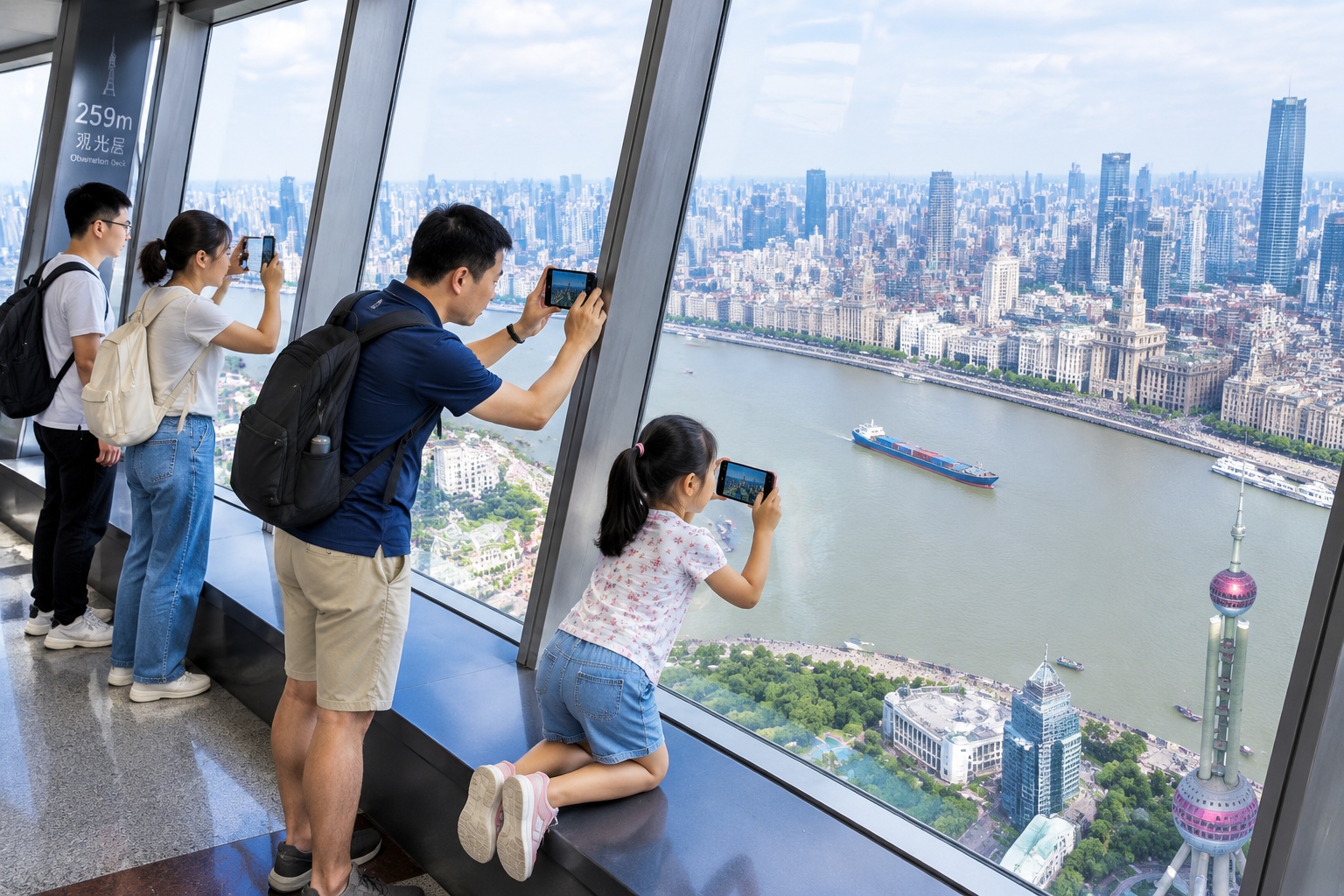
The view explains the city’s geography better than any map. Directly below, the Huangpu does a hairpin turn. The west bank is a solid wall of 1920s stone — the Bund — and the east bank is glass. Ships work their way upstream in both directions, slow and heavily loaded. Across the water, the low green strip of the Bund promenade is dotted with people who read as specks. And around you, close enough to feel slightly unfair, stand the three towers that have overtaken the Pearl in height.
Two honest notes. First, haze. Shanghai’s air has improved enormously since 2013, but on a muggy July afternoon the view turns to milk and the far bank disappears. The clearest hours tend to be the morning after rain. Second, the windows. Thousands of hands and children’s faces a day leave the glass less than pristine, and the best photographs are usually taken with the camera pressed flat against the pane.
The Glass Floor, a Rotating Room, and a Post Office in the Sky
The 259-meter corridor is the part people remember. It runs for roughly 150 meters around the outside of the sphere, about two meters wide, with transparent panels underfoot. Children lie down on them immediately. Adults take one step, laugh nervously, and grip the handrail with both hands. It is not, in truth, very frightening — the drop is real, but the engineering is obviously solid — and it is one of the few places in Shanghai where a queue of strangers will start talking to each other.
Higher up, at 267 meters, the floor rotates. A full turn takes about an hour, roughly the length of a buffet lunch. The food is fine and the prices are what you would expect from a restaurant in the sky; the reason to book is the slow reveal of the river bending below you. Lunch is significantly cheaper than dinner, and weekends need reserving days ahead.
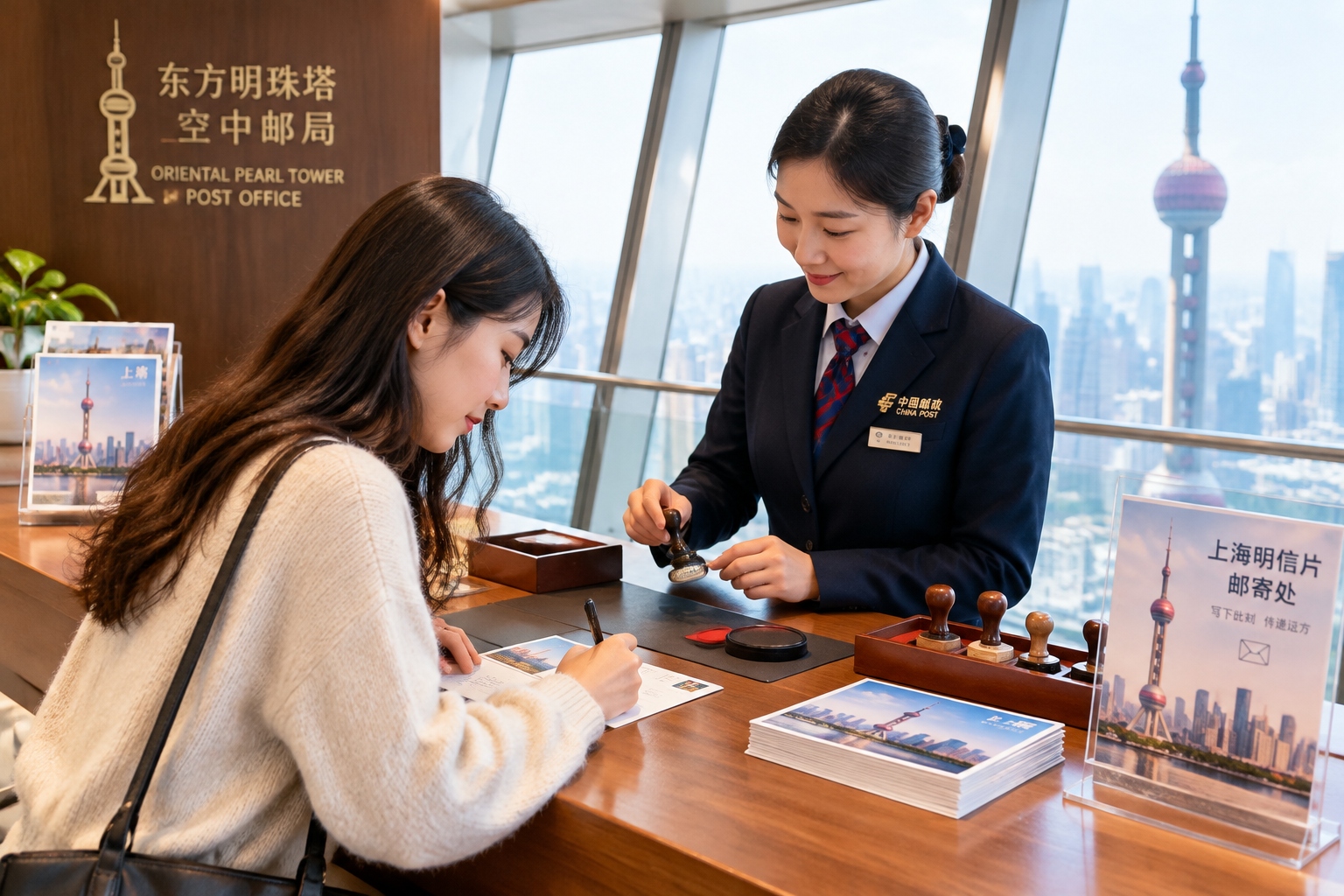
Then there is the small thing almost every visitor misses: the post office. On the sightseeing level there is a counter where you can buy a postcard, have it stamped with a special Oriental Pearl Tower postmark, and mail it from the tower itself. It is the highest post office in the city, and it is the only souvenir in the building that will still exist in thirty years. The staff will hand you a pen. Postcards to Europe or North America take a few weeks and usually arrive.
The Museum Underneath the Tower
Most tour groups ride the lift up, take their photographs, and leave. Beneath the tower, at ground level, there is a museum that gets maybe a fifth of the foot traffic: the Shanghai City History Development Exhibition Hall. It reconstructs the city as it was in the late 19th and early 20th centuries — a narrow lane of shikumen houses, a 1930s pharmacy lined with hundreds of small wooden drawers, a tram, a teahouse, a rickshaw, a row of wax shopkeepers and dock workers, and recorded street cries playing quietly overhead.
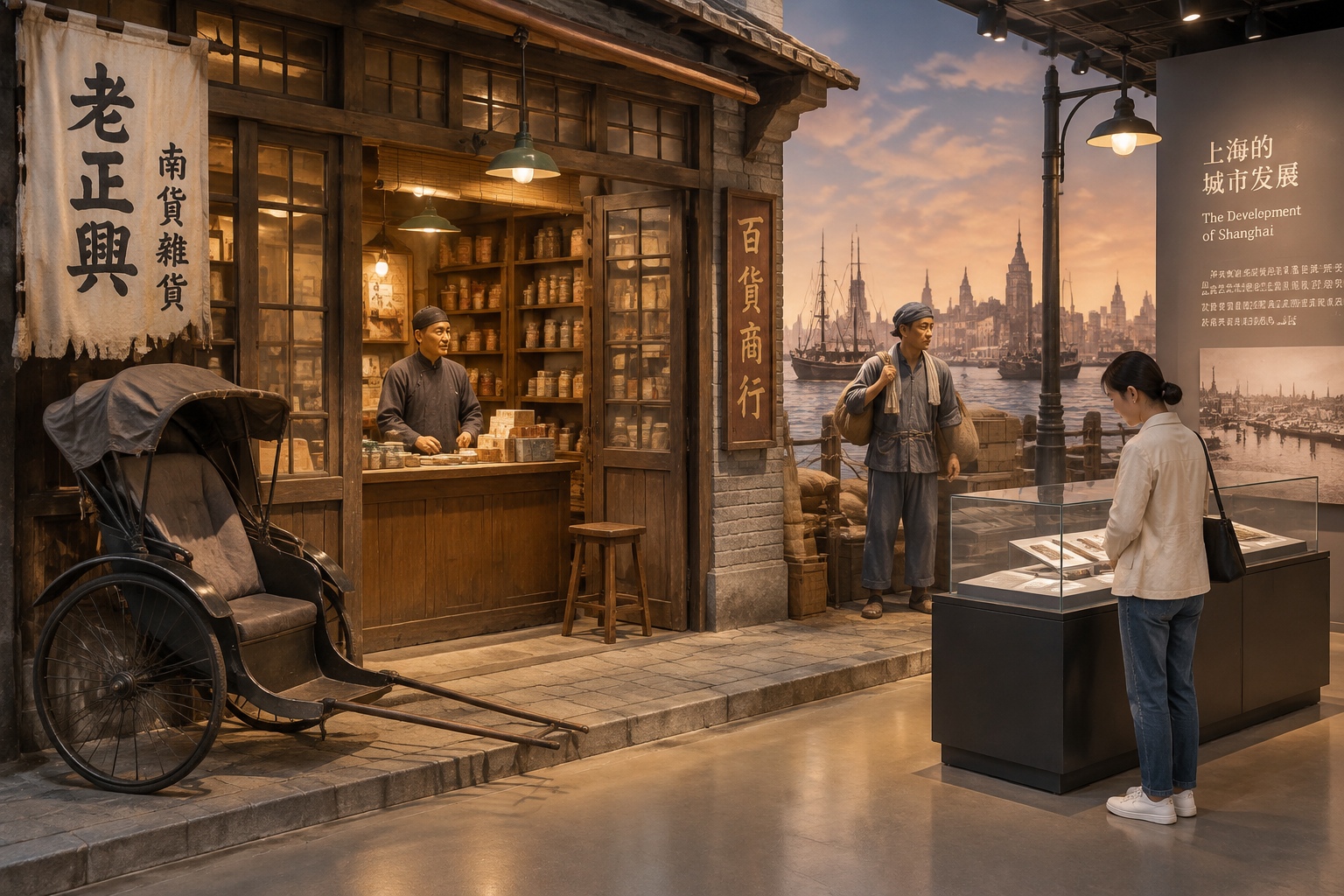
It is dim, slightly dusty, and almost empty on a weekday afternoon, which makes it a good place to wait out the rain. It also does something the observation deck cannot: it shows you what was demolished to build the skyline you just photographed. Give it an hour.
How Shanghai People Actually Use the Tower
Very few Shanghai residents go up the tower as adults. Ask around and the answer is usually the same: “Once, on a school trip.” Their memories are not of the view. They remember the coach ride, the queue, and the soft-serve ice cream at the top.
What the tower does for locals is more practical. It is a coordinate. “See you under the Pearl” is a real instruction, understood by taxi drivers, delivery riders and a friend who has lived in the city for three weeks. It is a backdrop: on any fine Saturday, dozens of couples in wedding clothes are being photographed on the Lujiazui promenade with the spheres behind them. It is a clock: at night the tower’s lighting changes colour for holidays and events, red and gold for Spring Festival, blue for various campaigns, and when the lights go off, usually around 10:30 or 11 p.m., the riverside turns noticeably darker. In August 2022, during a record heatwave and a regional power squeeze, the city switched off its riverside landscape lighting for two nights. The skyline went black at 10 p.m., and people noticed the way you notice a familiar sound stopping.
If You Go
- Getting there: Metro Line 2 to Lujiazui station, Exit 1. Better still, take the two-yuan ferry from Jinling Road on the Bund side to Dongchang Road, then walk 15 minutes north along the river. You see the whole Pudong skyline from the water.
- Tickets: roughly 160–220 yuan depending on the combination; the version that includes the 351-meter space capsule costs more. Prices change, so book online with a time slot, especially at weekends.
- Best time: a weekday, arriving around 3:30 or 4 p.m. — you get daylight, sunset and the lights in one visit. Avoid 10 a.m. to 3 p.m., and avoid the National Day holiday (October 1–7) and the first three days of Chinese New Year altogether.
- How long: two to three hours including queues. Security and lift queues can run 45 to 90 minutes on a busy day.
- Money: the tower, the museum and almost everything nearby are cashless. Alipay or WeChat Pay linked to a foreign card works in most places; a few ticket windows still accept cash.
- Nearby: the Shanghai Ocean Aquarium next door, the Super Brand Mall for air conditioning and food, the circular pedestrian bridge over the Lujiazui intersection, and the two-kilometer Binjiang promenade, which has the best free view of the Bund anywhere in Pudong.
- Weather: check visibility, not just temperature. After rain is usually clearest. Summer haze is real.
One Last Thing
Go up if you want the view. It is a good one, and the glass corridor is genuinely fun. But the tower works better as a fixed point than as an attraction. Walk the promenade at dusk, watch the lighting change colour, and notice that the thing Shanghai people use to find each other is the same thing tourists come to photograph. That is not a small job for a building.
Start the discussion at forum.chinacomes.com