
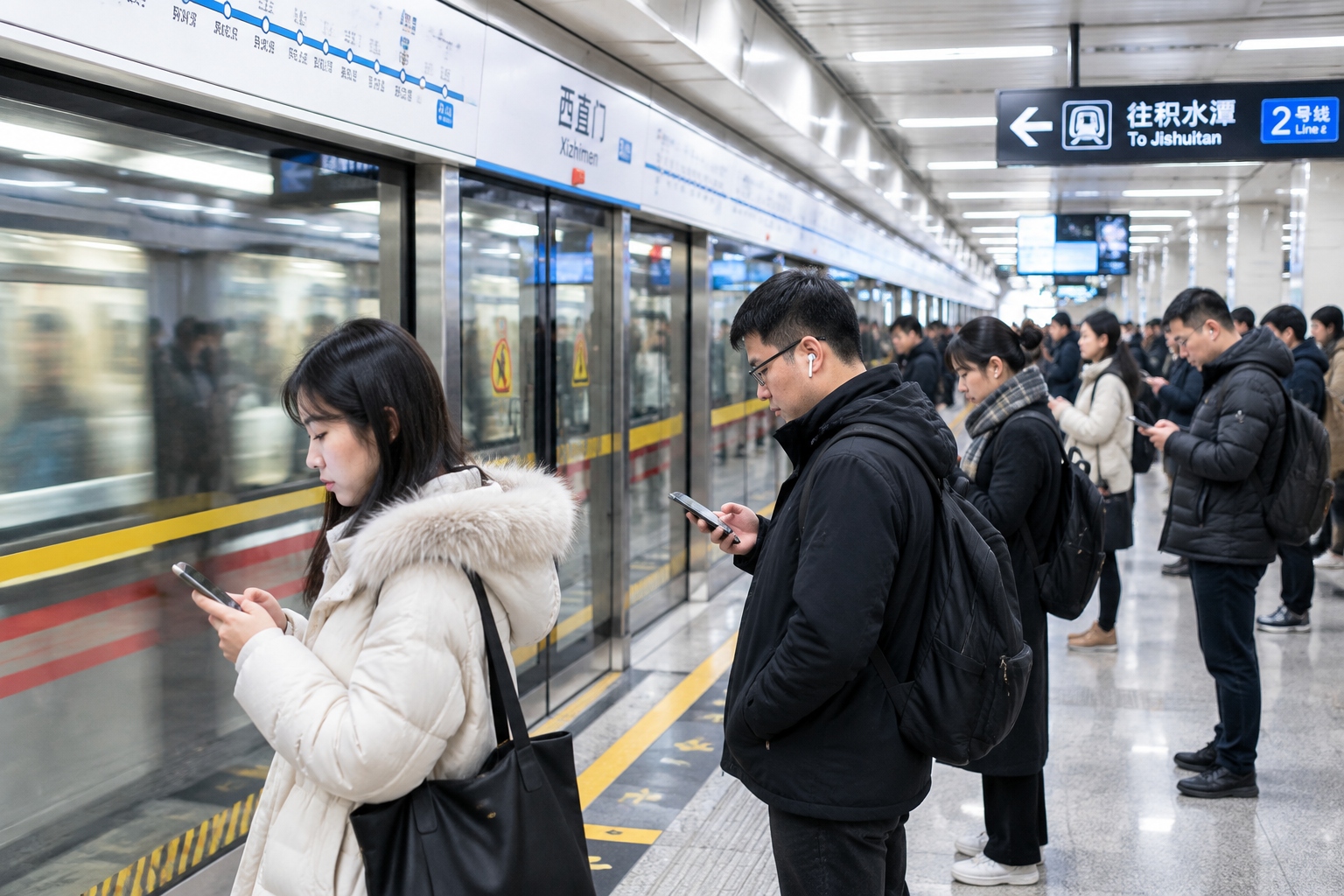

A Sleeping Man, an iPhone, and a Tuesday Morning on Line 10
It was a Tuesday, a little after 8 a.m., somewhere between Guomao and Jintaixizhao on Line 10. I was standing with my face half-buried in a stranger’s backpack. Next to me, a man in a delivery-company jacket had fallen asleep standing up — and his phone was resting in his open palm at hip level, screen still glowing with a short video.
Nobody looked at it twice. Not the two women sharing earbuds, not the teenager playing a game with the sound on. The doors opened, another hundred people pushed in, the delivery guy swayed, and the phone stayed in his hand.
A friend visiting from Chicago watched this happen and asked the question I have now heard maybe a dozen times: “Why is nobody stealing these?”

New Yorkers Have a Reflex That Beijingers Don’t
If you ride the New York subway, you know the move. Near the doors, as the train slows into a station, you tuck your phone into a pocket and put a hand over it. Phone-snatching at the doors — grab, jump, gone — is such a familiar pattern that it shapes how people stand.
Beijing’s subway moves more people than any system on earth: roughly 10 to 12 million rides on an ordinary weekday, across more than two dozen lines and hundreds of stations. It is also, by the standards of most big-city transit, an unusually bad place to steal a phone. Foreigners notice the absence long before they can explain it.
Reason One: A Stolen Phone Is Nearly Useless
Start with the object itself. Modern phones sold in China lock to their owner’s account in a way that survives a factory reset. An iPhone with an active iCloud lock is a paperweight. Android devices have the same problem. China also maintains a national registry of device ID numbers, so a phone reported lost can be flagged to carriers.
That guts the resale market, which is the entire point of stealing a phone. Chinese cities have a large, legal second-hand electronics trade — apps like Xianyu, the second-hand arm of Alibaba, and chains of phone-recycling counters in shopping malls. These channels ask for ID and serial numbers when they buy. What’s left of the grey market pays very little for a locked device, often less than the risk is worth.

Reason Two: The Phone Is the Wallet, the ID, and the Keys
This part genuinely surprises visitors. Chinese cities run on mobile payment. Alipay and WeChat Pay cover everything from a 3-yuan fried bun to a taxi fare to a hospital registration fee. Cash exists, but plenty of people haven’t touched a banknote in months.
So there is almost nothing else to steal. Pickpocketing a commuter used to mean a wallet. There is no wallet. And the money that does exist sits behind a password or a fingerprint inside a device that locks itself the moment it leaves your hand.
The SIM card, meanwhile, is registered to a national ID number. Real-name registration for mobile numbers has been required since 2013, and new SIMs have needed a face scan since late 2019. Your phone number is the spine of your digital identity: bank alerts, work messages, delivery apps, transit card, medical appointments. When a Beijinger loses a phone, the panic isn’t about the hardware. It’s about the two hours it takes to freeze everything.
Reason Three: Cameras in the Cars Themselves
Beijing’s subway has cameras. Not just at the gates and along the platforms — inside the carriages, mounted near the ceiling at both ends, watching the length of the car.
Then add the street level. China has one of the densest public camera networks in the world, and estimates of the national total swing wildly depending on who is counting and what they count. In a city like Beijing, a phone taken in a station is a phone taken on video, from multiple angles, at a known time, in a known place, by someone whose face is in a frame.
Foreigners often frame this as a surveillance question. For a lot of Chinese commuters, it is simply the reason the phone in their hand is safe.
Reason Four: A Crowd Is Bad for Thieves
Counterintuitive but true. Pickpocketing needs a bump, a distraction, and a small pocket of privacy inside a crowd. On a Beijing rush-hour train, everyone is pressed together so tightly that a deliberate movement is felt immediately. Phones are held up in front of faces, not tucked into back pockets. There’s no room to hand a stolen phone to a partner and walk away.
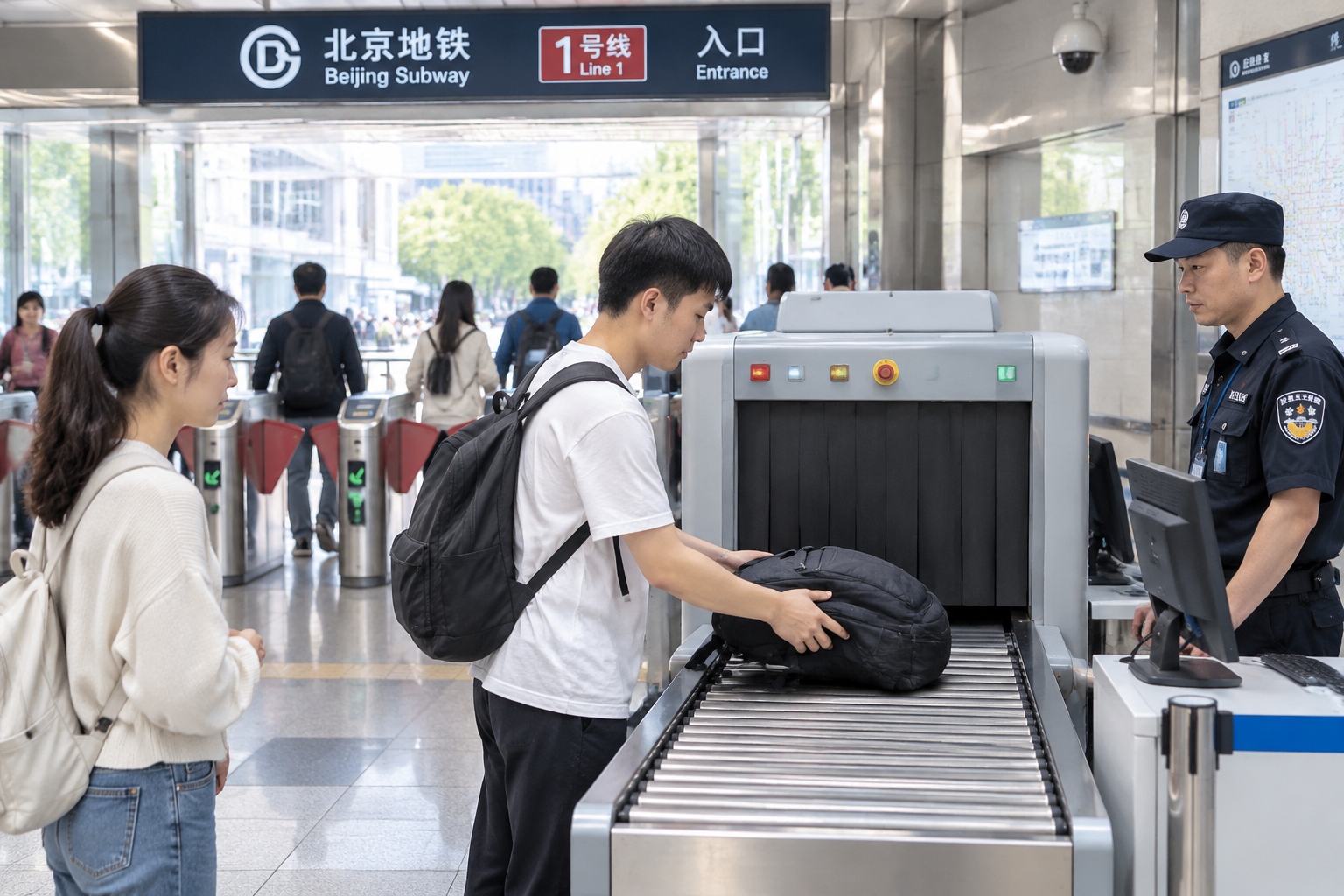
Then there’s the exit problem. Every Beijing subway station has an X-ray machine and a metal detector at every entrance. Bags go through the scanner; bottles of water sometimes get tested. The system is aimed at weapons and flammable liquids, not phone theft, and it slows everyone down. But it also means you cannot sprint out of a station unnoticed, and there are uniformed staff at every gate line.
Where the Theft Actually Went
Here’s the part the puzzle misses: street crime didn’t vanish in China. It moved online.
Telecom and online fraud is what ordinary Chinese people actually worry about. Fake investment platforms, delivery scams, “your son is in trouble” calls, romance schemes run out of compounds in Myanmar and Cambodia. Police across the country handle enormous volumes of these cases, and the government has pushed a national anti-fraud app that officials say has been downloaded hundreds of millions of times. Banks now interrupt large transfers with warnings, and it’s common to hear a teller talking a customer through a fraud alert at an ATM.
Street theft hasn’t disappeared either. Bikes and e-bike batteries still get taken. Delivery packages left in apartment lobbies disappear. Phones get lifted in bar districts late at night, and there are still snatch-and-run cases where someone on a scooter grabs a phone near a curb. It’s just rare enough that it no longer organizes people’s daily habits the way it does in New York.
What the Foreigner’s Question Really Reveals
“Why doesn’t anyone steal phones here?” sounds like a question about crime. It is usually a question about trust — and about what a society is willing to trade for it.
Beijing’s low phone-theft rate comes from a stack of systems all pointing the same direction: a payment culture that made cash obsolete, a locking system that destroyed resale value, real-name registration that ties every device and number to a person, and a camera network that makes anonymity in public space nearly impossible.
Chinese people argue about that last part. Facial recognition at residential gates, cameras in classrooms, apps collecting data — these are live debates here, not settled ones. The safety is real. So is the trade-off, and plenty of people will tell you both things in the same sentence.
So the honest answer to my Chicago friend isn’t “because China is safe.” It’s narrower than that. The phone in the sleeping delivery guy’s hand is worthless to a thief, traceable to a face, and worth more to him than the entire contents of his pockets used to be. The crime simply doesn’t pay well anymore. That is a very specific kind of order — and you only notice it when you come from somewhere it’s missing.
Start the discussion at forum.chinacomes.com